Our Top Picks
 Fit Simplify Resistance Loop Exercise Bands with Instruction12"12 x 2 x 0.6 inches0.2 poundsCheck on Amazon


Best Black Friday Resistance Band Deals 2026: How to Pick a Set That Won’t Snap
The best overall pick for most people is the Black Mountain Products Resistance Band Set, because it bundles five stacked bands plus handles, door anchor, ankle straps and a carry bag in one kit — the format that covers the widest range of training with the fewest gaps. Buyers who want one cheap, versatile starting point should look at the Fit Simplify Resistance Loop Exercise Bands Set of 5, and anyone training specifically for pull-ups or heavy assisted work should go straight to the DRAPER’S STRENGTH Heavy Duty Stretch Loop Bands. If you want the single most important buying rule up front: match the construction to the job. Flat fabric and flat latex loops resist rolling and are the right call for glute and hip work; molded latex tube sets are the right call for stacking to heavy resistance and for handle-based pulling; and any set advertising a top end above roughly 50 lbs per band should be checked for layered or “anti-snap” construction before you buy, because that is where early failures concentrate.
Top 3 Picks
Best Overall: Black Mountain Products Resistance Band Set
The most complete single purchase in this roundup. Five stackable bands plus handles, door anchor, ankle straps and a bag means you can run upper-body pulling, lower-body work and stretching without buying anything else. The stacked-tube format is the most flexible for progressive overload, since you add resistance in steps rather than jumping between fixed loops.
Best Budget: Fit Simplify Resistance Loop Exercise Bands, Set of 5
Five flat loops in graduated widths, an instruction guide and a carry bag for the price of a single tube band elsewhere. This is the correct first purchase for anyone who is not yet sure whether they will stick with band training, and the flat profile makes them the better option for hip and glute work anyway.
Best Premium / Heavy-Duty Pick: DRAPER’S STRENGTH Heavy Duty Stretch Loop Bands
Continuous-loop bands built for powerlifting assistance, band-resisted squats and deadlifts, and assisted pull-ups. If your training involves anchoring a band under a loaded barbell or to a rack, this is the category you want rather than a tube set — the loop format takes that kind of load far better than a molded tube with a clip at each end.
Quick Comparison
Every product covered below, with the format, construction class and resistance profile that matters most when you are comparing deals.
| Product | Best For | Format & Construction | Resistance Profile | Price Tier |
|---|---|---|---|---|
| LEZER Resistance Bands 25–65 lbs | Physical therapy and light rehab-style work | Molded latex tubes, no handles | Stated 25–65 lbs across the set | Budget |
| Dapofajo Resistance Bands, 5-Level Anti-Snap Silicone | Buyers who have had latex bands snap | Silicone, 5 discrete levels | Five graduated levels, high top end | Premium |
| Renoj Booty Resistance Bands Set [3 Set] | Glute and hip activation, non-slip | Fabric loops, non-slip inner grip | Three graduated loop tensions | Mid-range |
| THERABAND Resistance Band, Black, 6 Ft | Clinical-style and rehab progression | Flat latex, cut-to-length roll | Single resistance level per roll | Budget |
| DRAPER’S STRENGTH Heavy Duty Stretch Loops | Powerlifting assistance, assisted pull-ups | Continuous latex loops | Heavy, fixed sizes | Mid-range |
| Black Mountain Products Resistance Band Set (5 Bands) | All-round home training | Stackable tubes + handles, door anchor, straps, bag | Stackable, wide range | Premium |
| BODi Thick Resistance Bands, Set of 2 | Heavy lower-body work, minimal kit | Thick fabric loops | Two heavy fixed tensions | Budget |
| Fit Simplify Loop Bands, Set of 5 | First set, general conditioning, mobility | Flat latex loops | Five graduated widths | Budget |
| THERABAND Resistance Bands Set, Advanced Kit (Blue/Black/Silver) | Structured rehab and progression | Flat latex, three colour-coded levels + accessories | Three progressive levels | Premium |
| Amazon Basics Resistance Pull-Up Bands, 3/4 in, 30 lb class | Pull-up assistance, stretching | Continuous latex loop, single band | Single heavy-ish tension | Mid-range |
| Renoj Pilates Flexbands, 5-Pack Latex-Free | Pilates, yoga, stretching; latex sensitivity | Latex-free flat bands | Five graduated tensions | Budget |
| VanStretch Resistance Bands, 5-Level | Beginners who want guided progression | Elastic tubes, 5 levels | Five graduated levels | Premium |
How We Chose
This roundup is built from published product specifications, brand-documented construction details, and category knowledge about how each band format behaves under load — not from handling any of these products. Three criteria carried the most weight. First, specification clarity: a band set that states a resistance range in pounds, a width in inches, or a material class is more useful to a buyer than one that only says “light, medium, heavy,” so products with concrete numbers scored higher. Second, format fit: tubes, flat loops and fabric loops all solve different problems, and a set only earns a place here if it is a good example of its format rather than a compromise between two. Third, durability design: layered construction, “anti-snap” claims, fabric over-wrap and colour-coded progression systems are all signals that the maker thought about failure modes, and those products were preferred over equivalent sets with no such detail.
Upgrade path also mattered. A five-band graduated set that lets a beginner start light and work to heavier resistance before needing a second purchase is more valuable than a cheaper single band, even at a higher entry price. We deliberately included both latex and latex-free options, and both budget and premium tiers, because the right answer genuinely differs by skin sensitivity, training type and how much of your work happens at home versus in a gym. Anything that could not be described accurately from its published listing was described by spec class instead of with invented numbers. Prices are given only as tiers because retail pricing on this category moves constantly, especially around Black Friday.
1. LEZER Resistance Bands 25–65 lbs – Best for Physical Therapy and Light Rehab-Style Work
As an Amazon Associate we earn from qualifying purchases at no extra cost to you.

LEZER’s set sits at the entry point of the molded-tube category: a group of latex tube bands spanning a stated 25 to 65 lbs, sold with an instruction sheet rather than the full accessory kit. It suits someone recovering from a minor strain, doing mobility work, or building a very light home routine where a single band at a time is enough. It also suits a household that wants one inexpensive set covering several people of different strengths.
Key Specs
- Format: Molded latex tube bands, no handles or door anchor included
- Stated resistance: 25–65 lbs across the set
- Construction: Single-wall molded latex, colour-differentiated
- Accessories: Instruction sheet
- Colourway: Black
- Price tier: Budget
The 25–65 lb spread is the useful part. In tube sets, the lightest band is the one you will actually reach for during warm-ups and shoulder work, and the heaviest is what you graduate to for rows and presses. Having both in one purchase means you do not immediately need a second set. The stated ranges are the manufacturer’s figures; real tension depends on how far you stretch the band, so a band sold as 25 lbs at full extension will feel much lighter at the start of the range of motion. That is normal and not a defect, but it does mean you should treat the top of a stated range as the number you will rarely hit in practice.
What this set does not have is the accessory ecosystem. Without a door anchor or handles, you are limited to grip-based and foot-anchored movements. That is fine for therapy-style work and stretching but limiting for pulling patterns, where a door anchor makes a genuinely large difference to the number of exercises available.
Pros
- Wide stated range (25–65 lbs) covers light warm-up through moderate resistance work
- Cheapest useful entry into the tube format
- Compact — the whole set rolls into a small pouch or bag pocket
- Good for shared household use across different strength levels
Cons
- No handles, door anchor, ankle straps or bag
- Molded latex with no stated anti-snap layering
- Single-wall tubes are the least durable format if you store them in sunlight or heat
- Not suitable for anchoring under a heavy barbell or rack pin
Compared with the nearest alternative: against the VanStretch 5-Level set, this is the cheaper, plainer option. VanStretch trades up in price for a five-level progression system and a more premium feel; LEZER trades down in price and keeps the wide stated range. If your goal is therapy-style movement at home, LEZER is the better value. If you want a set that will carry you from beginner to intermediate with clearer progression, VanStretch is the more sensible spend. Against the THERABAND 6 ft roll, this is a very different approach — THERABAND gives you one resistance level per roll that you cut to length, which is far better for precise clinical progression and far worse for someone who just wants a set of five bands out of the box.
2. Dapofajo Resistance Bands, 5-Level Anti-Snap Silicone – Best for Buyers Who Have Had Latex Bands Snap

Dapofajo’s set is aimed at the single most common frustration with resistance bands: the band that fails early, usually at the point where the tube meets the clip or where a nick has formed. The “anti-snap” designation and silicone construction both point at that problem directly, which makes this the pick for anyone who has already thrown out a snapped latex band and does not want to repeat the experience. It is priced accordingly, at the top of the range.
Key Specs
- Format: Five discrete levels, handle-compatible tube-style set
- Material: Silicone rather than natural latex
- Levels: Five graduated resistances
- Construction claim: Anti-snap design
- Colourway: Black
- Price tier: Premium
Silicone is the real story here rather than a marketing label. Silicone tubing behaves differently from natural latex: it is generally more resistant to the degradation that comes from skin oils, sweat and prolonged UV exposure, and it does not have the same tendency to develop the small surface cracks that become tear points. It also tends to feel different in use — slightly stiffer in the early stretch and less grippy against skin, which some people like and some do not. For anyone whose previous bands failed within months, that trade is usually worth it.
The five-level structure is the standard progression approach: you work within a level, then move up when the top of your rep range becomes comfortable. With five levels there is enough width that most people will find at least two they can genuinely use, which is the practical test of whether a graduated set is worth its price. Sets with three levels often leave a gap in the middle; five is where the progression starts to feel continuous.
Pros
- Silicone construction addresses the most common failure mode directly
- Five levels give a genuinely usable progression width
- Better resistance to sweat, oils and UV than natural latex
- Premium build suits high-frequency use rather than occasional sessions
Cons
- Highest price tier here — for casual users this is over-specified
- Silicone feel differs from latex and is not universally preferred
- Colourway is monochrome black, so levels are harder to identify at a glance than colour-coded sets
Compared with the nearest alternative: against the Black Mountain Products set, this is a durability-first choice rather than an accessories-first one. Black Mountain gives you more equipment in the box — handles, door anchor, ankle straps, bag — but its tubes are conventional latex. Dapofajo gives you fewer accessories and a materially more failure-resistant band. If your priority is “buy once, do not replace next spring,” choose Dapofajo. If your priority is “cover as many exercises as possible for one purchase,” Black Mountain wins. Against the LEZER set, the trade is straightforward: LEZER is roughly the budget answer to the same question, Dapofajo the premium one, and the deciding factor is how much you value not having to re-buy.
3. Renoj Booty Resistance Bands Set [3 Set] – Best for Glute and Hip Work Without Slipping

This is a fabric loop set, designed specifically for hip, glute and leg work, with a non-slip inner surface. Fabric loops exist for one reason: flat latex loops roll, pinch and slide up your thighs during any movement where your legs are moving apart under tension. A fabric band with a grip strip largely solves that. If your training is built around glute bridges, lateral walks, clamshells and hip abduction, this is the format you want.
Key Specs
- Format: Fabric resistance loops
- Set size: Three bands
- Feature: Non-slip inner grip surface
- Construction: Woven fabric over elastic core
- Targeted use: Legs, hips, glutes
- Price tier: Mid-range
The three-band structure maps to a sensible progression: one light band for activation and warm-up work, one medium for main sets, one heavy for short-range high-tension work at the top of the movement. Three is fewer than five, but in the fabric-loop category the useful tension range is narrower, because fabric bands are primarily about hip work rather than full-spectrum loading. A three-band spread covering light, medium and heavy will serve most lifters indefinitely.
The non-slip feature is the reason to choose this over a plain latex loop. In practice, a band that stays put means you stop adjusting mid-set and can add load or reps instead. The fabric outer also means the band will not pinch bare skin the way a thin latex loop does, which matters for anyone training in shorts. The trade-off is that fabric loops are not designed for stretching or for anchoring under load — they are a hip-work tool, not a general-purpose band.
Pros
- Non-slip inner grip solves the biggest usability complaint with loop bands
- Comfortable against bare legs — no latex pinch
- Three tensions cover activation through heavy short-range work
- Fabric construction resists the surface cracking that shortens latex loop life
Cons
- Three bands means less granular progression than a five-band set
- Not suitable for stretching, pulling or anchoring
- Fabric can absorb sweat and needs occasional washing
- Limited to lower-body applications
Compared with the nearest alternative: against the BODi Thick Resistance Bands set of two, this gives you one more band and a stated non-slip surface, at a higher tier. BODi’s two thick bands are the heavier, more minimal option — fewer levels, but thick enough that the top band is genuinely heavy. If you need real heavy resistance for hip thrusters, BODi’s thicker bands have an edge; if you want a smoother light-to-heavy progression for activation and main work, Renoj’s three-band spread is more useful. Against the Fit Simplify flat latex loops, this is the upgrade you make once you have decided loop training is part of your routine long term. Fit Simplify is cheaper and more versatile; Renoj is better at exactly one job.
4. THERABAND Resistance Band, Black, 6 Ft – Best for Clinical-Style Progression and Cutting to Length

THERABAND is the reference product in the clinical and physical-therapy world, and this 6 ft roll is the simplest version of it: one flat latex band in a single colour-coded resistance level, which you cut to whatever length you need. It suits anyone working through a structured progression where the resistance level itself needs to change methodically rather than by feel, and anyone who wants to replace a single band without buying a whole set.
Key Specs
- Format: Flat latex band on a 6 ft roll, cut to length
- Resistance: Single level, indicated by colour (black)
- Material: Natural latex
- Colour coding: Part of a recognised progressive colour system
- Price tier: Budget
The colour system is what makes THERABAND genuinely different from a generic set. In a graduated five-pack from an unknown brand, “medium” means whatever that brand decided medium means. In a colour-coded clinical system, a given colour corresponds to a documented resistance band class, which means you can move up a level deliberately and compare your progress across sessions. That matters if you are following a rehab protocol or measuring progress over weeks.
Buying on a roll is either the best or the worst thing about this product depending on your habits. Cut to length, you get exactly the length you want for the exercise — a short loop for ankle work, a longer strip for a door anchor setup, a long band for stretching. The downside is that a roll gives you no handles, no anchor and no guidance, and you have to cut it yourself, which is a one-way operation. Cut it too short and you have a permanently short band.
Pros
- Recognised colour-coded resistance system enables true progressive loading
- 6 ft roll can be cut to multiple lengths or replaced in sections
- Cheapest way to get into the clinical-style band category
- Flat profile works well for stretching and ankle/foot mobility
Cons
- Single resistance level — you must buy additional colours to progress
- No accessories of any kind
- Natural latex; not suitable for latex sensitivity
- Latex flat bands degrade faster with UV and heat exposure than fabric bands
Compared with the nearest alternative: against the THERABAND Advanced Kit (blue, black and silver), this single roll is the entry point and the kit is the destination. The kit bundles three progressive colour levels plus accessories, which is the correct purchase if you intend to work through a full progression — and the single roll is correct if you already own bands and just need one level replaced or you are buying your first level to see whether the system suits you. Against the LEZER 25–65 lb set, this is a very different proposition: LEZER gives you a range of levels immediately but with non-standardised labelling, THERABAND gives you standardised labelling but only one level per roll.
5. DRAPER’S STRENGTH Heavy Duty Stretch Loop Bands – Best for Powerlifting Assistance and Assisted Pull-Ups
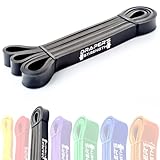
These are heavy continuous loops built for load-bearing assistance work: band-resisted squats and bench presses, band tension on a barbell, and assisted pull-ups where the band takes weight off you at the bottom of the movement. It suits lifters running strength programs who want band accommodation work alongside their barbell training, and anyone who wants a single heavy band rather than a graduated beginner set.
Key Specs
- Format: Continuous closed loops
- Construction: Layered heavy-duty latex
- Intended use: Powerlifting assistance, stretching, assisted pull-ups
- Sizing: Fixed loop sizes by resistance class
- Price tier: Mid-range
The loop format is the important distinction. A continuous loop has no end fittings, no clips and no joints — which means there is no single point where a band typically fails. Molded tubes with a clip at each end concentrate stress exactly where the tube meets the fitting, which is why tube sets are the ones most often reported to snap at the attachment point. Loops distribute load around the whole circumference. For anything involving a barbell, rack pin or pull-up bar, loops are the structurally sensible choice.
Heavy loops are also the right answer for assisted pull-ups in a way that tube sets are not, because a tube band under a pull-up bar gets twisted and loaded unevenly, which is where nicks and tears start. A loop sits cleanly over the bar and loads symmetrically. If you are training pull-ups and want one band rather than a set, this is the category to shop in.
Pros
- No end fittings or clips — no concentrated failure point
- Heavy resistance suitable for barbell assistance work
- Loop format loads symmetrically under a bar or rack pin
- Simple, durable design with nothing to break
Cons
- No handles or door anchor — grip and anchor options are limited
- One fixed resistance level per band, so you may need more than one
- Heavy start tension makes light warm-up work awkward
- Not a beginner’s general-purpose set
Compared with the nearest alternative: against the Amazon Basics 3/4 in pull-up band, both are continuous loops used for assistance work. Amazon Basics is the single-band, single-purpose option in a stated width class; Draper’s Strength offers a range of heavy resistance classes so you can match the band to your bodyweight and current pull-up strength. If you need exactly one band and want the simplest purchase, Amazon Basics is fine. If you want the ability to step down in assistance as you get stronger — which is the entire point of assisted pull-ups — Draper’s Strength’s range across resistance classes is the better structure. Against the Black Mountain tube set, this is the “assistance and heavy loading” answer versus the “general home training” answer.
6. Black Mountain Products Resistance Band Set (Five Bands) – Best Overall for All-Round Home Training

Five stacked tube bands, each with a clip, plus handles, a door anchor, ankle straps and a carry bag. This is the most complete single purchase in this roundup, and it is the pick if you want to buy once and be able to run a full bodyweight-plus-bands routine at home without improvising anchors or grips. It suits beginners who want a broad toolkit and intermediates who train at home and want pulling patterns available to them.
Key Specs
- Format: Clip-together molded tube bands with interchangeable handles
- Set size: Five bands
- Included: Handles, door anchor, ankle straps, carry bag
- Stacking: Bands clip together to combine resistances
- Price tier: Premium
The stacking capability is the feature that separates this from a five-pack of loose bands. Because each band clips to the handles independently, you can combine several to reach resistances that no single band in the set provides. A five-band set with stacking gives you far more than five usable resistance levels — pair the lightest with the heaviest and you have a level that exists nowhere in the set on its own. That is what makes a kit like this last through a long progression rather than becoming too easy within a few months.
The door anchor is the second big feature. It converts a doorframe into an anchor point for rows, presses, woodchops and face pulls, which are otherwise impossible with bands alone. In practice, the single largest difference between a band set that gets used and one that sits in a drawer is whether it includes a door anchor. Ankle straps come third: they open up kickbacks, hip flexion and leg curl variations that grip-based work cannot reach.
Pros
- Five bands plus full accessory kit in one purchase
- Stackable bands give far more than five effective resistance levels
- Door anchor massively expands the exercise library
- Carry bag makes the whole set portable
Cons
- Tube bands with clips concentrate stress where the tube meets the fitting
- Clip mechanisms add parts that can wear or bend
- Premium tier — more than a basic set that would cover the same beginner needs
Compared with the nearest alternative: against the Dapofajo silicone anti-snap set, this is an accessories-over-durability choice. Black Mountain wins clearly on what is in the box; Dapofajo wins on how long the bands themselves are likely to last under frequent use. If you train three or more times a week, the durability argument gets stronger. If you train twice a week and want maximum exercise variety for one purchase, Black Mountain is the better buy. Against the VanStretch 5-Level set, the difference is that VanStretch focuses purely on the bands and their graduation; Black Mountain adds the handle, anchor and strap system on top.
7. BODi Thick Resistance Bands, Set of 2 – Best for Heavy Lower-Body Work With Minimal Kit

A minimal two-band set of thick fabric loops in black and gray, aimed at people who want heavy resistance for lower-body work and nothing else. It suits a lifter who already has a training routine and just needs two dependable heavy loops for hip thrusts, squats and lateral work — not someone building a kit from scratch.
Key Specs
- Format: Thick fabric loops
- Set size: Two bands
- Colours: Black and gray
- Construction: Thick woven fabric over elastic core
- Price tier: Budget
Two bands is a deliberate, minimal choice rather than a shortfall, provided you know what you want. Thick fabric bands are primarily about high tension in short ranges — the top of a hip thrust, the outer range of a lateral walk — and two levels cover a light-heavy split adequately for that purpose. What they do not give you is a fine progression. If you need to move in small increments, a five-band set is the better structure.
The thickness is the selling point. A thicker fabric band resists rolling better than a thin one, sits more stably against the hip crease, and does not dig in as sharply. It also tends to hold its tension longer, because the elastic core is protected by more fabric. The trade-off is bulk: thick bands take up more bag space and are more cumbersome on light mobility work.
Pros
- Thick fabric resists rolling and digging better than thin loops
- Two heavy tensions cover light-heavy lower-body work
- Budget tier despite the heavy construction
- Compact, simple and durable — no clips or fittings
Cons
- Only two resistance levels
- Too heavy for activation-level work
- Not usable for stretching or upper-body pulling
- Bulkier to pack than flat loops
Compared with the nearest alternative: against the Renoj three-band non-slip set, BODi is the heavier, more minimal option and Renoj is the more progressive one. Choose BODi if you already know the tension you want and want two solid heavy loops; choose Renoj if you want light-to-heavy coverage including activation work. Against the Fit Simplify flat loops, this is an entirely different format — BODi is for loaded lower-body work, Fit Simplify is for general conditioning and mobility. Most people who train hips seriously would eventually own one of each rather than choosing between them.
8. Fit Simplify Resistance Loop Exercise Bands, Set of 5 – Best Budget First Set

Five flat latex loops in graduated widths, with an instruction guide and a carry bag. This is the cheapest sensible way to start band training and the correct first purchase if you are not yet certain how much you will use bands. It suits beginners, travellers, and anyone who wants a light, packable set for mobility work.
Key Specs
- Format: Flat latex loops
- Set size: Five bands
- Graduation: Varies by band width
- Included: Instruction guide, carry bag
- Price tier: Budget
The graduated-width approach is how flat loop sets create progression: a wider band has more material and therefore more resistance at the same stretch. It works, but it is less precise than colour-coded clinical systems because the actual tension depends heavily on how far you stretch the band, and there is no standard for what a given width means across brands. In practice, a five-loop set gives you a usable spread from very light to moderate, with the heaviest loop somewhere in the range where you would want a thicker band if you were doing serious glute work.
The instruction guide is worth noting. For a first set, a printed guide with named exercises removes the main barrier to actually using the bands, which is not knowing what to do with them. The carry bag matters more than it sounds: flat loops are easy to lose individually, and a set that stays together gets used more.
Pros
- Lowest cost entry into band training
- Five graduated levels for the price of one premium band
- Light and packable — good for travel
- Instruction guide helps beginners actually use the set
Cons
- Flat latex loops roll and slide during lower-body work
- Natural latex degrades with UV, heat and skin oils
- Top-end resistance is moderate, not heavy
- No door anchor or handles
Compared with the nearest alternative: against the Renoj Pilates Flexbands latex-free 5-pack, the key difference is material. If you have a latex sensitivity or react to natural rubber against the skin, the Renoj latex-free set is the correct choice and this one is not. Otherwise, Fit Simplify and Renoj Flexbands are close competitors in the same tier, and the deciding factor is usually just which material you prefer. Against the Renoj non-slip fabric set, this is the cheaper, more versatile option: flat loops stretch, Fit Simplify’s rolls do not, but fabric bands stay put during glute work. Buy Fit Simplify to explore, Renoj fabric to specialise.
9. THERABAND Resistance Bands Set, Advanced Kit (Blue, Black, Silver) – Best for Structured Rehab and Progression
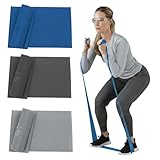
A three-level kit in blue, black and silver with accessories, built around the recognised THERABAND colour progression. It suits anyone following a structured progression — particularly in a rehab or return-to-training context — who needs to move up in documented steps rather than by guesswork, and who wants the accessories to make the exercises practical at home.
Key Specs
- Format: Flat latex bands in three colour-coded levels
- Levels: Blue, black and silver
- Included: Accessories for practical at-home use
- System: Part of a recognised progressive colour standard
- Price tier: Premium
Three levels sounds like fewer than the five-band sets here, but the difference is that these three sit inside a standardised progression. When you exhaust the blue level, moving to black is not a guess — it is the next documented step, and if you later switch to a different THERABAND product you can match the level you were using. For anyone tracking progress against a protocol, that standardisation is worth more than two extra bands of unspecified tension.
The blue-black-silver progression also spans a wide practical range. Blue sits in the light-to-moderate region used for early loading and shoulder work; black is a solid mid-level for general strength; silver reaches into the heavier end used for lower-body and stronger pulling movements. That spread covers most of what a home user needs, which is why a three-level standardised kit can replace a five-level generic one for many people.
Pros
- Standardised colour progression lets you load up in documented steps
- Three levels span light through heavy practical use
- Accessories make the kit usable at home without improvisation
- Levels are replaceable individually within the same system
Cons
- Premium tier — the standardisation is what you are paying for
- Natural latex, so not suitable for latex sensitivity
- Flat bands still roll during lower-body work
- Three levels is a coarse progression if you advance quickly
Compared with the nearest alternative: against the single THERABAND 6 ft black roll, this is the full progression versus one level. If you are starting from nothing and intend to progress, the kit saves you from buying each level separately and includes the accessories. If you already own bands from the same system and only need to step up a level, the single roll is cheaper and more sensible. Against the Black Mountain five-band set, the trade is standardisation versus quantity: Black Mountain gives you more bands and a door anchor, THERABAND gives you a documented loading system. For rehab-style work, THERABAND. For general home training, Black Mountain.
10. Amazon Basics Resistance Pull-Up Bands, 3/4 Inches, 30 lb Class – Best Single Band for Pull-Up Assistance

A single continuous loop in a stated 3/4 inch width and 30 lb resistance class, intended for pull-up assistance, stretching and muscle training. It suits someone who already has a pull-up bar and needs one band to help them get their first reps, or who wants a single general-purpose loop without buying a set.
Key Specs
- Format: Continuous latex loop
- Width: 3/4 in
- Resistance class: 30 lb
- Intended use: Pull-up assistance, stretching, muscle training
- Price tier: Mid-range
Stated width and resistance class are the two numbers that actually let you compare one loop band with another, and this listing gives both. That is more useful than a set that only says “heavy,” because the width tells you how the band will feel against your foot or bar and the resistance class tells you roughly how much assistance it provides. For assisted pull-ups, the relevant figure is how much of your bodyweight the band unloads at the bottom of the movement — a 30 lb class band is a sensible starting point for someone who can do a few partial reps but not full ones.
The single-band approach has a clear advantage and a clear limit. The advantage is cost and simplicity: no clips, no accessories, nothing to lose. The limit is that as you get stronger, you will need a lighter band, and buying a second single band means the first becomes redundant. A set gives you the step-down built in from the start.
Pros
- Stated width and resistance class make it easy to compare
- Continuous loop — no clips or fittings to fail
- Simple, portable and inexpensive for what it does
- Works for stretching as well as assistance
Cons
- Single resistance level only
- No accessories and no progression built in
- 30 lb class may be too much or too little depending on bodyweight and strength
- Natural latex
Compared with the nearest alternative: against DRAPER’S STRENGTH heavy duty loops, this is the simpler single-band purchase. Draper’s Strength offers resistance classes so you can build a progression across two or three bands; Amazon Basics gives you one clearly specified band. If you are buying your first assist band and want to test whether the approach works for you, Amazon Basics is the lower-commitment entry. If you already know you will need to step down in assistance over months, buying into a band range with multiple classes from the start is more economical than replacing a single band later.
11. Renoj Pilates Flexbands, 5-Pack Latex-Free – Best Latex-Free Set for Pilates and Stretching

A five-pack of latex-free flat bands with graduated tensions, aimed at Pilates, yoga and stretching. It suits anyone with a latex sensitivity, and anyone whose band use is primarily mobility and controlled movement rather than heavy loading. It is also the sensible choice for a studio or class environment where bands are shared and skin contact is frequent.
Key Specs
- Format: Flat latex-free bands
- Set size: Five bands
- Graduation: Five graduated tensions
- Intended use: Pilates, yoga, stretching, general exercise
- Price tier: Budget
Latex-free construction is the reason to buy this over any other flat band set here. Natural latex sensitivity is common enough that it is worth checking before you buy a multi-band set, because a reaction typically shows up on the skin where the band contacts your legs or hands, and it is not something you can work around by adjusting your grip. Latex-free bands are usually made from a synthetic elastic, which has a slightly different stretch feel — often a little less springy at the very top of the range — but performs equivalently for Pilates and stretching work.
Five graduated tensions is a generous spread for a stretching-focused set. For Pilates and yoga, the useful tension range is narrower than for strength training, so five levels within that range gives you genuinely fine control — which matters when you are using very light resistance to guide a movement rather than to load it.
Pros
- Latex-free — the correct choice for latex sensitivity
- Five graduated tensions give fine control at light loads
- Budget tier despite five bands
- Well suited to Pilates, yoga and flexibility work
Cons
- Top-end resistance is light — not for heavy strength work
- Synthetic elastic feel differs from natural latex
- Flat bands roll during lower-body loading
- No accessories
Compared with the nearest alternative: against the Fit Simplify five-loop set, the difference is essentially material. Both are five-band flat sets in the budget tier; Fit Simplify uses natural latex, Renoj uses latex-free material. If you have no sensitivity, either works and the choice is mostly a matter of feel. If you do, this one is the only viable option of the two. Against the Renoj fabric non-slip set from the same brand, this is the stretching and Pilates tool while the fabric set is the glute and hip tool — they are complementary rather than competing, and someone who does both would reasonably own one of each.
12. VanStretch Resistance Bands, 5-Level – Best for Beginners Who Want Guided Progression

A five-level elastic band set aimed at working out, with the levels structured so you can move up as you get stronger. It suits beginners, and anyone who wants a single purchase that will still be challenging a few months in — the five-level structure is the whole point, and it is what justifies the premium tier for a set of bands alone.
Key Specs
- Format: Elastic bands with five defined levels
- Levels: Five graduated resistances
- Price tier: Premium
Five levels is where a graduated set stops feeling like a compromise. With three levels, most people find one is too easy, one is right, and one is aspirational — leaving a gap where progress stalls. With five, there is usually a level that is genuinely challenging now and another that is slightly too hard, which is exactly the setup you want for continuous progress. That structure is worth paying for if you intend to train with bands regularly rather than occasionally.
Being sold as a level-based set rather than a collection of individual bands also means the manufacturer’s intention is progression, and the levels are designed to be distinguishable from each other. The practical test when the set arrives is whether adjacent levels feel meaningfully different. If two adjacent bands feel about the same, the graduation is poorly spaced and the extra levels are not doing anything for you.
Pros
- Five defined levels support continuous progression
- Designed as a progression system rather than loose bands
- Good fit for beginners who want one purchase to grow with
- Premium build intended for regular use
Cons
- Premium tier — more than a basic five-loop set
- No handles or door anchor
- Elastic band format is less durable than fabric loops for lower-body work
- Level spacing needs checking on arrival
Compared with the nearest alternative: against the LEZER 25–65 lb set, VanStretch is the premium version of essentially the same proposition — a graduated multi-band set for general and light training. LEZER wins on price; VanStretch wins on the clarity and structure of its five-level progression and on build quality. If you are buying your first set and want to spend as little as possible to find out whether band training suits you, take LEZER. If you already know you will use them consistently, VanStretch’s five-level structure is the better long-term spend. Against the Dapofajo silicone set, the difference is material durability versus price — Dapofajo is the anti-snap option, VanStretch the conventional one.
How to Choose
The format question comes before every other consideration, because tubes, flat loops and fabric loops are not interchangeable. Getting this wrong is why people buy a set, use it twice, and leave it in a cupboard.
Match the format to the movement
If your training is hip and glute work — bridges, lateral walks, clamshells, abduction — you want flat fabric loops. The reason is mechanical: fabric bands have a flat, wide contact surface with a grip strip, so they stay in place while your legs move apart. A latex loop in the same position rolls up your thigh within a few reps and has to be repositioned constantly. Fabric also does not pinch bare skin the way a thin latex loop does. Three to five bands in a light-medium-heavy spread covers this category completely, and the resistance numbers matter less here than whether the band stays put.
If your training is pulling, pressing or anything where you want to anchor the band to a door and hold handles, you want a tube set with clip-on handles and a door anchor. This is the most versatile format because you can stack bands to increase resistance, swap between handle types, and use the door anchor to open up rowing and pressing movements. The weakness of tubes is the attachment point: a molded tube with a clip at each end concentrates stress exactly where the tube meets the fitting, and that joint is where most tube band failures happen. Look for layered or reinforced construction at the ends if you plan to load tubes heavily.
If your training is stretching, mobility or rehab-style progression, flat latex bands — either on a roll or in a graduated set — are the best fit. The flat profile wraps easily around a foot or hand and gives a smooth, predictable stretch. For rehab work specifically, a standardised colour-coded system is worth the extra cost, because it lets you step loading up in documented increments rather than by guesswork.
If your training is barbell assistance — band-resisted squats, band tension on a bench press, assisted pull-ups — you want heavy continuous loops. No clips, no fittings, no joints: just a closed loop that loads symmetrically around a bar or rack pin. This is the format that takes that kind of load safely, and it is the wrong question to try to solve with a tube set.
Read resistance numbers sceptically
Stated resistance ranges in pounds are the most misread specification in this category. A band described as providing 50 lbs does not provide 50 lbs throughout the movement — it provides increasing tension as you stretch it, and the stated figure is usually the tension at a substantial elongation, not at the start of the range. A band you can barely move at full stretch is a band you can move easily at the beginning of a rep, which is precisely why bands are useful for accommodating resistance in the first place.
That means three practical rules. First, when comparing sets, compare the top of the range, not the bottom — the bottom figure is often close to meaningless because you will rarely stretch a band that far. Second, treat ranges from unbranded sets as approximate; there is no cross-brand standard for what “25 lbs” or “65 lbs” means, so a 65 lb band from one maker and a 65 lb band from another will not feel the same. Third, in standardised systems — the colour-coded clinical ones — the levels are at least internally consistent and comparable across products from the same maker, which is the closest thing to a real standard in this category.
Construction, and what actually fails first
Band failure is not random. In molded tube sets, the failure point is almost always the junction where the tube meets the clip or plug — the stress concentration is highest there, and any nick or abrasion at that point becomes the start of a tear. In flat bands, the failure point is usually a nick along the edge, particularly one caused by a rough anchor point or a sharp door edge. In continuous loops, failure is rarer and usually follows UV or heat degradation rather than mechanical stress.
That gives you a clear hierarchy of durability. Continuous loops last longest. Flat bands with clean storage last well but degrade faster with UV and heat. Molded tubes with clips are the most convenient and the most likely to fail early, particularly if they are single-wall and stored in a hot car or in direct sunlight. If a maker advertises layered construction or an anti-snap design, that is a direct response to the tube failure mode and is worth paying for if you train frequently.
| Format | Best Movement Type | Typical Failure Point | Durability | Accessory Compatibility |
|---|---|---|---|---|
| Molded latex tube (no handles) | Stretching, light therapy work | Surface nicks, end wear | Moderate | None without clips |
| Tube set with clips + handles | Pulling, pressing, anchored work | Tube-to-clip junction | Lowest | Highest — handles, anchor, straps |
| Silicone tube set | Pulling, pressing, frequent use | End wear (resistant to nicks) | High | High |
| Flat latex band (roll) | Stretching, rehab progression, ankle work | Edge nicks, UV degradation | Moderate | Low — cut to length |
| Flat latex loops | General conditioning, mobility | Edge nicks, rolling wear | Moderate | Low |
| Fabric loops | Glute and hip work, lower body | Fabric fraying, elastic core fatigue | High | Low — but no accessories needed |
| Continuous heavy loops | Barbell assistance, assisted pull-ups | UV and heat degradation | Highest | Low — bar and pin use |
Progression: how many levels do you actually need
Three levels is the minimum for meaningful progression. Five is where it starts to feel continuous for most people. More than five is useful mainly for rehab work where you are moving in small increments.
The test is whether adjacent levels feel meaningfully different to you at your current strength. If the lightest band in a set is already challenging, five levels means you have four steps of progress ahead of you — that set will last a long time. If the lightest band is trivially easy and the heaviest is also easy, the set is too light for you regardless of how many levels it has. Buying a set one strength class heavier than you think you need is usually the right call, because bands become easy faster than people expect.
Stacking is the other way to extend progression. A tube set with clip-on handles lets you combine bands to create resistances that no single band provides, which effectively multiplies the number of levels you own. A five-band stackable set can produce well over a dozen distinct combined resistances. Loose loops cannot do this — you either use one band or you use two awkwardly, and the second one usually slips.
Cost per use, and when premium pays
Resistance bands are cheap enough that the deciding factor is usually longevity rather than price. A budget five-loop set used three times a week for a year works out to a very small amount per session — but if the set is replaced twice in that year because the loops develop nicks and tear, the real cost is closer to a premium set that lasts. That calculation is what makes an anti-snap or silicone construction worth considering if you train frequently.
The rough rule: at one to two sessions a week, budget flat loops or a basic tube set are entirely adequate and premium construction is over-specified. At three or more sessions a week, the durability premium starts to pay for itself, particularly for tube sets where the clip junction is the weak point. For fabric loops and continuous heavy loops, buy the tier that matches the tension you need rather than paying up for durability — both formats are already durable, and the money is better spent on getting the right resistance.
Materials, skin sensitivity and storage
Natural latex is the standard material and the best-performing for stretch feel. It is also a common skin sensitiser, and if you have reacted to latex gloves, condoms or elastic waistbands, you should choose a latex-free or silicone option rather than discovering the problem mid-set. Silicone tube sets are a good compromise: they avoid natural latex and are more resistant to sweat, oils and UV than latex, at a higher price.
Storage is the single largest factor in how long any band lasts, and it costs nothing. Keep bands out of direct sunlight — UV degrades latex and synthetic elastic alike, and a band left on a sunny windowsill or in a hot car will fail far sooner than one kept in a bag. Wipe bands down after use if you have been sweating heavily, since skin oils and salts sit on the surface and accelerate ageing. Check bands before each session for nicks, especially at clip junctions and along the edges of flat bands, and retire any band with a visible cut or a change in colour at a stress point. Bands are cheap; a band that snaps at full stretch near your face is not worth the risk.
Fabric loops need a slightly different routine: they can be hand-washed with mild soap and air-dried, which removes the sweat and oils that otherwise break down the elastic core. Do not put them in a tumble dryer.
If you are buying for a specific situation
| Your Situation | Format to Choose | Levels Needed | Accessories That Matter |
|---|---|---|---|
| Complete beginner, unsure about commitment | Flat latex loops | 5 graduated | Instruction guide, carry bag |
| Training at home 3+ times weekly, want one purchase | Stackable tube set with clips | 5 stackable | Door anchor, handles, ankle straps |
| Glute and hip focused training | Fabric loops, non-slip | 3 (light/medium/heavy) | None needed |
| Structured rehab or return to training | Standardised colour-coded flat bands | 3+ in a known system | Accessories for anchored work |
| Pull-up progression | Continuous heavy loops | 1–3 classes to step down | None needed |
| Has had latex bands snap before | Silicone or anti-snap construction | 5 | Handles if pulling is the goal |
| Latex sensitivity | Latex-free flat bands | 5 | None needed |
| Barbell assistance work | Heavy continuous loops | 2+ classes | None needed |
| Travel and mobility only | Flat loops or flat bands | 3–5, light | Carry bag |
Frequently Asked Questions
What does the resistance number on a band actually mean?
It is the approximate tension the band provides at a substantial stretch, not a constant load. A band rated at 50 lbs will feel much lighter at the beginning of a rep and heavier at the end, because elastic tension rises with elongation. When comparing sets, compare the top of the stated range rather than the bottom, since you will rarely stretch a band far enough to reach the bottom figure meaningfully. There is also no cross-brand standard, so a 50 lb band from one maker will not necessarily match another’s.
How long do resistance bands last before they need replacing?
It depends far more on storage than on price. A band kept out of sunlight and wiped down after sweaty sessions can last years; the same band left in a hot car or on a sunny windowsill may degrade within months. Check before each session for nicks along the edges, discolouration at stress points, or damage where a tube meets its clip, and replace any band showing those signs. Fabric loops generally outlast latex tube sets because they have no fittings and the fabric protects the elastic core.
Are fabric bands better than latex bands?
They are better for one specific job and worse for others. Fabric loops with a non-slip inner surface are clearly superior for hip and glute work, because they stay in place while your legs move apart and they do not pinch bare skin. Latex bands — flat or tube — are better for stretching, pulling, anchoring and light therapy work, because they stretch further and more smoothly and can be combined with handles and door anchors. Most people who train both lower body and upper body end up owning one of each format.
Can resistance bands snap, and how do I reduce the risk?
Yes, they can, and the risk is concentrated in a few known places. Molded tubes with clips fail most often at the junction where the tube meets the fitting, so check that area for nicks before every session. Flat bands fail along the edges, usually after a nick from a rough anchor. Continuous loops rarely fail mechanically but degrade with UV and heat. To reduce risk: store out of sunlight, inspect before use, replace any band with a visible cut, and avoid stretching a damaged band to full extension — especially anywhere near your face.
How many resistance bands do I need to start?
A set of five graduated bands covers most beginners well, because it gives you four steps of progression before you run out of options. Three is the practical minimum for meaningful progression; five is where it stops feeling like a compromise. If you are buying a tube set with clip-on handles and can stack bands, five stackable bands produce far more than five effective resistance levels, which extends the set’s useful life considerably.
Do resistance bands work for building strength, or only for rehab?
Bands can build strength, but the loading profile is different from free weights: tension increases as you stretch, so the hardest part of the movement is at the end of the range rather than the start. That makes bands very effective for accommodating resistance on squats and presses, for assistance work like pull-ups, and for higher-rep hypertrophy work. They are less suited to maximal strength work in the low-rep range, where the load needs to be heavy at the start of the movement, not just at the top. For general fitness and moderate strength work, a graduated set is a legitimate tool, not a compromise.
Is there anything I should check before buying a band set for physical therapy?
Prefer a set with a standardised, documented progression — colour-coded systems are the closest thing the category has to a real standard — so you can step loading up in defined increments rather than guessing. Check the material if you have any history of latex sensitivity. This article is general information only and not medical advice; if you are recovering from an injury or following a rehabilitation protocol, work with a physiotherapist or other qualified professional to select resistance levels and progressions appropriate to you.
Why does one band feel so different from another at the same stated resistance?
Because there is no cross-brand standard for resistance labelling, and because the material and cross-section matter as much as the number. A wide flat band and a narrow tube band can both be labelled “30 lbs” and feel completely different: the flat band distributes pressure over a wider area and stretches differently, while the tube concentrates it. Silicone also feels stiffer in the early range than natural latex. Treat stated figures as a rough guide for sorting sets into categories, and expect to adjust based on how the band actually behaves in your hands.
The Bottom Line
If you want one purchase that covers the most ground, the Black Mountain Products Resistance Band Set is the pick: five stackable bands plus handles, door anchor, ankle straps and a bag, which together handle pulling, pressing, lower-body work and stretching. If you are new to bands and want to spend as little as possible to find out whether they suit you, take the Fit Simplify Loop Bands Set of 5 — or the latex-free Renoj Pilates Flexbands if you have a latex sensitivity. If your training is hip and glute focused, skip the tube sets entirely and buy the Renoj non-slip fabric set, because staying in place matters more than resistance numbers there. If you are training pull-ups or loading a barbell with bands, buy DRAPER’S STRENGTH heavy duty loops and leave the clip-on tube sets alone. And if you have already had a band snap, pay the premium for the Dapofajo silicone anti-snap set — that is precisely the problem it exists to solve.