
Key takeaways
- Budget: Handheld pull-through models such as the KitchenIQ Edge Grip. They are quick and compact, though results are basic and they can be aggressive on fine edges.
- Mid-range: Wusthof-style handhelds, the Work Sharp Rolling Knife Sharpener, and the lower-cost electric machines.
- Premium: The Work Sharp Precision Adjust Elite, Chef’sChoice Trizor XV or 15XV, and the Ken Onion Edition. You pay for adjustability, speed and replaceable abrasives.
For most home cooks, the Work Sharp Precision Adjust suits the buyer who wants control over the edge angle, the Chef’sChoice Trizor XV suits the buyer who wants a fast, low-effort electric machine, and a simple handheld pull-through such as the Wusthof two-stage model suits anyone who only needs occasional touch-ups on Western-style knives. Reviewers at outlets such as GearJunkie, Culinary Gene and Yahoo Shopping keep returning to those same names in their 2026 roundups, which makes them a sensible starting shortlist. The right choice still depends on what knives you own, how often you cook, and how much effort you want to spend.
Our top picks


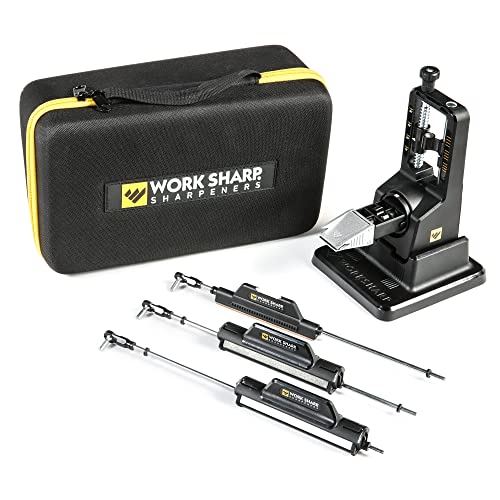

As an Amazon Associate we earn from qualifying purchases at no extra cost to you.
Knife Sharpeners at a Glance
| Model | Type | Best for | Stated features | Limits |
|---|---|---|---|---|
| Work Sharp Precision Adjust | Guided manual | Cooks who want repeatable, adjustable angles | The maker lists adjustable guided angles and replaceable abrasive plates | Slower than a motorized unit; takes setup time |
| Chef’sChoice Trizor XV / 15XV | Electric, multi-stage | Fast, simple sharpening of straight and serrated blades | The maker lists a 15-degree edge and multi-stage abrasives | Fixed angle; not suited to every knife style; takes counter space |
| Work Sharp Ken Onion Edition | Electric belt system | Hobbyists who sharpen knives of many kinds | Variable-speed belt with an adjustable angle guide, per the maker | Can remove metal quickly if used carelessly; learning curve |
| Work Sharp Rolling Knife Sharpener | Magnetic rolling | Beginners who like a guided, tidy approach | Knife sits on a magnetic angle guide and a puck rolls along the edge | Reviewers note it cannot handle serrated knives |
| Wusthof Precision Edge two-stage | Handheld pull-through | Touch-ups on German-style knives | Coarse and fine slots, compact body | Fixed angle; limited for very hard Japanese steels |
| KitchenIQ Edge Grip | Handheld pull-through | Budget buyers | Compact, grip-style design | Basic results; not for refining a premium edge |
How Sharpeners Differ
Guided manual systems
A guided system clamps or supports the knife and holds the abrasive at a set angle, so the cook supplies only the strokes. The Work Sharp Precision Adjust is the example reviewers cite most often. GearJunkie moved it up to Best Overall in a spring 2026 update, and We Tried It All describes it as the best pick for most people because the angles are repeatable. The trade-off is time: you must set up, clamp the blade, and work through grits. If you enjoy the process or own several good knives, that is a fair price for control. If you want a quick fix before dinner, it can feel like a chore.
Electric sharpeners
Electric units do the work for you. The Chef’sChoice Trizor XV is the model most often named as the best electric pick across several roundups, and the 15XV EdgeSelect appears in similar lists. Yahoo Shopping reports that it puts a 15-degree edge on straight and serrated blades in about a minute. The maker positions it as a way to convert 20-degree knives to a finer angle. The main caution is that a fixed-angle machine removes metal on every pass, so it is best used when the knife is truly dull rather than for weekly touch-ups. Check the manual for which knives it accepts; thick, bolstered or very hard blades may fit some slots poorly.
Belt systems
The Work Sharp Ken Onion Edition uses a motor-driven abrasive belt with a variable-speed control and an adjustable angle guide, according to the maker. Product Review Crew ranked it first in an April 2026 comparison for speed and versatility, and ShouldIt called it good value. Belt systems are the most flexible option for people who also sharpen pocketknives, hunting knives or garden tools, but they remove metal fast and generate heat if you press hard. Practice on an inexpensive knife first.
Rolling and handheld sharpeners
Rolling sharpeners place the knife against a magnetic guide and use a rolling abrasive puck. They are tidy and approachable, though GearJunkie notes that rolling sharpeners cannot sharpen serrated blades. Handheld pull-through sharpeners are the cheapest and easiest to store. The Wusthof two-stage handheld is the pick We Tried It All gives for German-style knives, since it is built around that blade geometry. Buyer feedback on some listings mentions the housing flaring below the slot so the knife tip contacts it on each pull, which is worth knowing if you own long, thin blades.
Whetstones and honing rods
Whetstones sit outside these roundups but remain the traditional answer for enthusiasts. They offer the finest control and work on almost any knife, but they demand technique. A honing rod does not sharpen; it realigns a slightly bent edge between sharpenings. Many cooks pair a rod with an occasional sharpener.
Budget Tiers
- Budget: Handheld pull-through models such as the KitchenIQ Edge Grip. They are quick and compact, though results are basic and they can be aggressive on fine edges.
- Mid-range: Wusthof-style handhelds, the Work Sharp Rolling Knife Sharpener, and the lower-cost electric machines.
- Premium: The Work Sharp Precision Adjust Elite, Chef’sChoice Trizor XV or 15XV, and the Ken Onion Edition. You pay for adjustability, speed and replaceable abrasives.
Fit, Compatibility and Care Notes
- Know your steel. Soft German-style knives tolerate most sharpeners. Very hard Japanese knives and ceramic blades can chip on aggressive abrasives, so follow the knife maker’s guidance.
- Match the angle. Western kitchen knives are commonly ground around 20 degrees per side and many Japanese knives finer. A sharpener with a fixed angle will reshape the edge toward its own geometry.
- Serrated knives. Only some sharpeners list serrated compatibility. Rolling sharpeners do not handle them, per reviewers.
- Cleaning. Electric units collect metal dust. Brush or wipe them per the manual, and replace worn belts, plates or discs when the maker advises.
- Wear and storage. Keep abrasives dry and flat, and store the sharpener where children cannot reach the blades.
Safety Basics
Work on a stable, non-slip surface. Keep fingers behind the edge, never test sharpness by running a thumb along the blade, and unplug electric units before cleaning. Wipe the knife clean of metal filings before cutting food. Follow each manual rather than improvising, especially with belt machines that spin quickly.
Pick X If You Want…
| Pick this | If you want… |
|---|---|
| Work Sharp Precision Adjust | Control over the angle and consistent, repeatable results |
| Chef’sChoice Trizor XV or 15XV | A fast, hands-off electric machine for straight and serrated knives |
| Work Sharp Ken Onion Edition | One tool for kitchen knives, pocketknives and outdoor blades |
| Work Sharp Rolling Knife Sharpener | A tidy, beginner-friendly approach for straight-edge knives |
| Wusthof two-stage handheld | Quick touch-ups for German-style knives with minimal storage space |
| KitchenIQ Edge Grip | The lowest-cost way to revive a dull everyday knife |
Alternatives to Consider
- Whetstone set: The classic option for people willing to learn technique; it suits both kitchen and specialty knives.
- Professional sharpening service: Worth considering for expensive or delicate knives, or if you rarely sharpen.
- Honing rod: An inexpensive add-on that extends time between sharpenings rather than replacing a sharpener.
Practical Buying Checklist
Before you buy, list the knives you actually own. A block of soft German-style chef knives, a few inexpensive paring knives and a bread knife point toward a different sharpener than a drawer of thin, hard Japanese gyuto and santoku blades. Look at the maker’s compatibility notes for blade thickness, bolster shape and maximum blade length, because a bolster can stop a knife from sitting flat against a guide or slot.
Next, think about how often you will use it. If you sharpen twice a year, a guided manual kit stored in a drawer is perfectly adequate and the slower pace is not a burden. If you run a busy household kitchen, hunt, fish or share knives among several people, speed becomes more valuable and an electric or belt unit earns its counter space. Consider noise too: electric and belt machines are loud compared with a handheld.
Finally, factor in consumables. Abrasive plates, belts and discs wear out, and the maker lists replacement intervals in the manual. A sharpener with widely available replacements is a safer long-term purchase than a bargain model whose parts are hard to find. A sharp edge depends on technique as much as hardware, so spend the first sessions on an old knife, take light passes, and stop when the manual says the stage is complete.
For anyone who owns an expensive handmade or collectible knife, the cautious path is to ask the knife maker what sharpening method they support. Some makers void warranties for machine sharpening, and a professional service may be the better choice.
Frequently Asked Questions
Which knife sharpener is best for a beginner?
A guided system such as the Work Sharp Precision Adjust or a rolling sharpener helps newcomers keep a consistent angle. A good electric model such as the Chef’sChoice Trizor XV is also forgiving because the machine sets the angle for you. Start on a knife you do not mind practicing on.
How often should I sharpen kitchen knives?
It depends on use, the steel, and the cutting board. Many home cooks sharpen a couple of times a year and hone more often. If a ripe tomato skin resists a clean slice, the edge is probably due for attention.
Are pull-through sharpeners bad for knives?
They are not harmful when used as the maker describes, but their fixed abrasives remove metal quickly and cannot be adjusted. They suit occasional touch-ups on inexpensive or German-style knives better than fine Japanese blades.
Can I sharpen serrated knives?
Some electric models list serrated compatibility, and special tapered tools exist for individual serrations. Rolling sharpeners cannot sharpen serrated blades, according to GearJunkie. Read the manual for the model you are considering.
Is an electric sharpener better than a manual one?
Electric units are faster and need less skill, while manual guided systems give more control and usually remove less metal. Neither is universally better; the choice comes down to your patience, your knives and your storage space.
What is the difference between honing and sharpening?
Honing straightens a slightly rolled edge without removing much steel, while sharpening grinds away metal to create a new edge. Regular honing delays sharpening but cannot restore a truly dull knife.





