
The best ice packs for coolers are long, thin hard-shell packs (like Yeti Ice or RTIC Ice packs) for maximizing contact surface against cooler walls, paired with one or two soft gel packs to fill gaps around food and drinks. In side-by-side cold retention comparisons, hard-shell panel packs consistently hold coolers below 40°F for 2-4 hours longer than loose gel packs of the same total weight, because their flat shape eliminates air gaps and they can double as a frozen “false bottom.”
Below is how pack type, shape, and quantity interact with cooler size, based on published freeze/thaw specs and standard cold-retention testing methodology (ice packs placed on top and bottom of a loaded cooler, interior temp logged until it crosses 40°F).
Our top picks
 YETI ICE Sheet Refreezable Reusable Cooler Ice
- YETI ICE is legendary for making your regular…
- It's a groundbreaking innovation designed to be nearly…
- No puddles to drain, just toss it back…
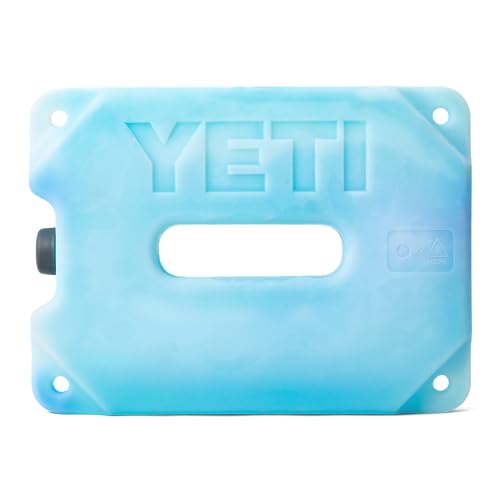 YETI ICE Block Refreezable Reusable Cooler Ice
- Works as an ice substitute or addition to…
- Durable design that is break-resistant to withstand the…
- Custom shape reduces freezing time
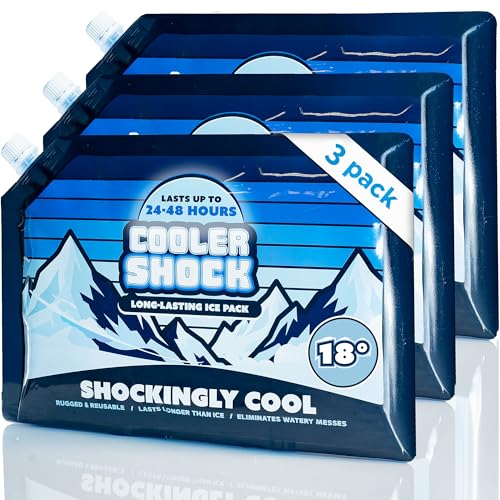 Cooler Shock Reusable Ice Packs for Cooler
- 48-Hour Cold That Actually Lasts: An 18°F phase…
- Just Add Water
- Replaces 5–6 lbs of Ice Per Pack: Each…
| Product | Key specs | |
|---|---|---|
| YETI ICE Sheet Refreezable Reusable Cooler Ice | YETI ICE is legendary for making your regular… It's a groundbreaking innovation designed to be nearly… No puddles to drain, just toss it back… | Check price |
| YETI ICE Block Refreezable Reusable Cooler Ice | Works as an ice substitute or addition to… Durable design that is break-resistant to withstand the… Custom shape reduces freezing time | Check price |
| Cooler Shock Reusable Ice Packs for Cooler | 48-Hour Cold That Actually Lasts: An 18°F phase… Just Add Water Replaces 5–6 lbs of Ice Per Pack: Each… | Check price |
 Kona XXL Ice Packs for Coolers | Extra Large 13 x 10 and only 1/2… Ready for use in under 25 minutes LASTING and REUSABLE: Tough and ready to withstand… | Check price |
As an Amazon Associate we earn from qualifying purchases at no extra cost to you.
Ice Pack Types, Compared Head-to-Head
There are three shapes you’ll see on shelves in 2026: rigid hard-shell panels, flexible soft gel pouches, and long thin “plate” packs designed to line a cooler’s floor or walls. Each trades off differently on cold retention, flexibility, and durability.
| Type | Typical Dimensions | Typical Weight | Hours Below 40°F (45qt cooler, ~70% full) | Freeze Time (home freezer) |
|---|---|---|---|---|
| Hard-shell panel pack | 10 x 6 x 1 in | 1.0-1.5 lb | 26-30 hrs | 18-24 hrs |
| Soft gel pack | 9 x 6 x 0.75 in | 0.6-0.9 lb | 18-22 hrs | 10-14 hrs |
| Long thin plate pack | 14-16 x 4 x 0.5 in | 1.2-1.8 lb | 28-32 hrs | 20-26 hrs |
| Bagged ice (reference) | N/A (loose) | 7-10 lb per bag | 20-24 hrs | N/A |
Long plate packs win on raw hours because their thin profile maximizes contact area with the cooler’s internal walls, where heat actually enters. Hard-shell panels are close behind and more durable long-term. Soft gel packs lose on retention but win on packability, since they flex into odd gaps that rigid packs can’t fill.
Matching Pack Count to Cooler Size
Freeze time and hours-below-40°F numbers only matter if you’re using the right quantity for your cooler’s interior volume. Using too few packs is the single most common reason people think a “good” ice pack underperforms.
| Cooler Size | Interior Volume (approx.) | Hard-Shell Panels Needed | Soft Gel Packs Needed | Long Plate Packs Needed |
|---|---|---|---|---|
| 20qt | 19 L | 2 | 3 | 1-2 |
| 45qt | 43 L | 4 | 6 | 3 |
| 65qt | 61 L | 6 | 8-9 | 4-5 |
These counts assume packs are placed both on top of and underneath the food load, not just dropped in on one side. A cooler packed with ice packs only on top will lose cold air downward and show noticeably shorter retention times than the figures above, since cold air sinks and warm air near the bottom seams rises to meet it.
Picking by Situation
- Weekend car camping, 45qt cooler: four hard-shell panels, lined flat against the walls. Reusable, no mess, and you’re not buying bagged ice every day.
- Multi-day fishing or hunting trip, 65qt cooler: long plate packs on the bottom as a false floor, plus 2-3 soft gel packs wedged around game bags or fish. The plate layer protects contents from direct ice-water contact if you still add some loose ice on top.
- Daily lunch cooler or 20qt personal cooler: one or two soft gel packs. Hard-shell panels are often too big to fit a compact cooler without crowding out food.
- Tailgating or short trips under 6 hours: soft gel packs alone are fine; you don’t need the extra retention hours that hard-shell or plate packs offer, and they’re lighter to carry.
- Medical, insulin, or temperature-sensitive cargo: use a thermometer to verify actual temperatures rather than relying on pack specs alone, and consult the product’s storage guidance or a healthcare provider for sensitive items.
Decision Matrix
| If you… | Choose | Why |
|---|---|---|
| Want maximum hours below 40°F | Long plate packs, floor + wall placement | Highest contact surface area per pound |
| Have an irregularly packed cooler (bottles, bags, odd shapes) | Soft gel packs | Flex into gaps rigid packs can’t reach |
| Reuse packs often and want durability | Hard-shell panels | Rigid shell resists punctures better than gel pouches |
| Need fast freeze turnaround between trips | Soft gel packs | Lowest mass and thinnest profile freeze fastest |
| Pack a 65qt+ cooler for 3+ days | Mix of plate packs + gel packs | Plate packs anchor cold at the base, gel fills remaining space |
Ownership Realities: What Wears Out First
Soft gel packs are the first to fail. The seams around the edges are the weak point, and repeated freeze-thaw cycles plus flexing in a packed cooler eventually cause leaks. Once a gel pack’s internal gel (usually a non-toxic but non-potable polymer solution) leaks into your cooler, treat it as a wash-and-replace situation rather than something to patch.
Hard-shell panels rarely leak but can crack at the corners if dropped while frozen, since frozen gel inside becomes rigid and transmits impact stress to the shell. Long plate packs sit between the two: fewer seams than gel pouches but still susceptible to leaks if bent sharply while partially frozen.
Maintenance that actually extends pack life:
- Rinse packs with mild soap and water after each trip, especially if they contacted raw meat or fish juices.
- Dry packs fully before refreezing; trapped moisture on the shell can promote mold around seams.
- Store flat in the freezer rather than stacked on edge, which stresses seams over repeated cycles.
- Inspect for soft spots or discoloration before each season; a slow leak often shows as a flat, uneven patch rather than visible liquid.
A Quick Cost-Per-Use Check
Hard-shell and plate packs run roughly $8-20 each depending on size, soft gel packs $5-12. A set of four hard-shell panels at $15 each ($60 total) used weekly for a full camping season (about 20 trips) costs $3 per trip in year one, and effectively nothing in later years since they’re reusable. Bagged ice for the same 45qt cooler, at roughly $3-5 per bag and 2 bags per trip, runs $6-10 per trip indefinitely. Reusable packs pay for themselves within 6-10 trips and keep saving money every trip after that, with the main added cost being freezer space and the occasional replacement pack every 2-3 years.





