
The best all mountain skis for most resort skiers are 90–100 mm underfoot, with moderate tip rocker, limited tail rocker, a turn radius of roughly 16–20 m, and a medium or medium-stiff flex that can edge firmly on groomers without becoming difficult in trees.
That broad category includes very different skis. A 90–94 mm model usually feels quicker edge to edge and more precise on hardpack, while a 97–102 mm ski offers more flotation and stability when storms, chopped snow, and soft bumps are part of your normal day. The right choice depends less on the biggest snowfall you might encounter than on the conditions you ski most often.
Our top picks
 Rossignol Sprayer Pro Xpress
- Modern Carving—Beginner to Intermediate downhill men & womens…
- Precision Steering—This downhill ski equipment with traditional camber…
- Premium Construction—Poplar Wood Core balances dampness & flex
 Nordica Enforcer 99 Men's All Mountain Skis
- Featuring a full wood core sandwiched between two…
- Smooth, confident, and stable, Nordica’s Enforcer construction embeds…
- We’ve refined the rocker on this collection and…
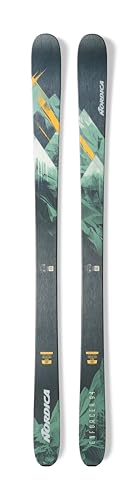 Nordica Enforcer 94 Men's All Mountain Skis
- Featuring a full wood core sandwiched between two…
- Smooth, confident, and stable, Nordica’s Enforcer construction embeds…
- We’ve refined the rocker on this collection and…
As an Amazon Associate we earn from qualifying purchases at no extra cost to you.
Best all-mountain skis by resort situation
| Best for | Recommended waist | Useful design | Representative skis |
|---|---|---|---|
| Mostly groomers and firm snow | 88–94 mm | Strong edge grip, moderate rocker, flatter tail | Nordica Enforcer 94, Atomic Maverick 95 TI |
| Balanced everyday resort skiing | 94–98 mm | Tip and light tail rocker, medium-stiff flex | Blizzard Rustler 9, Elan Ripstick 96 |
| Frequent powder, trees, and soft chop | 98–104 mm | More tip rocker, tapered tip, progressive flex | Salomon QST 98, Volkl Mantra 96 |
| One ski for mixed western conditions | 96–102 mm | Stable platform with a forgiving, pivotable tail | Salomon QST 98, Blizzard Rustler 9 |
Dimensions and construction vary by ski length and model year. Treat the figures below as comparison points, then confirm the current manufacturer specifications before buying.
Head-to-head: versatile all-mountain ski options
Nordica Enforcer 94: best for powerful edge control
The Enforcer 94 is a strong choice for skiers who spend much of the day on groomers but still want to leave the trail. Its 94 mm waist is narrow enough to roll quickly onto edge, while its metal-reinforced construction gives it composure at speed and through chopped-up snow.
- Waist: 94 mm
- Turn radius: approximately 16–19 m, depending on length
- Profile: rocker-camber-rocker, with a relatively supportive tail
- Flex: medium-stiff to stiff
Choose it if you drive the front of the boot, like carving medium-radius turns, and value stability over effortless pivoting. Smaller or less aggressive skiers may find it demanding, particularly in tight trees or slow-speed bumps.
Atomic Maverick 95 TI: best groomer-to-off-piste compromise
The Maverick 95 TI combines a directional feel with enough rocker and taper for soft snow at the sides of the trail. It is a sensible option for skiers who want predictable carving without the more substantial, damp feel of some heavier metal-laminate skis.
- Waist: 95 mm
- Turn radius: approximately 17–19 m
- Profile: camber underfoot with tip rocker and a modestly released tail
- Flex: medium, with a supportive center and relatively accessible tip
The Maverick suits intermediate-to-advanced skiers who want one ski for groomers, tracked powder, and occasional trees. It is less naturally surfy than a heavily rockered ski and is not intended to replace a dedicated powder model.
Blizzard Rustler 9: best for trees and mixed terrain
The Rustler 9 sits near the center of the all-mountain range. Its 96 mm waist adds useful flotation, while its shorter effective edge and rockered tail make it easier to pivot than a traditional directional ski.
- Waist: 96 mm
- Turn radius: approximately 16–18 m
- Profile: camber underfoot, pronounced tip rocker, and noticeable tail rocker
- Flex: medium, with a supportive center and more forgiving extremities
This is a strong match for skiers who frequently alternate between groomers, bumps, trees, and fresh snow. Compared with a flatter-tailed ski, it releases more readily at the end of a turn. That maneuverability comes with slightly less locked-in edge feel on very firm snow.
Elan Ripstick 96: best for a light, quick feel
The Ripstick 96 emphasizes low swing weight and agility. Its asymmetric left-and-right ski design uses different inside and outside edges, so it rewards a skier who pays attention to edging rather than simply pushing both skis flat.
- Waist: 96 mm
- Turn radius: approximately 17–19 m
- Profile: camber and rocker with a freeride-oriented tip and tail shape
- Flex: medium, with a relatively lively response
Pick it when quick direction changes, bumps, and long days matter more than maximum high-speed damping. It is less ideal for a skier who prefers a heavy, planted ski and rarely varies turn shape.
Salomon QST 98: best for soft snow and forgiving versatility
The QST 98 leans toward freeride performance without becoming unwieldy on resort runs. Its tapered shape, generous tip rocker, and rockered tail help it float and pivot when snow becomes deep or irregular.
- Waist: 98 mm
- Turn radius: approximately 17–19 m
- Profile: camber underfoot with substantial tip and tail rocker
- Flex: medium, with a damp but accessible feel
It is a particularly good answer for a skier who spends powder days in trees and open bowls but still skis lifts and groomers between storms. On hardpack, it will not feel as razor-precise as a narrower ski with a flatter tail.
Volkl Mantra 96: best for speed and firm-snow stability
The Mantra 96 is aimed at advanced skiers who want a powerful ski that can hold an edge while moving quickly through variable snow. Its metal construction and directional geometry favor deliberate, high-energy skiing.
- Waist: 96 mm
- Turn radius: approximately 19–22 m, depending on length
- Profile: camber with moderate tip and tail rocker
- Flex: stiff and highly supportive
Choose it for wide-open terrain, fast groomer laps, and heavy afternoon chop. It is less forgiving of back-seat technique and less playful at low speed than the Rustler 9 or Ripstick 96.
How waist width changes the decision
A ski’s waist is not a simple quality scale. It changes the compromises you feel underfoot.
- 88–93 mm: fastest edge-to-edge and easiest to grip on firm groomers; limited flotation in deeper snow.
- 94–98 mm: the most balanced range for many lift-served skiers; versatile without feeling sluggish.
- 99–104 mm: more comfortable in powder, crud, and soft bumps; slower to roll over and less precise on boilerplate.
For a 70 kg skier who skis mostly groomed eastern snow, a 90–94 mm ski may be more versatile in practice than a 102 mm model. For a 90 kg skier in a snowy western resort, 96–102 mm can provide useful support and flotation. Ski length, construction, and technique also affect these sensations, so waist width should not be considered alone.
Rocker, turn radius, and flex: what the numbers mean on snow
Rocker profile
Tip rocker lifts the front of the ski earlier, helping it plane in powder and stay manageable in uneven snow. Tail rocker makes the ski easier to release and pivot, especially in trees. More rocker generally reduces the amount of edge engaged on firm snow, so a heavily rockered ski may feel shorter than its stated length.
For mixed resort use, look for camber underfoot rather than a fully flat profile. Camber supplies pressure and edge contact on groomers, while moderate rocker keeps the ski from feeling hooky when you move into soft snow.
Turn radius
A 15–17 m radius encourages shorter, quicker turns. A 18–20 m radius is a useful middle ground for carving and variable terrain. A radius above 21 m feels calmer and more stable in long turns but asks for more room and stronger speed control.
Do not treat radius as a fixed turning requirement. A skier can make short turns on a 20 m ski, particularly if the tail is rockered, while a stiff 16 m ski can still resist quick pivots.
Flex pattern
A stiff ski can reward pressure at the shovel and remain stable when driven hard, but it can punish poor balance and tire lighter skiers. A softer ski is easier to bend and pivot, though it may feel nervous at speed. For most intermediate and advanced resort skiers, a medium flex with a supportive center and forgiving tip is the safest starting point.
Choosing length without overcomplicating it
Start with a ski that reaches somewhere between your chin and the top of your head when standing upright. Move shorter if you are lighter, newer to skiing, prioritize trees and short turns, or choose a ski with substantial rocker. Move longer if you are heavier, aggressive, frequently ski fast, or want additional flotation and stability.
As a practical example, a 178 cm, 75 kg advanced skier choosing a 96 mm ski might compare a 176–180 cm length. A 165 cm beginner at 60 kg may be better served by approximately 160–168 cm, depending on the ski’s rocker and manufacturer range. The binding mount point and boot size also affect how a given length feels.
Ownership realities: what wears first
Resort skis usually show damage first at the base edges, topsheets, and binding-area sidewalls. Lift lines and ski racks can cause more cosmetic harm than skiing itself. Regularly inspect for edge separation, deep core shots, loose binding screws, and cracks around the heel or toe mount.
- Have bases waxed when they look gray or feel slow; frequent skiers may need service every 5–10 days on snow.
- Repair deep gouges before moisture reaches the core.
- Dry skis before storage and avoid leaving them strapped tightly while wet.
- Use a qualified ski technician for binding adjustment and release-value work.
- Do not store skis base-to-base with damp snow trapped between them.
For a skier making 20 resort days per season, a ski that costs $600–$900 represents roughly $30–$45 per day over its first season, before servicing. Spending more for a ski whose width and flex match your actual terrain is usually better value than buying the widest or stiffest model simply for storm-day potential.
Bottom line
Choose the Nordica Enforcer 94 or Atomic Maverick 95 TI for groomer priority, the Blizzard Rustler 9 or Elan Ripstick 96 for the most agile mixed-terrain performance, the Salomon QST 98 for soft snow and trees, and the Volkl Mantra 96 for advanced skiers who value speed and edge stability. For most people searching for the best all mountain skis, a 94–98 mm model with camber, moderate rocker, and a medium flex is the most dependable starting point.





