Best Bow Cases for Safe Transport and Storage
The best bow case depends on how you travel: choose a fitted hard case for frequent vehicle transport or airline check-in, and a padded soft case for lighter, less bulky trips where impact protection is not the priority. Before buying, compare the case’s usable interior dimensions with your bow’s longest assembled measurement—not just its advertised exterior size.
Quick picks by situation
| Situation | Best case type | What to prioritize | Trade-off |
|---|---|---|---|
| Airline check-in or frequent rough handling | Rigid hard case | Lockable latches, crush-resistant shell, secure bow restraints, room for padding | Heavier and harder to store |
| Regular drives to a range or hunting area | Fitted hard case or reinforced soft case | Bow-specific fit, secure closures, manageable size | More protection usually means more bulk |
| Short carries and limited storage space | Padded soft case | Padding, abrasion-resistant fabric, comfortable carry straps | Less protection from crushing and sharp impacts |
| Recurve bow or takedown limbs | Long case or purpose-built takedown case | Fit for the bow’s longest component, separate limb and riser compartments | A long case may have excess space if the bow breaks down |
Hard versus soft: what protection actually means
A hard case’s shell helps resist crushing and impacts from other cargo. Its benefit depends on the interior: a bow that can shift inside may still strike the shell or press its cams and sights against an accessory tray. Look for shaped supports or adjustable restraints that hold the bow securely without bearing on the cams, limbs, cables, or sight.
Our top picks
 Flambeau Outdoors Formula Bow Case Foamless ABS
- Utilizes a revolutionary adjustable foamless chassis with shock…
- Automatic pressure release valve and weatherproof gasket produce…
- Free-floats sights, cams, cables, and strings to safeguard…
 Plano All Weather Series 44" Compound Bow
- This travel-friendly, industrial-strength compound bow carry case sports…
- Continuous Dri-Loc seal creates a water-resistant, dust-proof shield
- Features locking tabs for security
 SKB Hard Protective Storage Case for Archery
- Durable Bow Case Protection: Shaped compound bow case…
- Rugged Shell Build: Hard military-grade construction keeps equipment…
- Secure Storage Features: Includes hook-and-loop straps for fastening,…
| Product | Key specs | |
|---|---|---|
| Flambeau Outdoors Formula Bow Case Foamless ABS | Utilizes a revolutionary adjustable foamless chassis with shock… Automatic pressure release valve and weatherproof gasket produce… Free-floats sights, cams, cables, and strings to safeguard… | Check price |
| Plano All Weather Series 44" Compound Bow | This travel-friendly, industrial-strength compound bow carry case sports… Continuous Dri-Loc seal creates a water-resistant, dust-proof shield Features locking tabs for security | Check price |
| SKB Hard Protective Storage Case for Archery | Durable Bow Case Protection: Shaped compound bow case… Rugged Shell Build: Hard military-grade construction keeps equipment… Secure Storage Features: Includes hook-and-loop straps for fastening,… | Check price |
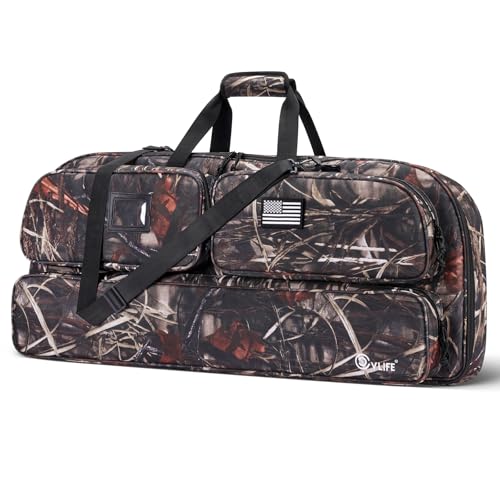 CVLIFE 37" Soft Compound Bow Case | Multiple-Layer Armor: Layered with shock-absorbing pearl cotton and… Smart Arrow Storage: Two large front pockets hold… Modular Storage Compartment: The main compartment of this… | Check price |
As an Amazon Associate we earn from qualifying purchases at no extra cost to you.
A soft case is lighter and often easier to carry or fit in a closet. Padding can protect against scratches and small knocks, but it cannot be treated as a substitute for a rigid shell when heavy items may be stacked on top. Check whether the padding covers the full length of the bow and whether the zipper or seams sit where they could press against protruding accessories.
Compare the numbers before choosing
The figures below are practical screening targets, not specifications for a particular branded model. Actual capacity varies, so confirm the manufacturer’s current measurements and layout before ordering.
| Use case | Useful interior length | Arrow storage target | Protection target | Typical weight range |
|---|---|---|---|---|
| Compact compound bow | At least bow length plus 2 in | 12–24 arrows; verify arrow length | Rigid shell for vehicle or checked-bag travel | Soft: about 2–5 lb; hard: about 8–18 lb |
| Full-size compound bow | At least bow length plus 2–3 in | 12–24 arrows, preferably in a separate tube or secured channel | Dedicated bow restraint with clearance around cams and sight | Soft: about 3–6 lb; hard: about 10–22 lb |
| Recurve or longbow | At least the longest assembled piece plus 2 in | 6–24 arrows, depending on quiver or tube layout | Full-length padding; separate storage for limbs if takedown | Soft: about 2–5 lb; hard: about 7–18 lb |
Weight ranges are broad category estimates, not guarantees; extra wheels, thick walls, and accessory compartments add weight. For a compound bow, measure from the outermost limb or cam points with the bow in the configuration you plan to store. For a recurve, measure the assembled bow if it stays assembled, or the longest limb if it will be taken down.
How to confirm fit before buying
-
Measure the bow in its travel configuration. Include a mounted sight, rest, and other parts you intend to leave attached. If you remove them, make sure the case has a protected place for them.
-
Compare usable interior dimensions. Exterior dimensions do not account for shell thickness, molded contours, or interior trays. Allow roughly 2–3 inches of extra length and enough width and depth to avoid pressure on cams and accessories.
-
Check the full layout. Confirm that the bow, arrows, quiver, release aid, tools, and other gear each have a secure place. A long arrow compartment is useless if your arrows exceed its stated capacity.
-
Plan for movement. With the case closed, the bow should not slide or rattle. Use the supplied restraints as intended; do not fill gaps with loose heavy items that could shift into the limbs or sight.
Airline travel: treat “lockable” and “airline-ready” as different claims
A case with lockable latches is not automatically compliant with an airline’s baggage rules or approved for every journey. Before flying, check the carrier’s current rules for archery equipment, checked baggage, weight and size limits, and accepted locks. A rigid, lockable case with well-secured contents is generally the more appropriate choice for checked transport, but airline acceptance depends on the route and carrier.
Pack the bow so it cannot move, and keep small parts from rattling loose. Photograph the contents before closing the case, and avoid placing fragile accessories where the lid or an internal tray can press on them. Do not assume a case’s lock prevents inspection or guarantees damage-free handling.
Where the money is best spent
- Choose a soft case if you mainly carry the bow by hand, store it in a controlled space, and can keep heavy objects away from it. Put the savings toward full-length padding and solid straps rather than decorative pockets.
- Choose a hard case if the bow shares a vehicle with other equipment, gets transported often, or will be checked for a flight. Wheels can help with a heavy case, but they add parts that may wear or break.
- Choose a takedown case for a recurve that is routinely disassembled. Separate, padded compartments can reduce bulk and keep limbs from rubbing against the riser.
- Choose a larger case only when you need the capacity. Extra room for arrows and gear is useful if everything can be restrained; excess space without tie-downs makes shifting more likely.
Ownership details that are easy to overlook
Zippers, handles, wheels, latches, and interior hook-and-loop straps are common wear points. Keep zippers free of dirt, inspect seams and latch attachment points, and replace worn straps before they stop securing the bow. For a hard case, clean grit from the closure and check that the lid still seats evenly. For a soft case, let it dry fully before storage to limit odor and fabric deterioration.
A frequent mistake is storing a bow with pressure on its cams, limbs, or sight because the case technically closes. Another is carrying arrows loose beside the bow, where they can shift and scratch equipment. If a case only fits after forcefully compressing padding or removing a part you expected to leave attached, choose a different size or layout.
Bottom line
For the best balance of protection and practicality, match the case to the bow’s measured travel configuration and the roughest transport it will face. A hard case is the safer starting point for airline check-in and frequent vehicle hauling; a padded soft case makes more sense for lighter carrying and compact storage. In either category, secure fit and sensible interior organization matter more than a long list of pockets.