The best bounce houses for most backyards are compact commercial-style inflatables with a fully enclosed jumping area, safety netting, a continuous-air blower, and a supplied anchoring kit; choose a larger obstacle-course model only if you have the clearance, storage space, and supervision it requires.
A bounce house is a deceptively practical purchase: the advertised footprint is only part of the decision. The usable play area, blower requirements, anchor layout, drying routine, and packed size determine whether the inflatable is safe and convenient after the novelty wears off.
Our top picks
 ACTION AIR
- Gift Idea: This bounce house is perfect for…
- Safe for Kids: The jumping area is surrounded…
- Extra Thick with Large Jumping Area: Durable Sewn…
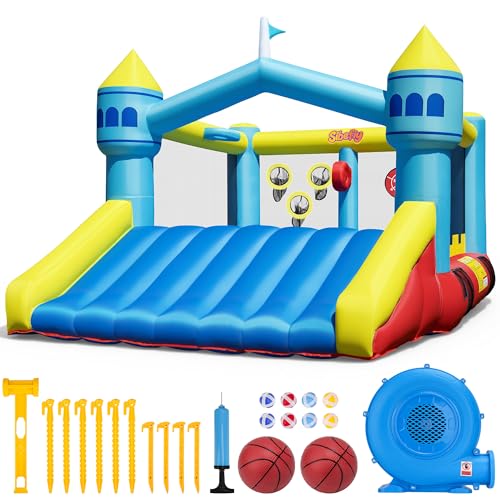 Sibefiy Bounce House
- 【6-In-1 Funy Activity Center】 Sibefiy Inflatable Bounce House…
- 【A Gift Loved All Year Long】The vibrant castle…
- 【Super Stable Structure】Designed by top aerodynamic engineers, this…
 Hongcoral Bounce House
- 【Rich Gameplay】The kids bounce house combines plenty of…
- 【Ideal Kid's Gift for All Seasons】A great gift…
- 【Durable Materials & Strong Structure】Our bouncy house with…
| Product | Key specs | |
|---|---|---|
| ACTION AIR | Gift Idea: This bounce house is perfect for… Safe for Kids: The jumping area is surrounded… Extra Thick with Large Jumping Area: Durable Sewn… | Check price |
| Sibefiy Bounce House | 【6-In-1 Funy Activity Center】 Sibefiy Inflatable Bounce House… 【A Gift Loved All Year Long】The vibrant castle… 【Super Stable Structure】Designed by top aerodynamic engineers, this… | Check price |
| Hongcoral Bounce House | 【Rich Gameplay】The kids bounce house combines plenty of… 【Ideal Kid's Gift for All Seasons】A great gift… 【Durable Materials & Strong Structure】Our bouncy house with… | Check price |
 Baralir Inflatable Bounce House with 8.98 * | Spacious Design for Nonstop Fun All-in-One Activity Center Durable & Safety-Focused Design | Check price |
As an Amazon Associate we earn from qualifying purchases at no extra cost to you.
Best bounce houses by backyard situation
| Best for | Recommended type | Typical inflated size | Typical usable area | Typical limits | Setup time |
|---|---|---|---|---|---|
| Small yard or occasional use | Compact enclosed bouncer | 10 × 10 × 8 ft | About 65–80 sq. ft. | 2 children; 300–350 lb combined | 3–6 minutes |
| Two or three children | 12 × 12 ft bouncer with slide | 12 × 12 × 9 ft | About 90–110 sq. ft. | 3 children; 350–500 lb combined | 4–7 minutes |
| Frequent family use | Commercial-style bounce house | 13 × 13 × 10 ft | About 110–130 sq. ft. | 4 children; 400–600 lb combined | 5–8 minutes |
| Mixed activities and parties | Bouncer with slide or obstacle course | 15 × 15 to 20 × 15 × 10–12 ft | About 150–220 sq. ft. | 4–6 children; model-specific | 6–10 minutes |
These are useful planning ranges, not substitutes for the individual manufacturer’s manual. Interior jumping space is smaller than the outside footprint because of inflatable walls, climbing lanes, slides, and entrance ramps.
Our practical picks
Best for a small yard: a compact enclosed bouncer
A 10-by-10-foot bouncer is the easiest choice when usable space is limited. It generally accommodates two similarly sized children at once and requires less fabric, less storage room, and less blower capacity than a slide combination. Look for mesh walls on all sides, a covered entrance ramp, a low step-up height, and a repair patch kit.
The main compromise is that compact inflatables have little room for children moving in different directions. They are better for short, supervised play sessions than for large birthday parties. Check the combined weight limit rather than assuming that a stated child count means any combination of ages is acceptable.
Best all-around option: a 12-by-12-foot bouncer with slide
This size is usually the best balance for a family with a moderate yard. It gives children a defined jumping area while adding a slide that helps prevent the bouncer from becoming congested. Many examples in this category use heavy-duty PVC-coated fabric, an approximately 680–950-watt blower, and four or more ground stakes.
Choose a model with separate slide walls, a climbing handhold, and a landing area that is not directly in the path of the jumping zone. A slide is useful, but it also adds wear: the slide entrance, climbing steps, and landing seam commonly receive more abrasion than the main floor.
Best for frequent use: a commercial-style bounce house
If the inflatable will be used weekly, a commercial-style design is worth considering. It typically has heavier fabric, reinforced stress points, stronger mesh, and replaceable components. The packed unit may weigh 100–150 pounds or more, however, so moving it often requires two adults and a storage location near the setup area.
Commercial-style does not mean unattended. These units still require an appropriate blower, proper anchoring, active supervision, and complete drying before storage. They are a better durability choice, not a substitute for safety procedures.
Best for parties: a bounce-and-slide or obstacle-course model
Combination inflatables offer the greatest play variety but demand the most from the yard. A 15-by-15-foot unit can require more than 300 square feet of clear working space after adding access paths and a safety margin. Obstacle courses also need a supervisor who can see the full route, because children may enter from opposite ends.
For mixed-age groups, choose an inflatable with separate lanes or activity zones. Do not rely on the headline capacity: a unit rated for six children may assume children within a narrow age and size range, not six larger children playing simultaneously.
What to compare before buying
Usable play area and age limits
Measure the internal jumping floor, not just the external dimensions. A 12-by-12-foot unit may have roughly 90 square feet of open jumping surface after walls and fixtures are excluded. Divide that area between children, keeping younger and older children in separate sessions when the manufacturer recommends it.
Age limits are not interchangeable with weight limits. A toddler-oriented inflatable may have a lower maximum height or a smaller slide even when its combined weight allowance appears generous. Follow the strictest applicable limit: age, height, individual weight, combined weight, or capacity.
Blower performance
Most backyard bounce houses use a continuous-air blower rather than an air-tight chamber. The blower must remain connected and running during play. A loose zipper, open deflation tube, damaged seam, or undersized blower can make the floor soft and the walls less stable.
Compare the included blower’s wattage, airflow rating if provided, electrical-cord length, and whether it uses a standard household outlet. A blower in the roughly 680-to-950-watt range is common for medium backyard units, but wattage alone does not prove performance. The model’s supplied blower is generally the safest match; replacing it with a different blower can create an underinflation or overpressure problem.
Anchoring
Anchoring is a core safety feature, not an accessory. A typical backyard unit uses four to six heavy-duty stakes through reinforced anchor points. On grass, drive stakes fully into the ground at the manufacturer’s angle and leave no exposed loop or sharp edge where children can fall.
Do not use ordinary tent pegs as a substitute. Do not set the inflatable on concrete, asphalt, or a hard patio unless the manufacturer supplies an approved ballast system and instructions for that surface. Never use water barrels, loose paving slabs, or improvised weights without written guidance from the manufacturer.
Safety construction
- Look for netting that encloses the jumping area rather than stopping at waist height.
- Prefer an entrance ramp with side walls and a landing zone.
- Check that slide exits have adequate padding and do not end against a fence, tree, or wall.
- Choose reinforced seams at the floor, entrance, slide, and anchor points.
- Confirm that the manual specifies a maximum wind speed and a shutdown procedure.
- Use a ground tarp underneath to reduce abrasion and keep the base cleaner.
Setup that prevents common problems
- Measure first. Add at least 2 feet of clearance around every side, and allow additional room at the entrance and slide exit. Keep overhead branches and electrical lines well away.
- Inspect the surface. Remove stones, sticks, pet waste, and sharp debris. Grass is usually preferable to hard surfaces for a backyard setup.
- Spread the fabric before inflating. Position the blower tube, anchor points, entrance, and slide before the unit becomes difficult to move.
- Connect the blower and close every unused air tube. Inflate until the floor is firm and the walls hold their intended shape. Do not block the blower intake.
- Anchor all points. Recheck stakes after inflation because the fabric can shift as it becomes taut.
- Establish rules before play. Remove shoes, glasses, food, and hard toys; keep children of substantially different sizes in separate turns; and stop play if the blower loses power.
Allow about five minutes for inflation, but plan 15–25 minutes for a careful setup, inspection, and anchoring. The extra time is spent positioning and checking the unit, not waiting for air.
Storage and ownership costs
Drying is the most important long-term maintenance task. After cleaning, inflate the unit until every seam and fold is dry. Moisture trapped in a folded inflatable can create mildew odors, discoloration, and fabric damage. If the unit becomes wet during use, allow several hours of drying time before packing; a sunny, breezy day helps, but do not leave it unattended outdoors.
Expect the entrance ramp, slide lane, floor seams, blower tube, and anchor straps to wear first. Keep children from dragging the unit, and never pull it by mesh walls or an air tube. Small punctures can often be addressed with the supplied repair material, but a damaged seam, anchor point, or structural wall deserves manufacturer-approved repair rather than adhesive tape.
A medium inflatable commonly weighs about 50–100 pounds, while heavier commercial-style units may exceed 120 pounds. Measure the storage shelf, garage doorway, and route to the yard before buying. A unit that fits the play area but cannot be carried safely or stored dry is a poor practical choice.
Final buying checklist
- Does the interior play area fit the children who will actually use it?
- Are the age, height, individual-weight, and combined-weight limits clear?
- Does the inflated footprint leave room for anchoring and entry access?
- Is the included blower correctly matched and suitable for your outlet?
- Are anchor points reinforced, with appropriate stakes or approved ballast?
- Can two adults move and fully dry the packed unit?
- Does the manufacturer provide a manual, repair guidance, and replacement-part support?
For most families, the best bounce houses are not the largest models. A properly anchored 10-by-10-foot bouncer is the sensible small-yard choice, a 12-by-12-foot bouncer with a slide is the strongest all-around option, and a commercial-style obstacle course makes sense only when frequent use, available space, and storage capacity justify its extra size and upkeep.