
The best coffee grinder machine for most home brewers in 2026 is a burr grinder with at least 40 grind settings, a 200–300 g hopper, and low static retention—because grind consistency matters more to cup quality than any other variable, including the beans themselves. Whether you need a $100 entry-level burr or a $500 prosumer flat-burr depends on your brew method, and this guide maps each scenario to the right choice.
Our top picks
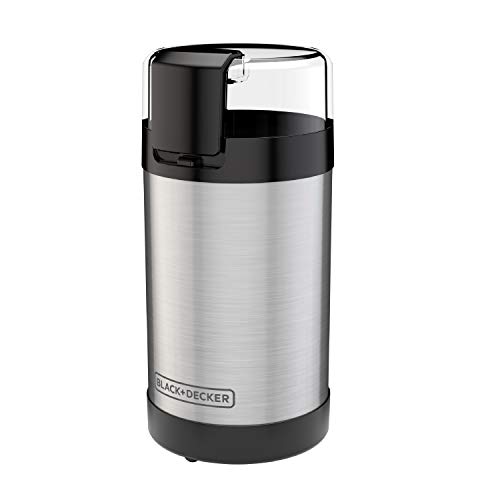 BLACK+DECKER One Touch Coffee Grinder
- The sharp blades and durable grinding bowl are…
- GRIND YOUR FAVORITES! - Stainless steel blades quickly…
- Intuitive push-button control lets you easily customize the…
 Hamilton Beach Fresh Grind Electric Coffee Grinder
- Hideaway cord storage under the base keeps cable…
- DISHWASHER SAFE GRINDING BOWL: The grinding bowl on…
- If you love the rich taste of coffee…
 Amazon Basics Fast Electric Coffee Grinder for
- Electric coffee bean grinder appliance for home use
- Can grind 30 grams/1 ounce of beans for…
- Grind coffee beans, herbs, spices, grains, nuts, and…
| Product | Key specs | |
|---|---|---|
| BLACK+DECKER One Touch Coffee Grinder | The sharp blades and durable grinding bowl are… GRIND YOUR FAVORITES! - Stainless steel blades quickly… Intuitive push-button control lets you easily customize the… | Check price |
| Hamilton Beach Fresh Grind Electric Coffee Grinder | Hideaway cord storage under the base keeps cable… DISHWASHER SAFE GRINDING BOWL: The grinding bowl on… If you love the rich taste of coffee… | Check price |
| Amazon Basics Fast Electric Coffee Grinder for | Electric coffee bean grinder appliance for home use Can grind 30 grams/1 ounce of beans for… Grind coffee beans, herbs, spices, grains, nuts, and… | Check price |
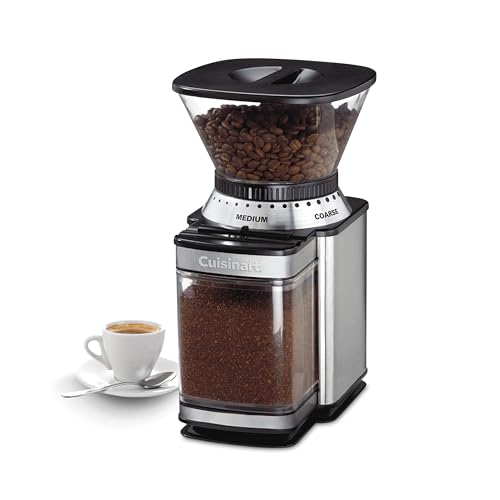 Cuisinart Electric Burr Coffee Grinder | The Cuisinart Coffee Grinder with 18-position slide-dial grind… The 8 oz The burr grinder features a removable grind chamber… | Check price |
As an Amazon Associate we earn from qualifying purchases at no extra cost to you.
Burr vs. Blade: The One Decision That Matters Most
Blade grinders chop beans with a spinning propeller, producing a random mix of dust and boulders. That inconsistency means some particles over-extract (bitter) while others under-extract (sour) in the same cup. Burr grinders crush beans between two abrasive surfaces set a precise distance apart, yielding uniform particles and repeatable results.
Within burr grinders there are two sub-types. Conical burrs (found in most home machines) run cooler, are quieter, and waste fewer grounds. Flat burrs (common in prosumer espresso machines) produce a slightly more uniform grind preferred for espresso, at higher cost and heat. Blade grinders have exactly one legitimate use: spices. Do not buy one for coffee, regardless of price.
Comparison: Representative Grinder Types at a Glance
| Type | Example | Burr | Settings | Hopper | Retention | Typical Price | Best For |
|---|---|---|---|---|---|---|---|
| Entry conical burr | Baratza Encore | 40 mm conical steel | 40 steps | ~227 g | ~0.5–1 g | $100–150 | Drip, pour-over, French press |
| Mid-range all-rounder | Fellow Ode Gen 2 | 64 mm flat steel | 31 steps | ~100 g (single dose) | <0.3 g | $300–400 | Filter/pour-over specialists |
| Espresso-focused | Eureka Mignon | 50 mm flat steel | Stepless (infinite) | ~250 g | ~1 g | $350–500 | Espresso dialing-in |
| Smart/timed dosing | Breville Smart Grinder Pro | Conical steel | 60 steps | ~450 g | ~1–2 g | $200 | Mixed methods, larger households |
| Manual | Timemore Chestnut | 38 mm conical steel | ~36 clicks | ~25 g | Near zero | $60–120 | Travel, single cups, quiet kitchens |
| Blade (for reference) | Generic blade mill | None | 1 (timer only) | ~80 g | Low | $20–35 | Not recommended for coffee |
Match the Grinder to Your Brewing Method
Espresso
Espresso punishes inconsistency because extraction happens in ~30 seconds under pressure. You need a stepless or micro-stepped adjustment (the Eureka Mignon, Niche-style single dosers, or similar) so you can fine-tune by fractions of a millimeter. Stepped grinders often jump from “too fast” to “choked” with no landing point between.
Pour-Over and Drip
A 40-step conical burr like the Encore class covers medium-coarse to medium-fine comfortably. Prioritize low fines production—flat burr single dosers like the Ode class shine here because cleaner particles mean less sludge and clearer flavor separation.
French Press and Cold Brew
Coarse grinding is forgiving; almost any burr grinder handles it. Spend less and put savings toward beans. Avoid blade grinders even here—the dust clogs press screens and muddies the cup.
Moka Pot and AeroPress
These sit between filter and espresso fineness. A stepped grinder with 40+ settings works if it has fine enough resolution in the middle range—check that settings 10–20 (not just the extremes) are usable.
Decision Matrix: Which Should You Buy?
| Your Situation | Recommended Type | Budget |
|---|---|---|
| First grinder, mostly drip/press | Entry conical burr (Encore class) | $100–150 |
| Daily espresso, plan to keep 5+ years | Stepless flat burr (Mignon class) | $350–500 |
| Single-doser chasing filter clarity | 64 mm flat burr (Ode class) | $300–400 |
| Household of 3+, multiple methods | Large-hopper timed grinder (Breville class) | $180–250 |
| Travel, small kitchen, or under $100 | Manual conical burr | $60–120 |
| Just want it cheap | Manual burr, not blade | $60+ |
Spec Details That Actually Affect Daily Use
- Retention: Every grinder traps grounds inside. 1 g of retention means yesterday’s stale coffee enters today’s dose. Single-dose grinders (bellows, blow-out hoppers) get under 0.3 g; big-hopper machines may hold 2–3 g. For a 20 g espresso dose, 1 g retention is 5% stale coffee.
- Hopper capacity vs. freshness: A 450 g hopper sounds convenient, but beans stale in 2–3 weeks. If you brew 40 g/day, a 450 g hopper holds 11 days of beans—fine. If you brew 15 g/day, that hopper holds a month of staling beans; buy a smaller hopper or single-dose workflow instead.
- Adjustment mechanism: Stepped = repeatable clicks, easy to switch between methods. Stepless = infinite adjustment, essential for espresso, annoying if you switch methods often (no reference points).
- Static and mess: Cheaper grinders build static that sprays chaff. Some newer models add ionizers or bellows; a spritz of water on beans (Ross Droplet Technique) also works on any grinder.
- Noise and speed: Most conical home grinders run 80–90 dB for 15–25 seconds per dose. Manual grinders are near-silent—relevant if the household sleeps in.
Ownership Reality: What Wears, What’s Consumable
Steel burrs on a home grinder last roughly 400–750 kg of coffee—at 40 g/day, that’s 25–50 years, so burrs effectively never wear out for home use. What actually fails first: cheap plastic grind-adjustment collars, stripped timer switches, and gearboxes in sub-$100 electrics. Brands like Baratza sell replacement parts for nearly every component, which is why a repairable $140 grinder often outlives a disposable $80 one. That works out to roughly $0.02–0.05 per cup over five years—grinder cost is noise compared to bean spend.
Common mistakes buyers make:
- Never cleaning it. Oils coat burrs and turn rancid within months, adding bitterness. Run grinder cleaning pellets monthly and brush out the chamber weekly.
- Grinding flavored or oily dark roasts. Sticky oils gum up the burr chamber and auger. If you drink dark roasts, clean bi-weekly.
- Rice as cleaner. It can crack burrs and void warranties—this is the most persistent bad advice in coffee.
- Storing beans in the hopper. Hoppers aren’t airtight; dose from a sealed container instead.
FAQ
Is a $150 grinder worth it over a $30 blade grinder?
Yes—it’s the highest-impact upgrade in home brewing. The difference between blade and burr output is larger than the difference between a $15 and $40 bag of beans.
Do I need a separate grinder for espresso?
Practically, yes. A grinder stepped for filter use rarely has fine enough adjustment for espresso. Some models (Encore ESP, Smart Grinder Pro) attempt both and do so acceptably at the budget end.
How often should I clean my grinder?
Brush the burr chamber weekly, run cleaning pellets monthly, and deep-clean (disassemble, vacuum, wipe) every 2–3 months—or monthly if you use oily beans.





