
Key takeaways
- Choose 50mm f/1.8 if you want one affordable, light prime for portraits and general use.
- Choose 85mm f/1.8 if headshots and outdoor portraits dominate and you have room to step back.
- Choose 35mm f/1.8 or f/1.4 if you photograph people in small spaces or want more of the setting in frame.
- Choose a fast APS-C portrait lens such as 56mm f/1.2 if subject isolation is a priority and the extra weight is acceptable.
- Choose a close-focusing portrait lens if you also photograph small details; compare magnification as well as minimum focus distance.
Best Fast Prime Lenses for Portraits: Picks by Camera and Shooting Style
The best fast prime lenses for portrait photography are a 50mm f/1.8 for affordable everyday portraits, an 85mm f/1.8 for flattering head-and-shoulders shots, and a 35mm f/1.4 or f/1.8 when you need environmental portraits or work in tight spaces. Before choosing, check your camera mount and sensor size: a lens’s field of view changes on APS-C cameras, and many full-frame lenses are larger than you need for a compact body.
Quick comparison
Approximate weights below are for the listed lens versions, without caps or hoods. Dimensions and autofocus features can vary slightly by mount. Price bands are broad new-market estimates, not live quotes.
Our top picks



As an Amazon Associate we earn from qualifying purchases at no extra cost to you.
| Lens | Mount and coverage | Maximum aperture | Weight | Minimum focus | Best fit |
|---|---|---|---|---|---|
| Canon RF 50mm F1.8 STM | Canon RF, full frame | f/1.8 | 160 g | 30 cm | Lightweight, low-cost everyday portraits |
| Nikon NIKKOR Z 50mm f/1.8 S | Nikon Z, full frame | f/1.8 | 415 g | 40 cm | Sharp standard prime with quiet autofocus |
| Sony FE 85mm F1.8 | Sony E, full frame | f/1.8 | 371 g | 80 cm | Headshots and outdoor portraits |
| Sony FE 50mm F1.8 | Sony E, full frame | f/1.8 | 186 g | 45 cm | Small, budget-friendly standard prime |
| Fujifilm XF 56mm F1.2 R WR | Fujifilm X, APS-C | f/1.2 | 445 g | 50 cm | Shallow-depth-of-field portraits on X bodies |
| Canon RF 85mm F2 Macro IS STM | Canon RF, full frame | f/2 | 500 g | 35 cm | Portraits plus close-up detail work |
These are representative options, not direct equivalents: 56mm on Fujifilm APS-C frames more like an 84mm lens on full frame. For other camera systems, look for the same focal-length role in a native lens or a compatible third-party version. Confirm the exact mount before buying; Canon RF, Nikon Z, Sony E, and Fujifilm X lenses are not interchangeable.
Choose by the portrait you make most
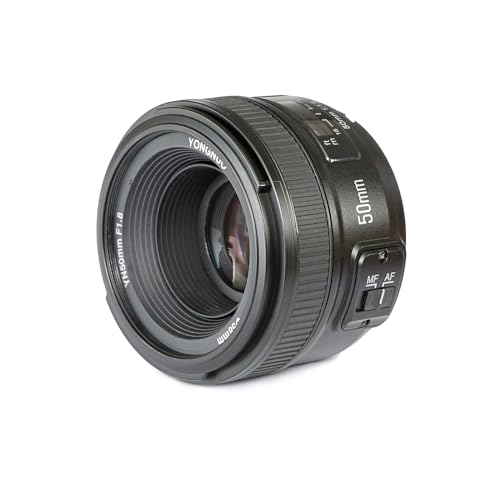
For a first portrait prime: 50mm f/1.8
A 50mm lens is a practical starting point because it can handle head-and-shoulders portraits, half-body images, and casual indoor photography. The Canon RF 50mm F1.8 STM is especially easy to carry at 160 g. The Nikon Z 50mm f/1.8 S is heavier, but offers a more substantial build and is designed for Nikon’s full-frame Z system. On APS-C, a 50mm lens gives a tighter view—roughly like a 75mm lens on full frame for many cameras—so it may feel more like a portrait lens than a general-purpose one.
At f/1.8, these lenses can separate a subject from a background, but aperture alone doesn’t determine blur. Subject distance, background distance, framing, and focal length all matter. For group portraits, stop down enough to keep people on different focus planes sharp rather than automatically shooting wide open.
For classic headshots: 85mm f/1.8
An 85mm prime gives you more working distance than a 50mm and a narrower view that helps simplify busy backgrounds. The Sony FE 85mm F1.8 is a relatively light full-frame option at 371 g, with a close-focus limit of 80 cm. That minimum distance is fine for faces and upper-body portraits, but it prevents very tight detail shots.
Longer working distance is useful outdoors and can feel comfortable for subjects who dislike having a camera close to their face. It is less convenient in small rooms: you may have to step back against a wall or settle for a tighter crop. On APS-C, an 85mm lens frames like roughly 125–130mm on full frame, which can be too tight indoors.
For environmental portraits and small rooms: 35mm
A 35mm f/1.4 or f/1.8 is the better choice when the location is part of the story—a workshop, campsite, studio, or crowded home. You can include context without backing up as far as an 85mm requires. The trade-off is perspective: move very close to fill the frame with a face and features nearest the camera can look exaggerated. Keep some distance and use a waist-up or wider composition when natural-looking proportions matter.
For a smaller, less expensive kit, a 35mm f/1.8 is usually the sensible starting point. Choose f/1.4 when shooting in dim light or when you specifically want the shallower depth of field and can accept more size, weight, and cost. Check the exact camera mount and whether the lens is intended for full-frame or crop-sensor coverage.
For pronounced background blur on Fujifilm X: XF 56mm F1.2 R WR
The Fujifilm XF 56mm F1.2 R WR combines a portrait-friendly angle of view on APS-C with a very wide maximum aperture. It is a compelling option for subject isolation, especially when you can focus carefully on the nearest eye. At 445 g, it is not a tiny lens, and f/1.2 leaves little depth of field at close portrait distances. The WR designation indicates weather-resistant construction, not permission to ignore dust, water, or the camera manufacturer’s care guidance.
When close focus matters more than maximum aperture
A portrait prime’s minimum focus distance determines how close you can get while still focusing; it is not the same as maximum magnification. For example, the Canon RF 85mm F2 Macro IS STM focuses down to 35 cm and offers 0.5x maximum magnification, making it much more versatile for details such as rings, fabric, or small gear than a conventional 85mm portrait lens. Its f/2 aperture is slower than f/1.8 or f/1.2, but close-focus ability and image stabilization can be more valuable for mixed portrait and detail work.
Close-focus numbers are measured from the camera’s sensor plane, not from the front of the lens. At close range, depth of field becomes extremely thin, so stop down when you need both eyes or a small object to remain sharp. Image stabilization can reduce blur from your own movement, but it cannot freeze a moving subject.
Autofocus, bokeh, and ownership trade-offs
For portraits, reliable eye detection and consistent focus are often more useful than a fractionally wider aperture. Check that the lens supports the autofocus features of your camera body, and look for quiet focusing if you also record video. Older or budget primes may focus more audibly or hunt more in low light; performance also depends on the camera body and firmware, so check compatibility notes for your specific pairing.
Bokeh is not a simple ranking by aperture. The shape and smoothness of out-of-focus highlights depend on optical design, aperture-blade shape, focus distance, and what is behind the subject. A bright background with many small lights may reveal outlining or cat-eye shapes that are less obvious in a softly lit, uncluttered setting. If bokeh matters, compare sample images made at similar framing and subject distance, not just the f-number.
In everyday use, the front element and mount are more likely to need routine attention than the optics inside a well-kept lens. Use a cap when the lens is stored, remove grit with a blower before wiping, and use a clean microfiber cloth for smudges. Don’t wipe dust across the glass, and don’t assume a weather-resistant lens is waterproof. A lens hood helps protect the front of the lens from bumps and stray light. Also budget for the right hood or filter size if you use filters; sizes differ even between lenses with the same focal length.
Make the choice fit your camera and space
- Choose 50mm f/1.8 if you want one affordable, light prime for portraits and general use.
- Choose 85mm f/1.8 if headshots and outdoor portraits dominate and you have room to step back.
- Choose 35mm f/1.8 or f/1.4 if you photograph people in small spaces or want more of the setting in frame.
- Choose a fast APS-C portrait lens such as 56mm f/1.2 if subject isolation is a priority and the extra weight is acceptable.
- Choose a close-focusing portrait lens if you also photograph small details; compare magnification as well as minimum focus distance.
Before ordering, verify the lens mount, sensor coverage, autofocus compatibility, and weight on the manufacturer’s specifications page. New-market pricing varies by region and promotions: basic f/1.8 primes are commonly in the lower hundreds of dollars, while premium f/1.2 lenses and specialized macro-capable options can cost several hundred dollars more.





