
Our Top Picks


The best propane gas forge for blacksmithing overall is the VEVOR Portable Propane Forge, Double Burner. Two burners, a 2600°F ceiling, and a chamber sized for knives, tongs, and small-to-mid stock make it the most versatile starting point for a home shop that does a bit of everything without paying premium-tier money. If your budget is tight and your work is small — blades, hooks, bottle openers, fire strikers — the Nelyrho 1 Burner Propane Blacksmith Forge Kit gets you forging for the least money and the least propane per session. If you run longer stock, batch out several pieces per session, or work in a cold or drafty shop, the Nelyrho 3-Burner Propane Forge Kit with Double Doors is the premium pick that still fits on a garage bench. And if you already own a forge body but the burner is dead, the LSMIITTH burner-only options cover that fourth case. This guide compares chamber size, burner layout, heat-up behavior, insulation class, and fuel requirements so you can match the forge to the work you actually do.
Top 3 Picks
Best Overall: VEVOR Portable Propane Forge, Double Burner
The two-burner VEVOR hits the sweet spot between chamber size and fuel burn. It is big enough to heat a knife blank, a pair of tongs, or a set of hinges, and small enough that a 20 lb propane tank can feed it without vaporization problems. Its 2600°F rating covers normal forging heats with headroom for occasional forge welding.
Best Budget: Nelyrho 1 Burner Propane Blacksmith Forge Kit
One burner, a compact chamber, and a kit that includes the hose and regulator. It heats a small hot zone quickly, sips propane, and takes up almost no bench space. If you are testing whether blacksmithing is for you, or your work never exceeds a knife blade or a hook, this is the cheapest sensible entry point.
Best Premium: Nelyrho 3-Burner Propane Forge Kit with Double Doors
Three burners, double doors, and a long chamber. The doors close to trap heat and swing open for long stock, which means faster recovery between heats and less fuel spent reheating a cold chamber. This is the pick for shops running longer workpieces or several pieces back to back.
Quick Comparison
| Product | Best for | Key specs | Price tier |
|---|---|---|---|
| VEVOR Portable Propane Forge, Double Burner | All-around home knife and tool making | 2 burners; 2600°F rated max; two-burner class chamber, roughly 16–20 in hot zone; open portable body; 20 lb tank friendly | Mid-range |
| Caifus 2 Burner Propane Forge with Double Doors | Heat retention and fast reheats | 2 burners; double doors; gas ball valve plus regulator and hose hardware; 2600°F class lining; closed-body design | Premium |
| ATkrou 2 Burner Propane Blacksmith Forge Kit, 2600°F | Beginners who want a complete kit | 2 burners; 2600°F rated max; two-burner class chamber; kit form with hose, regulator and starter accessories | Mid-range |
| Nelyrho 3-Burner Propane Forge Kit with Double Doors | Long stock and batch work | 3 burners; double doors; 2600°F max; three-burner class chamber, roughly 20–26 in hot zone | Premium |
| Nelyrho 2 Burner Propane Blacksmith Forge Kit | Small shops and everyday bladesmithing | 2 burners; kit form with hose and regulator; two-burner class chamber, roughly 14–20 in hot zone | Mid-range |
| Nelyrho 1 Burner Propane Blacksmith Forge Kit | Budget entry point and small work | 1 burner; kit form with hose and regulator; single-burner class chamber, roughly 8–12 in hot zone | Budget |
| Nelyrho 4 Burner Propane Forge Kit | Large chambers and production volume | 4 burners; kit form; large four-burner class chamber, roughly 26–36 in hot zone; needs a big tank | Premium |
| VEVOR 6KG Propane Melting Furnace Kit | Melting and casting metal | Crucible furnace design; 6 kg metal capacity class; crucible included; 2600°F class refractory; not a horizontal forge | Mid-range |
| LSMIITTH Propane Forge Burner with Regulator | Replacing a worn burner | Single burner assembly; regulator included; venturi style; fits most hobby forge bodies | Budget |
| ATkrou 4 Burner Propane Blacksmith Forge Kit, 2600°F | High-volume and long workpieces | 4 burners; 2600°F rated max; four-burner class chamber; kit form with hose and regulator | Premium |
| LSMIITTH Propane Gas Forge Furnace Burner, Cast-Iron Head | DIY forge builds | Single burner; high-pressure cast-iron burner head; flame control valve; no body or lining | Budget |
| LSMIITTH Tripple Gas Forge Burners with Regulator | Multi-burner custom builds | 3 matched burners; regulator included; designed for custom forge bodies and foundry shells | Budget |
How We Chose
These picks were assembled by comparing published specifications and category-standard behavior, not by running the equipment. The first filter was geometry: burner count, chamber length class, and bore diameter, because chamber size determines what you can actually heat. A forge that cannot swallow your longest workpiece is useless no matter how well it is built. The second filter was thermal design: insulation class, whether the body is open or closed with doors, and how those choices affect heat-up time, recovery between heats, and propane burn per hour.
The third filter was fuel and infrastructure fit. Multi-burner forges demand more propane per hour than a 20 lb tank can reliably vaporize in cold weather, so burner count has a real cost beyond the purchase price. The fourth was kit completeness and upgrade path: does the package include the regulator, hose, and valve hardware, and can you add a burner, re-line the chamber, or move up to a larger tank later? Finally, each product was matched to a specific reader situation — budget, experience level, shop space, and how often you forge — rather than ranked on a single scale. Prices shift constantly, so tiers are given instead of figures.
1. VEVOR Portable Propane Forge, Double Burner – Best for All-Around Knife and Tool Making
As an Amazon Associate we earn from qualifying purchases at no extra cost to you.

This is the forge to buy when you do not yet know what you will be making. Two burners in a portable body give you a chamber long enough for knife blanks, tongs, drifts, chisels, and most household hardware, while staying small enough that a standard 20 lb propane tank keeps up with it. The listing rates the forge at 2600°F, which is above the normal forging range for carbon and mild steel and leaves room for occasional forge welding if you learn to control the atmosphere.
The double-burner layout matters more than the raw burner count suggests. Two flames spaced along the chamber even out the hot zone, so a knife blank heats along its length instead of developing a bright spot at one end. That evenness is what lets you move a piece from the fire to the anvil and work the whole blade before it drops below forging temperature. On a single-burner forge of similar chamber size, you spend more time rotating the workpiece and more time walking back to the fire.
Key Specs
- Burners: two, venturi style, adjustable pressure
- Rated maximum temperature: 2600°F as stated by the listing
- Chamber class: two-burner class, typically around 16–20 in of usable hot zone with a 4–5 in bore
- Body: portable open-front design intended to be moved between bench and driveway
- Lining: ceramic fiber blanket with a refractory coating, standard for this class
- Fuel: standard propane with an adjustable regulator; a 20 lb tank is a realistic match
- Best workpiece range: knife blanks up to roughly 12 in, tongs, punches, small hardware
Heat-up is where a two-burner forge earns its keep. A well-insulated chamber of this size typically reaches a dull orange working heat in the range of five to ten minutes from cold, and the burner pressure can then be backed off substantially for the rest of the session. That backing-off is the single biggest fuel saver in forge operation: running both burners flat out the whole time wastes propane, oxidizes your steel, and shortens lining life. Most smiths find a comfortable middle pressure where the chamber holds heat and the workpiece comes up to temperature at a predictable rate.
Portability is the other reason this model sits at the top. Because the body is designed to be carried, it works for renters, people who share a garage with a car, and anyone who forges in a driveway and stores the equipment indoors. The trade-off is that an open body loses heat faster than a closed one with doors, and it will not hold temperature in a cold wind the way a door-equipped forge does.
Pros
- Two-burner chamber handles the widest range of common projects for the money
- Even heat along the length of a blade reduces trips back to the fire
- Portable body suits small shops, shared garages, and driveway work
- Runs comfortably on a standard 20 lb propane tank
- 2600°F rating covers forging heats and light forge welding
Cons
- Open body loses heat faster than a double-door design, especially in wind
- No doors means longer recovery time when you pull a piece out
- Two burners burn roughly twice the propane of a single-burner forge at full pressure
- Large stock and long bars will not fit; you need a three- or four-burner chamber for those
How it compares: Against the Nelyrho 2 Burner Propane Blacksmith Forge Kit, the VEVOR trades a slightly different accessory bundle and a more portable body for the same basic two-burner capability. Against the Caifus 2 Burner with Double Doors, the VEVOR gives up heat retention and cold-weather performance in exchange for a lower price tier and easier storage. If you forge in a sheltered spot and mostly work on blades, the VEVOR is the better fit; if your shop is cold or drafty, step up to the door-equipped Caifus.
2. Caifus 2 Burner Propane Forge with Double Doors – Best for Heat Retention and Fast Reheats

The Caifus kit is built around the problem that open-body forges have: heat escaping the moment you open the front. Double doors let you close the chamber during heat-up so the lining comes up to temperature faster and stays there, then open one or both sides to pass long stock through or to reach in with tongs. The listing also indicates a gas ball valve and regulator hardware, which gives you positive shutoff at the forge rather than relying on the tank valve alone.
This is a premium-tier pick, and the extra money goes into the body and the hardware rather than burner count. Two burners is the right number for a chamber in this size class — a third burner would add fuel consumption without adding much usable hot zone. What you are paying for is the enclosed shell, the door hardware, and the more complete gas control package.
Key Specs
- Burners: two, with individual flame adjustment
- Doors: double doors, hinged, allowing long stock to pass through when open
- Gas control: ball valve plus regulator and hose hardware as described in the listing
- Chamber class: two-burner class, typically around 16–20 in of hot zone
- Lining: ceramic fiber with refractory coating, 2600°F class
- Fuel: propane; a 20 lb tank works, a 30–40 lb tank is a better long-term match
- Best workpiece range: knives, axes, tongs, tooling, and mid-length bar stock
Heat retention changes how you work, not just how much fuel you burn. With doors closed, the chamber stabilizes and the burner pressure can be turned well down; the lining acts as a thermal reservoir and returns heat to the workpiece between hammer blows. That means a blade spends less time in the fire and more time under the hammer, which is the real productivity gain. It also means less scale forms, because the steel is not sitting in an oxidizing blast for as long.
Doors introduce a maintenance item that open bodies do not have: hinges, latches, and the door lining. Those are the parts that wear first on any door-equipped forge. The door edges take the most thermal cycling, the refractory around the opening tends to crack over time, and the hinge hardware works loose with repeated heating and cooling. None of that is a dealbreaker — it is the normal ownership reality of a closed forge — but it is worth knowing before you buy.
Weight is the other consideration. An enclosed body with doors is heavier and bulkier than a portable open design, so this is a forge that gets a permanent spot on a steel bench rather than being carried in and out of a shed. Plan for a stand or a heat-resistant bench surface, and keep clearance around the doors.
Pros
- Closed chamber heats faster and holds temperature far better than an open body
- Double doors accommodate long stock while still allowing an enclosed fire
- Ball valve gives immediate, positive gas shutoff at the forge
- Less scale and oxidation because the workpiece spends less time in the fire
- Better performance in cold shops, garages, and breezy outdoor setups
Cons
- Premium tier pricing for the same burner count as mid-range two-burner kits
- Heavier and less portable than open-body forges
- Door hinges, latches, and door-edge refractory become the first wear points
- Overkill if you only ever make small blades and hooks
How it compares: Against the VEVOR Portable Propane Forge, Double Burner, the Caifus is the same burner count with a better thermal envelope and a more complete gas control package — you pay for efficiency and consistency rather than size. Against the Nelyrho 3-Burner with Double Doors, it gives up chamber length and one burner but keeps the door advantage in a smaller footprint that a 20 lb tank can still feed. Choose the Caifus if your priority is heat retention; choose the Nelyrho 3-burner if your priority is how much steel you can fit inside.
3. ATkrou 2 Burner Propane Blacksmith Forge Kit, 2600°F – Best for Beginners Who Want Everything in the Box

The ATkrou two-burner kit is aimed squarely at the person who has never lit a forge before. It arrives as a kit — forge body, burners, hose, regulator, and starter accessories — so there is no scavenging for fittings or guessing at the right regulator range. The 2600°F rating matches the rest of the class, and the two-burner chamber is the standard mid-size configuration that covers knives, tongs, and general hardware.
For a beginner, kit completeness matters more than any single specification. The most common failure in a first forge build is not the forge itself but the plumbing: the wrong hose, a regulator with the wrong range, a missing fitting, or a leak at a joint nobody thought to check. A kit removes most of those variables, and the two-burner format gives you enough chamber to grow into without immediately wanting to upgrade.
Key Specs
- Burners: two, adjustable, 2600°F class
- Kit contents: forge body, burners, hose, regulator, and starter accessories as supplied
- Chamber class: two-burner class, roughly 16–20 in hot zone, 4–5 in bore
- Lining: ceramic fiber blanket with refractory coating
- Fuel: standard propane; 20 lb tank suitable for hobby sessions
- Assembly: bolt-on burner and plumbing setup, no fabrication required
- Best workpiece range: knife blanks, chisels, punches, hooks, small hardware
Where this kit earns its place is the learning curve. A beginner’s first ten sessions are about reading the fire — learning what a proper forging heat looks like in dim light, how the steel moves when it is right, and how quickly it drops below temperature on the anvil. A two-burner chamber with a 2600°F ceiling gives you enough working time per heat to actually learn those lessons instead of fighting a fire that is too small or too hot to control.
Two burners also give you flexibility a single burner cannot. You can run one burner for small work to save propane, then light the second when you need a longer hot zone or faster recovery. That is a genuinely useful operating mode for a beginner whose projects vary in size week to week.
The honest limitation is that a mid-range kit is a mid-range kit. The lining will need re-coating sooner than a premium forge’s, the regulator is functional rather than precise, and the body will not hold heat in a cold wind the way a door-equipped model will. Those are acceptable trade-offs at this price tier, but they are real.
Pros
- Everything needed to start forging arrives in one purchase
- Two burners give a flexible chamber you can run on one or both
- 2600°F rating handles forging heats and light forge welding
- Simple bolt-together setup with no fabrication
- Good chamber size for a first shop without demanding a huge propane tank
Cons
- Included accessories are starter-grade; expect to replace the regulator or hose eventually
- Open-body heat retention is weaker than double-door designs
- No doors means slower recovery between heats
- Not enough chamber length for long bar stock or gate hardware
How it compares: Against the Nelyrho 2 Burner Propane Blacksmith Forge Kit, the ATkrou is the same configuration with a different accessory bundle — the choice between them usually comes down to which kit contents suit you better. Against the VEVOR Portable Propane Forge, Double Burner, the ATkrou leans harder into the beginner kit angle while the VEVOR leans into portability. If you already own a regulator and hose, the ATkrou’s kit advantage disappears and the VEVOR becomes the more natural pick.
4. Nelyrho 3-Burner Propane Forge Kit with Double Doors – Best for Long Stock and Batch Work
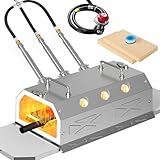
Three burners in a long chamber with double doors is the configuration that solves the two problems hobby forges run into: workpieces that are too long to fit, and recovery time between heats. The Nelyrho 3-burner kit is rated to 2600°F and comes as a complete package. With doors closed it behaves like a small furnace; with doors open it swallows bar stock that a two-burner forge simply cannot.
The third burner is not just about raw heat. In a chamber this long, three flames spaced along the body keep the hot zone even from end to end. With two burners in the same chamber you would get a hot center and cooler ends, which is exactly the wrong distribution for long stock — you would be constantly shuffling the workpiece to even out the heat. Three burners fix that geometry problem.
Key Specs
- Burners: three, individually adjustable
- Doors: double doors, hinged, for long stock and access
- Rated maximum temperature: 2600°F as stated by the listing
- Chamber class: three-burner class, typically around 20–26 in of hot zone
- Kit contents: forge body, burners, hose, regulator, and fittings
- Fuel: propane; a 20 lb tank works for short sessions but a 30–40 lb tank is the realistic match
- Best workpiece range: tongs, rails, gate hardware, long blades, batch runs of small pieces
Fuel demand is the part buyers underestimate. Three burners at working pressure draw roughly half again what two burners draw, and a 20 lb tank can only vaporize propane so fast, especially in cool weather. When demand outruns vaporization, the tank chills, pressure drops, and the burners fade — a frustrating problem that looks like a burner fault but is really a fuel supply issue. For a three-burner forge, plan on a larger tank or accept that long sessions in cold weather will need a tank swap or two.
What you get in return is throughput. Batch work — a run of ten hooks, a set of hinges, several blades in one session — becomes practical because the chamber stays hot between pieces. Instead of one heat-up per workpiece, you pay the heat-up cost once and then cycle pieces through. For anyone selling work or building a project with many identical parts, that is the difference between an evening’s work and a weekend’s.
Doors matter here too. With three burners and a long chamber, an open front would bleed heat fast. Closing the doors between pieces keeps the lining hot, so the next workpiece comes up to temperature in a fraction of the time a cold chamber would need.
Pros
- Long chamber accommodates workpieces two-burner forges cannot
- Three burners distribute heat evenly end to end
- Double doors preserve heat between pieces and give pass-through access
- Batch production becomes practical with minimal reheat time
- Complete kit with hose, regulator, and fittings included
Cons
- Highest fuel consumption in the roundup apart from the four-burner kits
- Effectively requires a 30–40 lb tank or larger for real sessions
- Large footprint; needs a dedicated bench or stand
- Door hardware and door-edge refractory are wear points
- More forge than a hobbyist making small blades needs
How it compares: Against the Caifus 2 Burner with Double Doors, this adds a burner and a longer chamber but increases fuel demand — Caifus wins on efficiency, Nelyrho 3-burner wins on capacity. Against the Nelyrho 2 Burner kit from the same brand, it is the direct upgrade: same design language, same kit approach, one more burner and a longer body. If you know you will be heating tongs, rails, or long stock, buy the three-burner now rather than upgrading later.
5. Nelyrho 2 Burner Propane Blacksmith Forge Kit – Best for Small Shops and Everyday Bladesmithing

The Nelyrho two-burner kit is the middle of the brand’s range and probably the most broadly useful configuration for a home bladesmith. Two burners in a mid-size chamber cover knife blanks comfortably, handle tongs and tooling, and still run on a 20 lb tank for a full evening session. It ships as a kit with hose and regulator, so the setup work is assembly rather than sourcing.
For bladesmithing specifically, a two-burner chamber is close to ideal. A blade blank of typical length fits entirely inside the hot zone, so you can heat the whole piece and work it in one pass. Longer chambers mean more burners, more fuel, and more heat you are not using when the workpiece is only ten inches long. Smaller chambers heat faster but force you to work in sections, which is slower and produces uneven results.
Key Specs
- Burners: two, individually adjustable
- Chamber class: two-burner class, typically around 14–20 in of hot zone
- Kit contents: forge body, two burners, hose, regulator, fittings
- Lining: ceramic fiber with refractory coating, 2600°F class
- Fuel: propane; 20 lb tank suitable for typical hobby sessions
- Assembly: straightforward bolt-together setup
- Best workpiece range: knife blanks, small tools, hooks, decorative ironwork
The practical question with any two-burner kit is whether you can run it on one burner when the work is small. You can, and you should. Single-burner operation on a small piece roughly halves propane consumption, and for a session of small hooks or bottle openers it is the sensible mode. Then, when a longer piece goes in, light the second burner for the even heat distribution you need.
Kit quality at this tier is generally sound but not premium. Expect the regulator to be functional with a usable adjustment range, the hose to be propane-rated, and the fittings to seal properly when you check them with soapy water. Expect also that the refractory coating on the lining will need touch-ups after heavy use, and that the burner orifices will eventually need cleaning if your propane supply is not perfectly clean. Those are maintenance realities across the whole category, not faults specific to this kit.
Where it sits relative to premium options is in heat retention and hardware refinement, not in basic capability. It will reach forging temperatures reliably and hold them well in a sheltered shop. In a cold garage with a draft, you will notice the difference between this and a door-equipped premium forge — recovery takes longer, and you will burn more propane holding temperature.
Pros
- Two-burner chamber is well matched to bladesmithing and general hobby work
- Runs on a standard 20 lb propane tank for full sessions
- Can be operated on one burner to save fuel on small pieces
- Complete kit; no separate sourcing of hose and regulator
- Compact enough for a small shop bench
Cons
- Open-body design loses heat faster than a double-door forge
- No doors, so recovery between heats is slower
- Chamber too short for long bar stock, rails, or tongs made from full-length material
- Included accessories are functional rather than refined
How it compares: Against the ATkrou 2 Burner kit, this is the same basic configuration with a different accessory package and body style — the practical difference is small, and the tiebreaker is usually kit contents. Against the Nelyrho 3-Burner with Double Doors, it saves fuel and space but gives up chamber length and heat retention. If your work stays under about a foot long, the two-burner kit is the more economical choice over the long run.
6. Nelyrho 1 Burner Propane Blacksmith Forge Kit – Best Budget Entry Point

One burner, a compact chamber, and a kit that includes the gas hardware. This is the cheapest honest way into propane forging, and for a specific kind of work it is not a compromise at all. If your projects are small — knives under a foot, hooks, bottle openers, fire strikers, small chisels — a single-burner forge heats the entire workpiece faster and on less fuel than any multi-burner option.
The physics favor small chambers. A smaller volume of air and lining takes less energy to bring up to temperature, so a one-burner forge reaches working heat quickly and stabilizes with a modest flame. Running a two-burner forge at low pressure to achieve the same result wastes propane heating chamber volume you are not using.
Key Specs
- Burners: one, adjustable
- Chamber class: single-burner class, typically around 8–12 in of hot zone
- Kit contents: forge body, burner, hose, regulator, fittings
- Lining: ceramic fiber with refractory coating, 2600°F class
- Fuel: propane; a 20 lb tank lasts many sessions at this burn rate
- Footprint: small enough for a shelf or a corner of a bench
- Best workpiece range: knife blanks under about 10–12 in, small tools, hooks, strikers
Fuel economy is the standout feature. A single burner drawing a modest volume of propane can run for a long evening on a fraction of a 20 lb tank. That matters if you forge frequently, because propane becomes the dominant ongoing cost of the hobby once the equipment is bought. It also matters if you forge somewhere without easy access to refills.
The constraint is length, and it is a hard one. Anything longer than the chamber either does not fit or has to be heated in sections, which produces uneven temperature along the piece and makes consistent work difficult. Tongs made from full-length bar, rails, gate hardware, and long blades are all out of reach. If there is any chance your interests will grow toward longer work, this is the wrong purchase and the Nelyrho 2 Burner kit is the better starting point.
There is also a practical limit on how much steel a single burner can bring up to temperature at once. Thick sections — a hammer head, a large axe body, heavy stock — take a long time to soak, and the burner may struggle to keep the surface from cooling while the core comes up. Thin and mid-section work is where a single-burner forge shines.
Pros
- Lowest entry cost in the roundup
- Excellent fuel economy; a 20 lb tank lasts many sessions
- Fast heat-up because the chamber volume is small
- Tiny footprint, easy to store, easy to move
- Complete kit with hose and regulator included
Cons
- Chamber length limits you to short workpieces
- Thick or heavy sections soak slowly and may not reach welding heat
- No doors and no second burner to widen the hot zone
- Most owners outgrow it within a year or two
How it compares: Against the Nelyrho 2 Burner kit, this saves money and propane but caps your workpiece length at roughly a foot. Against the LSMIITTH burner-only options, it is a complete forge rather than a component, which is the right call for anyone who does not want to build a body and line it. Buy the single burner if you are certain your work is small; otherwise spend the difference on the two-burner kit and skip the upgrade.
7. Nelyrho 4 Burner Propane Forge Kit – Best for Large Chambers and Production Volume

Four burners in a long chamber is the largest configuration in this roundup that is still a hobby-scale forge. It is built for two kinds of buyers: smiths who routinely heat long workpieces, and smiths who run production batches and want the chamber to stay hot continuously. The kit includes the hose and regulator hardware, and the chamber class runs roughly 26–36 in of hot zone depending on the body.
The four-burner layout exists to solve an evenness problem. In a chamber that long, two burners would create a hot center with cool ends, and three would still leave noticeable variation. Four burners distribute heat along the full length, so a long bar comes up to temperature uniformly and can be worked end to end without shuffling.
Key Specs
- Burners: four, individually adjustable
- Chamber class: four-burner class, typically around 26–36 in of hot zone
- Kit contents: forge body, four burners, hose, regulator, fittings
- Lining: ceramic fiber with refractory coating, 2600°F class
- Fuel: propane; a 40 lb or 100 lb tank is the realistic match
- Footprint: large; requires a dedicated bench, stand, or cart
- Best workpiece range: long bar stock, rails, tongs from full lengths, batch production
Fuel supply is the defining constraint. Four burners at working pressure demand far more propane per hour than a 20 lb tank can vaporize, particularly in cool weather when tank pressure drops. The result of undersupplying the forge is a slow fade — burners weaken, chamber temperature falls, and you end up chasing the fire with the regulator instead of forging. Anyone buying a four-burner forge should budget for a large tank from the start, and consider a manifold setup if a single large tank is impractical.
What the capacity buys you is uninterrupted work. In a shop making gates, railings, tooling, or runs of identical pieces, the forge stays at temperature all session and the workpiece is always ready. There is no waiting for the chamber to recover, no working in sections, and no compromising on the size of what you can heat. For that specific mode of work, four burners is not excess — it is the minimum.
For a hobbyist making knives on weekends, this is the wrong tool. The chamber is far larger than any knife needs, the fuel burn is high, and the heat-up time from cold is longer than a small forge’s. Big chambers are efficient only when they are full.
Pros
- Longest hot zone in the roundup; handles full-length bar stock
- Four burners deliver even heat end to end
- Chamber stays hot for continuous production work
- Individually adjustable burners allow partial operation for smaller pieces
- Complete kit with gas hardware included
Cons
- Very high propane consumption; needs a 40 lb or 100 lb tank
- Long heat-up from cold compared with smaller forges
- Large footprint requiring a dedicated station
- Wasteful and inefficient for small workpieces
- Four burners means four orifices and four adjustment points to maintain
How it compares: Against the ATkrou 4 Burner kit, this is the same burner count and chamber class in a different body and accessory package — the choice comes down to kit contents and body style. Against the Nelyrho 3-Burner with Double Doors, the fourth burner adds length and evenness but pushes fuel demand past what a 20 lb tank can support. Buy the three-burner if you occasionally heat long stock; buy the four-burner only if long stock is your normal work.
8. VEVOR 6KG Propane Melting Furnace Kit – Best for Melting and Casting Metal, Not Just Forging

This is not a forge in the blacksmithing sense, and that distinction matters. A melting furnace holds a crucible vertically inside a cylindrical chamber, heats it from all sides, and pours molten metal. A blacksmith’s forge is a horizontal chamber that heats a workpiece you hold with tongs. The VEVOR 6KG kit is the first type: a foundry furnace with a crucible included, rated for the temperatures needed to melt non-ferrous metals.
If your interest is casting ingots, pouring aluminum or brass into molds, or recycling scrap into usable stock, a melting furnace is what you need and a forge will not do the job. If your interest is shaping steel on an anvil, a melting furnace will not do that either. Buying the wrong one of these two is the single most common category mistake in home metalworking.
Key Specs
- Type: vertical crucible melting furnace, not a horizontal forge
- Capacity class: 6 kg of metal, roughly 13 lb, per melt depending on the metal’s density
- Included: crucible and furnace body as supplied in the kit
- Temperature class: 2600°F class refractory, sufficient for aluminum, copper, brass, and bronze
- Fuel: propane; consumption is high during a melt cycle
- Best use: melting and casting non-ferrous metals, ingot making, small foundry work
Melting is a different thermal problem from forging. Instead of bringing a surface to working temperature, you have to drive an entire mass of metal past its melting point and hold it there long enough to become fully liquid and pourable. That takes sustained energy and a chamber that can contain it. The 6 kg capacity class means you can pour a reasonably sized ingot or fill a small mold in one heat, which is the practical threshold where casting becomes useful rather than a novelty.
Metals behave very differently in a furnace. Aluminum melts at roughly 1220°F and is forgiving. Copper needs around 1985°F. Brass and bronze sit in between depending on alloy. Silver and gold are well within range for jewelry-scale work. Iron and steel are not — those require temperatures and equipment well beyond a propane foundry furnace, and attempting them damages the crucible and the lining.
Safety considerations are more serious here than with a forge. Molten metal at 2000°F and above spatters, and any moisture in a mold or on a crucible causes steam expansion that throws metal. Protective equipment, dry molds, dry crucibles, and a clear area around the pour are all non-negotiable. Work outdoors or with strong ventilation, since both propane combustion and metal melting produce fumes you should not breathe.
Pros
- Enables casting, ingot making, and scrap recycling that a forge cannot do
- Crucible included in the kit
- 6 kg capacity class is large enough for practical casting work
- Reaches the melting range for aluminum, copper, brass, bronze, and precious metals
- Vertical design contains heat efficiently around the crucible
Cons
- Cannot be used to heat and hammer steel like a forge
- High propane consumption per melt cycle
- Requires crucible tongs, molds, and protective equipment not included
- Molten metal handling carries significantly higher risk than forging
- Not suitable for ferrous metals
How it compares: Against any of the horizontal forges here, this is a different tool for a different job — it is the only product in the roundup that can produce molten metal. Against the LSMIIT





