
Our Top Picks


If you want the short answer: the Fieldpiece SM482V wireless 4-port SMAN manifold is the best refrigeration gauge set for most professional diagnostic work in 2026. It combines four service ports, an integrated vacuum gauge, wireless data logging, and digital pressure and temperature resolution that no analog manifold can match — which is exactly what you need when you are chasing superheat, subcooling, and evacuation targets on the same call. It suits working technicians who diagnose rather than just top off. If you prefer a brass-bodied analog manifold that never needs a battery and is already set up for A2L refrigerants, the Yellow Jacket 42036 Series 41 is the better fit. On a tight budget, the Lichamp HVAC gauge set covers R-134A, R-410A, and R-404A for a small fraction of a digital manifold’s cost. And if the fastest possible superheat/subcooling workflow matters most, the testo 550s arrives with two wired temperature clamp probes and a rechargeable battery. The rest of this guide works through gauge range, refrigerant compatibility, hose and connection quality, and readability so you can match a set to the diagnostics you actually perform.
Top 3 Picks
Best Overall: Fieldpiece SM482V Wireless 4-Port SMAN Manifold
Four ports, a built-in vacuum gauge, and wireless transmission make this the most diagnostically complete manifold in this roundup. It is the pick for technicians who measure superheat and subcooling on every call and want the pressure, temperature, and micron readings in one place. It is premium tier, and it earns that by replacing three separate tools.
Best Budget: Lichamp HVAC Gauges with Hoses
An analog three-hose manifold set covering R-134A, R-410A, and R-404A at a budget price. It is the right first set for apprentices, fleet and facility maintenance, and anyone doing occasional top-offs rather than full diagnostics. You give up digital accuracy and any vacuum measurement, but you get a complete working manifold with hoses in one box.
Best Premium for Superheat and Subcooling: testo 550s
The 550s ships with two wired temperature clamp probes and a rechargeable battery, so the two measurements that actually determine a correct charge are in the box from day one. It is the strongest choice for residential and light commercial commissioning work where a repeatable superheat number matters more than port count.
Quick Comparison
| Product | Best for | Key specs (as listed) | Price tier |
|---|---|---|---|
| Yellow Jacket 42036 Series 41 A2L Manifold | A2L-ready analog service without batteries | 2-valve, 3-1/8 in gauges, psi/°F scales, R-32/R-454B/R-410A graduations, 60 in Plus II R/Y/B hoses | Mid-range |
| Fieldpiece SM482V Wireless 4-Port SMAN | Full-system wireless diagnostics | 4-port digital manifold, integrated vacuum gauge, wireless transmission | Premium |
| Fieldpiece SM382V Wireless 3-Port SMAN | Wireless diagnostics with a smaller port count | 3-port digital manifold, integrated vacuum gauge, wireless transmission | Premium |
| testo 550s AC Manifold Gauge Set | Superheat/subcooling with clamps included | Digital manifold, 2 wired temperature clamp probes, rechargeable battery | Premium |
| Yellow Jacket 49974 Titan A2L 4-Valve Manifold | Building a premium analog kit around a bare manifold | 4-valve, 3-1/8 in (80 mm) gauges, R-32/R-454B/R-410A, manifold only | Premium |
| Measureman Refrigeration Pressure Gauge | Single-gauge replacement and panel builds | 2-3/4 in dial, blue and red dial variants, 1/8 in NPT lower mount, 30 inHg–0–250 psi | Budget |
| Relaxweex Refrigeration Pressure Gauge Kit | Low-cost multi-refrigerant pressure checking | 0–800 psi, 1/8 in NPT lower mount, listed for R-134a/R-404a/R-410a and more | Budget |
| Wisscool Digital Manifold Gauges | Digital readout on a mid-range budget | Digital manifold set, listed for R454B/R134A/R410A/R32 | Mid-range |
| VIVOHOME Vacuum Pump and Manifold Kit | One-box evacuate-and-charge on a budget | 110 V 1/3 HP 4 CFM single-stage rotary vane pump, R134a manifold gauge set, accessory kit | Mid-range |
| Lichamp HVAC Gauges with Hoses | First analog set and occasional service | Analog manifold with hoses, listed for R134A/R410A/R404A | Budget |
| VIVOHOME Digital HVAC Manifold Gauges | Mid-range digital with clamps included | Digital manifold, 2 wired temperature clamp probes | Mid-range |
| OMT 3-Way AC Gauges | Older refrigerants and R-12/R-22 equipment | 3-way manifold, 5 ft hoses, listed for R134a/R12/R22/R502 | Budget |
How We Chose
This roundup was assembled from product listings and published category specifications, not from bench testing. The first filter was range and refrigerant coverage: a set has to reach the pressures the equipment actually runs at, and it has to carry graduations or a refrigerant menu for the blends a technician meets in 2026, including the A2L family. The second was connection and hose quality — fitting size, hose length, and whether the hose set is included or sold separately, because a cheap manifold with soft hoses is a false economy. The third was readability, which means dial diameter on analog sets and display resolution, backlighting, and clamp-probe support on digital ones. The fourth was upgrade path: whether the tool can grow with the user through added probes, wireless modules, or a bare-manifold format that lets them choose their own hoses. Finally, we kept the list spread across budget, mid-range, and premium tiers so that a first-year apprentice and a commercial commissioning tech both find a sensible answer.
1. Yellow Jacket 42036 Series 41 A2L Manifold – Best for A2L-Ready Everyday Analog Service
As an Amazon Associate we earn from qualifying purchases at no extra cost to you.

The 42036 is the set you buy when your service mix has already shifted toward R-32 and R-454B equipment but you still want the simplicity of a brass manifold with no batteries, no firmware, and no charging cable. It is a two-valve Series 41 manifold with 3-1/8 in gauges, dual psi and °F scales, and refrigerant graduations printed for R-32, R-454B, and R-410A. Yellow Jacket includes a 60 in Plus II hose set in the standard red, yellow, and blue colour code, so it arrives as a complete working kit rather than a bare body you have to finish yourself.
Key specs as listed:
- Manifold type: two-valve, Series 41 body
- Gauge diameter: 3-1/8 in, the large-dial format that dominates professional analog manifolds
- Scales: psi and °F, with graduations for R-32, R-454B, and R-410A
- Hose set: 60 in Plus II hoses, red, yellow, and blue
- Refrigerant positioning: A2L-ready, covering the mildly flammable blends now standard on new residential and light commercial equipment
The strongest argument for this set is scale legibility. A 3-1/8 in dial gives you roughly 30 percent more face area than a 2-3/4 in gauge, which matters when you are interpolating between hash marks on a 0–800 psi scale at the end of a long day. The A2L graduations are the other reason to choose it over a legacy manifold: you read the saturation temperature directly for R-32 and R-454B instead of doing mental arithmetic from an R-410A scale that is close but not identical.
Two valves rather than three or four keeps the body compact and the operation simple. For charging, recovery, and pressure diagnosis on single-circuit equipment, two valves are genuinely enough. The Plus II hose set is the part of this package that separates it from a budget kit — the hose ends and gaskets are the first thing to fail on a cheap manifold, and Yellow Jacket’s hose construction is the reference point most technicians compare others against.
Pros
- 3-1/8 in dials are markedly easier to read than 2-3/4 in gauges
- A2L graduations for R-32, R-454B, and R-410A printed on the face
- No batteries, no firmware, no calibration software to manage
- Ships complete with a 60 in Plus II hose set in the standard colour code
- Brass-bodied construction that survives being thrown in a van
Cons
- Analog gauges carry far wider tolerance than digital manifolds, so it is a diagnostic aid rather than a precision instrument
- No vacuum or micron capability — evacuation still needs a separate gauge
- No temperature inputs, so superheat and subcooling require separate thermometers
- Two ports limit simultaneous hookups compared with a four-valve body
- Mid-range price for a set with no electronics at all
Against the nearest alternative in this list, the choice comes down to ports versus completeness. The Yellow Jacket 49974 Titan A2L is a four-valve manifold with the same 3-1/8 in A2L gauges, but it is sold as a manifold only, so you buy hoses and possibly extra fittings separately — a better foundation for a technician who already owns quality hoses and wants four ports for purge and evacuation work. The 42036 is the set to buy if you want to open one box and start working. Against the budget Lichamp analog set, the 42036 costs more and returns that in dial size, A2L scale coverage, and hose quality.
2. Fieldpiece SM482V Wireless 4-Port SMAN Manifold – Best for Full-System Wireless Diagnostics

The SM482V is the most capable instrument in this roundup and the one to choose if your idea of a service call involves proving a charge rather than guessing at it. It is a four-port digital manifold from Fieldpiece’s SMAN line with an integrated vacuum gauge and wireless transmission, which means pressure, temperature, and micron data can be read on the manifold itself or sent to a phone or tablet while you are up a ladder or inside a mechanical room. It suits technicians who diagnose, document, and hand a customer a number rather than an opinion.
Key specs as listed:
- Type: digital refrigerant manifold, SMAN series
- Ports: four
- Vacuum: integrated vacuum gauge for evacuation work
- Connectivity: wireless transmission to a companion app or display
- Readout: digital pressure and temperature, no interpolation between hash marks
The four-port layout is the practical difference between this and a three-port manifold. With four ports you can keep the low and high side connected while adding a vacuum pump and a recovery or charging line without swapping hoses mid-job — the single most common source of lost time and introduced air on a changeout. The integrated vacuum gauge removes a separate micron instrument from your bag, and because the micron reading sits alongside the pressure readings, you can watch decay while the system is still valved off.
Digital resolution is the second advantage. Analog gauges are typically accurate to a percentage of full scale, which on a 0–800 psi dial can translate to several psi of uncertainty before you even start interpolating. Digital manifolds in this class read to a small fraction of that, and because the manifold also handles saturation-temperature math for the refrigerants it supports, superheat and subcooling become arithmetic you read rather than arithmetic you do. Wireless transmission extends that further: you can watch the numbers move while you adjust a charge at the cylinder instead of walking back to the manifold.
What you give up is simplicity. There is a battery to manage, a display to keep dry, and a firmware and app ecosystem to keep current. Digital manifolds also demand more care with the sensors — dropping one or flooding a port with liquid can take it out of calibration, and recalibration is a service item rather than a screwdriver adjustment.
Pros
- Four ports allow pump, recovery, and charging hookups without hose swapping
- Integrated vacuum gauge covers evacuation and pressure work in one tool
- Wireless transmission lets you read the system while standing at the cylinder
- Digital resolution and automatic saturation-temperature math improve superheat and subcooling accuracy
- Replaces a manifold, a micron gauge, and a set of thermometers in the bag
Cons
- Premium tier — the highest investment in this roundup
- Battery, display, and app dependencies that analog tools do not have
- Recalibration is a real ownership cost after drops or liquid slugging
- More to go wrong in a wet, dirty, high-vibration environment
- Overkill if you only charge single systems occasionally
Compared with the SM382V, the decision is port count against price. The SM382V is the three-port member of the same wireless SMAN family and shares the vacuum gauge and wireless behaviour, so it delivers nearly identical diagnostics for a lower outlay — you simply have one fewer connection point, which matters most during evacuations where you want the pump and both system sides hooked up at once. Compared with the testo 550s, the Fieldpiece wins on port count and vacuum integration while the testo wins on having temperature clamp probes in the box. If evacuation and charging speed drive your day, take the SM482V.
3. Fieldpiece SM382V Wireless 3-Port SMAN Manifold – Best for Wireless Diagnostics on a Smaller Budget

The SM382V is the same wireless digital concept as the SM482V with one fewer port, and for a lot of technicians that is the correct trade. It is a three-port SMAN manifold with an integrated vacuum gauge and wireless transmission, aimed at residential and light commercial work where you are diagnosing one circuit at a time and do not routinely need four simultaneous connections. If you want digital accuracy, evacuation capability, and remote readout without paying for a port you will rarely use, this is the sensible entry into the SMAN family.
Key specs as listed:
- Type: digital refrigerant manifold, SMAN series
- Ports: three
- Vacuum: integrated vacuum gauge
- Connectivity: wireless transmission to a companion device
- Readout: digital pressure and temperature
Three ports is the classic configuration: low side, high side, and one utility port that you move between the vacuum pump, the recovery machine, and the charging cylinder. That covers the overwhelming majority of residential service. The port you lose relative to the SM482V is the one that lets you leave everything connected at once, so during a changeout you will swap the utility hose between the pump and the recovery machine instead of leaving both plumbed. On a straightforward evacuation and charge, that costs a minute or two per job, not a diagnosis.
Everything else carries over. The integrated vacuum gauge means you can pull a system down and watch the micron reading climb without adding a separate instrument, which is the single best defence against moisture left in a system after a repair. Wireless transmission means the readings follow you around the equipment instead of staying pinned to the manifold. And the digital pressure and temperature resolution supports the superheat and subcooling checks that actually determine whether a charge is right.
The ownership realities are the same as any digital manifold: protect the sensors, keep the display out of standing water, charge the battery, and budget for periodic recalibration. Treated well, it will out-diagnose any analog set here. Treated badly, it becomes an expensive analog manifold.
Pros
- Wireless readout keeps pressure and temperature data with you at the equipment
- Integrated vacuum gauge covers evacuation without a second instrument
- Three ports handle the standard low, high, and utility workflow
- Digital resolution improves superheat and subcooling repeatability
- Lower investment than the four-port SM482V for nearly the same diagnostics
Cons
- Premium tier pricing even with one fewer port
- No temperature clamp probes included — you still need a separate thermometer set
- One utility port means hose swapping during combined evacuate-and-recover jobs
- Battery and recalibration overhead
- Display and electronics add failure modes analog tools do not have
Against the SM482V, this is a straight port-count decision. If your jobs regularly involve pulling a vacuum while a recovery line is still connected, pay for the fourth port; if your work is one circuit at a time, the SM382V leaves money for the clamp probes you will need anyway. Against the testo 550s, the Fieldpiece gives you the vacuum gauge and a third port while the testo gives you two wired temperature clamps and a rechargeable battery — so if your bottleneck is temperature measurement rather than evacuation, the testo is the better fit.
4. testo 550s AC Manifold Gauge Set – Best for Superheat and Subcooling With Clamps Included

The 550s is the set to buy if the number you care about most is superheat or subcooling. It is a digital manifold gauge set that ships with two wired temperature clamp probes and a rechargeable battery, which means the pressure and the line temperature needed for a proper charge calculation arrive in the same box. It suits commissioning technicians, refrigeration installers, and anyone who has been doing superheat math with a separate thermometer and a paper chart and is ready to stop.
Key specs as listed:
- Type: digital manifold gauge set
- Temperature inputs: two wired clamp probes included
- Power: rechargeable battery with a charging kit
- Readout: digital pressure and temperature display
- Workflow: superheat and subcooling calculation from live pressure and line temperature
Superheat and subcooling are the two measurements that separate charging by gauge pressure from charging correctly. Gauge pressure alone tells you what the refrigerant is doing at saturation; it does not tell you how much liquid is stacked in the condenser or how much vapour is returning to the compressor. To get superheat you need suction pressure converted to saturation temperature and the actual suction line temperature; to get subcooling you need liquid line pressure converted to saturation temperature and the actual liquid line temperature. Without a clamp probe you are guessing at half of each calculation.
That is why the included clamps matter more than the port count. Clamp probes hold onto the line and read continuously, so you can watch superheat move as you adjust the charge instead of holding a contact thermometer against a vibrating pipe. The rechargeable battery is the second practical detail: digital manifolds that eat disposable batteries become analog manifolds with extra steps, and a rechargeable pack with a charging kit keeps the tool ready.
The trade-off relative to the Fieldpiece wireless manifolds is instrumentation breadth. The testo gives you a superb temperature-and-pressure workflow, while the Fieldpiece units add wireless transmission and a fully integrated vacuum gauge. If you already own a good micron gauge and your pain point is temperature measurement, the testo is the more efficient purchase.
Pros
- Two wired temperature clamp probes included, so superheat and subcooling work out of the box
- Rechargeable battery with charging kit reduces disposable battery waste
- Digital resolution makes small charge adjustments visible
- Clamps read continuously, which is far better than hand-held contact measurement
- Strong brand support and documentation for a premium instrument
Cons
- Premium tier pricing
- Wired probes mean cables to manage and a limited reach from the manifold
- No integrated vacuum gauge, so evacuation still needs a separate micron instrument
- Fewer ports than the four-port Fieldpiece SM482V
- Electronics and probes add care requirements over an analog manifold
Compared with the VIVOHOME digital manifold gauges, which also include two wired temperature clamp probes at a mid-range price, the testo is the more refined instrument and the VIVOHOME is the value route to the same measurement concept. Compared with the Fieldpiece SM482V, the split is clean: take the testo when temperature accuracy and included clamps drive your work, and take the Fieldpiece when wireless range, port count, and built-in vacuum measurement drive it.
5. Yellow Jacket 49974 Titan A2L 4-Valve Manifold – Best for Building a Premium Analog Kit Around a Bare Manifold

The 49974 Titan is for the technician who already knows which hoses, fittings, and accessories they want and resents paying for a kit that includes the wrong ones. It is a four-valve A2L manifold with 3-1/8 in (80 mm) gauges graduated for R-32, R-454B, and R-410A, sold as a manifold only. Nothing is included that you did not choose, which is either the whole point or a dealbreaker depending on how you buy tools.
Key specs as listed:
- Manifold type: four-valve Titan body
- Gauge diameter: 3-1/8 in (80 mm)
- Refrigerant graduations: R-32, R-454B, R-410A
- Format: manifold only, hoses and accessories not included
- Positioning: A2L-ready analog construction
Four valves change how a manifold behaves on a real job. Beyond low and high, the extra valves let you isolate sections, purge lines, and add a vacuum pump or recovery machine without breaking a connection. On a changeout, that means you can evacuate and then charge without disassembling the rig — the same practical advantage the four-port digital manifolds offer, achieved with brass instead of electronics.
The 3-1/8 in dials are the readability story here, identical in size to the 42036’s. With psi and °F scales and A2L graduations printed for the current blend family, you read saturation temperatures directly for R-32 and R-454B rather than estimating from an R-410A scale. For technicians doing high-volume analog work, that reduces both reading time and the arithmetic errors that creep in at the end of a long day.
The catch is completeness. You need hoses, and for A2L refrigerants you want hoses rated and sealed for those blends rather than a legacy set that has been sitting in the van. Factor in a quality 60 in hose set with appropriate gaskets and this stops being the cheaper option — but you end up with exactly the hose lengths and fittings you prefer, which is a genuine advantage if you work on equipment with awkward service port access.
Pros
- Four valves support evacuation, recovery, and charging without hose swapping
- 3-1/8 in (80 mm) dials are the easiest analog format to read accurately
- A2L graduations for R-32, R-454B, and R-410A
- Bare-manifold format lets you specify hose length and quality
- Titan build quality aimed at daily professional use
Cons
- Manifold only — hoses and accessories are an additional purchase
- Total cost once kitted out can exceed a complete premium analog set
- No vacuum or temperature measurement
- Still analog accuracy, so no gain in resolution over a cheaper dial
- Premium tier for a body with no hoses in the box
Against the Yellow Jacket 42036, this is the ports-and-packaging decision. The 42036 is a two-valve manifold with a 60 in Plus II hose set included and a mid-range price; the 49974 is a four-valve bare manifold at premium pricing. Buy the 42036 if you want to unbox and work, and buy the 49974 if you want four valves and have strong opinions about hoses. Against the budget Lichamp set, the difference is entirely in build quality, dial size, and A2L scale coverage rather than features.
6. Measureman Refrigeration Pressure Gauge – Best for Single-Gauge Replacement and Panel Builds

Not every job needs a manifold. The Measureman refrigeration pressure gauge is a standalone instrument: a 2-3/4 in dial available in blue and red variants, with a 1/8 in NPT lower mount and a 30 inHg to 0 to 250 psi range. It is the right answer when you are replacing a failed gauge on a piece of equipment, building a test panel, or adding a permanent pressure reference to a bench rig rather than carrying a manifold to a rooftop.
Key specs as listed:
- Dial diameter: 2-3/4 in
- Dial variants: blue and red, following the low-side and high-side colour convention
- Connection: 1/8 in NPT lower mount
- Range: 30 inHg vacuum through 0 to 250 psi
- Format: individual pressure gauge, not a manifold set
The 1/8 in NPT lower mount is the detail that defines this product’s niche. Manifold hoses use flare fittings; panels, compressors, and equipment-mounted gauges typically use NPT threads. A gauge with a 1/8 in NPT stem threads directly into a port or an adapter, which is why this format shows up on test benches, in equipment cabinets, and as a drop-in replacement for an OEM gauge.
The 30 inHg to 250 psi span covers low-side measurement on most common refrigerants and is the classic compound-gauge range for suction pressure. It is not a high-side gauge — R-410A and R-454B discharge pressures routinely exceed 250 psi, and R-410A condensing pressures at high ambient can approach 400 psi or more. Buying this gauge for high-side work would be a mistake; buying it as a suction reference or a vacuum-checking gauge is exactly right.
Because it is a single gauge, this is also the cheapest way to add a second pressure reference to a diagnostic setup. A technician who wants to cross-check a digital manifold against a mechanical gauge can do it with one of these and a suitable adapter, which is a useful sanity check after a drop or a suspected calibration drift.
Pros
- 1/8 in NPT lower mount fits panels, equipment ports, and adapters
- Very low cost per gauge, so building several test points is affordable
- Colour-coded blue and red dials match the standard low/high convention
- Compound range covers vacuum through 250 psi for suction-side work
- Simple mechanical construction with nothing to charge or update
Cons
- Not a manifold — no valves, no hoses, no charging capability
- 250 psi maximum rules out high-side use on R-410A, R-32, and R-454B systems
- 2-3/4 in dial is smaller and harder to read than a 3-1/8 in professional gauge
- Analog accuracy only, with no temperature inputs
- Refrigerant-specific graduations are limited compared with a full manifold face
Against the Relaxweex gauge kit, the Measureman is the narrower instrument: one gauge format in a defined range rather than a multi-refrigerant set with a wider 0–800 psi span. Choose the Measureman when you need an NPT-mounted gauge for a panel or a replacement, and choose the Relaxweex kit when you want a broader pressure range and multi-refrigerant labelling for general pressure checking.
7. Relaxweex Refrigeration Pressure Gauge Kit – Best for Low-Cost Multi-Refrigerant Pressure Checking

The Relaxweex kit is aimed at the technician or serious DIY user who needs to check pressures across several refrigerant families without buying a manifold. It is a pressure gauge kit with a 0–800 psi range, a 1/8 in NPT lower mount, and labelling that covers R-134a, R-404a, R-410a, and additional blends. The 800 psi ceiling is the important number: it is high enough to read the high side of R-410A and the newer A2L blends rather than only suction pressure.
Key specs as listed:
- Range: 0–800 psi
- Connection: 1/8 in NPT lower mount
- Refrigerant labelling: R-134a, R-404a, R-410a, and further listed blends
- Format: pressure gauge kit rather than a valved manifold
- Positioning: budget tier
The range is what separates this from the Measureman gauge. A 250 psi maximum is a suction-side instrument; an 800 psi maximum covers both sides of most systems, including the high side of R-410A at high ambient and the slightly higher pressures of R-32 and R-454B. If you want one gauge that can be connected to either service port without worrying about pegging the needle, this is the range to look for.
The 1/8 in NPT lower mount again signals a panel or equipment-mounting format rather than a hose-end manifold. In practice, that means this kit is at its best as a diagnostic add-on: a gauge to leave on a bench rig, a replacement for a failed equipment gauge, or a second opinion against a digital manifold. It is not a substitute for a valved manifold when you need to add or recover refrigerant, because there is no valve to control flow.
Budget gauge kits live and die on their seals and their zero. A mechanical gauge that has been dropped or over-pressured may not return cleanly to zero, and once that happens every reading is offset by the same amount. That is a manageable risk at this price point, and the reason a cheap gauge makes a fine cross-check tool but a poor primary instrument for a charge decision.
Pros
- 0–800 psi range covers low and high sides on common refrigerants including R-410A
- Multi-refrigerant labelling reduces lookup time
- 1/8 in NPT mount suits panels and equipment ports
- Budget tier pricing makes a spare or cross-check gauge easy to justify
- Mechanical construction with no batteries or calibration software
Cons
- No valves or hoses — cannot be used to charge or recover refrigerant on its own
- Budget analog accuracy, so it is a reference rather than a precision instrument
- Not explicitly positioned as A2L-rated, unlike the Yellow Jacket A2L manifolds
- Dial size and graduation spacing are basic compared with 3-1/8 in professional gauges
- Multi-refrigerant labelling does not replace saturation-temperature math for superheat
Against the Measureman gauge, the Relaxweex kit trades a defined low-side range for a much wider 0–800 psi span and broader refrigerant labelling — the better pick if you want one gauge that can go on either port. Against the Lichamp analog manifold, the Relaxweex is the cheaper and narrower tool: no valves, no hoses, and no charging capability, but also no pretence of being a complete service set.
8. Wisscool Digital Manifold Gauges – Best for a Digital Readout on a Mid-Range Budget

The Wisscool digital manifold is the value route into digital pressure readout. It is a digital gauge set listed for R454B, R134A, R410A, and R32, which puts the current A2L blend and the legacy residential refrigerants on the same tool. If you want the clarity of a digital display and multi-refrigerant coverage without premium-tier pricing, this is the category to shop in — and it is also the category where you should read the specifications carefully, because mid-range digital manifolds vary widely in what they include.
Key specs as listed:
- Type: digital manifold gauge set
- Refrigerant coverage: R454B, R134A, R410A, R32
- Readout: digital pressure display
- Positioning: mid-range tier
- Format: manifold gauge set for HVAC and refrigeration service
Digital readout changes the ergonomics of pressure work. Instead of interpolating between hash marks on a crowded dual-scale dial, you read a number. That reduces both reading time and the risk of a transcription error when you write pressures into a service log. Multi-refrigerant coverage on the same instrument means you are not swapping manifolds when the job changes from an R-410A rooftop unit to an R-134a reach-in cooler.
The R454B and R32 coverage is the forward-looking part of the specification. As new equipment ships with A2L blends, a manifold that lists them alongside R-410A and R-134A stays useful through the transition instead of becoming a legacy tool. That matters more than any single accuracy figure, because the refrigerant menu is what determines whether you can use the tool at all on a given job.
Where mid-range digital manifolds typically economise is in the extras: temperature clamp probes, vacuum measurement, wireless transmission, and app support may or may not be included. Before buying in this tier, confirm whether you are getting a bare digital manifold or a complete kit. If you need superheat and subcooling, you will need temperature probes from somewhere, and a mid-range manifold plus a separate clamp thermometer can approach the cost of a premium set that includes them.
Pros
- Digital pressure readout removes interpolation error
- Listed coverage of R454B and R32 alongside R134A and R410A
- Mid-range pricing makes digital capability more accessible
- Multi-refrigerant support reduces the number of manifolds needed in the van
- Compact digital format compared with a large-dial analog body
Cons
- Bundle contents vary — clamps, vacuum gauge, and wireless may not be included
- Mid-range electronics generally carry wider tolerances than premium digital manifolds
- Battery dependency and no analog fallback
- Less documentation and support depth than the established premium brands
- Recalibration options in this tier are limited
Against the VIVOHOME digital manifold gauges, the split is packaging. Both sit in the mid-range tier and both are digital; the VIVOHOME set explicitly includes two wired temperature clamp probes, which makes it the more complete purchase for superheat and subcooling work, while the Wisscool set is the more focused pressure instrument with broader listed refrigerant coverage. Against the premium Fieldpiece and testo manifolds, the Wisscool gives up vacuum integration, wireless transmission, and calibration support — the practical question is whether you need any of those on the jobs you actually run.
9. VIVOHOME Vacuum Pump and Manifold Kit – Best for One-Box Evacuate and Charge
This kit is the answer for anyone who needs to evacuate a system and charge it without assembling a tool collection first. It pairs a 110 V, 1/3 HP, 4 CFM single-stage rotary vane vacuum pump with an R134a AC manifold gauge set and the associated accessory kit, all in one purchase. It suits apprentices building a first kit, facility maintenance departments, and anyone doing automotive or light refrigeration work who wants evacuation capability without premium-tier pricing.
Key specs as listed:
- Vacuum pump: 110 V, 1/3 HP, 4 CFM, single-stage rotary vane
- Manifold: R134a AC manifold gauge set included
- Accessories: kit includes additional service accessories
- Power: mains-powered pump, no separate motor or compressor needed
- Positioning: mid-range tier for a combined package
The pump specification is the part worth understanding. Single-stage means one rotary vane set pulling down toward a single vacuum stage; it is the simpler, lighter, and cheaper design and is perfectly adequate for evacuating small to medium systems when you give it enough time. The 4 CFM displacement figure describes how much vapour the pump can move per minute at its inlet — more CFM means faster evacuation, all else being equal. A 1/3 HP motor driving 4 CFM is a typical small-system combination, well matched to automotive air conditioning, reach-in refrigeration, and residential split systems rather than large commercial racks.
The practical limit on a single-stage pump is how deep it will pull and how quickly it recovers from moisture. Reaching a deep vacuum takes longer than with a two-stage pump, and you should always use a dedicated micron gauge to confirm the evacuation rather than trusting the pump’s rating. That is the main gap in this kit: the included manifold handles pressure and charging, but a proper evacuation decision needs a micron reading, and a manifold gauge’s vacuum scale is not sensitive enough for that judgement.
The R134a manifold included here is a pressure and charging tool with the refrigerant labelling for that family. If your work is mostly automotive air conditioning or R-134a refrigeration, that is a coherent package. If you work across R-410A, R-32, and R-454B as well, you will want a manifold with broader refrigerant coverage and a higher pressure range than an R134a-focused set.
Pros
- Pump and manifold together, so evacuation and charging are covered in one purchase
- 110 V mains power works on standard job-site outlets
- 4 CFM and 1/3 HP are well matched to small and medium systems
- Mid-range price for a two-tool package
- Single-stage rotary vane design is simple, light, and easy to maintain with regular oil changes
Cons
- Single-stage pump pulls down more slowly than a two-stage unit on larger systems
- No micron gauge included, so evacuation depth cannot be verified properly
- Included manifold is R134a-focused rather than A2L-ready or R-410A-first
- Vacuum pump oil is a consumable that must be changed regularly
- Not a substitute for a digital manifold on diagnostic work
Against the Lichamp analog manifold, this kit is the broader purchase: it adds the pump that the Lichamp set does not have, at a higher mid-range price. Against the Wisscool digital manifold, the two serve different needs — the Wisscool gives you digital pressure readout across R454B, R134A, R410A, and R32, while this kit gives you the ability to actually pull a vacuum. Many technicians end up owning both categories rather than choosing between them.
10. Lichamp HVAC Gauges with Hoses – Best for a First Analog Set and Occasional Service
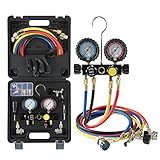
The Lichamp set is the classic budget entry point: an analog manifold gauge set with hoses included, listed for R134A, R410A, and R404A. It is not a diagnostic instrument in the sense that the digital manifolds here are, and it does not pretend to be. What it does is put a working manifold with hoses in your hands for a budget-tier price, which is exactly what an apprentice, a maintenance technician, or a homeowner doing their own R-410A equipment checks needs to start.
Key specs as listed:
- Type: analog HVAC manifold gauge set
- Hoses: included with the set
- Refrigerant coverage: R134A, R410A, R404A
- Readout: mechanical dual-scale gauges
- Positioning: budget tier
The refrigerant list is the honest limitation. R134A, R410A, and R404A cover a large share of installed equipment, but they do not include the A2L blends that new equipment ships with, and they do not include R-22 for older systems or R-32 and R-454B for the newest ones. If you are working exclusively on legacy and current R-410A equipment, that is fine. If your work is moving toward A2L, this set will not carry you through the transition and you should be looking at the Yellow Jacket A2L manifolds instead.
Analog accuracy is the other consideration. Mechanical gauges in this class are typically accurate to a percentage of full scale, which on a wide pressure scale can mean several psi of uncertainty. For topping off a system to a pressure target that is good enough. For deciding whether a charge is correct via superheat and subcooling, it is not — you need temperature measurement and a saturation table, and you would be





