Our Top Picks
Pros & cons
accepts full standard roll stock.
 VEVOR Vinyl Cutter 28 Inch Vinyl Cutter Machine28 Inch with Blades35 x 15 x 12 inches1.1 PoundsCheck on Amazon
 VEVOR Vinyl Cutting MachineKeypad & Touch Screen Version7.36 x 22.8 x 6.61 Inches18.08 PoundsCheck on Amazon
 VEVOR Vinyl Cutter Machine61.42 x 17.9 x 41.34 in61.42 x 17.91 x 41.34 inches61.4 PoundsCheck on Amazon


Best Vinyl Cutters for Small Business: The Direct Answer
The best vinyl cutter for most small businesses is the VEVOR Vinyl Cutter Machine 34-Inch Bundle. Its 34-inch cutting width handles full-width rolled vinyl, heat-transfer vinyl for apparel, and large-format signage in a single pass, while the included stand, blades, and pen holder mean you can be cutting sellable product the day it arrives. It suits shops making banners, decals, vehicle graphics, and T-shirt transfers at a volume where a 12-inch desktop machine becomes a bottleneck. If your products are small — mugs, tumblers, laptop decals, greeting cards — the Silhouette America Portrait 4 Deluxe Bundle is the smarter pick because its software workflow and PixScan feature eliminate the design guesswork that costs a small shop the most time. If every dollar counts and you only cut backing paper on wrapped panels rather than full designs, a WRAPXPERT two-pack of safety slitters is all you actually need. The rest of this guide maps cutting width, material compatibility, software, and production capacity against the products you actually sell, so you buy the machine that matches your order book rather than the one with the biggest number on the box.
Top 3 Picks
Best overall: VEVOR Vinyl Cutter Machine 34-Inch Bundle. A 34-inch feed width, bundled stand, and a full starter accessory kit make it the only cutter on this list that scales from a one-person Etsy shop to light contract work without a second purchase. It is the right machine if your product line includes anything wider than a laptop lid.
Best budget: WRAPXPERT Wrapping Paper Cutter 2-Pack. Two hidden-blade slitters with seven spare blades between them cover the single most common small-shop task — trimming vinyl wrap backing cleanly — for the price of one roll of material. It is not a plotter, and it does not pretend to be. Buy it alongside any cutting machine as a trimming and prep tool.
Best premium: USCutter MH100 34-Inch Vinyl Cutter Bundle. The MH100 is the long-standing workhorse in this width class, and the bundle adds a stand, software, and a full starter accessory set. Choose it over the VEVOR 34-inch if you want a machine with a deep, well-documented user community and a support ecosystem built specifically around sign shops.
Best for design-led small work: Silhouette America Portrait 4 Deluxe Bundle. A 9-inch cutter with PixScan and business-edition software, aimed at makers whose bottleneck is design and registration rather than raw cutting width.
Quick Comparison
| Product | Best for | Key specs (per listing) | Price tier |
|---|---|---|---|
| VEVOR Vinyl Cutter Machine 34-Inch Bundle Manual Plotter | Wide-format decals, banners, apparel HTV at volume | 34 in cutting width; manual plotter; bundled stand and starter accessories | Premium |
| VEVOR Vinyl Cutter 28-Inch with 20 Blades | Mid-size shops needing 720 mm feed without full 34 in footprint | 28 in (720 mm max paper feed); 20 blades included | Mid-range |
| VEVOR Vinyl Cutting Machine 12-Inch Button/Screen Controlled | Beginners and small-format craft production | 12 in width; button and screen control; 20,000+ built-in design resource | Mid-range |
| USCutter MH100 34-Inch Bundle with Stand and Software | Sign shops wanting a supported, community-backed workhorse | 34 in width; stand, software, full starter accessories | Premium |
| OSHARK Vinyl Backing Cutter with 10 Extra Blades | Trimming wrap backing and film on the bench | Hidden blade; 10 spare blades included | Mid-range |
| WRAPXPERT Wrapping Paper Cutter 2-Pack (7 Blades) | Budget prep and trimming of wrap film | 2 slitters; 7 blades total; safety film cutter design | Budget |
| Evteck A4 Paper Cutter Slider Trimmer | Squaring cardstock, photo prints, and small vinyl sheets | A4 format slider trimmer; flatbed guillotine-style rail | Budget |
| Gomake Vinyl Backing Cutter Bodyguard Knife | Safe roll trimming during wrap installation | Hidden-blade bodyguard knife; roll cutter design | Mid-range |
| TECKWRAP Vinyl Backing Cutter Knife | Car wrap and DIY project trimming | Backing cutter knife; craft and wrap film use | Budget |
| NEWISHTOOL Vinyl Cutter Back Paper Slitter with 10 Razor Blades | High-consumption trimming stations | Back paper slitter; 10 razor blades included | Budget |
| Silhouette America Portrait 4 Deluxe Bundle | Design-led makers, PixScan registration, small-format products | 9 in cutting width; PixScan; business-edition software bundle | Premium |
| VEVOR Vinyl Cutter Machine 53-Inch Dual Blade | Large-format production, dual-blade jobs, high-volume signage | 53 in max feed width; dual blades; adjustable force and speed; LED display | Premium |
How We Chose
Every cutter and trimming tool here was selected against four criteria that decide whether a small business makes money with it. First, cutting width and paper feed: a machine is only useful if it accepts the roll width your products demand, and the jump from 12 to 28 to 34 to 53 inches changes the material you can buy, the waste you generate, and the products you can quote. Second, material compatibility: adhesive vinyl, heat-transfer vinyl, cardstock, and stencil film behave differently under a blade, and machines with adjustable force and speed handle a wider material range than fixed-setting cutters. Third, software and workflow: for a small shop, design software, contour cutting, and print-and-cut registration are often the difference between a two-minute job and a twenty-minute one. Fourth, upgrade path and support: we favored products where the brand ecosystem, spare blades, and community documentation mean the tool still works in three years.
We also gave weight to the trimming tools that surround a cutter, because in most small shops the cutter is only half the workflow — cutting backing paper cleanly and safely on a wrapped panel matters as much as the plotter itself. Pricing is described only as a tier because listing prices move daily. These picks are based on published specifications, brand documentation, and category-standard capabilities, not on physical evaluation of the units.
1. VEVOR Vinyl Cutter Machine 34-Inch Bundle — Best Overall
As an Amazon Associate we earn from qualifying purchases at no extra cost to you.

This is the machine to buy if you have decided that 12 inches is not enough and you want the widest reasonable step up without jumping into full commercial territory. A 34-inch cutting width accepts the standard roll sizes that most vinyl suppliers stock, which means you buy material in the width it is sold rather than cutting it down first. For a small business making banners, window decals, vehicle door graphics, wall quotes, and heat-transfer apparel, that single specification removes the most common production constraint.
Key specs
- Cutting width: 34 inches — accepts full standard roll stock
- Type: manual vinyl plotter cutter
- Bundle: stand and starter accessories included
- Contour cutting: supported through the plotter workflow with registration
- Best material fit: adhesive vinyl, heat-transfer vinyl, stencil film, transfer tape
Who it suits
It suits the shop that has outgrown a desktop cutter and is now quoting jobs by the square foot rather than by the decal. If a typical order includes a 24-inch banner, a set of vehicle graphics, or a run of shirts with a full back print, a 34-inch machine lets you cut those in one pass. It also suits the operator who wants a stand as standard rather than as an accessory, because floor-standing cutting frees the bench for weeding and application.
Strengths
The headline strength is width per dollar relative to the premium sign-shop brands. The bundle approach means you are not hunting for a compatible stand, blade holder, or pen after purchase. Manual plotters of this class are mechanically simple, which matters for a small business: fewer electronics means fewer failure points, and blade replacement is a consumable cost rather than a service call. The 34-inch class also has the widest availability of aftermarket blades, cutting mats, and transfer tape, so your ongoing supply chain is not tied to one vendor.
Material compatibility is broad within the soft-goods category. Adhesive vinyl, heat-transfer vinyl, and stencil film all cut well when you match blade force and speed to the material thickness, which is the core skill of running any plotter in this class.
Pros
- 34-inch width covers banners, vehicle graphics, and apparel transfer work
- Bundle includes stand and starter accessories — no immediate add-ons
- Mechanically simple, easy to maintain, cheap blades
- Huge aftermarket supply of blades, mats, and transfer tape
- Strong upgrade path: it is the last cutter many small shops buy
Cons
- Large footprint — needs a dedicated floor or long bench space
- Manual workflow means no automatic roll feeding or unattended runs
- Overkill and wasteful if your products are all under 9 inches
- Requires you to learn blade-force and speed settings per material
How it compares
Against the VEVOR 28-Inch with 20 Blades, the 34-inch model wins on material flexibility — a 28-inch (720 mm) feed handles most roll stock but leaves less margin on wide designs and cannot take the widest rolls in one pass. Choose the 28-inch if bench space is the binding constraint and your largest product is around two feet wide. Against the USCutter MH100 34-Inch, the two are direct competitors in width and both bundle a stand and software-grade accessories; the MH100 leans toward the sign-shop support ecosystem while this VEVOR leans toward value and simplicity. Against the VEVOR 53-Inch Dual Blade, the 34-inch is the more sensible purchase unless you already have order volume that justifies 53-inch material.
2. VEVOR Vinyl Cutter 28-Inch with 20 Blades — Best Mid-Size Compromise
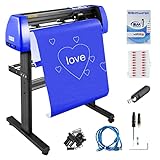
The 28-inch VEVOR is the machine for the shop that wants serious cutting width without dedicating half a room to it. A 720 mm maximum paper feed width sits in the sweet spot: wide enough for almost all standard decal, signage, and apparel transfer work, narrow enough to live on a long workbench rather than a floor stand. The inclusion of 20 blades is not a gimmick — blades are the consumable you will replace most often, and a 20-pack defers that cost for months of normal production.
Key specs
- Cutting width: 28 inches
- Maximum paper feed: 720 mm
- Blades included: 20
- Type: vinyl plotter cutter
- Best material fit: adhesive vinyl, HTV, stencil film, cardstock within force limits
Who it suits
This is the right machine if your products are mostly one to two feet wide and your workspace is shared. Sign makers doing window decals, crafters selling large wall quotes, and apparel shops cutting front and back transfer designs all fit comfortably inside a 28-inch envelope. It also suits a business that is upgrading from a 12-inch desktop cutter and wants a real step up in capacity without a real step up in floor space.
Strengths
The 720 mm feed width is the practical maximum for most roll stock sold to small shops, so you rarely need to trim material before loading. The 20-blade pack is a genuine operational advantage: blade wear is the number one cause of ragged cuts and incomplete weeding, and having spares on hand means you replace a dull blade in thirty seconds instead of losing an afternoon. The machine keeps the same simple manual-plotter architecture as its larger sibling, so maintenance is a matter of cleaning the blade holder, checking the carriage for debris, and keeping the cutting strip in good condition.
Material handling is flexible within the soft-goods range. Adjustable blade force lets you move between thin adhesive vinyl and heavier stencil film without changing hardware.
Pros
- 720 mm feed width covers most standard roll stock
- Bench-friendly footprint compared with 34-inch and 53-inch machines
- 20 blades included — a real consumable saving
- Same simple manual architecture as larger VEVOR plotters
- Good value tier between desktop and full commercial
Cons
- Cannot take the widest rolls in a single pass
- Still a manual workflow with no unattended operation
- Less headroom for very large banner work
- Blade-force and speed calibration still required per material
How it compares
Against the 34-inch VEVOR bundle, you give up six inches of width and the included stand in exchange for a smaller footprint and a lower price tier. If your largest product fits inside 28 inches, that trade is almost always correct. Against the 12-inch VEVOR, this is a different class of machine entirely — the 12-inch is a design-and-craft tool, while the 28-inch is a production tool. Against the Silhouette Portrait 4, the VEVOR 28 wins decisively on width and raw output, while the Portrait wins on software and registration workflow.
3. VEVOR Vinyl Cutting Machine 12-Inch — Best for Beginners and Small-Format Production

The 12-inch VEVOR is the entry point to machine cutting, and its most interesting specification is the one no plotter on this list matches: a built-in design resource of more than 20,000 designs. Combined with button and screen control, that turns the machine from a plotter that needs a computer into a standalone production tool for someone who wants to start selling decals this week rather than learning vector software first.
Key specs
- Cutting width: 12 inches
- Controls: button and screen controlled
- Built-in designs: 20,000+ design resource
- Type: desktop vinyl cutter
- Best material fit: small adhesive vinyl decals, HTV, cardstock, labels
Who it suits
It suits the new business owner who wants the shortest path from purchase to first sale. Tumbler decals, laptop stickers, car window decals, mug wraps, and small heat-transfer designs for shirts and tote bags all fit inside a 12-inch working width. It also suits an established shop that wants a second, small machine for detail work and quick jobs without tying up the wide-format cutter.
Strengths
The built-in design library is the differentiator. For someone whose bottleneck is design time rather than cutting capacity, having thousands of ready shapes on the machine removes the single biggest cost in small-batch production — the hours spent in vector software. Button and screen control mean you are not tethered to a laptop for every job, which is genuinely useful in a small shop where the computer is also the order desk.
Footprint is minimal, so it can sit on a shelf or a corner of the bench. Power draw is low. Consumables are cheap and universally available, and the learning curve is gentle enough that a first-time operator can produce sellable output the same day.
Pros
- 20,000+ built-in designs remove design-software dependency
- Button and screen control; no computer needed for every job
- Smallest footprint and lowest commitment in the cutter category
- Ideal for decals, tumblers, labels, and small HTV work
- Gentle learning curve for a first machine
Cons
- 12-inch width caps product size — no banners or vehicle graphics
- Slower throughput than wider machines for volume work
- Becomes a bottleneck quickly if order size grows
- Built-in designs are generic; custom branding still needs design work
How it compares
Against the Silhouette Portrait 4, both are small-format machines, but their strengths diverge: the VEVOR leans on its built-in design library and standalone control, while the Portrait leans on PixScan registration and its business-edition software for print-and-cut work. If your products are printed then contour cut, the Portrait is the better fit. If your products are single-color decals and you want to skip design software entirely, the VEVOR 12-inch is the faster start. Against the 28-inch VEVOR, the 12-inch is a starter tool and the 28-inch is a production tool — buy the 12-inch only if you are confident your product line stays small.
4. USCutter MH100 34-Inch Bundle — Best for Sign-Shop Support

The MH100 is the model that sign shops recommend to each other, and the 34-inch bundle is its most popular configuration. It matches the VEVOR 34-inch on cutting width and bundle contents, but its real advantage is the ecosystem: software, documentation, and a user community built around commercial vinyl cutting rather than around hobby crafting.
Key specs
- Cutting width: 34 inches
- Bundle: stand, software, and full starter accessories
- Type: vinyl plotter cutter
- Best material fit: adhesive vinyl, HTV, stencil film, transfer tape
- Positioning: entry-to-mid commercial sign work
Who it suits
It suits the operator who expects to need help. If you are moving from craft cutting to commercial sign work and you want a machine whose quirks are already documented in forums, tutorials, and videos, the MH100’s long production history is worth real money in saved troubleshooting time. It also suits a shop that wants included software rather than sourcing its own design-and-cut pipeline.
Strengths
Bundle completeness is the standout. Stand, software, and a full accessory kit mean the machine arrives as a working station. The 34-inch width covers standard roll stock so you can buy material at the width it is sold. The community documentation is unusually deep for this price tier: blade selection, force settings, and contour-cutting setup for this machine class are widely published, which shortens the learning curve considerably.
Mechanically, it is a straightforward plotter with adjustable force and speed — the same architecture that has made this class of machine the backbone of small sign shops for years. Consumables are standard and inexpensive.
Pros
- 34-inch width for banners and vehicle graphics
- Stand, software, and starter accessories all included
- Deep community documentation and tutorials for troubleshooting
- Proven design with widely available blades and parts
- Clear upgrade path within the USCutter line
Cons
- Premium tier pricing for a manual plotter
- Large footprint requiring dedicated space
- Included software has a learning curve of its own
- No advantage in width over the cheaper 34-inch VEVOR
How it compares
Against the VEVOR 34-Inch Bundle, this is a value-versus-support decision. Both cut 34 inches, both include a stand. The VEVOR costs less; the MH100 comes with software and a support ecosystem tailored to sign work. If you have never run a plotter before and you are selling to businesses that expect fast turnaround, the MH100’s documentation advantage is worth the premium. Against the VEVOR 53-Inch Dual Blade, the MH100 is the better choice unless you genuinely need 53 inches of feed width — most small shops do not.
5. OSHARK Vinyl Backing Cutter — Best Bench Trimming Tool

Not every tool in a vinyl workflow is a plotter. The OSHARK backing cutter is a hidden-blade slitter for cutting vinyl wrap film and backing paper cleanly on the bench, and it ships with 10 extra blades. For a shop that applies as much vinyl as it cuts, this is the tool that prevents the most common and most expensive mistake: scoring through the film and into the panel beneath it.
Key specs
- Blade configuration: hidden blade
- Spare blades: 10 included
- Type: vinyl backing and wrap cutting knife
- Best material fit: car wrap vinyl, backing paper, film rolls
- Handle: bodyguard-style guarded grip
Who it suits
It suits wrap installers, detail shops, and anyone applying vinyl to glass, painted metal, or vinyl-wrapped panels where a slip means a scratch. It also suits the cutter operator who trims backing paper to size before loading a plotter — a hidden blade slides along the backing without catching the adhesive face.
Strengths
The hidden-blade design is the whole point. A standard utility knife requires you to control depth by hand every time; a guarded slitter fixes the blade depth so the edge protrudes only enough to cut the film or backing. That single design decision reduces scratched glass, gouged panels, and cut fingers. The 10-blade pack means you replace a dull blade immediately rather than pressing harder with a worn one, which is how most accidental damage happens.
It is small, light, and pocketable, so it lives on the install cart rather than in a drawer. There is no power, no calibration, and no maintenance beyond blade changes.
Pros
- Hidden blade protects panels, glass, and fingers
- 10 spare blades included
- Fast backing-paper trimming before loading a plotter
- No setup, no power, no calibration
- Cheap enough to keep several around the shop
Cons
- Does not cut designs — it is a trimming tool only
- Fixed blade depth limits it on very thick materials
- Blades are small and easy to misplace
- Not a substitute for a plotter in any workflow
How it compares
Against the Gomake Vinyl Backing Cutter Bodyguard Knife, both are guarded hidden-blade slitters aimed at wrap work; the Gomake leans toward roll cutting while the OSHARK comes with a larger spare-blade count, which matters more if you are trimming all day. Against the budget TECKWRAP and NEWISHTOOL options, the OSHARK sits a tier higher but includes more blades, which offsets the difference quickly at production volumes. Against the WRAPXPERT two-pack, the OSHARK is the single-tool choice for one user, while the two-pack outfits two stations.
6. WRAPXPERT Wrapping Paper Cutter 2-Pack — Best Budget Trimming Set

The WRAPXPERT two-pack is the cheapest genuinely useful tool on this list. Two hidden-blade safety slitters with seven blades between them cover the routine job that every vinyl business does constantly: cutting wrap film and backing paper to length. At the budget tier, it is the tool you buy two of so that one is always where you need it.
Key specs
- Quantity: 2 cutters
- Blades: 7 total
- Type: safety vinyl film cutter / roll cutter
- Best material fit: car wrap vinyl, wrapping paper, film rolls, backing paper
- Blade style: hidden blade
Who it suits
It suits the new wrap or vinyl business equipping its first bench, and it suits any shop that wants a spare slitter at the cutting table and another at the install bay. It is also the correct first purchase for someone testing whether vinyl work is worth pursuing before committing to a plotter.
Strengths
Two tools and seven blades for a budget-tier price is straightforward value. The hidden-blade design gives the same panel protection as more expensive slitters, so the safety benefit is not something you pay extra for. The roll-cutter geometry is designed to ride along a roll edge and produce a straight cut, which is faster and more consistent than freehand knife work.
Because they are cheap, they can be treated as consumable bench tools rather than precious instruments — a genuine advantage in a busy shop where tools get borrowed and lost.
Pros
- Two cutters plus seven blades at a budget price
- Hidden-blade safety design protects panels
- Straight roll cuts faster than freehand knife work
- Cheap enough to keep at multiple stations
- No setup or maintenance
Cons
- Budget build quality — expect to replace eventually
- Blade replacement count is lower than mid-range options
- Not suitable for very heavy or thick films
- Trimming tool only; no design cutting capability
How it compares
Against the OSHARK and Gomake mid-range slitters, the WRAPXPERT set trades build quality for quantity: you get two tools and more total blades for less money, but each tool is less refined. For a shop doing occasional wrap work, that is the right trade. Against the NEWISHTOOL slitter with 10 blades, the WRAPXPERT wins on having two cutters while NEWISHTOOL wins on blade count in a single tool — choose based on whether you need coverage across stations or maximum blade life at one station.
7. Evteck A4 Paper Cutter Slider Trimmer — Best for Finishing and Squaring

The Evteck A4 slider trimmer fills a gap most vinyl buyers do not think about until they need it: squaring printed sheets, trimming photo prints, and cutting small vinyl or cardstock pieces to exact size. A rail-guided slider produces a straight, repeatable cut in a way a handheld knife cannot, which matters when a customer orders fifty identical pieces.
Key specs
- Format: A4
- Type: slider trimmer
- Best material fit: cardstock, photo paper, printed sheets, small vinyl pieces
- Cut style: rail-guided sliding blade
- Bench footprint: desktop
Who it suits
It suits makers selling printed-then-trimmed products: cards, prints, stickers on sheets, labels, and packaged goods. It also suits anyone producing decals in multiples who needs to separate a printed sheet into identical units. If your product line includes anything printed, this tool pays for itself in consistency.
Strengths
Repeatability is the core benefit. A slider trimmer holds the sheet against a guide and the blade travels on a fixed rail, so every cut lands in the same place. For a small business selling sets of cards or multi-packs of stickers, that consistency is the difference between a professional product and a homemade one.
It is compact, needs no power, and stores flat. Blades last a long time on paper and cardstock, and the cutting bed is replaceable on most models in this class. It also handles the small trimming jobs that would waste plotter material and time.
Pros
- Rail-guided cuts are straight and repeatable
- Ideal for cards, prints, labels, and sticker sheets
- No power, no software, stores flat
- Handles jobs that would waste plotter material
- Budget-tier price
Cons
- A4 format limits it to small-format work
- Not designed for adhesive vinyl at production volume
- Blades dull on thick or abrasive materials
- Cannot contour cut or cut designs
How it compares
Against the hidden-blade slitters in this list, the Evteck does a different job — it trims flat sheets to size, while slitters trim rolls and backing paper. Most shops eventually own both. Against the 12-inch VEVOR cutter, the Evteck is a finishing tool rather than a design tool: it will not cut a shape, but it will square fifty cards in the time it takes to set up a plotter job.
8. Gomake Vinyl Backing Cutter Bodyguard Knife — Best for Roll Trimming

The Gomake bodyguard knife is built for one motion done thousands of times: cutting a vinyl roll to length without cutting anything underneath it. Its guarded, hidden-blade geometry is designed to ride a roll edge, and the bodyguard handle keeps the blade shielded except during the cut itself.
Key specs
- Type: hidden-blade vinyl wrap cutting knife / roll cutter
- Blade style: guarded bodyguard design
- Best material fit: car wrap vinyl, film rolls, wrapping paper, backing paper
- Use context: bench prep and install trimming
Who it suits
It suits wrap installers and vinyl shops that cut from rolls rather than from flat sheets. If your workflow is unroll, measure, cut, apply, the Gomake is the tool at the center of it. It also suits shops that have had a close call with a utility knife and want depth control built into the tool rather than into their hand.
Strengths
The guarded blade is the defining feature, and it solves a real problem: trimming vinyl on a vehicle or a wrapped panel means the blade is inches from a surface you cannot repair cheaply. A fixed-depth guarded blade removes the variable. The handle geometry also gives a natural rolling cut along a roll edge, which produces a straighter line than a pulling motion.
Build quality sits a tier above the budget slitters, so the mechanism holds up to daily use. There is nothing to calibrate and nothing to charge.
Pros
- Guarded hidden blade with fixed depth
- Designed specifically for cutting rolls to length
- Better build quality than budget slitters
- Rolling cut geometry produces straight edges
- No setup, no power, no maintenance
Cons
- Mid-range price for a single hand tool
- No spare blades included as standard
- Fixed depth limits very thick materials
- Trimming only — no design capability
How it compares
Against the OSHARK, both are guarded slitters at the mid tier; the OSHARK includes 10 spare blades, which makes it the better value if you are buying one tool to use hard. The Gomake’s advantage is its roll-cutting geometry for shops doing high volumes of roll-to-length work. Against the WRAPXPERT two-pack, the Gomake is one better tool instead of two cheaper ones — the right call if you work alone at a single station, and the wrong call if you need coverage at two.
9. TECKWRAP Vinyl Backing Cutter Knife — Best Budget Slitter for Craft Use

TECKWRAP is a vinyl material brand first, and this backing cutter knife is designed to pair with its wrap and craft films. It is a straightforward hidden-blade slitter for backing paper and film, priced at the budget tier and aimed at DIY and small craft production rather than professional install bays.
Key specs
- Type: vinyl backing cutter knife
- Use: car wrap vinyl and DIY projects
- Blade style: hidden blade
- Best material fit: craft vinyl, wrap film, backing paper
- Price tier: budget
Who it suits
It suits craft sellers who buy TECKWRAP vinyl and want a matching trimming tool, and it suits beginners who want a safe slitter without paying mid-tier prices. It is a sensible add-on purchase alongside a first roll of material rather than a standalone investment.
Strengths
It does the basic job correctly: hidden blade, backing-paper cuts, no scratched surfaces. The brand pairing is convenient if you already buy TECKWRAP films, and the price is low enough to buy as a spare without deliberation. For a craft-scale operation trimming decal backing and small wrap pieces, it is entirely adequate.
Pros
- Very low cost
- Hidden-blade safety design
- Brand-matched with TECKWRAP vinyl products
- Adequate for craft-scale trimming
- No setup or maintenance
Cons
- Budget build — not built for all-day professional use
- Fewer included blades than mid-tier competitors
- Limited performance on thick or heavy film
- No design cutting capability
How it compares
Against the WRAPXPERT two-pack, the TECKWRAP gives you one tool; the WRAPXPERT gives you two plus more blades for a similar budget outlay, which makes the two-pack the stronger buy for most shops. The TECKWRAP’s advantage is brand matching if you already stock its vinyl. Against the Gomake and OSHARK, you are trading build quality for price — fine for occasional craft trimming, less so for daily professional install work.
10. NEWISHTOOL Vinyl Cutter Back Paper Slitter with 10 Razor Blades — Best for Blade Volume

NEWISHTOOL’s slitter takes a different approach to value: instead of bundling two tools, it bundles ten razor blades with one slitter. For a shop where blade wear is the limiting factor — that is, a shop trimming constantly — a large blade reserve is worth more than a second handle.
Key specs
- Type: vinyl cutter back paper slitter
- Blades included: 10 razor blades
- Best material fit: backing paper, vinyl film, wrap material
- Use: bench trimming and prep
- Price tier: budget
Who it suits
It suits a trimming-heavy operation: a wrap shop, a decal business that preps a lot of rolls, or any station where a single slitter is used for hours a day. It also suits a shop that has learned the hard way that a dull blade causes more damage than a sharp one.
Strengths
Ten blades is a substantial reserve at a budget price. Blade replacement is the only recurring cost in a slitter’s life, and a ten-pack converts that cost into a one-time purchase that lasts a long time. The tool itself is a standard back-paper slitter: simple, safe, and effective on backing paper and film.
Because it is inexpensive, it can be dedicated to a single station and left there, which is how trimming tools stay sharp — a tool that lives on the bench gets used correctly instead of borrowed and abused.
Pros
- 10 razor blades included at a budget price
- Lowest ongoing consumable cost of the budget slitters
- Simple, safe back-paper cutting
- Cheap enough to dedicate to one station
- No setup or maintenance
Cons
- Single tool rather than a pair
- Budget build quality
- Razor blade replacement requires care
- Trimming only, no design cutting
How it compares
Against the WRAPXPERT two-pack, NEWISHTOOL wins on blade count in one tool and WRAPXPERT wins on tool count. If you work alone at one bench, ten blades beats two handles. If you and an employee both trim, the two-pack is the better purchase. Against the mid-tier OSHARK and Gomake, NEWISHTOOL is the budget option with the strongest consumable economics — the trade is a less refined handle and mechanism.
11. Silhouette America Portrait 4 Deluxe Bundle — Best for Design-Led Small Products

The Portrait 4 is a 9-inch cutting machine, and on paper that sounds like a downgrade against 34-inch plotters. In practice it competes on a different axis: software workflow, PixScan registration, and a business-edition bundle that targets people selling designed products rather than cutting large sheets. If your bottleneck is design time and print-and-cut accuracy rather than width, it is the strongest machine on this list.
Key specs
- Cutting width: 9 inches
- Key feature: PixScan for registration of printed images
- Bundle: Deluxe bundle with business-edition software
- Type: desktop cutting machine
- Best material fit: adhesive vinyl, HTV, cardstock, sticker sheets, printed-then-cut projects
Who it suits
It suits makers whose products are designed and printed first: sticker sheets, printed cards, planner accessories, custom labels, and small apparel graphics. PixScan lets you photograph a printed sheet, register it in software, and cut precisely around printed artwork — a workflow that turns a home printer into a small-batch production line. It also suits a designer who values software quality over raw cutting capacity.
Strengths
The software is the strength. A mature design application with tracing, layout, and print-and-cut registration means less time in third-party vector software and fewer failed cuts. The business-edition bundle points the machine at commercial use, and the library-and-project ecosystem is large enough that most beginner questions already have published answers.
Physically it is small, quiet, and safe enough to run on a desk. For a one-person business selling designed goods, that combination — accurate registration plus a compact footprint — produces more sellable units per hour than a wide manual plotter for many product types.
Pros
- PixScan registration enables accurate print-and-cut work
- Mature design software with tracing and layout tools
- Business-edition bundle aimed at sellers
- Compact, quiet, desk-friendly
- Excellent fit for stickers, cards, labels, and small HTV
Cons
- 9-inch width rules out banners and vehicle graphics
- Premium tier price for a small-format machine
- Slower than wide plotters on large single-color jobs
- Depends on the brand’s software and material ecosystem
How it compares
Against the 12-inch VEVOR, both are small machines, but their workflows differ sharply. The VEVOR offers more built-in designs and standalone button-and-screen operation with no computer; the Portrait offers better registration and design software for printed products. If you print first and cut second, choose the Portrait. If you cut single-color decals and want zero software time, choose the VEVOR. Against the 34-inch VEVOR and MH100, the Portrait is not a competitor in width — it is a competitor for a different product catalog, and many successful shops run both a small registration machine and a wide plotter side by side.
12. VEVOR Vinyl Cutter Machine 53-Inch Dual Blade — Best for Large-Format Volume

The 53-inch VEVOR is the largest machine on this list, and the only one with dual blades. It targets shops whose order book has moved past standard roll widths: large banners, big window graphics, wide wall murals, and multi-panel vehicle wraps where a 34-inch machine would force you to tile every job.
Key specs
- Maximum feed width: 53 inches
- Blades: dual blade configuration
- Controls: adjustable force and speed
- Display: LED display
- Best material fit: wide adhesive vinyl, banner material, large stencil film, transfer tape
Who it suits
It suits a business already selling wide-format work: commercial signage, large window graphics, event banners, and vehicle panels. It also suits a shop that currently tiles large jobs on a smaller machine and wants to eliminate the seams and the extra labor. If you are not already quoting jobs wider than three feet, this machine is a cost with no matching revenue.
Strengths
Width is the headline. A 53-inch feed means most large-format roll stock loads without trimming and most large graphics cut in one piece, which removes both material waste and alignment labor. Adjustable force and speed let you dial settings per material rather than living with one compromise setting, and the LED display makes those settings easy to read and repeat — important when jobs must match across runs.
The dual-blade configuration supports workflows that benefit from two blade positions, which can reduce blade changes during mixed-material production. For a shop running long jobs, small time savings per job compound quickly.
Pros
- 53-inch feed width eliminates tiling on most large jobs
- Dual blade configuration for mixed production
- Adjustable force and speed for material flexibility
- LED display for repeatable settings
- Real revenue expansion if you already sell wide-format work
Cons
- Very large footprint — needs a dedicated production area
- Premium tier cost, and wide material costs more per roll
- Unnecessary and wasteful for small-format product lines
- Manual workflow still requires operator attention throughout
How it compares
Against the 34-inch VEVOR bundle, the 53-inch is the right machine only when your product width genuinely exceeds what 34 inches can handle — otherwise you are paying more and giving up floor space for capacity you will not use. Against the USCutter MH100 34-Inch, the MH100 offers better support and software at a narrower width; the 53-inch wins purely on format. Against the Portrait 4, they occupy opposite ends of the market and a growing shop could reasonably own both.
How to Choose
Choosing a cutter for a small business comes down to four decisions, and getting them in the right order prevents the most expensive mistake in this category: buying capacity you cannot sell.
1. Start with the widest product you actually sell
Everything else follows from width. Measure your largest current product and add a few inches of margin, because material is sold in standard roll widths and you want to load it as-is rather than trimming it down.
| Widest product you sell | Minimum sensible cutting width | Machines in this list that fit |
|---|---|---|
| Decals, tumblers, labels, small HTV (under 9 in) | 9–12 in | Silhouette Portrait 4; VEVOR 12-Inch |
| Shirt backs, wall quotes, mid-size decals (9–24 in) | 24–28 in | VEVOR 28-Inch |
| Banners, vehicle doors, multi-panel decals (24–33 in) | 34 in | VEVOR 34-Inch; USCutter MH100 |
| Wide banners, wall murals, large wraps (34+ in) | 53 in | VEVOR 53-Inch Dual Blade |
A useful rule: if your biggest product needs 20 inches and you buy a 12-inch machine, you will be back to buy again within a year. If your biggest product needs 20 inches and you buy a 53-inch machine, you paid for 33 inches of nothing. Buy one step above your current maximum, not two or three.
2. Match material compatibility to your product catalog
Not every machine handles every material equally well, and the differences are practical rather than theoretical.
- Adhesive vinyl is the baseline material for cutting plotters and works on every machine in this list at the appropriate width. Thin calendered vinyl cuts easily; cast vinyl and thicker films want adjustable blade force.
- Heat-transfer vinyl requires clean, consistent blade pressure because the cut has to release from its carrier. Machines with adjustable force and speed handle HTV far more reliably than fixed-setting units.
- Cardstock and paper cut well on small machines and slider trimmers, but heavy cardstock needs a new blade and a slower speed to avoid tearing.
- Stencil film and transfer tape are forgiving and cut on almost anything, but wide transfer tape is only practical on a wide machine.
- Vinyl wrap film and backing paper are trimmed by hand with hidden-blade slitters rather than cut on a plotter. This is the workflow most beginners underestimate.
If your catalog spans thin decal vinyl and thick cast wrap film, prioritize adjustable force and speed over any other feature after width. If your catalog is mostly printed-then-cut products, prioritize registration and software instead.
3. Weigh software and workflow against your time
Software is where small businesses lose money invisibly. A machine that cuts beautifully but requires you to build every design from scratch in third-party software costs you hours per week. Three workflow models matter:
- Standalone design libraries. The 12-inch VEVOR’s 20,000+ design resource is the fastest possible start — you are producing without design software at all. The trade-off is that library designs are generic, so branding work still needs a designer.
- Design-software ecosystems. The Silhouette Portrait 4 pairs with a mature application that includes tracing, layout, and PixScan registration. This is the best workflow for print-and-cut products and for anyone selling designed goods rather than plain vinyl shapes.
- Open plotter workflows. The 28-inch, 34-inch, and 53-inch VEVOR machines and the USCutter MH100 work with vector files from whichever software you prefer. This is the most flexible model for sign work, but it puts the design burden entirely on you.
If you already have a designer or you are comfortable in vector software, the open plotter model is efficient. If you are a one-person business doing design, cutting, and shipping, the design-library and design-software models save more time than any hardware upgrade.
4. Plan production capacity and the honest cost per unit
Capacity is where a purchase decision either pays off or quietly eats your margin. Work through a real job:
Suppose you sell 50 single-color decals per week, each 6 by 6 inches. That is 1,800 square inches of cutting, or about 12.5 square feet. A 12-inch cutter handles it comfortably in short sessions. Now suppose you win one standing order for 24-by-36-inch window graphics, 20 per month. That is 120 square feet per month, and on a 12-inch machine it requires cutting each graphic in multiple panels, weeding each panel, and aligning them during application. The labor cost of tiling is what forces the upgrade — not the material cost.
Consumables are the other half of ownership cost. Blades are the only recurring item on a plotter, and they are cheap. On trimming slitters, blades are the entire cost of ownership, which is why blade-count bundles matter more than they look. Keep a simple rule: replace a blade the moment cuts stop releasing cleanly from the backing, because a dull blade forces you to increase pressure, and increased pressure is what tears vinyl and scratches panels.
5. Budget space and setup before you budget the machine
Floor space is a hidden specification. A 53-inch plotter with a stand needs a clear run of wall several feet longer than its cutting width so material can feed and discharge. A 34-inch machine needs a similar but shorter run. A 12-inch machine needs a bench corner. Measure the room before you order, because a machine that fits your budget but not your workspace is a machine you will not use.
6. Buy the trimming tools at the same time
Every shop in this list eventually needs both a cutter and a trimming tool, and the trimming tools are inexpensive enough that there is no reason to defer them. A hidden-blade slitter handles wrap film and backing paper. A slider trimmer handles printed sheets and cards. Together they cost a fraction of a plotter and remove the two most common causes of wasted material: crooked hand cuts and scratched panels.
7. Consider the upgrade path before you buy
Ask what your next machine will be. A 12-inch desktop cutter is a starting point; the natural upgrade is a 28-inch or 34-inch plotter. A 34-inch plotter is often a terminal purchase for a small business. A 53-inch machine is the ceiling unless you move into full commercial production. Machines that share blade types, software, and accessories with their larger siblings make that upgrade cheaper, which is one reason the VEVOR and USCutter families work well as a growth path. Confidence in the ecosystem — spare parts, documentation, and community answers — is worth more over three years of ownership than a small saving at purchase.
Frequently Asked Questions
What cutting width do I need for a small vinyl business?
Match width to your widest product plus a few inches of margin. If you sell decals, tumblers, and small apparel graphics, 12 inches is usually enough. If you sell shirt backs, wall quotes, and mid-size decals, 28 inches covers nearly everything. If you sell banners, vehicle graphics, or multi-panel decals, 34 inches is the practical minimum, and 53 inches is only necessary for wide-format signage and murals. Buying one step above your current maximum is the safest approach.
Can a vinyl cutter cut materials other than vinyl?
Yes, within limits. Machines with adjustable blade force and speed can cut heat-transfer vinyl, stencil film, transfer tape, cardstock, and some paper products. Thicker materials such as heavy cardstock or thick cast films require more force and slower speeds, and very hard or abrasive materials will dull blades quickly. Trimming tools such as hidden-blade slitters are used for wrap film and backing paper, which are cut by hand rather than on a plotter.
Do I need design software to use a vinyl cutter?
Not always. Some machines include large built-in design libraries and standalone button-and-screen controls, which means you can produce sellable designs without design software or even a computer. Others work with vector files from whichever design application you prefer, which offers more flexibility but puts the design work on you. Machines aimed at print-and-cut products come with their own software ecosystems that handle tracing, layout, and registration.
How often do I need to replace cutter blades?
Blade life depends on material and volume, but the practical rule is to replace the blade as soon as cuts stop releasing cleanly from the backing or edges look ragged. Pushing a dull blade forces you to increase pressure, which tears vinyl and damages cutting strips. For this reason, bundles that include many spare blades — 10 or 20 — are genuinely valuable rather than filler.
What is the difference between a plotter and a trimming slitter?
A plotter is a machine that cuts shapes from a design file, using a computer-controlled carriage and blade. A trimming slitter is a hand tool with a guarded blade that cuts film or backing paper to length, usually along a roll edge. Plotters make products; slitters prepare materials and finish wrap work. Most vinyl businesses need both, and the slitter is by far the cheaper of the two.
What wears out first on a vinyl cutter?
Blades wear fastest, followed by the cutting strip under the blade path, which develops grooves from repeated passes. Blade holders and the carriage assembly wear more slowly but are the parts most affected by debris — vinyl scraps and adhesive buildup on the carriage cause misalignment. Standard maintenance is simple: keep the cutting strip clean and replace it when grooved, clear debris from the carriage, and change blades before they force you to increase pressure.
Is a wide-format cutter worth it for a small shop?
Only if you already sell wide products. A wide machine removes tiling labor on large graphics and lets you load standard roll widths without trimming, but it costs more, takes significant floor space, and requires wider — and more expensive — material rolls. If your largest product fits in 28 inches, a 34-inch or 53-inch machine mostly adds cost. If you are tiling every large job on a small machine, the labor savings usually justify the upgrade.
Can I run a vinyl business from a small home workspace?
Yes, and a 12-inch desktop cutter plus a slider trimmer and a hidden-blade slitter fits on a single bench. The constraint is material storage rather than machine footprint. Note that wide plotters need a clear feed and discharge run the length of their cutting width, which is often the real limit on a home setup. Many home-based shops start small and add a wide machine only after order volume demands it.
Which One Should You Buy?
Buy by situation rather than by specification sheet. If you are making decals, tumblers, labels, and small apparel graphics, pair the VEVOR 12-Inch Cutting Machine with the Evteck A4 Slider Trimmer and a budget slitter like the WRAPXPERT two-pack — that combination covers most small-product work for the least money. If you sell printed-then-cut designs such as sticker sheets, cards, and labels, the Silhouette America Portrait 4 is the better engine because registration and software matter more than width. If your products run up to shirt backs and mid-size decals, the VEVOR 28-Inch is the value pick, with a mid-range slitter such as the OSHARK for trimming. If you sell banners, vehicle graphics, or multi-panel work, choose between the VEVOR 34-Inch Bundle for value and the USCutter MH100 34-Inch Bundle for software and support — and only step up to the VEVOR 53-Inch Dual Blade when your order book already includes wide-format jobs. Whatever you choose, budget for the trimming tools in the same purchase: they are cheap, they prevent the most common material losses, and they are the difference between a clean product and a scratched one.