
Key takeaways
- Heavy duty cargo net
- Ideal for small & large items
- Metal carabiners
Best Cargo Nets for Secure Hauling
The best cargo nets are sized to your load, have mesh small enough to contain it, and offer enough stretch and tie-down points to keep tension even without relying on the net as a substitute for proper restraints. For a pickup bed, a roughly 4-by-6-foot elastic net suits many mixed loads; for bulky, irregular cargo, choose a larger net with adjustable attachment points; for small loose items, prioritize tighter mesh over stretch.
Compare cargo nets by size and job
Dimensions and mesh openings are not standardized across brands, and manufacturers may list a net’s relaxed size, stretched size, or both. Treat the measurements below as practical selection ranges, not specifications for a particular product. Check the maker’s sizing method and maximum stretch before buying.
Our top picks
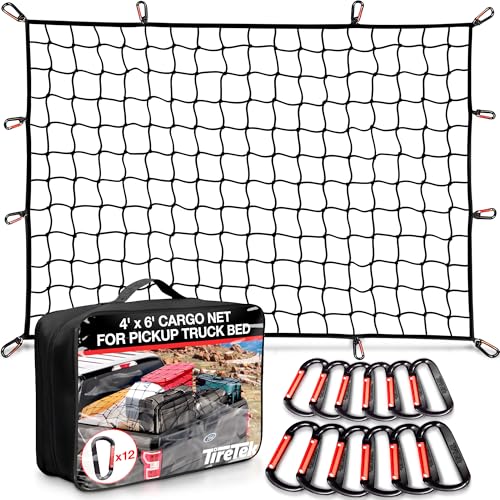 Cargo Net for Pickup Truck Bed
- Heavy duty cargo net
- Ideal for small & large items
- Metal carabiners
 4'x6' Cargo Net for Pickup Truck Bed
- Our 4'× 6' bungee cargo net has a…
- Our cargo net is made of high quality…
- The bungee cargo net has a wide range…
 Heavy Duty Cargo Net for Pickup Truck
- 【Strong Tensile Strength】The 4'x6' cargo net for pickup…
- 【Premium Materials】The truck cargo net cargo net for…
- 【Universal Mesh Cargo Net】This truck bed net is…
| Product | Key specs | |
|---|---|---|
| Cargo Net for Pickup Truck Bed | Heavy duty cargo net Ideal for small & large items Metal carabiners | Check price |
| 4'x6' Cargo Net for Pickup Truck Bed | Our 4'× 6' bungee cargo net has a… Our cargo net is made of high quality… The bungee cargo net has a wide range… | Check price |
| Heavy Duty Cargo Net for Pickup Truck | 【Strong Tensile Strength】The 4'x6' cargo net for pickup… 【Premium Materials】The truck cargo net cargo net for… 【Universal Mesh Cargo Net】This truck bed net is… | Check price |
 AUTOWN Cargo Net for Pickup Truck Bed | Practical Design: Crafted with a flat shape and… Strong Protection: Featuring eight robust metal climbing buckles… Easy to Use: Say goodbye to cumbersome bundling… | Check price |
As an Amazon Associate we earn from qualifying purchases at no extra cost to you.
| Typical net size (relaxed) | Approximate mesh opening | Best fit | What to check |
|---|---|---|---|
| 3 × 4 ft | 1–2 in | Small loads in a compact SUV, trailer, or short pickup bed | Enough edge reach to attach at all corners without overstretching |
| 4 × 6 ft | 2–4 in | Mixed bags, bins, and moderate loads in many pickup beds | Whether the stated size is relaxed or stretched |
| 6 × 8 ft | 3–6 in | Wide loads, larger trailers, and uneven stacks | More than four usable anchor points and a safe attachment route |
| Vehicle-specific roof net | 1–3 in | Light cargo contained within a compatible roof basket | Basket dimensions, net compatibility, and the rack’s load limit |
Those mesh ranges are a starting point: openings should be smaller than the items you need to contain. A net with 4-inch openings may hold a duffel securely but let a small bottle or tool slip through. For loose firewood, sports gear, or mixed small items, use a tighter mesh or add a suitable cargo bag beneath the net.
Choose by cargo and vehicle
- Pickup bed with varied cargo: Start with a 4 × 6 ft elastic net and 2–4 in mesh. It can conform to uneven piles, provided its hooks or straps reach the bed anchors without being pulled to their limit.
- Small items or a shallow load: Choose 1–2 in mesh. Smaller openings improve containment, but they do not increase the net’s load rating.
- Bulky or irregular cargo: Look for a larger net with adjustable straps or numerous perimeter attachment points. Multiple anchor options help distribute tension and accommodate awkward shapes.
- Roof basket: Match the net to the basket rather than the vehicle roof. The net should attach to the basket, not stretch over sharp edges or depend on unsecured rack accessories.
- Frequent commercial or rough-weather use: Favor UV-resistant, abrasion-resistant materials and replaceable or repairable attachment hardware. Inspect the net regularly; a tough-looking cord can still be damaged internally.
What matters beyond the dimensions
Stretch and tension
Elastic nets adapt to changing load shapes and make quick jobs easier. Too much stretch, however, can let cargo shift or allow the net to ride high above the load. A useful fit has enough give to cover the cargo while leaving the perimeter under steady tension. If the net must be stretched to its stated maximum just to reach the anchors, size up or choose a design with adjustable straps.
Non-elastic nets are less forgiving but can be cinched to a defined shape. They are a better option when adjustable webbing and secure buckles matter more than fast, one-step coverage. In either case, the net is a restraint aid—not a reason to ignore the vehicle’s tie-down points or the cargo’s weight and stability.
Attachment points
Count the attachment points and check how they connect: molded hooks, metal hooks, loops, or adjustable straps each suit different anchor layouts. More attachment points can spread tension, but only if they can be used without sharp bends or unsafe improvisation. Avoid hooking to trim, handles, or parts not intended to secure cargo. Keep hooks oriented so they cannot release if the net slackens.
Material and durability
Common choices include elastic cord with a woven or knotted mesh, polypropylene, nylon, and polyester webbing. Performance varies by construction and coating, so material names alone do not establish strength. Sun exposure can degrade elastic and synthetic fibers; grit and sharp cargo edges can abrade strands; moisture and dirt can conceal damage. Check for a stated load rating where applicable, but do not treat it as permission to exceed the vehicle’s or anchor’s limits.
A quick fit calculation
Suppose the cargo pile measures 4 ft long by 3 ft wide and 2 ft high. A rough rectangular cover needs about 4 × 3 ft across the top, plus material to reach down the sides. Allowing roughly 1 ft of drop on each side calls for about 6 × 5 ft of coverage before accounting for stretch and anchor placement. A 4 × 6 ft net may be too small or too tight for that pile; a larger net with adjustable points is the safer fit to investigate.
This is only a sizing estimate. A load with sharp projections, steep sides, or widely spaced anchors needs extra allowance. Compare the net’s relaxed dimensions with the cargo footprint and confirm the manufacturer’s maximum stretch rather than assuming the advertised size is its usable coverage.
Setup and care that extend service life
- Check the load first. Arrange heavy items low, stabilize rolling objects, and protect the net from sharp corners. A net cannot correct a top-heavy or unstable stack.
- Place the net centrally. Cover the load evenly instead of pulling one edge tight while leaving another loose.
- Attach opposite sides in sequence. Work around the perimeter, balancing tension. Use proper vehicle anchors and keep hooks clear of wiring, paint-sensitive surfaces, and moving parts.
- Check movement and clearance. Press the load from several directions. Secure individual heavy items with rated tie-downs as needed, and make sure nothing can enter the driver’s view or contact wheels, exhaust, or the road.
- Recheck after starting the trip. Stop somewhere safe after a short distance and inspect for loosened attachments or shifted cargo; check again during longer journeys.
- Clean and store dry. Brush off grit, rinse when needed, and let the net dry fully before storage. Keep it out of prolonged direct sunlight and away from oils, chemicals, and sharp tools.
Inspect the mesh intersections, perimeter cord, stitching, hooks, and buckles. Replace a net if strands are cut, elastic has lost its recovery, hardware is cracked or bent, or attachment points are pulling loose. Wear often appears first at hooks and corners that rub on the vehicle or cargo.
Bottom line
For general pickup-bed hauling, a medium elastic net around 4 × 6 ft is a sensible starting point, not a universal fit. Choose tighter mesh for small items, greater coverage and adjustable attachments for irregular loads, and materials and hardware suited to your exposure and frequency of use. Before every trip, make sure the net reaches sound anchors without excessive stretch—and secure heavy cargo independently when the load or journey calls for it.





