
Best Aluminum Dog Crates for SUVs: What to Buy in 2026
The best crash tested aluminum dog crates for suvs are models with published, independently verifiable crash-test documentation and dimensions that fit your vehicle—not simply the lightest aluminum box. Among established options, the MIM Variocage is the strongest starting point when crash-test documentation is your priority; for a lighter, simpler enclosure, compare the Ruff Land Performance Kennel, while checking its current model-specific safety documentation before treating it as a crash-tested choice.
There is no universal “best” crate for every SUV: cargo-area width, hatch shape, dog size, installation method, and the precise scope of a manufacturer’s test all matter. Use the comparison below as a shortlist, then verify the exact model, size, and installation instructions with the manufacturer before buying.
Our top picks
 MidWest Homes for Pets Solutions Series Large
- Designed for Vehicles: Specially made to fit SUVs,…
- Dual Door Access: Features doors on both ends-use…
- Space-Saving Crate Design: Narrower than standard crates to…
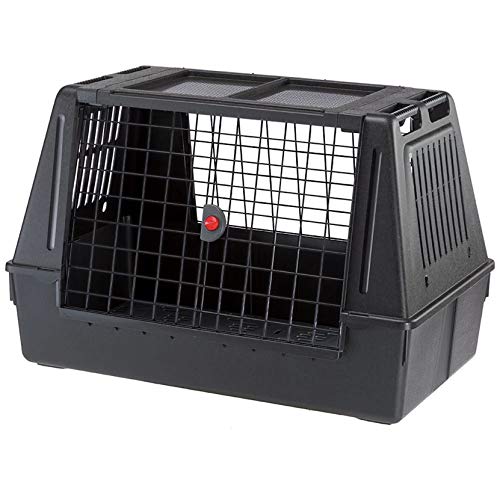 Ferplast Atlas Vehicle SUV Dog Crate
- Atlas 100 SUV dog crate is designed specifically…
- SUV dog crate measures 39 length x 23…
- Great ventilation: Atlas car dog crate features strong…
 MidWest Homes for Pets Solutions Series Side-by-Side
- Designed for Vehicles: Specially made to fit SUVs,…
- Dual Door Access: Features doors on both ends-use…
- Space-Saving Crate Design: Narrower than standard crates to…
| Product | Key specs | |
|---|---|---|
| MidWest Homes for Pets Solutions Series Large | Designed for Vehicles: Specially made to fit SUVs,… Dual Door Access: Features doors on both ends-use… Space-Saving Crate Design: Narrower than standard crates to… | Check price |
| Ferplast Atlas Vehicle SUV Dog Crate | Atlas 100 SUV dog crate is designed specifically… SUV dog crate measures 39 length x 23… Great ventilation: Atlas car dog crate features strong… | Check price |
| MidWest Homes for Pets Solutions Series Side-by-Side | Designed for Vehicles: Specially made to fit SUVs,… Dual Door Access: Features doors on both ends-use… Space-Saving Crate Design: Narrower than standard crates to… | Check price |
 Ferplast Atlas Vehicle SUV Dog Crate | Atlas 80 SUV dog crate is designed specifically… SUV dog crate measures 32 length x 20… Great ventilation: Atlas car dog crate features strong… | Check price |
As an Amazon Associate we earn from qualifying purchases at no extra cost to you.
Shortlist by situation
- Choose the MIM Variocage if crash documentation comes first. MIM describes its Variocage line as crash-tested and offers multiple sizes, adjustable depth, and a separation door on some versions. Confirm that the documentation covers the exact model and installation configuration you plan to use.
- Consider a Ruff Land Performance Kennel for lighter-duty, frequent handling. Its molded-plastic construction is lighter than a typical aluminum crate and comes in different sizes. Do not assume that a product’s durability or marketing language is equivalent to a vehicle-crash test; request model-specific test details if crash performance is a deciding factor.
- For a custom cargo layout, consider an aluminum specialist such as TNC Fabrication. Custom sizing can help use a wide or irregular cargo area, but ask for written test documentation for the exact crate, mounting points, and vehicle setup. Custom fit alone does not establish crash safety.
Comparison: fit, weight, doors, and evidence
Published specifications and product configurations can change. The figures below are screening information, not a substitute for checking the current manufacturer sheet for the exact size you intend to order. Where a manufacturer does not give one universal dimension or weight for a product family, the table says so rather than implying a single specification.
| Product | Construction | Size and weight information | Crash documentation to verify | Door and installation considerations |
|---|---|---|---|---|
| MIM Variocage | Aluminum frame and panels | Multiple size configurations; depth is adjustable on applicable models. Dimensions and weight vary by configuration. | Manufacturer describes the line as crash-tested. Request the report or test summary for the exact model and ask what vehicle, restraint, and loading conditions were used. | Single- and double-crate arrangements are available. Confirm door swing, divider position, and required tie-down points. |
| Ruff Land Performance Kennel | Rotomolded plastic, not aluminum | Multiple kennel sizes; dimensions and weight vary by size. Check the current size chart against your dog and cargo area. | Do not infer crash-test status from the brand or material. Ask whether the precise model has been tested and request the test scope in writing. | Door options vary by model and configuration. Its lighter body can be easier to move, but secure installation still matters. |
| TNC Fabrication aluminum crates | Aluminum, with configurations that can be made to suit a vehicle or dog | Dimensions and weight depend on the order; obtain a drawing and finished weight before purchase. | Ask for model-specific independent crash-test evidence and clarify whether the mounts and vehicle attachment method were part of the test. | Confirm door location and opening clearance with a cargo-area drawing; custom geometry can solve fit problems but may limit resale. |
These products are not equivalent crash-tested aluminum alternatives: Ruff Land is included as a practical lightweight comparison, not as an aluminum pick. If a seller cannot provide clear evidence for a crash-safety claim, treat the crate as an unverified travel kennel rather than a documented crash-tested option.
Measure the SUV before choosing a crate
A crate can fit through the hatch and still be unusable once installed. Measure the narrowest width between interior trim, the floor-to-ceiling height at the intended position, and cargo depth from the seatback to the closed hatch. Repeat the depth measurement at crate-floor height: sloping seatbacks and hatch glass often make the upper space shorter.
Next, check the loaded crate’s route into the vehicle. Measure the hatch opening diagonally as well as horizontally and vertically; a large crate may fit inside the cargo area but not pass through the opening. Account for seats that fold, trim bulges, the cargo cover, and any equipment that must stay accessible.
For the dog, compare the crate’s usable interior—not its outside dimensions—with the dog’s standing height and body length. The dog should be able to stand naturally, turn around, and lie down. Follow the manufacturer’s size guidance, especially if a divider changes the usable space. A crate that is too tight can restrict movement; one that is excessively spacious may allow more movement during abrupt deceleration.
Decision matrix: which trade-off fits your use?
| Your situation | Prioritize | Practical direction |
|---|---|---|
| Frequent highway travel; safety evidence is the deciding factor | Test documentation, correct size, vehicle-compatible mounts | Start with the MIM Variocage and verify the report and installation details for your configuration. |
| Small cargo area or sloped hatch | Adjustable depth, narrow external width, door clearance | Compare dimensioned drawings and test-fit measurements before choosing; do not buy by dog weight alone. |
| Crate is regularly lifted in and out | Finished weight, handles, simple latches | Compare an aluminum model’s actual listed weight with a lighter molded kennel, while keeping crash evidence as a separate criterion. |
| Two dogs travel together | Separate compartments, independent access, total cargo footprint | Look at a double configuration only if each dog has adequate usable space and the full crate can be properly secured. |
| Irregular cargo space or specialized fit | Accurate drawings, door location, mounting plan | Ask a custom fabricator for a dimensioned proposal and written safety evidence before placing an order. |
Crash-test claims: what to ask the seller
“Crash tested” is not a complete specification. Request the test date, testing organization, test method, crate size and model, restraint or anchor arrangement, and whether the crate was tested in a vehicle or on a sled. Ask what dummy or load was used and whether the test assessed crate integrity, door retention, or the forces on an animal. A result for one size or mount setup may not apply to another.
Also distinguish the crate from the vehicle’s cargo attachment points. A strong enclosure attached to weak or incompatible anchors can still move in a collision. Follow both the crate maker’s installation instructions and your vehicle manual; do not improvise with bungee cords or unverified anchor locations. A crate is one part of a travel-safety setup, not a guarantee of injury prevention.
Installation and ownership details that matter
- Check the door path. Open the hatch and crate door fully before loading the dog. A door that strikes the hatch trim or is blocked by luggage can become difficult to use in a hurry.
- Use the specified hardware. Confirm whether the crate includes straps, brackets, or vehicle-specific fittings. If hardware is sold separately, get the exact part numbers and permitted anchor locations.
- Secure loose items. Bags, tools, and cargo can become hazards if they shift. Keep the crate’s ventilation openings clear rather than packing gear against its sides.
- Inspect moving parts. Door latches, hinges, adjustment rails, and mounting hardware are likely wear points. Check for looseness, corrosion, damaged threads, or a latch that no longer closes positively.
- Clean without damaging finishes. Remove bedding and debris, wash with a mild cleaner, and dry metal surfaces and joints. Avoid harsh chemicals unless the manufacturer confirms they are compatible with the finish and hardware.
Aluminum keeps weight manageable and resists ordinary corrosion, but panels, welds, and fasteners can still deform, loosen, or wear. Recheck the crate after removal and reinstallment, after a hard impact, and periodically during routine vehicle maintenance. Replace damaged hardware with approved parts rather than assuming a visually similar fastener is suitable.
Bottom line
For shoppers specifically seeking a documented crash-tested aluminum crate, put the MIM Variocage near the top of the shortlist, then verify the exact test evidence, dimensions, and mounting setup before purchase. Choose by measured SUV fit and installation compatibility first; compare door access and weight next. If no candidate has documentation for the configuration you need, it is safer to acknowledge that gap than to treat “heavy-duty” or “aluminum” as proof of crash performance.





