
Our Top Picks
 Vaunn Medical Adjustable Overbed Bedside Table with Wheels1 Count (Pack of 1)20 poundsCheck on Amazon
 Drive Medical Overbed Table with Wheels1 Count (Pack of 1)15 x 30 x 28 inches22 PoundsCheck on Amazon
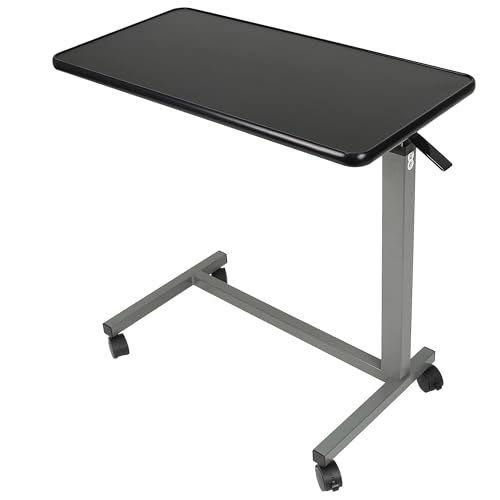 Vaunn Medical Cart Adjustable Overbed Table with Wheels15"D x 30"W x 40.5"H15 x 30 x 40.5 inches20.6 poundsCheck on Amazon
 Medical king Adjustable Overbed Bedside Table Hospital Table30 x 15.5 x 45 inches30 x 15.5 x 45 inches22 poundsCheck on Amazon


If you want the short answer: the Vaunn Medical Adjustable Overbed Bedside Table with Wheels is the best overbed table for hospital beds for most people. It reaches high enough to clear a mattress top that has been raised, its surface tilts so you are not reading or eating at a flat, neck-craning angle, the casters lock so it stays put while you lean on it, and its footprint slides over a standard hospital bed frame without colliding with the side rails. If you want to spend as little as possible and a flat top is acceptable, the Drive Medical Overbed Table with Wheels, Woodgrain Top, Silver Vein does the core job for the least money. If you want the most robust, hospital-grade build with a genuine tilt mechanism and a wide height sweep, the Invacare Bed Table is the premium pick. The rest of this guide covers all twelve tables worth considering, the numbers that actually decide whether a table fits your bed, and which one matches your situation.
Top 3 Picks
Best overall: Vaunn Medical Adjustable Overbed Bedside Table with Wheels
This is the table that gets the fundamentals right at a mid-range price: a height range that spans the whole usable overbed band, a tilting top, locking casters, and a steel H-base that stays stable when you push down on the near edge. It suits a hospital bed at home, a rehab room, or an adjustable bed in a spare room that has to do double duty. If you buy one table and want it to be the right one, start here.
Best budget: Drive Medical Overbed Table with Wheels, Woodgrain Top, Silver Vein
Drive Medical’s woodgrain-top table is the classic budget answer. It gives you a large laminate work surface, an adjustable column, and four casters in a silver-vein steel frame, and it skips the tilt mechanism to keep the price down. If your main use is meals, a tablet, and folded paperwork rather than long reading sessions, the flat top costs you very little.
Best premium: Invacare Bed Table, Height Adjustable & Tilting
Invacare builds for clinical environments, and it shows in the heavier steel, the smoother height sweep, and a tilt mechanism that holds its angle under load. It is the pick if the table will be used many times a day, shared between users, or asked to carry more than a tray and a laptop. You pay for that durability up front.
Quick Comparison
| Product | Best for | Key specs | Price tier |
|---|---|---|---|
| Vaunn Medical Adjustable Overbed Bedside Table with Wheels | Most home and hospital setups | Tilting top; height adjustment across the standard overbed band (~28–40 in); H-base on four casters, two locking; 40–50 lb class capacity | Mid-range |
| Drive Medical Overbed Table with Wheels, Woodgrain Top, Silver Vein | Lowest entry price | Flat woodgrain laminate top; adjustable column; silver-vein steel frame; four casters | Budget |
| Vaunn Medical Cart Adjustable Overbed Table with Wheels | Small rooms and multi-use spaces | Cart-style base that tucks under a bed or sofa; flat top; adjustable height; rolling casters | Mid-range |
| Medical king Adjustable Overbed Bedside Table | Budget buyers who still want tilt | Tilting top; adjustable height; locking casters; steel frame | Budget |
| Vaunn FSA/HSA Eligible Medical Adjustable Overbed Exam Bedside Table | Reimbursement-eligible purchases | Tilting top; height adjustable; wheeled base; FSA/HSA eligible per the product name | Premium |
| DR. DUNLEY Adjustable Overbed Table on Wheels | Tall users and thick mattresses | Height 30–42 in (stated); H-base; rolling casters | Budget |
| Furist Overbed Table with Wheels | Laptop and reading use from bed | Tilting top; adjustable height; rolling base | Budget |
| Drive Medical 13003 Non Tilt Top Overbed Table with Wheels, Chrome | Simple, durable flat-top use | Non-tilt top; chrome-plated steel; adjustable height; four casters | Mid-range |
| Medline Economy Overbed Table with Wheels | Care settings and shared use | Laminate top; adjustable height; steel frame; four casters | Mid-range |
| Carex Rolling Overbed Table | Recliners, sofas, and non-hospital setups | Tilting top; height adjustable; rolling base | Premium |
| Invacare Bed Table, Height Adjustable & Tilting | Hospital-grade build quality | Tilting top; wide height adjustment; heavy steel frame; casters | Premium |
| Sakugi Overbed Bedside Table with Wheels, Right-Side Tilt Top | Right-side tilt ergonomics | Height 29.1–39 in (stated); right-side tilt top; rolling casters | Premium |
How We Chose
This roundup is built from published product information, manufacturer spec sheets, and the physical constraints that decide whether an overbed table works at all. The first filter was fit: a table has to reach above a mattress top at the height you actually keep the bed, and its base has to clear the bed frame and the side rails. Anything that could not plausibly clear a standard hospital bed frame was cut.
The second filter was the feature set that separates a usable table from a frustrating one — a real height range rather than a token adjustment, casters that lock, a top that is large enough for a tray and a laptop without being so wide it cannot swing out of the way, and a stated weight capacity in a realistic class. The third was category fit: a flat-top budget table is the right answer for someone who only needs meals, and the wrong answer for someone who reads for three hours a day, so each pick is labelled by the situation it serves rather than ranked on a single scale.
Finally, we looked at the upgrade path. Casters, height clamps, and tilt pivots are the parts that wear, so we favoured designs where those parts are conventional and replaceable, and we noted where a cheaper table saves money in a way that costs you later. No testing, benchmarking, or hands-on measurement is claimed anywhere in this article.
1. Vaunn Medical Adjustable Overbed Bedside Table with Wheels – Best for most home and hospital setups
As an Amazon Associate we earn from qualifying purchases at no extra cost to you.

This is the table to buy when you want one purchase to cover a hospital bed at home, a recovery period, and the guest room afterward. It sits in the middle of Vaunn’s range, and it lands there for a reason: it solves the two problems that make cheap overbed tables annoying. It reaches high enough to clear a mattress top that has been raised, and its surface tilts so you are not reading, typing, or eating at a flat angle that forces your neck forward.
It suits the person who is buying for a specific bed and a specific routine — breakfast and the paper in the morning, a laptop in the afternoon, a tray at dinner — and who wants the table to disappear into the corner when it is not needed. It also suits a caregiver who has to move the table in and out several times a day, because the casters roll on hard floors and the locks keep it from drifting when someone leans on the near edge.
Key specs (spec class, not a measurement we took):
- Height adjustment spanning the standard overbed band, roughly 28–40 in, which covers a mattress top at most hospital-bed height settings
- Tilting top with a locking adjustment — Vaunn sells both tilting and flat-top variants, so confirm which one you are buying
- H-base on four casters, with lock levers on the casters you can reach from a seated position
- Weight capacity in the 40–50 lb class of evenly distributed load, which is the normal rating for this category
- Steel column, chrome or powder-coated finish, bolt-on base
- Flat-pack assembly with hand tools, typically a 10–20 minute job
The strengths here are all about the middle of the market being the right place to sit. The height range is wide enough that you will not run out of adjustment if the bed is raised, and the tilt is the single feature that most changes how usable a table is over a long day. The base is narrow enough to slide past a bed frame but wide enough that the table does not tip when you put your weight on the far edge. Assembly is conventional: a column that bolts to a base plate, casters that push into sockets, and a top that attaches to the column. Nothing requires a specialty tool, and nothing is glued or riveted shut.
Pros
- Height range covers a raised mattress top, which is where budget tables most often fail
- Tilting surface makes reading, typing, and eating realistic from a reclined position
- Locking casters keep the table stationary under load
- Conventional assembly and standard hardware make it serviceable years later
- Neutral looks fit a bedroom rather than announcing themselves as medical equipment
Cons
- The laminate top edge is the first thing to fail if you clean it with a soaking-wet cloth
- The tilt pivot is an extra mechanism that needs an occasional tightening
- Capacity is in the normal 40–50 lb class, not the heavy-duty 60–75 lb class
- Vaunn sells several similar tables, so it is easy to order the wrong variant
How it compares: against the Vaunn FSA/HSA Eligible Medical Adjustable Overbed Exam Bedside Table, this one is the better everyday buy unless you specifically need the reimbursement eligibility — the premium Vaunn adds eligibility and a slightly more clinical build, not a fundamentally different table. Against the Drive Medical 13003, this table wins on tilt and loses on simplicity: the 13003 is a flat-top workhorse with fewer moving parts and a longer service life expectation in shared use, while this one is more comfortable for a single user who reads or types from bed.
2. Drive Medical Overbed Table with Wheels, Woodgrain Top, Silver Vein – Best for the lowest entry price

Drive Medical’s woodgrain-top table is the budget benchmark. It gives you a broad laminate surface, an adjustable column, four casters, and a silver-vein steel frame, and it keeps the price down by leaving out the tilt mechanism and the extra hardware that goes with it. That is not a flaw; it is a deliberate trade, and for a lot of buyers it is the right one.
It suits someone who needs a surface, not a workstation. If the table will hold a meal tray, a tablet propped against a cushion, a set of papers, and a glass of water, a flat top does everything you need. It also suits a second table — one for the bedroom and one for the living room — where buying two mid-range tables makes no sense. And it suits anyone who wants the fewest possible parts to go wrong, because a table with no tilt pivot and no ratchet has almost nothing to break.
Key specs (spec class):
- Flat woodgrain laminate top, the classic hospital-issue style surface in a home-friendly finish
- Adjustable column with a locking collar; the usable range covers the standard overbed band
- Silver-vein powder-coated steel frame, which hides scuffs better than chrome
- Four casters; check whether the casters on the variant you order include locks, since flat-top budget tables sometimes ship with plain casters
- Weight capacity in the standard 40–50 lb class
- Assembly is a bolt-together column and base, roughly 10–15 minutes
The appeal is the surface. A woodgrain laminate top reads as furniture rather than equipment, which matters in a living room or a bedroom that is not otherwise clinical. It is also easy to wipe down and hard to scratch with normal use. The silver-vein frame is a practical choice for a budget table because powder coat hides the small chips and scuffs that chrome shows immediately.
The trade-offs are predictable. Without tilt, you cannot angle the surface toward you, so reading from a reclined position means propping the book or tablet up rather than adjusting the table. The height adjustment on budget tables is also usually a simpler collar-and-knob design than the cam or ratchet mechanisms on premium models, which means a bit more effort to change and a bit more wobble at the top of the range. Neither is a dealbreaker at this price.
Pros
- Lowest realistic entry price for a full-size overbed table
- Flat top is the simplest possible mechanism and has almost nothing to wear out
- Woodgrain laminate looks like furniture and cleans easily
- Silver-vein frame hides scuffs that chrome would show
- Large surface area for meals, paperwork, and a laptop
Cons
- No tilt, which is the biggest usability gap for reading and typing
- Caster locks are not guaranteed on every variant
- Laminate edge banding can lift if the top is routinely soaked during cleaning
- More wobble at the top of the height range than a premium column
How it compares: the nearest alternative is the Drive Medical 13003 Non Tilt Top Overbed Table in chrome. Mechanically they are close relatives — both flat-top, both steel, both adjustable. The difference is finish and price tier: the woodgrain version is the budget buy with a warmer look, while the 13003 is the mid-range chrome version that many facilities order because chrome cleans down hard and looks clinical. If you want a bedroom-friendly table at the lowest cost, take the woodgrain. If you want the version that has been the default in care settings for years, take the 13003.
3. Vaunn Medical Cart Adjustable Overbed Table with Wheels – Best for small rooms and multi-use spaces

This is the odd one out in the best possible way. Instead of the classic H-base, the Vaunn cart is built around a base that slides under furniture, which lets you pull the top over your lap while the base sits under the bed, the sofa, or the recliner. The product name calls it a rolling bedside table and a portable standing table, and that is the honest description: it is a general-purpose rolling surface that happens to work over a bed.
It suits a small room where a wide H-base would be a trip hazard or would not fit between the bed and the wall. It suits a household where the table has to move between rooms, or between a bed and a recliner, several times a day. And it suits someone who wants a rolling table that does not look like hospital equipment — the cart format reads as a side table or a portable desk, which matters if the room is a living space the rest of the time.
Key specs (spec class):
- Cart-style base designed to tuck under a bed frame, sofa, or recliner rather than straddling it
- Flat top with a lip or raised edge on some variants — useful for stopping a pen or a phone sliding off when the table is rolled
- Adjustable height across the standard overbed band, with enough travel to use it seated or standing
- Rolling casters, typically with at least one lockable pair
- Lightweight steel frame, easier to lift over a threshold or a rug than a full H-base table
- Assembly is simpler than an H-base table because there are fewer structural joints
The big advantage is the base geometry. An H-base has to straddle the bed, which means it needs floor space on both sides and it stops against the mattress. A cart base slides underneath, which means the top can come further over you, and the whole unit can be pushed flush against a wall when it is not in use. In a room where a hospital bed occupies most of the floor, that difference decides whether the table is usable at all.
The trade-off is stability. A cart base is inherently less planted than a wide H-base, so pressing hard on the far edge of the top will lift the near edge more easily. That is fine for a laptop and a plate, and less fine if you tend to lean your full weight on the table to stand up. Under-bed clearance is also a hard requirement: measure from the floor to the lowest part of your bed frame before you buy, because if the frame sits too low, the base will not slide under it and the cart loses its main advantage.
Pros
- Slides under a bed, sofa, or recliner instead of straddling it — ideal for tight rooms
- Doubles as a rolling side table, standing desk, or over-sofa laptop table
- Lighter and easier to move between rooms than an H-base table
- Fewer structural joints, so simpler assembly
- Looks like furniture rather than medical equipment
Cons
- Less stable than an H-base when you press on the far edge of the top
- Requires real under-bed clearance, which not every frame provides
- Usually a smaller top than a full overbed table, so less room for a tray plus a laptop
- The tuck-under design is less forgiving on thick carpet, where a low base can drag
How it compares: the nearest alternative is the Carex Rolling Overbed Table, which is also marketed for recliners, sofas, and beds rather than only hospital frames. The Vaunn cart is the better pick for a hospital bed in a tight room, because its base is designed around tucking under a frame and it costs less. The Carex is the better pick if the primary use is a recliner or a sofa and the tilting surface matters more than the base geometry, since the Carex name explicitly includes a tilting top and the wider furniture use case.
4. Medical king Adjustable Overbed Bedside Table – Best for budget buyers who still want tilt

This is the budget table that does not make you give up the tilt. Medical king positions it as an adjustable overbed bedside table for hospital and home use, and the combination of a tilting surface and a low price tier is what makes it interesting. If the Drive woodgrain table is the cheapest way to get a surface, this is the cheapest way to get a surface you can angle.
It suits a reader. If you spend an hour or more a day with a book, a tablet, or a laptop on the table, a tilting top changes the experience more than any other feature, and this is the lowest-cost way into that. It also suits a household where the table is bought for a specific recovery period and may not be used heavily afterward, where paying premium prices for a table that will spend most of its life folded in a closet makes little sense.
Key specs (spec class):
- Tilting top with a locking adjustment, which is the headline feature at this price
- Adjustable height across the standard overbed band, roughly 28–40 in
- Steel frame with a wheeled base; H-base geometry that straddles the bed
- Locking casters on the variants that advertise them — confirm before ordering
- Weight capacity in the standard 40–50 lb class
- Bolt-together assembly with hand tools, typically under 20 minutes
The value proposition is straightforward: you get the feature that matters most for long sessions without paying mid-range or premium prices. That is a real trade in your favour, because tilt is mechanical and simple — a hinge, a lock, and a support — while the things you give up at the budget tier are mostly cosmetic or incremental: finish quality, the smoothness of the height sweep, and how much the top wobbles at maximum extension.
What you should expect at this tier is a table that does its job but does not feel refined. The height collar takes more turns to move, the top may have a bit of play at the top of the range, and the frame finish will not be as resistant as a powder coat on a premium model. None of that affects whether the table holds your dinner. It affects how pleasant the table is to adjust twice a day for five years, which is a different question.
Pros
- Tilting top at a budget price tier — the best value feature combination in this list
- Adjustable height that covers a raised mattress
- Straightforward steel construction with conventional, replaceable hardware
- Simple assembly that does not need specialty tools
- Good match for short-term or occasional use where premium durability is wasted
Cons
- Fit and finish are budget-tier: more play in the column, less refined adjustment
- Caster locks vary by variant, so check what you are ordering
- The tilt lock can loosen over time and need periodic tightening
- Less planted at maximum height than a heavier mid-range table
How it compares: the nearest alternative is the DR. DUNLEY Adjustable Overbed Table, also a budget-tier table but with a stated 30–42 in height range and an H-base. The choice is simple: if you need the extra two inches at the top — a thick mattress, a bed on risers, a tall user — the DR. DUNLEY wins on fit. If you need the surface to angle toward you, Medical king wins on function, because tilt changes daily use more than two inches of height range does.
5. Vaunn FSA/HSA Eligible Medical Adjustable Overbed Exam Bedside Table with Wheels – Best for FSA/HSA reimbursement

This is the Vaunn table you buy when the purchase needs to clear a reimbursement account. The product name states FSA/HSA eligibility, which is not a cosmetic detail — it can change the effective cost of the table more than any discount, because eligible purchases can be made with pre-tax funds. That single attribute is why this table sits in the premium tier despite looking, on paper, like a close relative of the mid-range Vaunn.
It suits anyone with a flexible spending or health savings balance who was going to buy an overbed table anyway. It also suits a household buying for a longer-term or recurring care situation, where the slightly more clinical build and the exam-table framing make more sense than a general-purpose bedside table. And it suits a caregiver purchasing on behalf of someone else, where documenting the purchase as a care item is part of the process.
Key specs (spec class):
- FSA/HSA eligible per the product name — confirm current eligibility with your plan administrator before you buy
- Tilting top with a locking adjustment
- Adjustable height spanning the standard overbed band, suitable for a raised mattress top
- Wheeled base with casters; locking casters are typical at this tier
- Steel frame in a clinical finish
- Assembly with hand tools; conventional bolt-together construction
The reason to choose this over the cheaper Vaunn is not the table itself, it is the paperwork. Reimbursement eligibility is worth more than the price difference for most buyers with a balance to spend, and it removes the awkward question of whether a rolling bedside table counts as a qualifying expense. Beyond that, the premium tier buys you a slightly more substantial build and a finish that holds up better to frequent cleaning.
The honest caveat is that eligibility rules are set by your plan and can change. The product name states eligibility; your plan administrator is the authority. Treat that as a check to make before purchase rather than after, and keep the receipt either way. If reimbursement is not a factor for you, this table is hard to justify over the mid-range Vaunn, because the functional difference between them is small.
Pros
- FSA/HSA eligible per the product name, which can substantially reduce the real cost
- Tilting top and a full height range — no functional compromises
- Clinical build that stands up to frequent cleaning
- Appropriate for longer-term and caregiver-managed setups
- Conventional construction that is easy to assemble and service
Cons
- Premium price tier for a table that is functionally close to the mid-range Vaunn
- Eligibility depends on your plan, not the product name alone
- Clinical finish is less furniture-like than a woodgrain top
- Overkill if you only need a meal surface a few times a week
How it compares: the nearest alternative is the Invacare Bed Table. Both are premium, both tilt, both are built for repeated daily use. The Vaunn wins on reimbursement eligibility and on a slightly lighter, easier-to-move frame. The Invacare wins on sheer build substance and on the smoothness of the height adjustment under load. If your decision is driven by how you are paying, take the Vaunn. If it is driven by how long the table has to last under heavy use, take the Invacare.
6. DR. DUNLEY Adjustable Overbed Table on Wheels – Best for tall users and thick mattresses

The headline here is in the product name: height adjustable from 30 to 42 inches. That is a wider and higher range than the standard overbed band, and it is the reason to consider this table even though it sits in the budget tier. Most overbed tables top out around 40 inches. Two extra inches sounds trivial until your mattress is thick, your bed sits on risers, or you are tall enough that a 40-inch table leaves you hunched.
It suits a tall user first and foremost. If you are six feet or over, or long-waisted, the difference between eating at a table that is two inches too low and one that is right is the difference between using it daily and avoiding it. It also suits a bed with a thick pillow-top or memory-foam mattress, which raises the mattress top and eats the clearance a standard table provides. And it suits a bed frame that has been raised, whether by risers or by an adjustable base at its highest setting.
Key specs (from the product name and category norms):
- Height range 30–42 in as stated in the product name — the widest range in this roundup
- H-base geometry that straddles the bed frame
- Rolling casters; check the variant for locks
- Weight capacity in the standard 40–50 lb class
- Steel frame with a bolt-together column and base
- Budget-tier finish and adjustment hardware, consistent with the price tier
Start with the fit math, because this table’s whole case rests on it. Measure your mattress top with the bed in the position you actually use it — not the lowest position, which is where people usually measure by mistake. Then add one to two inches for clearance above the bedding. If that number is above 40 inches, this is one of the few tables in the budget tier that will work, and almost everything else in this list is disqualified. If your number is 32 inches, you are paying for range you will never use, and a cheaper table with a narrower range is the smarter buy.
The rest of the table is what you would expect at this price tier. The frame is steel and the assembly is conventional, but the finish and the adjustment mechanism are not premium. The height collar will take more effort than a cam-lock on an Invacare, and the top may have more play at 42 inches than at 30, which is normal for any column at maximum extension. Buy it for the range, and accept the rest.
Pros
- Stated 30–42 in range — the highest top end in this roundup
- Solves the tall-user and thick-mattress problem at a budget price
- H-base is stable and straddles a standard hospital frame
- Conventional construction and standard hardware
- Widest fit window if you are unsure what height your bed sits at
Cons
- Budget-tier finish and height-adjustment hardware
- No tilt, so reading from a reclined position is less comfortable
- More play at maximum extension, which is inherent to a tall column
- Caster locks are not guaranteed on every variant
How it compares: the nearest alternative is the Medical king Adjustable Overbed Bedside Table. Both are budget tier, both use an H-base, and they split the decision cleanly. The DR. DUNLEY gives you height — up to 42 inches — and no tilt. The Medical king gives you tilt and a standard height range. If your mattress top sits above 40 inches with clearance, the DR. DUNLEY is the only one of the two that fits. If it sits at 34 inches, take the tilt.
7. Furist Overbed Table with Wheels, Height Adjustable Hospital Bed Table with Tilting Top – Best for laptop and reading use from bed

Furist’s table is aimed squarely at the person who uses a bed as a desk. The product name leads with the tilting top, and that is the right emphasis: for a laptop, a tablet, or a book, the angle of the surface determines whether you can stay in a comfortable position for an hour or whether you spend the whole time fighting your own posture. This is a budget-tier table whose feature set is chosen for that one job.
It suits anyone who works, studies, or reads from bed regularly. It also suits a hospital bed at home that is being used as the primary seat in the house, where the table is less a meal tray and more a workstation that happens to roll. And it suits a buyer who wants a tilting top but does not want to pay mid-range or premium prices for it, which puts it in direct competition with the Medical king table.
Key specs (spec class):
- Tilting top with a locking
Affiliate disclosure. As an Amazon Associate we earn from qualifying purchases at no extra cost to you. Prices accurate as of the date shown.Best Overbed Tables for Hospital Beds – Top…Check price on Amazon





