
Our Top Picks




If you want one answer: the Sparthos Rotator Cuff Shoulder Brace is the best overall pick for most people who need everyday rotator cuff support. It is a single universal size, reversible to either shoulder, adjustable at both the chest and the upper arm, low enough to wear under a shirt, and priced in the budget tier — which means you can try it without much risk. If you would rather have a sized fit and a firmer, more structured hold for sport, the FIGHTECH Rotator Cuff Shoulder Brace comes in four sizes and sits at the premium tier. If inflammation is as much of a problem as instability, the Arctic Flex Shoulder Ice Pack Brace combines compression with a reusable cold gel wrap. Everyone else in this roundup solves a narrower problem: side-specific support, immobilization with a sling, or a brace built specifically for training. The rest of this article explains the compression levels, strap systems, materials and sizing numbers behind those picks so you can match one to your own situation rather than to a marketing label.
Updated October 2026 — Quick answer for anyone searching for the best shoulder braces for rotator cuff support: the Sparthos Rotator Cuff Shoulder Brace is the best all-round pick, the FIGHTECH Rotator Cuff Shoulder Brace (4 Sizes) is the best sized fit for sport, and the Arctic Flex Shoulder Ice Pack Brace is the best choice when you want cold therapy built in. Tears that are large or freshly repaired need a different tool, so this guide also covers slings and structured stabilizers.
Top 3 Picks
Best overall: Sparthos Rotator Cuff Shoulder Brace. A universal, reversible compression brace that adjusts at the chest and arm, sits flat under clothing, and costs the least of anything here. It suits the widest range of buyers because it does not commit you to a side, a size, or a sport.
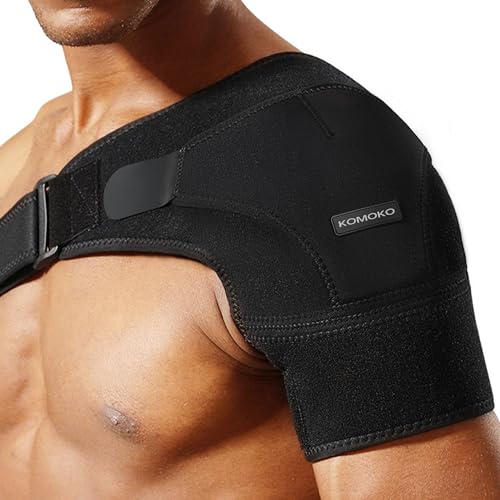
Best budget: Komoko Shoulder Brace, Rotator Cuff Support Brace and Arm Sling. Budget-tier pricing with two functions in one package — a compression sleeve plus an arm sling for the days when you need the arm supported and rested rather than merely compressed. The sling is the differentiator at this price.
Best premium: FIGHTECH Rotator Cuff Shoulder Brace (4 Sizes). Sized rather than universal, which is the single biggest upgrade you can buy in this category. A sized brace distributes strap tension more evenly, holds its position through movement, and is the better choice if you plan to wear it during sport or long workdays.
Quick Comparison
| Product | Best for | Key specs | Price tier |
|---|---|---|---|
| Sparthos Rotator Cuff Shoulder Brace | Everyday wear, first brace, sleeping and desk work | Universal (UNI) size; reversible; chest and arm hook-and-loop straps; neoprene-blend panel; gray | Budget |
| FIGHTECH Rotator Cuff Shoulder Brace (4 Sizes) | Precision fit, sport, long wear days | Four sizes (S–XL class); sized chest band; adjustable upper-arm strap; neoprene; black; listing shown is the large | Premium |
| Arctic Flex Shoulder Ice Pack Brace | Cold therapy plus compression in one wrap | Reusable gel pack; wrap-style fit; adjustable straps; compression plus cold; refreezable | Mid-range |
| BraceUP Shoulder Brace with Ice Pack Pocket | Side-specific support with optional cold | Left- or right-specific cut; dedicated ice pack pocket; adjustable straps; budget construction | Budget |
| Komoko Shoulder Brace and Arm Sling | Rested immobilization after a flare-up | Compression sleeve plus detachable arm sling; adjustable; single-size class; budget materials | Budget |
| FIGHTECH Shoulder Brace for Injury Support | AC joint, dislocation and post-injury support | Sized fit; cross-body strap configuration; neoprene; designed for higher-support needs | Premium |
| CDFZ Rotator Cuff Shoulder Support | Sports and training sessions | Compression sleeve style; adjustable straps; breathable knit panel; mid-range build | Mid-range |
How We Chose
This roundup is built from published product specifications, brand sizing documentation, and established category knowledge about how shoulder braces are constructed — not from bench work or wear trials. The selection criteria were: whether the brace solves a distinct problem (daily compression, cold therapy, immobilization, sport, side-specific support); whether the strap system can actually be adjusted by one person without help; whether the material class suits the use case, since neoprene and breathable knits trade off warmth against airflow; whether the fit model is sized or universal, because that drives comfort more than any other single spec; and whether there is a sensible upgrade path — a buyer who outgrows a universal budget brace should be able to move up to a sized premium one, or across to a cold-therapy model, without leaving the category. Price tiers are given as budget, mid-range and premium because retail prices move daily and a hard number ages badly. Nothing here is medical advice; if you have a suspected tear, a dislocation, or pain that is getting worse, see a clinician before choosing a brace.
1. Sparthos Rotator Cuff Shoulder Brace – Best for All-Day Wear on a Budget
As an Amazon Associate we earn from qualifying purchases at no extra cost to you.

The Sparthos brace is the one to start with when you know your shoulder needs support but you do not yet know how much. It arrives in a single universal size in gray, uses hook-and-loop straps to adjust both the chest band and the upper-arm strap, and is cut so it can be worn on either shoulder without needing a second person to help you fasten it. That combination — one size, one price, either side — is why it takes the overall pick.
Who it suits: someone in the early weeks of a rotator cuff problem who wants light-to-moderate compression during desk work, driving, light chores or sleep; anyone who wants a spare brace to leave in a gym bag or at the office; and anyone who has been advised to use a supportive brace but has not been pointed at a specific model. It is also the sensible first purchase if you are not sure whether compression helps you at all, because the budget tier means the experiment costs little.
Key specs
- Fit: single universal (UNI) size, adjustable via straps
- Handedness: reversible — fits either shoulder
- Closure: hook-and-loop straps at the chest band and upper arm
- Compression: adjustable, light to moderate range
- Material class: neoprene-blend panel with elastic strapping
- Profile: low, intended to sit under a shirt
- Color: gray
- Care: hand wash cool, air dry, closure fastened during washing
The strength of this brace is its adjustability per dollar. A universal fit is often dismissed as a compromise, but on a shoulder it works better than it does on a knee or an ankle, because the chest band does most of the anchoring and the chest is a far more forgiving circumference than a joint. You set the chest strap once, then use the arm strap to dial compression up for activity and down for rest. That two-strap layout is the minimum viable design for a rotator cuff brace, and Sparthos includes it at the lowest tier.
The second strength is the low profile. Braces that are thick or heavily padded get taken off after an hour because they print through a shirt or bunch under a jacket. A flatter panel means more wear time, and more wear time is what actually produces the benefit of compression — consistency, not intensity. If your plan is to wear the brace through a workday rather than for a twenty-minute session, profile matters more than any single spec on the box.
Where it gives ground is breathability and fit precision. Neoprene-blend panels hold warmth, which is pleasant in a cold office and less pleasant in summer or during exercise. And a universal size cannot be perfect for everyone: the further your chest circumference sits from the middle of the intended range, the more the strap has to take up the slack, and long straps tend to migrate.
Pros
- Lowest-cost way to find out whether compression helps your shoulder
- Reversible, so it works on either side and can be handed to a family member
- Two-point adjustment (chest plus arm) is the right minimum design
- Low profile enough for all-day and under-clothing wear
- Simple enough that you will actually put it on
Cons
- Universal sizing will not suit every body; very small or very large chests may need a sized brace
- Neoprene-blend fabric runs warm and holds sweat
- No cold therapy, no sling, no sport-specific reinforcement
- Budget elastic and closures are the first things to wear out
How it compares: against the FIGHTECH four-size brace, the Sparthos trades fit precision for price and convenience. If your chest measurement sits comfortably inside a universal range and you want one brace for the whole day, Sparthos is the better buy. If you have already tried a universal brace and found it slid, bunched, or needed re-tightening every hour, the FIGHTECH sized option is the upgrade that fixes exactly that problem. Against the Komoko sleeve-and-sling, Sparthos is the lighter, more wearable everyday option, while Komoko is the one you reach for when the arm needs to be taken out of play entirely.
2. FIGHTECH Rotator Cuff Shoulder Brace (4 Sizes) – Best for a Precision Fit in Sport

The FIGHTECH Rotator Cuff Shoulder Brace is the premium pick because it is sold in four sizes rather than one. The version shown in the listing is the large, black, with the brand’s multi-strap layout and a neoprene construction. If you have ever worn a universal brace that felt like it was either cutting in or sliding down, sizing is the fix, and this is the brace in this roundup that offers it.
Who it suits: athletes and active people who need the brace to stay put through movement; anyone with a chest circumference near the edges of a universal range; people who wear a brace for six or more hours a day and are tired of re-tightening; and anyone whose clinician has recommended a more supportive brace than a simple sleeve. It is also the right choice for someone who has already used a budget brace successfully and wants to upgrade rather than replace a failing one.
Key specs
- Fit: four-size range (S through XL class), so you choose by measurement rather than by default
- Listing shown: black, large
- Straps: adjustable chest band plus upper-arm strap, designed to be set by the wearer
- Material class: neoprene with elastic strapping
- Support level: moderate to firm, higher than a plain compression sleeve
- Use case: sport, training, long wear days, general rotator cuff support
- Price tier: premium
The reason sizing matters more than any other specification is mechanical. A shoulder brace holds by wrapping the chest and then pulling the upper arm slightly in and back. If the chest band is too long, the closure sits off-center and the whole wrap rotates during arm movement; if it is too short, the band digs into the ribs and you loosen it, which defeats the purpose. A sized brace puts the closure near the middle of its adjustment range, where hook-and-loop holds best and where the elastic has the most room to accommodate swelling, layers, and the difference between a morning fit and an evening fit.
The second advantage is tension distribution. With a properly sized band, the compression is spread across a wider area of the chest and back rather than concentrated at one strap line. That is the difference between a brace you forget about and one that leaves a red mark. For sport, this matters even more: a brace that shifts under a throwing or swinging motion is worse than no brace, because you end up adjusting it mid-session.
The trade-offs are price and warmth. Premium pricing buys sizing, stitching quality, and a stronger closure system, but the neoprene construction still runs warm, and this is not a breathable mesh design. If you overheat easily or plan to wear it under a heavy uniform, look at the CDFZ sports brace instead. And if you are only going to wear a brace for an hour a day at a desk, the extra money spent on a sized premium fit is hard to justify.
Pros
- Four sizes means the closure sits mid-range, where it holds best
- Stays in position through arm movement, which is the key sport requirement
- Firmer support than a sleeve-style brace without being rigid
- Better stitching and closure hardware than budget alternatives
- Clear upgrade path for anyone who outgrew a universal brace
Cons
- Premium price for what is still a soft brace, not a rigid immobilizer
- Neoprene holds heat and moisture
- You must measure before ordering; a wrong size wastes the advantage
- Overkill for light, occasional, at-desk use
How it compares: the nearest alternative is the second FIGHTECH brace in this list, the injury-support model aimed at AC joint and dislocation support. That one is built for higher-support needs and a cross-body strap configuration; this one is built for rotator cuff support and movement. If your priority is holding the shoulder in a supported position after an injury, take the injury-support model. If your priority is training and daily activity with the joint held in a better position, this is the one. Against the Sparthos, it is simply the same idea executed with better fit and better materials, at a higher price.
3. Arctic Flex Shoulder Ice Pack Brace – Best for Cold Therapy Plus Compression

The Arctic Flex Shoulder Ice Pack Brace does two jobs at once: it wraps the shoulder in adjustable compression and holds a reusable gel pack against the joint. That combination is the reason it earns a place in this roundup even though it is a different kind of product from the fabric braces above. For the phase of a shoulder problem where swelling and irritation are the main complaint, cold plus compression in a single wearable wrap is more practical than juggling a separate ice bag and a strap.
Who it suits: anyone whose clinician has recommended cold therapy; people in the first days after a strain or flare-up; anyone doing post-exercise recovery work; and anyone who finds that a plain compression brace feels good but does not address the heat and throbbing that come with activity. It is also useful as a second brace alongside a fabric one, so you have a cold option for the evening and a compression option for the day.
Key specs
- Type: wrap-style brace with an integrated reusable gel pack
- Therapy: cold (freeze the pack) with adjustable compression
- Fit: adjustable straps; wrap design sized to the shoulder rather than the chest
- Reusability: gel pack refreezes and can be reused repeatedly
- Material class: soft fabric wrap with a gel-filled insert
- Price tier: mid-range
The practical detail that determines whether a cold wrap gets used is how long it stays cold and how well it stays in place. Gel packs in this class typically hold useful cold for roughly 15 to 30 minutes depending on pack mass, freezer temperature, and how much fabric sits between the pack and the skin. That matches the usual guidance for cold application, which is short blocks rather than long ones, with a barrier layer such as a thin cloth between the pack and bare skin. A wrap that stays where you put it means you can sit, read, or work while it does its job, which is a large part of why people actually finish a cold-therapy routine.
The compression side is genuinely useful too. An adjustable wrap applies circumferential pressure, which is the same mechanism a fabric brace uses; the difference is that this one is designed around a pack rather than around all-day wear. That makes it comfortable for a 20-minute session and less ideal for an eight-hour shift, because the gel insert adds bulk and the wrap is not cut to disappear under a shirt.
Its limits are straightforward. It is not a structural brace: it will not hold the humeral head in a better position the way a properly tensioned chest-and-arm strap will. The gel pack is also a consumable in the sense that seams and the gel itself are what eventually fail, so treat the wrap gently and follow the brand’s freeze and cleaning instructions. If you need support during activity rather than cold afterward, this is the wrong tool.
Pros
- Cold therapy and compression in one wearable wrap instead of two separate items
- Reusable gel pack, so no ongoing consumable cost
- Adjustable straps let you set compression separately from pack placement
- Useful as a complement to a fabric brace rather than a replacement
- Mid-range price for a two-function product
Cons
- Not a structural support brace; it will not stabilize the joint under load
- Bulky compared with a plain compression brace
- Cold duration is finite and requires planning around the freezer
- Gel pack seams are a known wear point in this product class
How it compares: the closest alternative is the BraceUP Shoulder Brace with Ice Pack Pocket, which is the budget route to the same idea. BraceUP uses a pocket you fill with your own cold source and is cut left- or right-specific, which gives a more anatomical fit; Arctic Flex ships with its own reusable gel pack and a simpler universal wrap. If you want a lower entry price and already own a gel pack or cold pack, BraceUP is the smarter buy. If you want the pack included and a wrap designed around it, Arctic Flex is the cleaner package. Neither one replaces a compression brace for activity — they replace the ice bag on the couch.
4. BraceUP Shoulder Brace with Ice Pack Pocket – Best for Side-Specific Support

The BraceUP Shoulder Brace is built around a simple, sensible idea: a compression brace with a dedicated pocket for a cold pack, cut specifically for the left or the right shoulder. That side-specific cut is unusual at the budget tier, where most braces are universal, and it is the main reason this one stands out.
Who it suits: someone who knows exactly which shoulder is the problem and wants the brace to follow the anatomy of that side rather than adapt to it; anyone who wants the option of cold therapy without buying a separate gel-pack product; and budget-conscious buyers who would rather put money into fit than into branding. It also suits people who own a reusable cold pack already and just need somewhere to put it.
Key specs
- Fit: left- or right-specific cut — you choose a side when ordering
- Cold therapy: integrated ice pack pocket (pack not necessarily included; check the listing)
- Straps: adjustable, chest and arm
- Material class: neoprene-style panel with elastic strapping
- Support level: light to moderate compression
- Price tier: budget
Side-specific cutting matters more than it sounds. A shoulder brace has to route a strap across the back and over the opposite side of the chest, and the geometry of that path is not symmetrical — the strap leaves the shoulder at a different angle depending on which side you are bracing. A universal brace handles this by making the strap long and letting you thread it either way, which works but tends to put the buckle off-center. A side-specific cut puts the panel and the strap exits where they belong, so the closure lands closer to the front of the chest and the whole wrap resists rotating.
The pocket is the second feature worth understanding. A pocket design lets you use your own cold source, which means you can use a gel pack, a freezer bag of ice wrapped in a cloth, or a microwaveable pack if your clinician prefers heat. It also means the brace is still a brace when the pocket is empty, which is the real advantage over a dedicated cold wrap: you own one item that does two jobs, and the compression function does not depend on the freezer.
The compromises are typical of the budget tier. The fabric and closures are functional rather than refined, the neoprene panel runs warm, and a pocket adds a layer of bulk over the joint. Because the pack is not integrated, you also have to be careful about how much material sits between the cold source and your skin — always use a barrier and keep sessions short.
Pros
- Left/right-specific cut gives better strap routing than a universal brace
- Ice pack pocket accepts your own cold (or heat) source
- Works as a plain compression brace when the pocket is empty
- Budget price with a feature usually found higher up the range
- Straightforward two-strap adjustment
Cons
- Cold source not always included, so read the listing carefully
- Budget fabric and closure quality; expect a shorter service life
- Pocket adds bulk under clothing
- You must commit to a side, so it cannot be shared or swapped
How it compares: against the Arctic Flex cold wrap, BraceUP is the budget route with a better anatomical fit but no included gel pack. Against the Sparthos universal brace, BraceUP gives up reversibility and gains side-specific routing plus cold capability — a good trade if you know your side and want both functions in one item. If you are unsure which shoulder you will need to brace, or you want one brace that anyone in the house can use, the Sparthos is the more flexible purchase.
5. Komoko Shoulder Brace and Arm Sling – Best for Resting the Arm After a Flare-Up

The Komoko Shoulder Brace is a compression sleeve for the shoulder with a detachable arm sling. That second component is what separates it from everything else here. Most braces hold the joint in a supported position while your arm keeps working; a sling takes the arm out of the equation so the shoulder can rest. Having both in one budget-priced package is genuinely useful during the acute phase of a shoulder problem.
Who it suits: anyone whose clinician has advised resting the arm in a supported position; people in the first days after a strain or a flare-up of an old injury; anyone recovering from a period of overuse who needs to stop using the arm for a few days rather than merely support it; and anyone who wants one item that can switch between “supported and active” and “supported and resting” without buying two products.
Key specs
- Type: shoulder compression sleeve with a detachable arm sling
- Modes: compression only, or compression plus sling support
- Fit: adjustable straps; single-size class
- Material class: elastic knit sleeve with a fabric sling
- Support level: light to moderate compression; sling provides positional support
- Price tier: budget
The case for a sling is easy to underestimate. A compression brace encourages you to keep moving with support, which is usually the right long-term strategy. But there is a phase where movement itself is the problem, and during that phase the useful thing is to take the weight of the arm off the shoulder. A sling does that by supporting the forearm and elbow, which reduces the downward pull on the shoulder joint. Because the sling here is detachable, you are not locked into that mode — you can wear the sleeve for a workday and add the sling for the commute home, or use the sling for a few hours and then take it off.
Practically, the sleeve itself is a light-to-moderate compression garment rather than a strap-and-bandage brace. That means it wraps the shoulder more continuously and tends to be more comfortable against the skin for long stretches, but it has less ability to pull the upper arm into a specific position than a chest-and-arm strap design. For straightforward compression, that is fine. For positional support, the sling does the work.
The trade-offs are the usual budget ones, plus a specific caution: slings are not meant to be worn indefinitely, because prolonged immobilization can stiffen a shoulder. Follow whatever schedule you have been given, and if you have not been given one, ask before you make a sling your default. The knit sleeve also loses its rebound with repeated washing and stretching, and the sling strap is the part most likely to fray first.
Pros
- Two functions in one budget-priced product: compression and sling support
- Detachable sling lets you switch modes through the day
- Knit sleeve is comfortable against the skin for long wear
- Good option for the acute phase, when rest matters more than activity
- Simple to put on without help
Cons
- Less positional control than a strap-based brace
- Sling should not be worn for long stretches without guidance
- Budget knit loses elasticity over time
- Single-size class will not suit every body type
How it compares: the nearest alternative in this list is the FIGHTECH injury-support brace, which is the premium route to higher-support needs. FIGHTECH gives you a sized, structured, strap-based hold designed for AC joint and dislocation support; Komoko gives you lighter compression plus the option to fully rest the arm, at a fraction of the price. If your clinician wants the shoulder held in a specific position, the structured premium brace is the better match. If you mainly need to stop using the arm for a few days while keeping light compression on the joint, Komoko covers both at the budget tier.
6. FIGHTECH Shoulder Brace for Injury Support – Best for AC Joint and Dislocation Support
This is the second FIGHTECH brace in the roundup and it is aimed at a different job than the first. Where the four-size rotator cuff model is built for support during movement, this one is built for higher-support needs — the listing names torn rotator cuff, AC joint problems, and dislocation among the situations it is designed around. It uses a structured, sized design with a strap configuration intended to hold the shoulder in a supported position rather than simply wrap it.
Who it suits: people recovering from a dislocation or managing an AC joint problem under a clinician’s guidance; anyone who has been told they need more support than a sleeve provides; and people who have tried a light compression brace and found it insufficient. It is a serious brace for a serious shoulder problem, and it is priced accordingly.
Key specs
- Fit: sized construction with adjustable straps (measure before ordering)
- Support level: firm — the highest of the fabric braces in this list
- Strap system: chest band plus cross-body routing to control upper-arm position
- Material class: neoprene with reinforced stitching at the strap anchors
- Use case: AC joint support, post-dislocation support, torn rotator cuff support, general shoulder injury support
- Price tier: premium
What you are paying for here is control over position, not just pressure. A simple compression sleeve squeezes the shoulder evenly; a structured brace with cross-body routing can hold the upper arm slightly in and forward, which is the position many clinicians want for certain shoulder injuries. That is a meaningful mechanical difference, and it is the reason this brace costs more than a sleeve. It is also the reason fit accuracy matters so much: a cross-body strap that is even slightly too long will not hold the position you set, and one that is too short will be uncomfortable enough that you stop wearing it.
The construction is aimed at durability as well. Reinforced stitching at the strap anchors is the detail that separates braces that last a year from braces that last a season, because the anchors take the full load every time you tension the strap. If you are wearing this daily for a multi-month recovery, that matters more than any comfort feature.
The limitations are the ones that come with any soft brace at this support level. It is not a rigid orthosis, so it cannot fully restrict movement, and it will not replace a clinician-directed immobilization device if that is what you have been prescribed. It also runs warm, and the more structured the fit, the more noticeable the bulk under clothing becomes. Expect to wear it over a thin base layer rather than directly under a fitted shirt.
Pros
- Firmest support of the fabric braces here, with positional control
- Sized fit and cross-body routing for higher-support needs
- Reinforced strap anchors hold up to daily tensioning
- Appropriate for the situations its listing names, under professional guidance
- Clear step up from a sleeve for anyone who needs more
Cons
- Premium price
- Bulky relative to a compression sleeve; harder to hide under clothing
- Requires accurate measurement; a wrong size wastes the design advantage
- Not a substitute for a prescribed rigid immobilizer
How it compares: against the four-size FIGHTECH rotator cuff brace, this model is the higher-support sibling. Choose the rotator cuff model if you are active and want support that moves with you; choose this one if you are managing an AC joint problem or recovering from a dislocation and need the shoulder held in position. Against the Komoko sleeve-and-sling, this is the structured alternative: Komoko rests the arm, FIGHTECH controls the shoulder. Some people use both — the sling for the worst days and the structured brace for the return to activity.
7. CDFZ Rotator Cuff Shoulder Support – Best for Sports and Training

The CDFZ Rotator Cuff Shoulder Support is aimed squarely at people who want to keep training. Its listing positions it as a sports brace, and its construction reflects that: a compression sleeve style with adjustable straps and a knit panel rather than a solid neoprene sheet, which trades a little warmth for airflow. For a mid-range price it fills the gap between a bare-bones budget brace and a premium structured one.
Who it suits: gym-goers, runners, cyclists, and recreational athletes who want the shoulder held in a supported position without a brace that overheats or restricts the arm’s range; anyone returning to activity after a shoulder problem who wants reassurance during movement; and people who find solid neoprene braces uncomfortable after an hour of sweating.
Key specs
- Style: compression sleeve with adjustable straps
- Material class: knit/elastic panel, breathable relative to neoprene
- Compression: adjustable, light to moderate
- Fit: strap-adjusted; single-size class
- Use case: sports and training, general rotator cuff support
- Price tier: mid-range
The single most useful thing about a breathable knit construction is that it changes how long you wear the brace. Warm neoprene braces get removed at the first break in a workout and often do not go back on. A knit panel that lets moisture and heat escape stays on for the whole session, and consistency is what compression is for. If you have ever abandoned a brace halfway through a gym session because it felt like a sauna, this is the category to look at.
The second advantage is range of motion. A sleeve-style brace with adjustable straps supports without locking the arm into a single plane, which matters for anything involving overhead movement or rotation. That is also its limitation: it will not hold the shoulder in a specific position the way a cross-body strap design will. Think of it as support that travels with you rather than control that holds you.
Mid-range pricing buys better fabric and a longer service life than the budget tier, but it does not buy the sizing precision of the premium braces. If you are between sizes or near the edge of the intended range, the strap will have to work harder and will need more frequent adjustment. Check the brand’s stated measurement range before ordering, and if you sit outside it, move up to a sized brace.
Pros
- Breathable knit panel is far more comfortable during exercise than neoprene
- Preserves range of motion, so it suits overhead and rotational movement
- Mid-range price with better materials than the budget tier
- Adjustable straps let you loosen between sets and tighten for work
- Good complement to a firmer brace for the rest of the day
Cons
- Less positional control than a structured cross-body brace
- Single-size class; edge-of-range buyers may need something sized
- No cold therapy and no sling
- Light compression only — not enough for higher-support needs
How it compares: the nearest alternative is the FIGHTECH four-size rotator cuff brace. FIGHTECH wins on fit precision and firmness; CDFZ wins on breathability and range of motion, and costs less. If you train hard and sweat heavily, CDFZ is the more wearable choice for sessions, while FIGHTECH is the better choice for the hours around them. Against the Sparthos budget brace, CDFZ is the upgrade you buy when you have decided that a breathable material is worth paying for.
Best Shoulder Braces for Rotator Cuff Support by Budget Tier
Use this tier view to narrow the field fast. Each line gives the key specs of one pick, using the specs listed by the maker.
| Tier | Pick | Key specs |
|---|---|---|
| Budget | Sparthos Rotator Cuff Shoulder Brace | Universal size · reversible · chest and arm straps |
| Budget | Komoko Shoulder Brace and Arm Sling | Compression sleeve · detachable sling · adjustable |
| Mid-range | Shock Doctor Rotator Cuff Shoulder Brace | Stabilizer design · AC joint support · multiple sizes |
| Mid-range | Arctic Flex Shoulder Ice Pack Brace | Compression wrap · reusable cold gel pack |
| Premium | FIGHTECH Rotator Cuff Shoulder Brace (4 Sizes) | Four sizes · sized chest band · adjustable arm strap |
| Premium | Saunders Sully Shoulder Stabilizer Brace | Structured stabilizer · built for instability and strain |
What to expect at the budget tier (under $30)
- One universal size, so strap tension is the only fit control you have.
- Soft neoprene or knit panels that compress and warm the joint but do not block motion.
- Hook-and-loop straps that loosen with washing; plan on a replacement within a season of daily wear.
- Good enough for mild strain, desk work and sleeping comfort; not a substitute for a surgeon-prescribed brace.
What to expect at the mid-range tier
- Added features such as a cold pack pocket, stabilizing straps or an AC joint pad.
- Better stitching and more consistent sizing than the cheapest sleeves.
- A noticeable step in hold for lifting, throwing and overhead work.
What to expect at the premium tier (over $70)
- Sized or structured designs that limit unwanted motion instead of just compressing.
- Materials and straps built for months of daily wear.
- Closer to what a physical therapist would suggest, though a clinician should still guide any post-surgical choice.
More Rotator Cuff Brace Options for Higher-Support Needs
The seven picks above cover mild to moderate problems. These three go further when a soft sleeve is not enough, and the short list after them adds four more worth knowing.
8. Shock Doctor Rotator Cuff Shoulder Brace — Best for Active Stability and AC Joint Support

- Listed as a rotator cuff shoulder stabilizer and AC joint brace for men and women
- Sold in several sizes, so measure against the maker’s chart before ordering
- Designed for sport use, where the arm moves through a wide range
Pros: Stabilizer design rather than a plain sleeve; sport-focused brand; sized fit. Cons: Costs more than universal sleeves; sizing needs care. Skip it if you only need light compression for desk work.
9. Saunders Sully Shoulder Stabilizer Brace — Best for Instability and Muscle Strain

- Listed for posterior instability, anterior instability, muscle strains and rotator cuff deceleration
- Structured stabilizer, not a soft sleeve
- Sold in sizes starting at extra small
Pros: The most structured hold in this guide; made for instability problems. Cons: Premium tier; more strapping to learn. Skip it if your goal is simple warmth and compression.
10. DonJoy UltraSling PRO — Best for Rest After Injury or Repair

- Listed as a shoulder immobilizer and rotator cuff injury sling
- Listing states it puts no pressure on the neck
- Rests the arm instead of moving with it
Pros: Takes load off the shoulder; comfort-focused neck design. Cons: Not for exercise; premium tier. Skip it if your clinician wants you moving the shoulder.
Also Consider
Velpeau Arm Sling Shoulder Immobilizer

Best for budget immobilization after a flare-up. Listed as a sling for rotator cuff, clavicle and elbow support. Trade-off: it limits movement, so it is a short-term tool.
Bauerfeind OmoTrain Shoulder Support

Best for a knit anatomical support worn through the day. Sold in numbered sizes, so use the maker’s chart. Trade-off: premium tier.
Bula Bear Rotator Cuff Shoulder Brace with Copper Fiber
Best for a breathable compression sleeve with copper-fiber fabric. Trade-off: it is a sleeve, so it will not restrict motion.
TheraICE Shoulder Ice Pack Wrap PRO

Best for a dedicated cold wrap that doubles as a compression sleeve. Trade-off: cold packs need freezer time between uses.
How to Choose
Choosing a rotator cuff brace comes down to five variables: what job you need it to do, how the fit model matches your body, how much compression you actually want, what the material does to your skin over a full day, and how the thing is going to wear out. Get those five right and the brand barely matters.
Start with the job, not the product
Shoulder braces in this category fall into four functional groups, and picking the wrong group is the most common mistake. Compression braces hold the joint and encourage supported movement. Cold-therapy wraps reduce heat and irritation after activity. Sling designs rest the arm. Structured, cross-body braces control the position of the upper arm for higher-support needs. Most buyers need the first group and a little of the second. If you are unsure which group you belong to, that is a question for a clinician, not a product page.
| Your situation | Functional group | Suggested pick from this list |
|---|---|---|
| First brace, unsure how much support you need | Universal compression | Sparthos |
| Active, trains or works out, needs the brace to stay put | Sized compression | FIGHTECH four-size |
| Swelling and heat after activity | Cold therapy plus compression | Arctic Flex or BraceUP |
| Knows the side, wants one item for support and cold | Side-specific compression with pocket | BraceUP |
| Advised to rest the arm for a few days | Compression plus sling | Komoko |
| AC joint or post-dislocation, needs positional control | Structured firm support | FIGHTECH injury-support |
| Wants breathability for sweaty sessions | Knit compression sleeve | CDFZ |
Sizing: the numbers that matter
Almost every fit problem in this category traces back to measurement. The chest band does the anchoring, so the number you need is your chest circumference measured at the widest point under the armpits, taken with a soft tape and with the arm relaxed at your side. Measure twice, once in the morning and once in the evening, and use the larger figure — shoulders swell over the course of a day, and a brace that fits at 7 a.m. may be tight at 7 p.m.
Universal or single-size braces typically accommodate a broad band of chest circumferences through strap adjustment, but the further you sit from the middle of that band, the more slack the strap has to absorb and the more often you will re-tighten. Sized braces split the same population into discrete ranges, which puts the closure nearer the middle of its adjustment travel. As a rule of thumb, if your measurement falls within roughly the middle half of a universal brace’s stated range, universal is fine. If you are near either end, buy sized.
| Measurement | How to take it | Why it matters |
|---|---|---|
| Chest circumference | Soft tape under the armpits, arm relaxed, tape level | Determines whether you need universal or sized |
| Upper arm circumference | Mid-bicep, arm relaxed | Determines arm-strap length and whether it will cut in |
| Shoulder-to-shoulder width | Across the back, from one shoulder point to the other | Determines whether a cross-body strap will sit flat |
| Torso length | From the top of the shoulder down to the waist | Determines whether the chest band rides up when you sit |
Compression levels, in plain terms
Compression is not a single setting; it is a range, and most braces let you move along it. Light compression feels like a snug athletic sleeve — noticeable, not restrictive. Moderate compression is a firm, even squeeze that you are aware of but can forget about. Firm compression is a deliberate hold that you notice when you take it off. As a working guide, most people find a brace most useful somewhere between light and moderate for daily wear, and firm only for specific activities or specific clinical instructions.
The practical test is simple: if you can slide two fingers under the chest band without effort, you are at light compression. If you can just barely slip one finger under, you are at moderate to firm. If you cannot get a finger under at all, it is too tight, and over-tightening is the most common self-inflicted problem with shoulder braces — it does not produce more support, it produces a brace you take off.
Materials: what you trade
Neoprene is the default for shoulder braces because it grips, stretches, and holds a shape. It is also warm and does not breathe much. Knit and mesh panels breathe and stay comfortable through exercise but stretch out faster and offer slightly less rebound. Hybrid designs use neoprene where the load is and knit where the skin is. Choose neoprene if you want warmth and firmness and will mostly wear the brace at rest or in cool conditions; choose knit if you will sweat in it.
| Material class | Breathability | Compression feel | Durability | Best for |
|---|---|---|---|---|
| Solid neoprene | Low | Firm, even | High | All-day wear, cooler conditions, firmer support |
| Neoprene blend | Low to moderate | Moderate | Moderate to high | General daily use on a budget |
| Knit / mesh panel | High | Light | Moderate | Sport, sweat, long hot days |
| Fabric wrap with gel insert | Moderate | Moderate, session-based | Moderate; insert is the wear point | Cold therapy sessions |
Strap systems and how they fail
A shoulder brace has to do something structurally awkward: hold a joint that moves in more planes than any other in the body. The strap system is how it copes. A single chest strap is the minimum, and it will migrate on anyone who moves their arm a lot. A chest strap plus an upper-arm strap is the standard design and the one most people should look for. A cross-body routing adds positional control at the cost of complexity and bulk.
The failure mode to watch for is the closure. Hook-and-loop fasteners lose their grip gradually as lint and fabric fibers clog the hooks, and they lose it fastest on braces that are taken on and off several times a day. You can extend the life of a closure substantially by fastening it before washing, washing by hand in cool water, and never putting the brace in a dryer. Heat is what kills elastic; lint is what kills closures.
Cold therapy: the numbers
If you are buying a brace with a cold component, plan around minutes rather than hours. Gel packs in this class typically stay usefully cold for somewhere in the region of 15 to 30 minutes, depending on pack mass and freezer temperature, and most guidance for cold application points to short blocks with a barrier layer between the pack and bare skin rather than one long session. That has two design implications. First, a wrap that stays in place while you sit matters more than a pack that is marginally colder. Second, a pocket design that accepts your own cold source is more flexible than a fixed insert, because you can swap packs and keep going.
Cost per use: a rough calculation
It is worth thinking about braces the way you would think about any other piece of gear: by cost per use, not by sticker price. If the premium brace’s better fit means you actually wear it every day instead of abandoning it after a week, the premium option is cheaper in practice. If you are buying a brace for a two-week flare-up and nothing more, the budget option wins on pure arithmetic.
The same logic applies to the cold-therapy products. A wrap with a reusable gel pack has no ongoing cost beyond electricity for the freezer, while a brace with an empty pocket assumes you already own a cold source. Factor that in before deciding which one is actually cheaper for you.
Durability and ownership: what wears first
Three things fail on a shoulder brace, in this order. First, the closure: hook-and-loop loses grip as it picks up lint, and it is the single most common reason people replace a brace that is otherwise intact. Second, the elastic: repeated stretching and hot washing cause the straps to lose rebound, so the brace feels loose even when fully tensioned. Third, the strap anchors: the stitching where the strap meets the panel takes the entire load every time you put the brace on, and budget construction shows here first.
On cold-therapy products, the gel pack is the consumable. Seams are the weak point, and a pack that has been frozen while folded, or microwaved when it was not designed for it, will fail sooner. Follow the manufacturer’s freeze and heat instructions exactly, and treat the pack as a part you may eventually replace.
Common mistakes
- Wearing it too tight. More tension does not mean more support; it means a brace you remove. Two fingers under the band is the working standard.
- Wearing it too long without a break. Compression braces are usually intended for blocks of wear with the brace off in between, and slings especially should not become a permanent default without guidance.
- Buying universal when you need sized. If you are near either end of a universal range, sized is almost always the better purchase.
- Putting a gel pack directly on skin. Always use a barrier layer, and keep cold sessions short.
- Machine washing and drying. Hand wash cool, fasten the closure first, air dry. This alone can double the service life of a brace.
- Buying a brace instead of getting a diagnosis. A brace manages symptoms. It does not tell you what is wrong with your shoulder, and it will not fix a structural problem.
What is the best shoulder brace for a torn rotator cuff?
For a partial tear, a sized stabilizer such as the FIGHTECH Rotator Cuff Shoulder Brace or the Saunders Sully is a sensible start; a large or repaired tear needs the sling or brace your surgeon specifies. Compression sleeves reduce strain but do not heal a tear, so treat them as support, not treatment.
Is a sling or a compression brace better for a rotator cuff injury?
A sling is better when the arm needs rest, and a compression brace is better when you need to keep moving. Many people use a sling in the first days and switch to a brace as pain settles, following a clinician’s advice.
Frequently Asked Questions
How tight should a rotator cuff shoulder brace be?
Snug enough that you can just slide one or two fingers under the chest band, and no tighter. That is roughly the light-to-moderate compression range, which is where most people get the most benefit for daily wear. If you cannot get a finger under the band, it is too tight and you will end up taking the brace off, which defeats the purpose. Adjust the arm strap separately from the chest strap so you can dial support up for activity and down for rest.
Should I wear a shoulder brace all day, or only during activity?
It depends on what the brace is for. For general compression support, many people wear a brace through the working day and take it off in the evening, or wear it during specific activities only. Sling designs are different: they are usually intended for shorter periods, because long stretches of immobilization can stiffen a shoulder. If you have been given a wear schedule by a clinician, follow that rather than a general rule.
Do I need a sized brace or will a universal one do?
Measure your chest circumference under the armpits first. If your measurement sits comfortably in the middle of the universal brace’s stated range, a universal fit is fine and you save money. If you are near either end of that range, or you have already used a universal brace and found it slid or needed constant re-tightening, buy sized. Sizing is the single biggest upgrade available in this category, and it costs less than most people expect.
Is a compression brace or a cold therapy wrap better for a rotator cuff problem?
They do different jobs, so the honest answer is that many people benefit from both. Compression supports the joint and encourages supported movement; cold therapy addresses heat, swelling and irritation, usually in short sessions after activity. If you can only buy one, buy compression, because it is the one you will wear during the day. If swelling and post-activity discomfort are your main complaints, add a cold wrap as a second item.
How long does a gel pack stay cold in a shoulder ice pack brace?
Expect useful cold for roughly 15 to 30 minutes, depending on the mass of the pack, how cold your freezer runs, and how much fabric sits between the pack and your skin. That aligns with the usual guidance to apply cold in short blocks rather than one long session. Always use a thin barrier layer between the pack and bare skin, and let the skin return to normal temperature between sessions.
Can I wear a shoulder brace under my clothes?
Yes, and several of the braces here are specifically designed for it. Low-profile neoprene and knit designs sit flat enough to disappear under a shirt or a light sweater. Structured, firm-support braces and cold-therapy wraps with gel inserts are bulkier and are usually worn over a thin base layer or over clothing rather than under it. If discreet wear is a priority, profile matters more than any other spec.
How do I stop my shoulder brace from sliding down?
Three fixes, in order of effectiveness. First, check your size: sliding is usually a sizing problem, not a strap problem. Second, tighten the chest band before the arm strap, because the chest band is what anchors everything else. Third, check that the brace is positioned correctly — the panel should sit over the top and back of the shoulder, not down the front of the upper arm. If it still migrates after all three, the brace is the wrong shape for your build.
How should I wash and store a shoulder brace?
Fasten the closures, hand wash in cool water with a mild detergent, rinse thoroughly, and air dry flat away from direct heat. Never put a brace in a dryer — heat is what destroys the elastic that gives a brace its compression. Store it flat or loosely rolled with the closures fastened, so the hook side does not snag the fabric. Done consistently, this is the cheapest way to get a longer service life out of any brace in this list.
When should I see a professional instead of buying a brace?
See a clinician if you have had a dislocation, if you cannot lift your arm, if there is visible deformity, if pain is worsening rather than settling, or if you have numbness or tingling in the arm or hand. A brace is a support tool, not a diagnosis. For anything beyond mild, gradually improving discomfort, a professional assessment should come before a product purchase.
The Short Version, by Reader Situation
If you are buying your first brace and just want to know whether compression helps, get the Sparthos Rotator Cuff Shoulder Brace. It is reversible, adjustable at two points, low profile, and budget-priced, which makes it the lowest-risk experiment in this roundup.
If you already know compression helps but your universal brace keeps sliding or needing re-tightening, step up to the FIGHTECH Rotator Cuff Shoulder Brace in one of its four sizes. Fit precision is the upgrade that fixes the problem you actually have.
If swelling and heat after activity are your main complaints, add the Arctic Flex Shoulder Ice Pack Brace for short cold sessions, or the BraceUP Shoulder Brace with Ice Pack Pocket if you already own a cold pack and prefer a side-specific cut.
If you have been advised to rest the arm, the Komoko Shoulder Brace and Arm Sling gives you compression and sling support in one budget purchase. If you are managing an AC joint problem or recovering from a dislocation and need the shoulder held in position, the FIGHTECH Shoulder Brace for Injury Support is the structured option here.
And if you are training through it, the CDFZ Rotator Cuff Shoulder Support is the breathable, mid-range choice that will still be on your shoulder at the end of a session. Whichever you pick, measure first, size up rather than down when you are between options, and treat the brace as one part of a plan that includes a proper assessment.





