
The best boat stereos for most owners are the Fusion MS-RA210 for a permanent, feature-rich installation, the Fusion MS-RA60 for a compact budget system, and the JL Audio MM50 for a premium helm where readable controls and strong source flexibility matter most.
Our top picks
 Pyle Marine Radio Stereo Receiver with Bluetooth
- Enjoy wireless audio with this stereo receiver with…
- Stay tuned with a crisp am/fm radio featuring…
- Built as a durable marine stereo, this boat…
 BOSS Audio Systems MCKGB450B.6 Marine Boat Stereo
- Bluetooth - Play and control music through your…
- Weatherproof - The receiver is IPX6 rated to…
- Inputs
 BOSS Audio Systems MCK632WB.6 Marine Bluetooth Stereo
- Multicolor Illumination - Colorize your ride with all…
- Inputs - The USB port gives you the…
- Outputs - Use the front/rear pre-amp outputs to…
| Product | Key specs | |
|---|---|---|
| Pyle Marine Radio Stereo Receiver with Bluetooth | Enjoy wireless audio with this stereo receiver with… Stay tuned with a crisp am/fm radio featuring… Built as a durable marine stereo, this boat… | Check price |
| BOSS Audio Systems MCKGB450B.6 Marine Boat Stereo | Bluetooth - Play and control music through your… Weatherproof - The receiver is IPX6 rated to… Inputs | Check price |
| BOSS Audio Systems MCK632WB.6 Marine Bluetooth Stereo | Multicolor Illumination - Colorize your ride with all… Inputs - The USB port gives you the… Outputs - Use the front/rear pre-amp outputs to… | Check price |
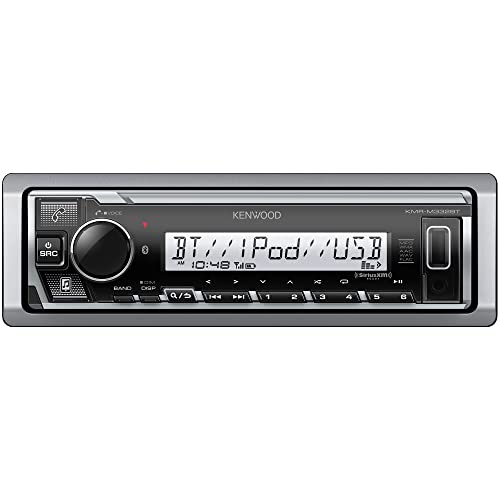 KENWOOD KMR-M332BT Car & Marine Stereo | The high contrast black characters on a white… Enjoy convenient control of popular apps thru your… Sound quality enthusiasts will love the playback support… | Check price |
As an Amazon Associate we earn from qualifying purchases at no extra cost to you.
Best boat stereos at a glance
| Model | Best for | Rated audio output | Sources and connectivity | Marine protection | Typical market range |
|---|---|---|---|---|---|
| Fusion MS-RA60 | Small boats and simple upgrades | 50 W x 4 maximum; about 15 W RMS x 4 | Bluetooth, AM/FM, USB, auxiliary input | Marine-designed chassis, conformal-coated electronics, UV-resistant front | $180–$260 |
| Fusion MS-RA210 | Most fixed installations | 50 W x 4 maximum; about 15 W RMS x 4 | Bluetooth, AM/FM, USB, auxiliary input, Fusion networking | IPX6-rated front panel; marine-rated construction | $300–$430 |
| Rockford Fosgate PMX-3 | Compact helm with larger controls | 50 W x 4 maximum; about 15 W RMS x 4 | Bluetooth, AM/FM, USB, auxiliary input | IPX6-rated front; UV-resistant design | $300–$450 |
| JL Audio MM50 | Premium, highly visible helm systems | 50 W x 4 maximum; about 15 W RMS x 4 | Bluetooth, AM/FM, USB, auxiliary input, zone control | Water-resistant marine face and coated internal electronics | $450–$650 |
| KICKER KMC5 | Large-display value systems | 50 W x 4 maximum; about 15 W RMS x 4 | Bluetooth, AM/FM, USB, auxiliary input | Marine-oriented face and corrosion-resistant construction | $250–$380 |
Manufacturer specifications and package contents can change, so confirm the current manual before cutting the console or ordering a wiring harness. The output figures above are head-unit amplifier ratings; they are not the same as the continuous power rating of the speakers.
Our picks by boating situation
Best overall: Fusion MS-RA210
The MS-RA210 is the safest all-around choice when you want a conventional marine stereo rather than a portable speaker. Its four-channel amplifier can run four modest coaxial speakers, Bluetooth handles everyday phone playback, and the front panel is designed for a wet, bright helm. It also supports Fusion’s marine audio ecosystem, which is useful if you may add a second control station or separate audio zones later.
Choose it for a runabout, fishing boat, or pontoon used regularly throughout the season. Its main limitation is power: 15 watts RMS per channel is adequate for efficient 6.5-inch marine speakers at moderate volume, but it will not deliver clean, high-volume sound across a large deck without a separate amplifier.
Best compact budget choice: Fusion MS-RA60
The MS-RA60 makes sense when the boat has a small dash opening and the priority is dependable Bluetooth playback rather than networking. It provides the core sources most owners use, including Bluetooth, radio, USB, and a wired auxiliary input. The simpler interface is also less intimidating for occasional users.
It is a good fit for two or four speakers on a small boat. Do not select it solely because the maximum wattage matches more expensive units: its real-world continuous output remains in the same modest range, and its long-term volume depends more on speaker sensitivity, enclosure location, and amplifier gain.
Best for a bright, busy helm: JL Audio MM50
The JL Audio MM50 earns its premium position through helm usability and system control. Its display and buttons are intended to remain readable while underway, and zone features make it easier to balance cockpit and bow audio. It is particularly attractive for owners who want a polished installation and expect to operate the stereo while wearing wet or gloved hands.
It is expensive for a four-channel head unit, and it still benefits from an external amplifier when powering multiple speaker pairs. Buy it when control, visibility, and expansion matter more than the lowest installation cost.
Best compact control layout: Rockford Fosgate PMX-3
The PMX-3 is worth considering where the dash has limited depth but you want a full-featured control panel. Its marine-oriented front, Bluetooth, USB, auxiliary input, and four-channel output cover the usual requirements. The physical layout is often easier to use than a tiny waterproof remote paired with a hidden receiver.
As with the other units here, the face rating does not mean the rear wiring can be left exposed. A good installation still needs a drip loop, sealed connections, and a dry mounting location behind the console.
What to compare before buying
Marine rating is more than an IP code
An IPX6 rating generally indicates protection against powerful water jets, not permanent submersion. It does not protect an unsealed wiring harness, an amplifier mounted under a leaking hatch, or a USB socket left open in spray. Look for a marine-specific enclosure, UV-resistant plastics, corrosion-resistant hardware, conformal-coated circuit boards, and a sealed or covered connector area.
The stereo and speakers must be treated as separate components. A marine-rated head unit paired with ordinary indoor speakers is still a weak system. Marine speakers use water-resistant cones, synthetic surrounds, sealed voice-coil assemblies, and grilles designed to tolerate sunlight and salt exposure.
Power: compare RMS, not the largest number
Most marine head units advertise approximately 50 watts per channel maximum but deliver around 15 watts RMS per channel continuously. That is enough for efficient 6.5-inch coaxial speakers at conversational-to-loud levels, especially in a small cockpit. It is not enough for clean output on a large open deck at cruising speed.
If you want four or six speakers, check whether the stereo has preamp outputs for an external marine amplifier. A practical upgrade is a four-channel amplifier rated around 50–75 watts RMS per channel at 4 ohms. Match that figure to the speaker’s RMS rating rather than its peak rating.
Bluetooth is convenient; wired sources are insurance
Bluetooth is the everyday choice, but phones can disconnect, run out of battery, or be damaged by spray. A USB input can charge and play compatible devices, while an auxiliary input provides a simple fallback. AM/FM reception depends heavily on antenna placement; a stereo with excellent Bluetooth will not fix a poorly installed antenna.
For multi-zone boats, check whether volume, source selection, and balance can be controlled independently. Some systems require a compatible network or remote, adding both cost and wiring.
Display readability and controls matter underway
A small display can be adequate at the dock and frustrating in direct sun. Compare button size, knob placement, viewing angle, dimming behavior, and whether the screen can be read through polarized sunglasses. Physical controls are usually preferable to relying entirely on a phone because the phone may be stored in a dry bag or out of reach.
Decision matrix
| Your situation | Recommended direction | Why |
|---|---|---|
| Small boat, two speakers, occasional use | Fusion MS-RA60 | Lower cost and sufficient four-channel output without paying for expansion features |
| Four speakers, regular weekend use | Fusion MS-RA210 | Good source selection, marine protection, and a path to additional zones |
| Large open cockpit or high cruising noise | Any listed head unit plus external amplifier | Continuous amplifier power matters more than changing between similarly rated head units |
| Bright helm or frequent operation underway | JL Audio MM50 or Rockford Fosgate PMX-3 | Prioritizes readable controls and robust front-panel operation |
| Future second helm or multiple zones | Fusion MS-RA210 | Its ecosystem makes later expansion more coherent |
Wiring and installation details that prevent failures
- Measure the cutout and depth. Standard mounting holes are not universal. Allow room behind the unit for the plug, cable bend radius, and ventilation.
- Run a dedicated fused power circuit. Use marine-grade tinned copper wire and size the fuse and conductor according to the manual and cable length. Do not rely on a thin accessory circuit shared with pumps or navigation equipment.
- Make every connection watertight. Use adhesive-lined heat-shrink terminals or sealed marine connectors. Crimped household wire nuts and unsealed twist connections corrode quickly in humid air.
- Protect the rear of the stereo. Route cables downward to form drip loops, keep connectors above bilge water, and seal the mounting surface without blocking any required ventilation.
- Match speakers and amplifier loads. Most marine head units expect 4-ohm speakers. Do not wire multiple speakers in parallel unless the manual confirms the resulting impedance is safe.
- Test before final sealing. Confirm every source, speaker channel, memory setting, and remote function before applying permanent sealant or reinstalling trim.
Ownership realities: what wears first
Sunlight usually degrades rubberized buttons, display coatings, speaker surrounds, and grille plastics before the electronics fail. Salt crystals can also accumulate around USB covers and connectors. After saltwater use, wipe the face and grilles with fresh water on a damp cloth, then dry them. Do not blast the stereo with a pressure washer, and do not spray cleaners directly into buttons or ports.
Keep the USB cover closed when unused, disconnect power before changing wiring, and inspect speaker surrounds at the start of each season. If a speaker sounds distorted, check for a torn surround or loose grille before increasing amplifier gain. Replacing a damaged speaker is usually cheaper than trying to compensate with more power.
Bottom line
For most boats, the Fusion MS-RA210 is the best boat stereo because it combines practical sources, marine protection, clear controls, and useful expansion potential. Choose the Fusion MS-RA60 for a compact, lower-cost installation, the JL Audio MM50 for premium helm usability, or the Rockford Fosgate PMX-3 when its control layout and fit suit your dash. Whichever receiver you buy, spend equal attention on marine-rated speakers, tinned wiring, fusing, drip protection, and UV maintenance; those details determine whether the system still sounds clear after several seasons on the water.





