Key takeaways
- Pro: Switches between propane and butane without adapters.
- Pro: Includes a carrying case that doubles as storage for small canisters.
- Con: Single burner limits you to one pot at a time for family meals.
Choosing the right camping gas stove means balancing output, weight, fuel availability, and how much effort you want to spend keeping food hot and your campsite safe. A bad choice boils water so slowly that your dinner plans fall apart, or it tips over because the legs can’t handle a full pot. A good one heats fast, ignites reliably, and packs down without rattling in your bag all day.
The market splits into two broad camps: single-burner units designed for backpacking and small tasks, and two-burner cooktops built for car camping, tailgating, or emergency home use. Within each camp, BTU output, wind resistance, ignition method, and build quality separate a dependable daily driver from a frustrating purchase. Below we compare eight models spanning under twenty dollars to just over eighty, using published specs and aggregated owner feedback to identify where each one shines and where it lets you down.
As an Amazon Associate we earn from qualifying purchases at no extra cost to you. Product prices and availability are accurate as of the date shown and are subject to change.


![Vivicreate 2 Burner Propane Stove, [20000 BTU] Portable Camping Gas Cooktop with Auto Ignition, Stainless Steel Outdoor Cooker with Regulator & Hose for RV, Backyard, Camping and Emergency Use](https://m.media-amazon.com/images/I/41OK9G+X3XL._SL160_.jpg)

Quick Picks
| Product | Best For | Price |
|---|---|---|
| Gas One GS-3400P | Dual-fuel versatility and emergency kits | $29.99 |
| Coleman Triton 2-Burner | High-output car camping and tailgating | $83.99 |
| Gas One Portable Butane | Simple butane cooking with auto ignition | $24.99 |
| GasOne High Pressure Burner | Wok-style outdoor cooking and boiling | $29.99 |
| Vivicreate Single Butane | Lightweight budget backpacking backup | $19.99 |
| Vivicreate 2-Burner Propane | Stainless steel cooktop on a budget | $40.00 |
| Odoland 3500W Collapsible | Ultralight backpacking with windproof design | $22.79 |
| ODSD 2-Burner Folding | All-in-one camp kitchen kit | $79.99 |
How We Picked
We evaluated every model on four criteria: thermal output and its real-world impact on boil time, fuel type and availability at typical camp stores, portability measured by folded dimensions and weight relative to output, and ignition reliability—specifically whether piezo igniters or manual matches are required. We also weighed owner-reported durability issues, since a stove that corrodes or clogs after a season fails its core purpose. Price was used as a tiebreaker between otherwise comparable units.
The 8 Best Camping Gas Stove in 2026
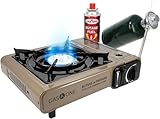
Gas One GS-3400P Dual Fuel Stove
This compact unit accepts both propane and butane canisters, making it the most flexible option for a home emergency preparedness kit or a car-camping shoulder bag. The dual-fuel capability means you grab whichever canister is left on the shelf without worrying about compatibility.
- Pro: Switches between propane and butane without adapters.
- Pro: Includes a carrying case that doubles as storage for small canisters.
- Con: Single burner limits you to one pot at a time for family meals.
Skip it if you routinely cook for more than two people outdoors; you will wish for a second burner.
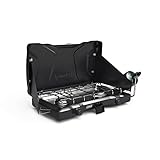
Coleman Triton 2-Burner Propane Stove
With 22,000 total BTUs split across two adjustable burners and integrated wind guards, the Triton is the output king of this list. It is built for base-camp cooking, tailgating, or backyard use where you want stove-like performance without hauling a full kitchen.
- Pro: Highest BTU output here, boiling large pots noticeably faster than competitors.
- Pro: Wind guards are substantial and actually reduce flame blowout on breezy evenings.
- Con: At $83.99 it costs three times more than comparable two-burner units, and it weighs enough that backpacking is out of the question.
Pass if your campsite is a half-mile hike from the car or if budget is your top priority.
Gas One Portable Butane Stove with Case
A straightforward butane-powered unit with automatic ignition and a precise heat-control knob. It targets casual campers who want tabletop cooking without fiddling with propane hoses or regulators.
- Pro: Push-button auto ignition works reliably on the first press, per owner reports.
- Pro: Includes a hard carrying case that protects the stove and a spare canister.
- Con: Butane canisters lose pressure in cold weather, so this stove underperforms below roughly forty degrees Fahrenheit.
Choose something propane-based if you camp in shoulder seasons or high-altitude locations where temperatures dip.
GasOne High Pressure Single Propane Burner
This is a raw propane burner head, not a cooktop. It delivers intense heat through a cast-iron-style burner with a built-in heat shield and guard, designed for seafood boils, turkey frying, home brewing, and wok cooking.
- Pro: Patented high-pressure design produces a focused flame that handles heavy stockpots.
- Pro: The heat shield protects the regulator and hose from radiant heat damage.
- Con: No legs or pot support— you must supply your own stand or use it ground-level.
Skip if you need an all-in-one cooktop; this is a component, not a complete stove.
Vivicreate Portable Butane Stove 8500 BTU
The least expensive entry here at under twenty dollars, this single-burner butane stove includes auto ignition, a safety lock, and a lightweight build. It suits backpackers who want a compact backup burner or casual picnickers.
- Pro: The safety lock prevents accidental gas release, a meaningful feature at this price.
- Pro: Compact and light enough to clip to a pack without noticeable bulk.
- Con: Owner feedback notes inconsistent auto-ignition after several months of storage.
Avoid it as your sole stove for a multi-day trip if reliability matters more than weight savings.
Vivicreate 2-Burner Propane Stove
At $40, this two-burner propane cooktop hits 20,000 BTU total and includes a regulator and hose—hardware that many competitors sell separately. The stainless steel body resists rust better than painted alternatives in this price tier.
- Pro: Ships with regulator and hose included, saving you a separate accessory purchase.
- Pro: Stainless steel construction holds up to scrubbing and outdoor moisture.
- Con: Burner spacing is tight, so large pots on both burners tend to touch or overlap.
Look elsewhere if you routinely cook with oversized skillets or Dutch ovens that need elbow room.
Odoland 3500W Windproof Collapsible Stove
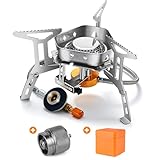
Rated at 3500 watts and folding to roughly the size of a paperback, this backpacking-focused stove includes a fuel canister adapter, piezo ignition, and a carry case. It targets hikers who need a trail-weight burner with wind resistance.
- Pro: Collapses small and light enough for any pack without a second thought.
- Pro: Windproof design keeps the flame stable in gusts that snuff cheaper backpacking stoves.
- Con: The included fuel canister adapter can feel loose on threaded canisters, occasionally causing minor leaks.
Consider a dedicated canister stove instead if you prioritize a rock-solid canister connection over multi-fuel flexibility.
ODSD 2-Burner Folding Camp Stove
This green two-burner propane stove delivers 20,000 BTU, includes a windshield, and comes bundled with a frying pan, coffee stand, and carry bag—essentially a starter camp kitchen in one box. It folds flat for car-camping storage.
- Pro: The bundled accessories eliminate the need to source a pan and coffee maker separately.
- Pro: Integrated windshield and folding legs provide stable cooking in breezy conditions.
- Con: The included pan is thin-gauge and warps over high heat, per several owner reports.
Treat the cookware as a convenience bonus rather than a reason to skip your own better pan.
Buying Guide
Fuel Type and Canister Availability
Propane and butane behave differently in the field. Propane maintains usable pressure down to very low temperatures, making it the default choice for year-round or high-altitude use. Butane canisters are slimmer, often cheaper, and perform well in warm weather but sputter when it gets cold. If you camp across seasons, pick a propane model or a dual-fuel unit like the Gas One GS-3400P. If you only cook at summer festivals or backyard gatherings, butane’s convenience wins.
BTU Output vs. Pot Size
BTU rating tells you how much heat a burner produces, but the practical question is whether it can bring your specific pot to a boil in a reasonable time. Small backpacking pots of about 700 ml need roughly 5,000 to 8,000 BTU. Full-size stockpots for a seafood boil or turkey frying demand 12,000 BTU or more per burner. The GasOne High Pressure Burner and the Coleman Triton cover the upper end; single butane stoves like the Vivicreate serve the lower end well.
Wind Resistance and Ignition Reliability
Wind is the enemy of outdoor cooking. Without a guard, even a moderate breeze steals heat away from your pot base and can blow out a pilot flame. Built-in wind guards, as seen on the Coleman Triton and ODSD model, are more effective than separate shields. For ignition, piezo push-button igniters eliminate the need for matches but can fail after prolonged storage. Manual ignition via a lighter is slower but never runs a battery dry or gets clogged with grease.
Our Verdict
The Coleman Triton 2-Burner earns our top pick for anyone who camps by car and wants reliable, high-output cooking without worrying about wind or fuel logistics. Its 22,000 BTU total and integrated guards set it apart from every other two-burner here, and it earns the price premium through sheer cooking speed.
For budget-conscious buyers, the Vivicreate 2-Burner Propane Stove at $40 delivers solid output, includes a regulator and hose, and uses stainless steel instead of thin painted metal—making it the best value in this roundup.
If your primary scenario is a short hike to a trailside cook spot, the Odoland 3500W wins outright: nothing else on this list folds that small while staying windproof.
FAQ
Can I use a propane camping gas stove indoors during a power outage?
Only in a well-ventilated space, and never in a sealed room. Propane combustion produces carbon monoxide, and any indoor use requires an open window or door plus a working CO detector. Dedicated indoor heaters exist for a reason; a camping stove is a temporary workaround, not a replacement.
How long does a single propane canister last?
A standard one-pound propane cylinder delivers roughly six to eight hours of cooking at moderate heat on a single burner. Running both burners at full output, as on the Coleman Triton, can drain the same canister in under three hours. Carry a spare whenever you plan meals for more than four people.
Are butane stoves safe for backpacking?
They are safe in terms of construction, but butane’s poor cold-weather performance makes it unreliable at altitude or in shoulder seasons. If you backpack only in warm months, a lightweight butane stove like the Vivicreate 8500 BTU is a reasonable choice. For anything beyond fair weather, switch to propane or an isobutane mix.
What is the difference between a burner head and a complete stove?
A burner head, like the GasOne High Pressure model, is the flame-producing component only; you supply your own stand, regulator, and hose. A complete stove integrates legs, a pot support, ignition, and often a case. Burner heads excel at raw heat for big pots but are unsuitable as a turnkey camp cooking solution.