
Our Top Picks
 PetPivot Open Top Self Cleaning Cat Litter BoxOne Size21.06 x 15.75 x 21.85 Inches20.6 PoundsCheck on Amazon


For a multi-cat household, the Neakasa M1 Plus is the best self-cleaning litter box overall: it pairs a large rotating drum with app-based monitoring and a sensor package built to survive the sheer number of cycles that two, three or four cats generate in a day. If you want automation at the lowest sensible cost, the Mimfam open-top automatic is the best budget pick, and if raw capacity is your bottleneck — big cats, big household, fewer bin empties — the Cumrige 95L model is the best premium choice. Everything below is judged on the four things that actually decide whether an automatic box works in a busy home: how long a cleaning cycle takes and how many cycles per day the mechanism must endure, how odor is controlled and where the waste goes, which litter types the mechanism will accept, and waste-bin capacity measured in cat-days rather than litres. Get those four right and a self-cleaning box genuinely reduces daily work. Get them wrong and you have bought an expensive box that jams, smells, or gets refused by your cats.
Top 3 Picks
Best overall: Neakasa M1 Plus Automatic Cat Litter Box. A large-drum automatic with app control and a bundled two-year protection plan, it is the most complete package here for a household running three or more cats. The drum format handles high cycle counts better than rake arms, and the app gives you per-cat weight and usage visibility you cannot get from a box with no electronics.
Best budget: Mimfam Automatic Self Cleaning Litter Box. An open-top automatic with four pairs of infrared sensors and a design explicitly aimed at multi-cat homes, at a budget-tier price. It is the cheapest credible route to hands-off scooping, and the open-top format is the one nervous cats accept most readily.
Best premium for large households: Cumrige Automatic Litter Box. The 95L capacity figure is the headline, and it matters most for large-breed cats and households where you want the longest possible gap between maintenance sessions. App control and a safety sensor round it out.
Quick Comparison
| Product | Best for | Key specs | Price tier |
|---|---|---|---|
| Mimfam Automatic Self Cleaning Litter Box | Budget multi-cat households | Open-top; 4 pairs infrared sensors; multi-cat design; fine clumping clay | Budget |
| Fumoi Automatic Litter Box | App-first buyers who want a washable tray | App control; safety sensor; washable litter tray | Premium |
| Cumrige Automatic Litter Box | Large cats and high-volume homes | 95L capacity; app control; safety sensor | Premium |
| WARCAT Automatic Litter Box | Homes with small children | Open top; child lock; gray & white finish | Budget |
| PetPivot Open Top Self Cleaning Cat Litter Box | Pinch-risk worry | Open top; 7 pairs of safety sensors; anti-pinch design | Premium |
| Omega Paw Roll ‘n Clean Self Cleaning Litter Box, Large | No-power, no-electronics simplicity | Manual roll-to-sift; large size; brown; no sensors or app | Budget |
| OneBug Self Cleaning Open Top Automatic Litter Box | First automatic on a tight budget | Open top; automatic cycle; multiple-cat design; white | Budget |
| PetSafe ScoopFree Crystal Pro Legacy Self-Cleaning Litter Box, Uncovered | Crystal-litter users, single or pair of cats | Uncovered rake system; disposable crystal tray; no app | Mid-range |
| Neakasa M1 Plus Automatic Cat Litter Box | Three-plus cat homes wanting full monitoring | Large rotating drum; app control; 2-year protection plan included | Premium |
| Purina Tidy Cats Breeze Litter Box System Kit, XL | Odor-sensitive owners who accept weekly pad changes | XL box; pellet litter; absorbent pads; no power | Budget |
| PetSafe ScoopFree Disposable Crystal Litter Tray, 6 Pack | Consumable planning for ScoopFree owners | 6 sealed disposable trays; crystal litter; fresh scent | Mid-range |
| PetSafe ScoopFree SmartSpin Waste Bin Liners, 25 Count | Cutting bag changes on a SmartSpin box | 25 liners sized for the SmartSpin waste bin | Budget |
How We Chose
These picks come from comparing published specifications, system architecture and the practical math of multi-cat ownership — not from handling the units. We started with mechanism type, because a rotating drum, a raking arm and a manual roll-to-sift box fail in completely different ways and suit completely different households. From there we looked at litter compatibility, since the single most common reason an automatic box underperforms is that the wrong litter was loaded into it, and at waste storage, because a bin that needs emptying every second day is not really self-cleaning. Sensor count and anti-pinch design were weighted heavily, particularly for homes with kittens, small pets or children, and a child lock counted as a genuine feature rather than a footnote.
We also weighted ownership realities: what wears first, which consumables are mandatory, and whether the replacement parts are the kind you can plan for or the kind that strand the box. Finally, we kept a spread across price tiers so there is a defensible answer whether your ceiling is budget, mid-range or premium, and we included the accessory kits that ScoopFree and SmartSpin owners will need anyway, because consumables are where a self-cleaning box quietly becomes expensive or quietly becomes cheap. Where a specification is not published in a listing, we describe the box by spec class rather than guessing a number.
1. Mimfam Automatic Self Cleaning Litter Box – Best for Budget-Minded Multi-Cat Homes
As an Amazon Associate we earn from qualifying purchases at no extra cost to you.

The Mimfam box is built for the household that wants to stop scooping twice a day but cannot justify a premium price. Its listing describes an open-top automatic design with four pairs of infrared sensors, explicitly aimed at multi-cat homes. That combination — open top plus redundant sensing — is the right shape for a busy household, because open-top boxes get accepted faster by cats that dislike enclosed spaces, and multiple sensor pairs matter when several cats approach the box within seconds of each other.
Key specs at a glance
- Format: open-top automatic, no lid or hood
- Safety sensing: four pairs of infrared sensors
- Intended household: multi-cat
- Litter type: fine-grain clumping clay (the standard for raking automatics)
- Waste storage: internal receptacle under the open pan
- Price tier: budget
In a three-cat home, a box like this typically sees somewhere between ten and fifteen cleaning cycles a day, because each cat visits four to five times. That is the number that governs whether a budget automatic survives. Simple mechanisms with fewer moving parts and a straightforward cycle tend to hold up better at this price point than complex ones, and the Mimfam’s design language suggests a conventional sweep-and-drop cycle rather than anything exotic. The practical consequence is that you should expect to keep the mechanism clean and the litter depth consistent, because a budget automatic is less forgiving of a neglected box than a premium one.
Where it earns its place is the entry price. Four sensor pairs is a real safety feature set at this tier, and the open-top format means you are not fighting a hood that traps odor or frightens a shy cat. It also means you can see at a glance whether the box has cycled, which sounds trivial until you own a closed unit that fails silently. The trade-off is noise and refinement: budget automatics tend to run louder and cycle less gracefully than premium drums, and the waste receptacle is usually smaller, so emptying intervals in a four-cat home can drop to roughly every other day.
Pros
- Lowest-cost credible route to hands-off scooping in a multi-cat home
- Four pairs of infrared sensors is a strong safety spec for the tier
- Open-top design suits cats that refuse hooded boxes
- Simple mechanism with fewer failure points than a drum system
- Easy visual check that the box is cycling normally
Cons
- Smaller waste capacity means more frequent bin empties with four cats
- Budget mechanisms are less tolerant of irregular cleaning and overfilled litter
- No app, so no per-cat weight or usage data
- Open top lets more odor into the room than a sealed drum
- Typically louder in operation than premium units
Against the nearest alternative in this list, the WARCAT open-top automatic, the choice comes down to priorities rather than price. The WARCAT adds a child lock, which matters in a home with toddlers, while the Mimfam leans on sensor redundancy and a multi-cat framing. Against the OneBug, the Mimfam’s four sensor pairs give it the clearer safety story. If you have children and cats, look at the WARCAT. If you simply have several cats and a tight budget, the Mimfam is the more purpose-built answer.
2. Fumoi Automatic Litter Box – Best for App-First Buyers Who Want a Washable Tray

The Fumoi automatic box targets a specific buyer: someone who wants the convenience layer of an app but also wants to be able to take the litter tray out and hose it down. Its listing names a safety sensor, app control and a washable litter tray. That last item is more significant than it first appears, because the tray is where odor compounds and clay dust accumulate fastest, and a removable washable tray turns a chore that most owners avoid into a ten-minute job.
Key specs at a glance
- Format: enclosed automatic with app control
- Safety: dedicated safety sensor
- App: remote status and control
- Litter tray: removable and washable
- Litter type: fine-grain clumping clay
- Price tier: premium
The app is where the value sits for a multi-cat household. A box that reports cycle counts, usage frequency and timing gives you something no amount of watching can match: an early warning. If one cat’s visits drop from five a day to two, or if the box starts cycling twice as often because a cat is urinating more frequently, you see it in the data before you see it in behaviour. That is not a medical diagnosis and it is not a substitute for a vet, but it is a legitimate reason to pay premium pricing — and if you notice a sustained change, the right move is a conversation with your veterinarian rather than a settings tweak.
The washable tray addresses the other premium problem, which is long-term hygiene. Even well-maintained automatics develop a smell layer in the tray that no amount of scooping removes, because clay dust and urine residue bond to the plastic. A tray you can remove and wash resets that clock. Combine it with a sealed waste compartment and you have a box that stays presentable in a living space rather than being exiled to a utility room.
Pros
- App control with usage visibility that helps you spot behaviour changes early
- Removable washable litter tray makes deep cleaning practical
- Safety sensor provides a pause-and-wait behaviour around cats
- Enclosed format contains odor better than open-top rivals
- Premium build tier generally means quieter, smoother cycles
Cons
- Premium pricing puts it well above budget open-top automatics
- App dependency means the box is less useful if your Wi-Fi is unreliable
- Enclosed designs are refused by some cats, particularly shy rescues
- More electronics means more to go wrong than a manual roll box
- Washable tray still needs removing and cleaning on a schedule you have to keep
The nearest alternative here is the Neakasa M1 Plus. Both are premium automatics with app control, but they solve different problems. The Neakasa uses a rotating drum and bundles a two-year protection plan, which suits a household pushing high cycle counts and wanting the longest service life. The Fumoi leans on the washable tray and enclosed format, which suits an owner who cares more about hygiene maintenance and odor containment than about raw throughput. If you have four cats, the Neakasa’s architecture is the safer bet. If you have two and hate scrubbing a fixed tray, the Fumoi is the more thoughtful choice.
3. Cumrige Automatic Litter Box – Best for Large Cats and High-Volume Households

The Cumrige box leads with a number: 95L of capacity. Its listing also names a safety sensor and app control. That capacity figure is the reason to consider it, and it is also the number most likely to be misunderstood. In automatic litter box marketing, “capacity” almost always refers to the litter drum or the overall interior volume — the space the cat occupies and the litter sits in — not to how much waste the bin holds. A 95L drum means a genuinely large interior, which is exactly what a Maine Coon, a big domestic shorthair or a cat that likes to turn around three times before squatting needs.
Key specs at a glance
- Format: enclosed automatic with large interior drum
- Stated capacity: 95L (interior/litter volume class)
- Safety: dedicated safety sensor
- App: remote control and status
- Litter type: fine-grain clumping clay
- Price tier: premium
Interior volume translates directly into litter depth. A large drum lets you run a proper three-inch bed of clumping litter without the box looking overfilled, and depth is what keeps urine from reaching the bottom of the tray and cementing there. Shallow litter is the most common cause of a sticky, smelly automatic box, and it is a problem that disappears when the interior is generous. Larger interiors also reduce the odds of a cat urinating over the edge, which is a real failure mode for big cats in standard-size automatics.
The counterintuitive part is that a bigger box does not automatically mean less frequent maintenance. Waste storage is separate from drum volume, and most automatic waste bins hold somewhere in the range of one litre of clumped waste per cat-day. A bin in the eight-to-ten-litre class therefore buys you roughly two to three days in a three-cat home regardless of how large the drum is. Buy the Cumrige for the cats’ comfort and for fewer edge misses, not because you expect to empty the bin once a week.
Pros
- 95L interior class accommodates large-breed and long cats
- Generous litter depth is easier to maintain, which reduces sticking
- App control adds usage visibility
- Safety sensor pauses the cycle when a cat approaches
- Reduces over-the-edge urination in big cats
Cons
- Large footprint needs real floor space and a clear approach
- Bigger drum means more litter to fill at setup
- Waste bin capacity is still the limiting factor for emptying intervals
- Premium tier pricing
- Heavier to move for cleaning than a compact box
Compared with the Neakasa M1 Plus, the Cumrige is the capacity specialist and the Neakasa is the all-rounder. Both are premium, both have app control and safety sensing. The difference is that the Neakasa adds a bundled two-year protection plan and a drum architecture known for handling high cycle counts, while the Cumrige’s case rests on that 95L interior. If your cats are large, or if you have watched a big cat struggle in a standard automatic, the Cumrige’s volume is worth more than any feature list. If your cats are average-sized and you want the most durable overall package, the Neakasa edges ahead.
4. WARCAT Automatic Litter Box – Best for Homes With Small Children

The WARCAT automatic box is an open-top unit in gray and white with one feature that separates it from every other budget automatic here: a child lock. Its listing names an open top, a child lock and the two-tone finish. For a household with a toddler and a cat, that single feature is the difference between an automatic box being usable and being a liability, because the lock stops small hands from interrupting a cycle or opening a waste compartment mid-operation.
Key specs at a glance
- Format: open-top automatic
- Safety: child lock
- Finish: gray and white
- Litter type: fine-grain clumping clay
- Waste storage: internal receptacle
- Price tier: budget
Beyond the lock, the WARCAT is a conventional open-top automatic: a pan, a sweeping mechanism and a covered waste compartment. That is not a criticism. Open-top automatics are the most forgiving design for cat acceptance, because there is no hood to make a cat feel cornered and no enclosed drum to climb into. For a household that has never used an automatic box, an open-top unit is the lowest-risk starting point, and starting cheap on the first automatic is sensible — you learn whether your cats will tolerate automation at all before committing premium money.
The child lock also functions as a general safety interlock. It prevents the box from being opened while cycling, which matters more than most owners realise: a waste compartment opened mid-cycle can spill clumped waste across the mechanism, and that is one of the fastest ways to foul a rake or sweep arm. Treating the lock as a maintenance feature rather than only a child-safety feature is the right mental model.
Pros
- Child lock is genuinely useful in homes with toddlers
- Open-top design is the easiest format for cats to accept
- Budget pricing makes it a low-risk first automatic
- Lock also prevents accidental mid-cycle opening and spillage
- Neutral gray and white finish fits most rooms
Cons
- No app or usage data
- Open top contains odor less effectively than an enclosed drum
- Budget-tier waste capacity means frequent emptying in larger households
- Fewer documented sensor pairs than the PetPivot or Mimfam
- No washable tray or premium cleaning conveniences
Against the Mimfam, which is the closest budget open-top rival, the WARCAT trades sensor redundancy for the child lock. The Mimfam names four pairs of infrared sensors; the WARCAT names a lock. If your household has both small children and multiple cats, you have to pick which risk worries you more, and honestly the answer is the lock, because a cat interrupting a cycle is a nuisance while a child interrupting a cycle is a hazard. Against the PetPivot, which names seven pairs of safety sensors and an anti-pinch design, the WARCAT is the cheaper, simpler box with one distinctive feature rather than a sensor-rich premium one.
5. PetPivot Open Top Self Cleaning Cat Litter Box – Best for Pinch-Risk Worry

The PetPivot box is the safety-spec leader in this list, naming seven pairs of safety sensors and an anti-pinch design in an open-top format. For an owner whose main hesitation about automatic boxes is the idea of a mechanism moving near a cat, that specification is the entire argument. Seven sensor pairs means the box is checking multiple zones rather than a single beam, which reduces the chance of a cycle starting while a cat is partially inside.
Key specs at a glance
- Format: open-top self-cleaning automatic
- Safety: seven pairs of safety sensors
- Design feature: anti-pinch mechanism
- Litter type: fine-grain clumping clay
- Waste storage: internal covered receptacle
- Price tier: premium
Safety sensing in automatic boxes works on a delay-and-confirm principle: the box detects that a cat has left, waits, then confirms the interior is clear before starting. More sensor pairs shrink the blind spots in that confirmation step. In a multi-cat home, this matters more than in a single-cat home, because cats queue. One cat leaves, another walks in three seconds later, and a box with a short confirmation window and sparse sensing is the one that gets itself into trouble. The PetPivot’s sensor count is a direct answer to that scenario.
Anti-pinch design addresses the other half of the problem. Even a well-sensed mechanism can encounter a tail, a paw or a curious nose at the edge of its travel. An anti-pinch architecture means the moving parts are shaped and sequenced so there is no scissoring gap where a body part can be caught. Combined with seven sensor pairs, this is the most conservative safety package in the roundup, and it is worth paying premium pricing for if you have kittens approaching the size threshold or a household with a lot of traffic around the box.
Pros
- Seven pairs of safety sensors is the strongest sensing spec here
- Anti-pinch design reduces the worst-case mechanical risk
- Open-top format is easy for cats to accept
- Suits busy multi-cat homes where cats queue for the box
- Premium build tier generally means quieter, more consistent cycles
Cons
- Premium pricing for an open-top box
- No app or usage monitoring mentioned in the listing
- Open top means less odor containment than a sealed drum
- Sensor lenses need regular dusting to keep working reliably
- More sensors means more components that can be fouled by clay dust
Against the WARCAT, the comparison is straightforward: both are open-top automatics, but the WARCAT is budget and offers a child lock, while the PetPivot is premium and offers seven sensor pairs plus anti-pinch geometry. Choose the WARCAT if the risk in your home is a toddler; choose the PetPivot if the risk is a busy cat household with kittens or small pets. Against the Mimfam, the PetPivot is the same idea executed with more sensing and a higher price — a reasonable upgrade if safety is the criterion you weight most heavily.
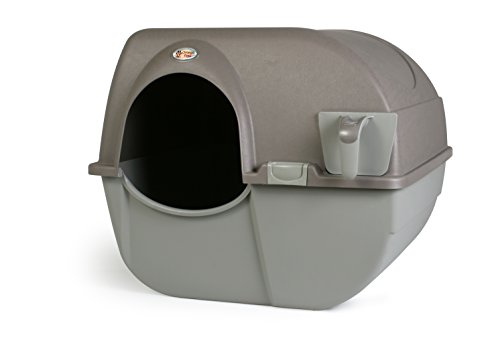
6. Omega Paw Roll ‘n Clean Self Cleaning Litter Box, Large – Best for No-Power Simplicity
The Omega Paw Roll ‘n Clean is the odd one out and deliberately so. It is a large brown box with no motor, no sensors, no app and no power requirement. Cleaning works by rolling the entire box onto its side and back, which sifts clean litter through a grate while clumps and solids drop into a separate internal tray. You then roll it upright, pull out the tray and tip the waste away.
Key specs at a glance
- Format: manual roll-to-sift box with internal waste tray
- Size: large
- Power: none — no motor, sensors, app or cable
- Litter type: clumping clay
- Colour: brown
- Price tier: budget
The case for a roll box is durability and predictability. There is nothing to break, nothing to jam, no sensor lens to dust and no motor duty cycle to worry about. In a multi-cat home, that means the box will still be doing its job years after a budget automatic has been replaced. It also means there is no cycle noise, no startle risk for a nervous cat, and no electronics near a wet environment. For a household that wants reduced scooping effort rather than zero effort, a roll box sits in a useful middle ground.
The trade-off is that it is not self-cleaning in the automatic sense. You are still the mechanism, and the box needs rolling once or twice a day in a multi-cat home, which takes seconds but is not nothing. The internal waste tray also fills faster than an automatic’s covered bin because it is shallow, so emptying is a daily-to-every-other-day task with three cats. Rolling a full box also requires enough floor space to lay it on its side, which is a real constraint in a small bathroom.
Pros
- No motor, sensors or app means nothing electronic to fail
- Very low purchase price and no consumables beyond litter
- Silent in use — nothing to startle a nervous cat
- Large size suits bigger cats better than compact automatics
- Simple enough that it works during a power cut
Cons
- Not automatic — you roll it, daily in a multi-cat home
- Shallow internal waste tray fills quickly
- Needs clear floor space to roll onto its side
- Litter tracking out of an open box is significant
- No usage data of any kind
Against the OneBug, the nearest budget alternative, the decision is philosophical. The OneBug is an actual automatic open-top box with a powered cycle, which means less daily effort and more things to break. The Omega Paw is a manual mechanism that will outlast it and costs less to run. If you want the lowest-effort solution and are willing to accept a shorter service life, choose the OneBug. If you want a box you will still be using in five years and do not mind twenty seconds of rolling, the Omega Paw is the better long-term buy.
7. OneBug Self Cleaning Open Top Automatic Multiple Cat Litter Box, White – Best for a First Automatic on a Tight Budget
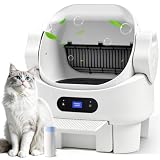
The OneBug box is a white open-top automatic described as suitable for multiple cats, sitting at budget-tier pricing. It is the entry point to powered self-cleaning: a pan, a sweeping mechanism and a waste compartment, with the cycle triggered by the cat leaving. For someone who has never owned an automatic box, it is the cheapest way to find out whether the whole category works for their cats.
Key specs at a glance
- Format: open-top automatic
- Intended household: multiple cats
- Finish: white
- Litter type: fine-grain clumping clay
- Waste storage: internal covered receptacle
- Price tier: budget
The value of starting here is diagnostic. Roughly speaking, the cats that will use an automatic box will use almost any automatic box, and the cats that will not will refuse almost any of them. Before spending premium money on a drum unit with app control, it is sensible to spend budget money on a simple open-top automatic and observe for two weeks. If your cats use it, upgrade later with confidence and knowledge about their preferences. If they avoid it, you have saved several hundred pounds or dollars and learned something useful.
The open-top format helps with that test. Enclosed boxes and rotating drums are more intimidating because they require a cat to enter a tunnel or a moving cylinder. An open pan with a sweep arm is closer to what most cats already know, so a refusal is more likely to reflect the automation itself than the enclosure. That makes the OneBug a cleaner experiment than a cheap enclosed unit would be.
Pros
- Lowest-risk way to test whether your cats accept automation
- Open-top format is familiar to cats used to a standard pan
- Budget pricing keeps the experiment cheap
- Multi-cat framing suggests a cycle suited to repeated visits
- Simple mechanism with fewer parts to foul
Cons
- Fewer documented safety sensors than the Mimfam or PetPivot
- No app, no usage data, no per-cat insight
- Smaller waste capacity than premium units
- Budget motors are noisier and less refined
- Open top does little for odor containment
Against the Mimfam, the OneBug is the cheaper and simpler box, while the Mimfam names four pairs of infrared sensors and a multi-cat design. If the price gap is small in your market, the Mimfam’s sensor redundancy makes it the better budget automatic. Against the Omega Paw, the OneBug offers genuine hands-off cycles in exchange for electronics that will eventually fail. It is the right first automatic if you want minimum daily effort; it is the wrong choice if you want maximum service life.
8. PetSafe ScoopFree Crystal Pro Legacy Self-Cleaning Litter Box, Uncovered – Best for Crystal-Litter Households

The ScoopFree Crystal Pro Legacy is a different category of machine from everything above it. It is an uncovered automatic rake system designed from the ground up for crystal (silica gel) litter, and it uses disposable pre-filled trays rather than a reusable pan you fill yourself. Its listing describes an uncovered self-cleaning box that works with crystal litter trays.
Key specs at a glance
- Format: uncovered automatic rake system
- Litter type: crystal / silica gel, supplied in sealed disposable trays
- Tray: pre-filled, disposable, leak-resistant lining
- Odor control: crystal desiccation plus a covered waste compartment
- App: none
- Price tier: mid-range
Crystal litter works on a completely different principle from clumping clay. It does not form clumps; it absorbs urine and dries solid waste out, so the rake only has to move solids into a covered compartment. That is why a rake system designed for crystal can use a much simpler mechanism than a clumping-litter automatic, and why the mechanism tends to be more reliable — there is no wet clay cementing itself to the rake tines. The manufacturer positions a tray as lasting up to about a month for a single cat, which is the single biggest operational difference between this system and a clay-based automatic.
The trade-offs are equally specific. Crystal litter does not clump, so you cannot scoop it, which means you are locked into the disposable tray ecosystem and its ongoing cost. Cats with sensitive paws sometimes dislike the texture of silica crystals, and the uncovered format means odor control depends almost entirely on the litter and the sealed waste compartment rather than on a hood. In a multi-cat home, tray life shortens dramatically — a tray rated for a month with one cat may last a week or less with three, which changes the economics considerably.
Pros
- Crystal litter controls odor by desiccation, which many owners find superior
- No clumping means the rake mechanism stays cleaner and jams less
- Disposable trays eliminate scrubbing entirely
- Long tray life for a single-cat household
- Uncovered format suits cats that refuse hoods
Cons
- Locked into proprietary disposable trays as a recurring cost
- Tray life collapses in multi-cat homes
- Some cats dislike the crystal texture underfoot
- No app or usage monitoring
- Uncovered design offers little odor containment on its own
Against the Purina Tidy Cats Breeze, the other non-clumping system here, the choice is about waste handling. The Breeze uses pellets with urine draining to an absorbent pad below, which keeps solid waste on top and separates liquid entirely; the ScoopFree uses crystal to absorb and dry. Both avoid clumping litter and both have recurring consumables. The ScoopFree automates the removal of solids, while the Breeze does not automate anything. If you want a powered system that suits crystal, the ScoopFree is the pick; if you want the simplest possible odor-control system with no mechanism at all, the Breeze wins.
9. Neakasa M1 Plus Automatic Cat Litter Box – Best Overall for Three-Plus Cat Homes
The Neakasa M1 Plus is the best overall self-cleaning litter box in this roundup for a household with three or more cats. It is a large rotating-drum automatic with app control, and this particular listing bundles a two-year protection plan, which is unusual and materially changes the ownership math. Neakasa is an established name in the automatic litter box category, and the M1 Plus is its mainstream flagship format.
Key specs at a glance
- Format: rotating-drum automatic
- Capacity class: large drum, typically in the 60-70L range
- App: control, status and usage monitoring
- Protection: two-year plan bundled with the box
- Litter type: fine-grain clumping clay
- Price tier: premium
The drum format is why this box wins on durability for busy homes. A rake or sweep arm drags through litter on every cycle, which means the mechanism does continuous work against a load, and clumped waste sticking to the tines is the classic failure mode. A drum rotates the entire litter bed instead, sifting waste through a grate into a sealed compartment. There is less contact between moving parts and wet clay, and the waste ends up in a genuinely sealed container rather than an open tray under a hood. In a three-cat home running twelve to fifteen cycles a day, that difference compounds.
The app layer is the second reason. Rotating-drum automatics with weight sensing can log which cat used the box and when, which gives you a baseline you can actually compare against. If you have an older cat in a multi-cat household, that baseline is the only practical way to know whether the cat is still using the box normally, since you cannot tell whose clumps are whose. This is monitoring, not diagnosis — if something looks persistently off, the answer is your veterinarian, not the app.
The bundled two-year protection plan matters because automatic litter boxes are electromechanical devices in a humid, dusty, chemically aggressive environment. Urine, clay dust and ammonia are hostile to motors, gears and sensor lenses. A two-year plan covers the window in which infant-mortality failures typically show up, which is when a warranty is worth the most.
Pros
- Drum architecture handles high daily cycle counts better than rake systems
- Sealed waste compartment contains odor effectively
- App control with usage monitoring across multiple cats
- Two-year protection plan bundled in this listing
- Large drum suits bigger cats and generous litter depth
Cons
- Premium pricing
- Large footprint and a heavier unit to move for cleaning
- Drum format is refused by some cats that dislike enclosed spaces
- Dependent on app and connectivity for full functionality
- Requires consistent litter type and depth to cycle reliably
Against the Cumrige, the closest premium rival, the Neakasa wins on completeness: app monitoring plus a bundled protection plan plus a drum built for throughput. The Cumrige wins narrowly on interior volume with its 95L figure. If your cats are unusually large, take the Cumrige. If they are average-sized and your household is busy, take the Neakasa — the protection plan alone justifies the difference over a two-year ownership window. Against the Fumoi, the Neakasa is the higher-throughput machine and the Fumoi is the easier-to-clean one.
10. Purina Tidy Cats Breeze Litter Box System Kit, XL – Best for Odor-Sensitive Owners Who Accept Weekly Pad Changes
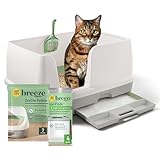
The Tidy Cats Breeze system is not an automatic box, and it is in this roundup because it solves the two problems automatics are usually bought for — odor and daily scooping — by a completely different route. The kit comprises an XL box, a supply of pellet litter and absorbent pads. Urine passes through the non-absorbent pellets onto a pad in the base tray; solid waste stays on top and is scooped off with a slotted scoop.
Key specs at a glance
- Format: non-clumping pellet system with absorbent pad base
- Size: XL box
- Included: box, pellet litter, pad supply
- Power: none
- Consumables: pellets and pads
- Price tier: budget
The odor argument is the strongest one. Ammonia smell comes from urine sitting in contact with litter and air. In a Breeze system, urine drops straight through the pellets into a sealed pad, so the litter itself stays dry and the smell source is contained in a closed tray. Owners who have struggled with a smelly clay box often find this system dramatically better, and the effect is mechanical rather than chemical — no additive or scent is doing the work.
The trade-off is a recurring schedule. Commonly cited guidance is to change the pad roughly once a week per cat and to replace the pellet litter about once a month, stirring solids daily. In a three-cat home that means three pads a week and a full pellet change every month or so. That is more frequent intervention than a self-cleaning box requires, but each intervention takes under a minute and never involves scrubbing caked clay.
Pros
- Excellent odor control because urine never sits in litter
- No power, no motor, no sensors — nothing to break
- Low entry price for the full system kit
- Pellets do not track as badly as fine clay
- XL size suits larger cats
Cons
- Not self-cleaning — solids
Affiliate disclosure. As an Amazon Associate we earn from qualifying purchases at no extra cost to you. Prices accurate as of the date shown.Best Self Cleaning Litter Boxes for Easy CareCheck price on Amazon





