
Our Top Picks


If you want the short answer: the Gskyer 600x90mm AZ Astronomical Refractor is the best telescope for most adults buying their first serious instrument. A 90 mm aperture with a 600 mm focal length (f/6.7) gives enough light grasp to show Saturn’s rings and Jupiter’s cloud belts, a wide enough field to sweep star clusters, and an alt-azimuth mount that a beginner can set up in under ten minutes with no polar alignment. It suits someone with a balcony, a backyard or a car boot who observes a few nights a month and does not want to learn equatorial mount mechanics before seeing anything at all. If your budget is tighter, the Koolpte 80 mm f/7.5 refractor delivers most of that experience for less money. If you have genuinely dark skies, a permanent spot to leave a scope assembled, and the patience to collimate a mirror, the MEEZAA 150EQ Newtonian collects roughly 2.8 times more light than a 90 mm refractor and is the stronger long-term instrument. Everything below sorts the rest of the field by aperture, mount type, portability and setup difficulty.
Top 3 Picks
Best overall: Gskyer 600x90mm AZ Refractor. The 90 mm aperture and f/6.7 focal ratio hit the sweet spot between light grasp and field of view, and the alt-azimuth mount means the scope is usable the first clear night you own it. It is the pick for an adult who wants one instrument that does the Moon, the planets and the brighter deep-sky objects reasonably well, from a small space, without a steep learning curve.
Best budget: Koolpte 80 mm f/7.5 Refractor. An 80 mm fully multi-coated objective is the smallest aperture that still shows Jupiter’s moons as discs and real crater relief on the Moon. It is the right choice if you are testing whether the hobby will stick, or if the telescope has to fit a tight budget and a small closet at the same time.
Best premium / best for dark-sky deep sky: MEEZAA 150EQ Newtonian. A 150 mm mirror gathers about 2.8 times the light of a 90 mm refractor, which is the difference between seeing the Orion Nebula as a smudge and seeing its wings. The equatorial mount adds tracking and a real upgrade path, but it also adds weight, setup time and collimation. Buy it if you have dark skies and a place to leave it standing.
Quick Comparison
| Product | Best for | Key specs | Price tier |
|---|---|---|---|
| Koolpte 80 mm Refractor | First scope on a tight budget | 80 mm aperture · 600 mm focal length · f/7.5 · FMC optics · alt-az mount · ~60 cm tube | Budget |
| CELTICBIRD 80 mm AZ Refractor | Shared family use with kids | 80 mm aperture · 600 mm focal length · f/7.5 · AZ mount · refractor | Budget |
| MEEZAA 90 mm Refractor | Lunar and planetary viewing | 90 mm aperture · 800 mm focal length · f/8.9 · refractor · ~80 cm tube | Mid-range |
| Gskyer 600x90mm AZ | Most adults, best all-rounder | 90 mm aperture · 600 mm focal length · f/6.7 · AZ mount · ~60 cm tube | Premium |
| Dianfan 90 mm Refractor | Portability in the 90 mm class | 90 mm aperture · 800 mm focal length · f/8.9 · portable refractor | Mid-range |
| MEEZAA 150EQ Newtonian | Deep-sky from dark sites | 150 mm aperture Newtonian · equatorial mount · focal length varies by bundle (f/5–f/8 typical for the class) | Premium |
| Hawkko 90 mm Refractor | High-magnification planetary work | 90 mm aperture · 900 mm focal length · f/10 · multi-coated refractor · ~90 cm tube | Premium |
| SOLOMARK 130 mm Reflector | Wide-field deep sky, mid budget | 130 mm aperture · 650 mm focal length · f/5 · Newtonian reflector | Mid-range |
| HETEKAN 90 mm Refractor | Colour-corrected planetary detail | 90 mm aperture · 900 mm focal length · f/10 · refractor · ~90 cm tube | Premium |
| HUGERSTAR 90 mm Refractor | Travel and small-space storage | 90 mm aperture · 800 mm focal length · f/8.9 · portable refractor | Mid-range |
| WOSPORTS 90 mm Refractor | Largest aperture at the budget tier | 90 mm aperture · focal length not stated in the listing name · refractor · check focal ratio before buying | Budget |
| ToyerBee 70 mm Refractor | Wide field, travel and daytime use | 70 mm aperture · 300 mm focal length · f/4.3 · FMC optics · ~30 cm tube | Budget |
Focal ratios, tube lengths and aberration figures above are calculated from the aperture and focal length stated in each product name. Where a listing does not state a focal length, the table says so rather than guessing at a number.
How We Chose
This roundup is a specification-based comparison, not a set of test results. Every product here was assessed against four criteria that decide whether an adult actually keeps using a telescope after the first month.
Aperture and what it buys. Aperture sets light grasp and resolution, and it is the one number that cannot be upgraded without buying a new telescope. We weighted 80 mm as the practical floor for an adult instrument, 90 mm as the comfortable middle, and 130–150 mm as the point where deep-sky objects stop being faint smudges. We also calculated each scope’s practical magnification ceiling and Dawes resolution limit so the numbers in this article are comparable rather than marketing claims.
Mount type and setup difficulty. An alt-azimuth mount needs no alignment and can be ready in minutes; an equatorial mount tracks objects but requires polar alignment and a learning curve. We treated mount type as a gating criterion, because a scope that is too fiddly to set up gets left in the closet.
Portability and storage. For a refractor, tube length closely tracks focal length, so a 900 mm refractor is roughly a metre of tube to store and carry. We scored each product on whether it fits a closet, a car boot or a stairwell.
Category fit and upgrade path. We checked whether each product sits in a coherent tier — budget starter, mid-range workhorse, premium long-term instrument — and whether it accepts standard 1.25-inch eyepieces and accessories, because that determines what you can improve later. Products that only accept proprietary fittings or that bundle magnification claims beyond their aperture’s limit were marked down.
1. Koolpte 80 mm f/7.5 Refractor – Best for First-Time Adult Buyers on a Tight Budget
As an Amazon Associate we earn from qualifying purchases at no extra cost to you.
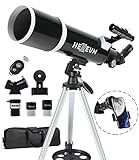
The Koolpte 80 mm is aimed at the adult who has never owned a telescope and does not want to find out whether the hobby sticks by spending a lot of money on the answer. An 80 mm objective is the smallest aperture that still shows Jupiter’s four Galilean moons as discs rather than points of light and gives genuine crater relief along the lunar terminator. The 600 mm focal length keeps the tube short enough to live in a wardrobe or on a shelf, which matters more than most beginners expect.
- Aperture: 80 mm (3.15 in)
- Focal length: 600 mm, giving f/7.5
- Optics: fully multi-coated (FMC) objective, described in the listing as high transmission
- Mount: alt-azimuth on a tripod, no polar alignment required
- Practical magnification ceiling: about 160x (roughly 2x per millimetre of aperture)
- Resolution limit (Dawes): about 1.45 arcseconds, enough to split easier double stars such as Mizar
- Chromatic aberration index: about 2.4 (focal ratio 7.5 ÷ 3.15 in) — a violet fringe on the Moon’s bright limb at high power, not visible on stars
- Tube length: roughly 60 cm
It is worth doing the eyepiece arithmetic before you buy. Magnification is telescope focal length divided by eyepiece focal length, so on a 600 mm tube a 25 mm eyepiece gives 24x, a 10 mm gives 60x, and a 6 mm gives 100x. Add a 2x Barlow to that 6 mm and you are at 200x, which is past the point where an 80 mm aperture delivers useful detail — the image gets larger and softer, not better. The productive range here is roughly 40x to 120x, where the Moon, Saturn’s rings and the brighter open clusters look their best.
Pros
- Lowest entry cost in this roundup while still using real multi-coated glass
- Alt-azimuth mount means no alignment routine — out of the box and pointing at the Moon in minutes
- 60 cm tube stores upright in a closet or behind a door
- Works as a daytime spotting scope with a correct-image diagonal
- Accepts standard 1.25-inch eyepieces, so upgrades transfer to a future telescope
Cons
- 80 mm limits deep-sky work to the brightest objects — the Orion Nebula, the Pleiades, the Andromeda core
- Entry-tier focusers and tripods introduce vibration at high power; a light touch on the focuser is required
- Visible colour fringing on bright objects at the top of its magnification range
- Bundled eyepieces in this tier are often the weakest part of the kit and are the first thing worth replacing
- No tracking, so high-power viewing means constantly nudging the tube
How it compares. The nearest alternative is the CELTICBIRD 80 mm AZ, which shares the same 80 mm aperture and 600 mm focal length, so the optics are effectively a wash and the chromatic aberration behaviour is identical. The difference comes down to the bundle and the mount hardware rather than the glass: whichever of the two ships the sturdier tripod and the more usable eyepieces is the better buy. Step up to a 90 mm refractor and you gain about 27 percent more light grasp and roughly 11 percent finer resolution — noticeable on Saturn, marginal on star clusters.
2. CELTICBIRD 80 mm AZ Refractor – Best for Households Sharing One Scope With Kids

The CELTICBIRD 80 mm is the pick when the telescope is not exclusively yours. Its listing positions it for adults and beginners together, and that framing matters: the 80 mm aperture is forgiving enough that a child can point it at the Moon and get a satisfying view without adult intervention, while the 600 mm focal length and alt-azimuth mount keep the whole procedure simple. For an adult who wants a scope that survives being handed around, this is a sensible starting point.
- Aperture: 80 mm (3.15 in)
- Focal length: 600 mm, giving f/7.5
- Optical design: refractor with a coated glass objective
- Mount: alt-azimuth, tripod-mounted
- Practical magnification ceiling: about 160x
- Resolution limit (Dawes): about 1.45 arcseconds
- Chromatic aberration index: about 2.4
- Eyepiece standard: 1.25-inch, so the standard accessory ecosystem applies
The case for this scope over a 70 mm instrument is straightforward arithmetic: light grasp scales with the square of aperture, so 80 mm collects about 31 percent more light than 70 mm, and resolution improves from roughly 1.66 to 1.45 arcseconds. That is the difference between the Ring Nebula being a guess and being a small, definite ring. It is also the difference between a child seeing Saturn as a shape and seeing nothing worth returning to.
Pros
- Simple enough that a beginner of any age can operate it without supervision after one session
- 80 mm aperture is a genuine step above the 50–60 mm scopes sold in toy aisles
- Short 60 cm tube means it can be carried outdoors by a child without risk of knocking a doorframe
- Alt-azimuth mount cannot be knocked out of alignment
- Same accessory standard as the rest of this list
Cons
- Shares the 80 mm class limits: bright deep-sky objects only
- No tracking, so anything above about 100x drifts out of the field quickly
- Light tripods in this tier are the usual source of frustration and the usual first upgrade
- If the scope is shared, eyepieces and caps go missing — budget for spares
- Not a long-term instrument if the adult half of the household gets serious
How it compares. Against the Koolpte 80 mm, this is the same optical specification in a different bundle, so the deciding factor is which one includes the better mount and the more useful eyepieces — not the aperture. Against the ToyerBee 70 mm/300 mm, the CELTICBIRD trades a much wider field of view for more light grasp and a longer tube. If your household mostly wants wide, easy views of the Moon and bright clusters at low power, the ToyerBee is the friendlier object; if you want Saturn to look like Saturn, the extra 10 mm here is worth having.
3. MEEZAA 90 mm f/8.9 Refractor – Best for Lunar and Planetary Viewing on a Mid-Range Budget

The MEEZAA 90 mm refractor sits at the point where a telescope stops being a novelty and starts being an instrument. The 800 mm focal length gives an f/8.9 focal ratio, which is a meaningfully better colour-correction ratio than the f/6.7 and f/7.5 scopes above, and the longer tube makes high-magnification planetary viewing steadier and more comfortable. It suits an adult who has decided the hobby is real, observes the Moon and planets most often, and wants a refractor rather than a reflector with its collimation routine.
- Aperture: 90 mm (3.54 in)
- Focal length: 800 mm, giving f/8.9
- Optical design: refractor, coated objective
- Mount: alt-azimuth, tripod-mounted
- Practical magnification ceiling: about 180x
- Resolution limit (Dawes): about 1.29 arcseconds
- Chromatic aberration index: about 2.5 (8.9 ÷ 3.54) — better controlled than the f/7.5 80 mm scopes but not colour-free
- Tube length: roughly 80 cm
The focal length changes what your eyepieces do. On an 800 mm tube, a 25 mm eyepiece yields 32x, a 10 mm yields 80x, and a 6 mm yields 133x. A 2x Barlow on the 10 mm reaches 160x, which is still inside this aperture’s useful range — unlike the 80 mm scopes, where the same Barlow combination overshoots. That headroom is the practical argument for 800 mm over 600 mm: it lets you use the eyepieces you already own at higher powers without running out of aperture.
Pros
- 90 mm aperture is enough for the Trapezium in Orion and the brighter globular clusters
- f/8.9 focal ratio keeps colour fringing on bright objects noticeably lower than the f/6.7–f/7.5 class
- 180x ceiling is genuinely usable for splitting close double stars and studying lunar craters
- Refractor design means no collimation, ever — an underrated advantage for casual observers
- Longer focal length makes budget eyepieces perform better than they do on fast scopes
Cons
- 80 cm tube is harder to store and to carry through a doorway than a 60 cm scope
- Still an achromatic refractor, so a violet halo remains on Venus and the Moon’s limb at high power
- Narrower maximum field of view than the 600 mm scopes, which matters for large clusters and for daytime scanning
- 90 mm remains a modest aperture — galaxies beyond Andromeda stay faint and featureless
- Longer tube on a lightweight tripod amplifies vibration; the mount matters more here than on a 60 cm scope
How it compares. Against the Dianfan 90 mm, the specifications are identical — 90 mm, 800 mm, f/8.9 — so the choice comes down to mount rigidity and bundle. The real decision is between this scope and the Gskyer 600x90mm at f/6.7: the Gskyer gives a wider field and a shorter tube, this one gives better colour correction and more usable high-power headroom. If your sessions are mostly Moon and planets, take the longer focal length; if you want one scope for both sky and landscape, take the shorter one.
4. Gskyer 600x90mm AZ Refractor – Best Overall for Most Adults

The Gskyer 600x90mm is the best telescope for most adults because it makes the fewest compromises that beginners actually notice. The 90 mm aperture provides real light grasp; the 600 mm focal length at f/6.7 keeps the tube at roughly 60 cm so it fits a closet and a car boot; and the alt-azimuth mount means the scope is usable on the first clear night rather than after a weekend of learning polar alignment. Gskyer has been a long-standing name in entry-level refractors, and the 600x90mm AZ is its best-known configuration in that class.
- Aperture: 90 mm (3.54 in)
- Focal length: 600 mm, giving f/6.7
- Optical design: refractor, coated objective
- Mount: alt-azimuth, tripod-mounted
- Practical magnification ceiling: about 180x
- Resolution limit (Dawes): about 1.29 arcseconds
- Chromatic aberration index: about 1.9 (6.7 ÷ 3.54) — more visible fringing than an f/10 scope, so keep bright-object magnification moderate
- Tube length: roughly 60 cm
- Eyepiece standard: 1.25-inch
The f/6.7 ratio is the key trade-off to understand. On a 600 mm tube, a 25 mm eyepiece gives 24x and a true field of view of roughly 2.2 degrees with a typical 52-degree apparent-field eyepiece — wide enough to frame the Pleiades or the whole of the Andromeda galaxy’s brighter half. A 10 mm eyepiece gives 60x and a 0.9-degree field; a 6 mm gives 100x. For the Moon and planets you will want 100x to 150x, and the colour fringing that appears at that power is the price of the wider field and shorter tube.
Pros
- 90 mm aperture and a 60 cm tube in the same package — the best portability-to-light-grasp balance here
- Alt-azimuth mount gets you observing in minutes with no alignment routine
- Wide field of view handles large clusters and the Moon’s full disc easily
- Double duty as a daytime spotting scope with a correct-image diagonal
- Mature, widely supported platform with a large accessory ecosystem
Cons
- f/6.7 shows more chromatic aberration on bright objects than the f/8.9 and f/10 scopes in this list
- No tracking — at 150x you will be re-centring every 20 to 30 seconds
- Premium tier pricing for an aperture that mid-range competitors match
- Tripod stiffness is the limiting factor at the top of the magnification range
- Deep-sky reach stops well short of what a 130 mm or 150 mm reflector offers
How it compares. Against the MEEZAA 90 mm at f/8.9, you are trading colour correction for field of view and tube length: same aperture, same 180x ceiling, but this scope is easier to store and better at wide targets while the MEEZAA is cleaner on Jupiter and Venus. Against the HUGERSTAR 90 mm, the specification difference is the 600 mm versus 800 mm focal length, and the shorter tube here is the more portable of the two despite the higher tier.
5. Dianfan 90 mm f/8.9 Refractor – Best for Portability in the 90 mm Class

The Dianfan 90 mm is listed as a portable professional refractor, and that framing is accurate in the sense that matters: it pairs a 90 mm aperture with an 800 mm focal length in a package designed to be carried rather than parked. It suits an adult who wants 90 mm of light grasp but moves the telescope — out to a park, up to a roof, into a car — rather than leaving it set up in one place.
- Aperture: 90 mm (3.54 in)
- Focal length: 800 mm, giving f/8.9
- Optical design: refractor, coated objective
- Mount: alt-azimuth, tripod-mounted
- Practical magnification ceiling: about 180x
- Resolution limit (Dawes): about 1.29 arcseconds
- Chromatic aberration index: about 2.5
- Tube length: roughly 80 cm
Portability in this class is a two-part problem. The optical tube is the easy half — an 800 mm refractor tube weighs little and travels fine in a padded bag. The hard half is the tripod, which is usually the heaviest single item and the one that determines whether the scope is stable at 150x. Any 90 mm refractor on a marginal mount will vibrate for two or three seconds after you touch the focuser, which makes fine lunar detail difficult to hold. When comparing the Dianfan against other 90 mm/800 mm scopes, weigh the mount as heavily as the optics, because the optics in this class are very similar.
Pros
- 90 mm aperture in a package intended to be moved, not permanently installed
- f/8.9 ratio gives better colour correction than the 600 mm scopes in this list
- 180x usable ceiling for lunar craters and double stars
- No collimation required, ever
- Compatible with standard 1.25-inch eyepieces and filters
Cons
- 80 cm tube is the practical limit for a backpack-style carry; it needs a proper case
- Narrower field than the f/6.7 Gskyer, which is felt most on large clusters
- Identical specification to the MEEZAA 90 mm means you are choosing on mount and bundle, not optics
- Achromatic design still fringes on Venus and the Moon’s limb at high power
- Transporting a refractor means re-checking the finder alignment every trip
How it compares. Against the MEEZAA 90 mm, this is a near-identical instrument on paper — 90 mm, 800 mm, f/8.9 — so the decision rests entirely on which mount is steadier and which bundle is more useful. Against the HUGERSTAR 90 mm, the specs match again and the tiebreak is the same. If you genuinely move the telescope every session, pick whichever of the three has the most rigid tripod; if it stays in one spot, buy on eyepiece bundle instead.
6. MEEZAA 150EQ Newtonian Reflector – Best for Deep-Sky Observing From Dark Sites

The MEEZAA 150EQ is the only genuinely different instrument in this roundup. Where every refractor above tops out at 90 mm of aperture, this Newtonian reflector opens at 150 mm — and aperture is the one specification that determines how much of the deep sky you can actually see. It suits an adult with dark skies, a place to leave the telescope assembled, and the willingness to learn collimation and polar alignment in exchange for views that no 90 mm refractor can match.
- Aperture: 150 mm (5.9 in)
- Optical design: Newtonian reflector
- Focal length: varies by bundle — 150 mm Newtonians commonly ship between f/5 and f/8, so confirm the focal ratio before buying
- Mount: equatorial, with the tracking and alignment routine that implies
- Practical magnification ceiling: about 300x
- Resolution limit (Dawes): about 0.77 arcseconds
- Chromatic aberration: none — mirrors focus all wavelengths at the same point
- Maintenance: collimation of the primary and secondary mirrors
The light-grasp arithmetic is the whole argument. Light collection scales with the square of aperture: 150 mm versus 90 mm is (150/90)² ≈ 2.8 times the light, and versus 70 mm it is about 4.6 times. In practice that moves objects across the visibility threshold — the Ring Nebula becomes a defined ring rather than a grey patch, globular clusters such as M13 resolve into individual stars rather than a fuzzy ball, and dozens of galaxies that are invisible in a 90 mm scope appear as definite smudges. Resolution improves in step, from 1.29 arcseconds at 90 mm to 0.77 at 150 mm, which is what allows tight double stars to split cleanly.
Pros
- 150 mm aperture delivers roughly 2.8x the light grasp of the 90 mm refractors here
- No chromatic aberration, so planetary and lunar views are colour-free at any magnification
- Equatorial mount tracks objects, which transforms high-power observing and is the foundation for basic astrophotography
- 300x ceiling is enough to make planetary detail genuinely rewarding on steady nights
- The most direct upgrade path in this list — the mount accepts a motor drive and the tube accepts standard eyepieces
Cons
- Heaviest and bulkiest setup here; this is not a telescope you carry down stairs every night
- Equatorial alignment takes practice — allow 20 to 40 minutes for the first few sessions
- Newtonian mirrors need collimation, especially after transport
- Open tube means the mirror collects dust and needs occasional cleaning
- Premium tier pricing, and a reflector of this size rewards dark skies far more than a city balcony
How it compares. Against the SOLOMARK 130 mm f/5, this scope offers about 33 percent more light grasp and better resolution, but the SOLOMARK’s shorter focal ratio gives a wider field of view that is better suited to large nebulae and star fields. Choose the 150EQ if you want to go deep on individual objects; choose the 130 mm if you want to sweep. Against the 90 mm refractors, the comparison is not close on deep-sky performance — but the refractors win decisively on setup time, storage and the likelihood that you actually use the scope on a work night.
7. Hawkko 90 mm f/10 Refractor – Best for High-Magnification Planetary Work

The Hawkko 90 mm is the planetary specialist of this group. Its 900 mm focal length produces an f/10 focal ratio, the highest in this roundup among the refractors, and that ratio is exactly what you want when the target is the Moon, Jupiter, Saturn or Mars. It suits an adult whose observing is dominated by the solar system, who is willing to accept a narrow field and a metre-long tube in exchange for the cleanest high-power image a 90 mm achromat can deliver.
- Aperture: 90 mm (3.54 in)
- Focal length: 900 mm, giving f/10
- Optical design: refractor, multi-coated objective
- Mount: alt-azimuth, tripod-mounted
- Practical magnification ceiling: about 180x
- Resolution limit (Dawes): about 1.29 arcseconds
- Chromatic aberration index: about 2.8 (10 ÷ 3.54) — the best colour correction among the 90 mm refractors here
- Tube length: roughly 90 cm
The focal ratio is doing measurable work. A useful rule of thumb in amateur astronomy is the chromatic aberration index — focal ratio divided by aperture in inches — where higher is better and anything below about 1.5 shows obvious false colour. This scope scores roughly 2.8, against 1.9 for the f/6.7 Gskyer and 2.5 for the f/8.9 group. In practice, that means a tighter, more colour-neutral lunar limb and a cleaner edge on Jupiter’s disc at 150x, which is precisely where a fast achromat starts to smear.
Pros
- f/10 focal ratio gives the best colour correction of any refractor in this list
- 900 mm focal length makes budget eyepieces perform well — even a simple 25 mm yields 36x
- Long focal length is ideal for high-power lunar and planetary detail
- No collimation, no alignment, no maintenance beyond keeping the lens clean
- Multi-coated optics per the listing
Cons
- 90 cm tube is the second-longest here and awkward to store or carry
- Narrow field of view — a 25 mm eyepiece gives roughly 1.4 degrees, which will not frame the Pleiades
- Same 90 mm aperture ceiling as cheaper mid-range scopes; you are paying for focal ratio, not light grasp
- Long tube on a light tripod is more prone to vibration than a short one
- Less useful as a daytime spotting scope because of the narrow field
How it compares. Against the HETEKAN 90 mm, the specification is identical — 90 mm, 900 mm, f/10 — so this is another mount-and-bundle decision rather than an optical one. Against the Gskyer 600x90mm, the trade is stark: the Gskyer gives a 2.2-degree field and a 60 cm tube, the Hawkko gives better colour correction and more comfortable high-power viewing in a 90 cm tube. If you observe planets more than anything else, take the f/10; if you want one scope that also sweeps star fields, take the f/6.7.
8. SOLOMARK 130 mm f/5 Reflector – Best for Wide-Field Deep Sky on a Mid-Range Budget

The SOLOMARK 130 mm is the value play for deep-sky observing. Its 650 mm focal length combined with a 130 mm aperture yields an f/5 focal ratio, which is a fast, wide-field instrument: you get more light grasp than any refractor here and a wider true field than the longer-focal-length reflectors. It suits an adult on a mid-range budget who wants to see nebulae and star fields properly and is willing to collimate a mirror to get there.
- Aperture: 130 mm (5.1 in)
- Focal length: 650 mm, giving f/5
- Optical design: Newtonian reflector
- Mount: tripod-mounted; check the listing for whether the bundle ships an equatorial or alt-azimuth head
- Practical magnification ceiling: about 260x
- Resolution limit (Dawes): about 0.89 arcseconds
- Chromatic aberration: none, as with any reflector
- Field of view: with a 25 mm eyepiece, 26x magnification and roughly 2 degrees true field
Compare the light grasp directly: 130 mm collects about 2.1 times as much light as 90 mm and roughly 3.4 times as much as 70 mm. That is the difference between the Orion Nebula’s core and its extended wings, and between a globular cluster being a glow and being a swarm of stars. The cost is maintenance — a Newtonian’s mirrors go out of alignment, particularly after a car journey, and collimation with a simple cap or laser tool is a five-minute job you will repeat regularly.
Pros
- 130 mm aperture at a mid-range tier is the best light-per-cost ratio in this roundup
- f/5 focal ratio gives a wide field well suited to large nebulae and Milky Way star fields
- No chromatic aberration at any magnification
- 260x ceiling makes planetary detail accessible on steady nights
- Compact tube for its aperture compared with a 90 mm/900 mm refractor
Cons
- Requires collimation, and fast f/5 systems are less forgiving of miscollimation than f/8 ones
- Fast focal ratio is harder on budget eyepieces — edge softness and astigmatism show up sooner
- Open tube gathers dust; the mirror needs occasional cleaning
- Mirror thermals mean 20 to 30 minutes of cooldown before high-power views settle
- Mount quality in this tier is the usual weak point and determines whether 260x is usable
How it compares. Against the MEEZAA 150EQ, this scope gives up about 25 percent of light grasp and some resolution but gains a wider field and a lighter, faster-to-set-up package. Against the 90 mm refractors





