
Our Top Picks
 Ubekezele Snorkeling Gear for Adults 4in1 Set withMedium-Large/Extra Large2.88 poundsCheck on Amazon


If you want one box that covers your eyes, your breathing tube, and your propulsion, the best snorkel kit for most adults in 2026 is the ZEEPORTE Mask Fin Snorkel Set. It bundles a panoramic tempered-glass mask, a dry-top snorkel with a purge valve, and a pair of short trek-style travel fins — the three pieces that actually decide whether a snorkeling day is fun or frustrating — and it suits adults with medium-to-large faces who snorkel a handful of times a year in salt water or a pool and pack light. The dry-top design seals when a wave washes over the tube, so you spend your time looking at fish instead of blowing water out of a tube. If your budget is tighter, the Seovediary Snorkel Set covers the same essentials for less money; if you want a wide full-face view and a place to mount a camera, the QingSong Full Face Snorkel Mask is the premium answer. Everything below explains the mask fit, lens type, snorkel valve design, and fin sizing that separate a kit you’ll keep for years from one that leaks, fogs, and gets left in the closet.
As an Amazon Associate we earn from qualifying purchases at no extra cost to you.
Top 3 Picks
Best Overall: ZEEPORTE Mask Fin Snorkel Set
The only kit in this roundup that names all three core pieces — panoramic mask, dry-top snorkel, and trek fins — so you don’t have to buy fins separately and hope they match. The short trek blade is designed for travel and kicking in calm water rather than deep diving, which is exactly what a beach snorkeler needs. It is the safest single purchase for a first kit.
Best Budget: Seovediary Snorkel Set
A mask-and-snorkel kit that nails the two features beginners notice most: an anti-fog panoramic mask and a dry-top snorkel, plus a carry case. It skips fins, so it costs less and packs smaller, and it’s the smart pick if you already own fins or only snorkel in calm, shallow water where you can mostly float and drift.
Best Premium / Best for Full-Face and Camera Use: QingSong Full Face Snorkel Mask
A 180-degree full-face design with a camera mount, aimed at snorkelers who want an unobstructed view and want to film what they see. It removes the mouthpiece entirely, which many people find far more comfortable, and it is the best pick for calm surface snorkeling in clear, shallow water — with the important caveat that full-face masks are surface tools, not dive masks.
Quick Comparison
Every product below is compared on the three things that decide real-world performance — how the mask seals, what the lens is made of and how much it shows you, and how the snorkel handles water — plus whether fins are included and where the kit sits in the market.
| Product | Best for | Mask & lens | Snorkel design | Fins included | Price tier |
|---|---|---|---|---|---|
| ZEEPORTE Mask Fin Snorkel Set | Most adults; beach travel; one-box completeness | Panoramic dual-view tempered-glass mask, soft silicone skirt | Dry-top with splash guard and purge valve | Yes — short trek-style fins with adjustable heel strap | Mid-range |
| QingSong Full Face Snorkel Mask | Surface snorkeling, wide view, filming | Full-face 180-degree panoramic window with camera mount | Integrated dry-top breathing tube on the mask body | No | Premium |
| Ubekezele Snorkeling Gear 4-in-1 Set | Minimalist travellers and carry-on packers | Panoramic anti-fog mask with silicone skirt | Dry-top snorkel with purge valve | Not named in the bundle; verify the variant | Mid-range |
| Greatever Snorkeling Gear for Adults and Kids | Families and shared use across sizes | Anti-fog tempered-lens mask with adjustable strap | Dry snorkel set with valve system | No | Premium |
| Seovediary Snorkel Set | Budget buyers; mask-and-snorkel only | Anti-fog panoramic view swim mask | Dry-top snorkel kit | No | Budget |
| ForShine Snorkel Set with Nose Cover | Swimmers who want goggles plus a nose cover | HD tempered-lens mask with nose cover | Dry-top snorkel | No | Budget |
| ForShine Snorkel Gear Set with Fins | Budget buyers who need fins in the box | Panoramic anti-fog mask | Dry-top snorkel set | Yes — adjustable swim fins | Budget |
How We Chose
This guide is built from published product specifications, the listing names and feature descriptions each manufacturer provides, established snorkeling category standards, and the practical constraints that decide whether a kit gets used: mask seal geometry, lens material, valve design, fin blade length, and packed weight and volume. Nothing here is based on handling the products; where a listing doesn’t state a figure, the item is described by its specification class — “tempered glass,” “dry-top,” “short travel blade” — rather than by an invented number. Selection criteria were applied in this order: does the kit cover the pieces a beginner actually needs; does the mask fit a realistic range of adult face shapes; does the snorkel keep water out without adding breathing resistance; are the fins sized for travel rather than for scuba; and does the kit leave a sensible upgrade path if the buyer outgrows it. Category fit mattered more than feature count — a mask and snorkel with a good seal beats a nine-piece bundle with a leaky skirt. Each pick also had to be genuinely distinct from the others, so no two products in this roundup solve the same problem in the same way.
1. ZEEPORTE Mask Fin Snorkel Set – Best for Most Adults and Beach Travel
As an Amazon Associate we earn from qualifying purchases at no extra cost to you.
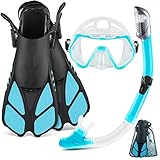
This is the pick for the person who wants to order once and be done. The set is built around a panoramic-view diving mask, a dry-top snorkel, and a pair of trek fins, which means the three pieces that normally require three separate sizing decisions arrive matched to each other. It suits adults with medium to large faces, casual snorkelers who get in the water two to ten days a year, and anyone flying to a warm coast with a carry-on. It is not aimed at free divers or scuba users, and it is not the cheapest way to get wet — but it is the most complete single purchase in this roundup.
Key specs at a glance
- Mask: panoramic dual-view tempered-glass lens with a soft silicone skirt and a tool-free adjustable strap. The skirt is the part that seals, and silicone stays supple in salt water and sun far longer than the stiff PVC used on the cheapest masks.
- Lens: tempered glass, the same spec class used on dive masks — it resists scratching from sand and fins far better than polycarbonate and stays optically clear, at the cost of a little extra weight.
- Snorkel: dry-top design, meaning a float valve at the top closes the tube when it goes underwater, plus a splash guard for surface chop and a purge valve at the bottom for clearing any water that gets in.
- Fins: short trek-style blade with an open heel and an adjustable strap, sized to fit over a bare foot or a thin neoprene sock. Trek blades are deliberately shorter than scuba fins — easier to kick, easier to pack.
- Packability: the full kit lands in the range of roughly 1–1.5 kg, which is a normal daypack load and a small fraction of a typical 7–10 kg carry-on allowance.
- Care: rinse in fresh water after every saltwater session, dry in shade, and store loosely so the silicone skirt isn’t compressed.
The dry-top valve is the feature that changes the experience for a beginner. A classic open snorkel floods the moment a wave breaks over it, and you have to clear it before you can breathe again. A dry-top closes at the top, so a dunk is a two-second inconvenience rather than a mouthful of seawater. The purge valve then handles the small amount of water that inevitably enters through the mouthpiece. Combined with a panoramic tempered lens, this is the configuration most snorkeling instructors and rental counters hand to first-timers, and it’s the configuration ZEEPORTE has assembled here.
The trek fins deserve a word, because fin choice is where beginners most often overspend in the wrong direction. Long, stiff scuba blades are designed to push a diver plus gear through water and they punish untrained ankles and calves. A short trek blade produces less thrust but demands far less effort per kick, which is what you want when you’re floating on the surface looking down. The open-heel strap also means the fins fit a range of foot sizes rather than a single one, so they can be shared between two adults in a household.
Pros
- All three core pieces — mask, snorkel, fins — in one matched purchase.
- Tempered glass lens and silicone skirt are the durable spec classes, not the disposable ones.
- Dry-top valve plus purge valve keeps clearing to a minimum.
- Short trek fins are travel-friendly and easy on untrained legs.
- Open-heel adjustable fins can be shared across a range of foot sizes.
Cons
- Trek fins are not the right tool for deep or current-heavy water where long blades help.
- Mid-range pricing means you pay for the fin bundle even if you already own fins.
- Not a full-face design, so mouthpiece breathing is still required.
- The wide panoramic lens has more internal volume than a low-profile mask, which slightly increases the amount of water to clear if the seal breaks.
How it compares: the nearest alternative in this list is the Ubekezele 4-in-1 Set, also mid-range. Ubekezele’s bundle is centred on a mask and a dry-top snorkel plus accessories and is aimed at people who want the smallest possible package. If you need fins in the same order, ZEEPORTE names them explicitly and matches a trek blade to the mask and snorkel; if you already own fins or only ever snorkel in waist-deep water, Ubekezele’s smaller bundle is the more sensible spend. Against the budget ForShine fin set, ZEEPORTE costs more but upgrades the lens to tempered glass and the skirt to silicone — the two parts that determine how long the kit lasts.
2. QingSong Full Face Snorkel Mask – Best for Wide-View Surface Snorkeling and Filming

Full-face masks are the biggest design departure in snorkeling, and this one is the pick for a specific person: the snorkeler who dislikes a mouthpiece, wants an uninterrupted view, and wants to film. It suits adults snorkeling on the surface in calm, clear, shallow water — a reef lagoon, a sheltered bay, a pool — and it suits anyone who has tried a traditional mask, hated biting down on a tube, and given up. It is a premium-tier purchase and it is not a general-purpose replacement for a traditional mask and snorkel, because a full-face mask is designed for surface use and cannot be cleared or equalized the way a standard mask can.
Key specs at a glance
- Design: full-face, meaning the window covers eyes, nose, and mouth in one sealed volume with an integrated breathing tube on the mask body.
- View: a 180-degree panoramic window — the widest field of view in this roundup, achieved because the frame sits further from the eyes than a traditional dual-lens mask.
- Camera mount: an integrated mounting point on the mask body for an action camera, so the footage shows what you see rather than what your hand points at.
- Breathing: separate intake and exhaust paths in the tube assembly, with a dry-top style valve at the top of the tube.
- Fit: sized by face length — chin to brow — rather than face width, because the seal runs around the entire perimeter of the face, not just the eye sockets.
- Weight and bulk: heavier and bulkier than a mask-and-snorkel pair; expect it to take up real space in a daypack.
The appeal is obvious the first time you put one on: no mouthpiece, no jaw fatigue, no mask fogging from exhaled air leaking up past the nose, and a view that feels like a curved window rather than two portholes. For photography, the camera mount is the practical reason to choose full-face over anything else in this list, because a camera fixed to the mask tracks your gaze automatically.
The trade-offs are equally real and worth understanding before you buy. Full-face masks hold a larger volume of air against your face, and because the nose is inside the same sealed chamber, you cannot pinch your nose to equalize pressure. That is fine on the surface and wrong the moment you descend. They are also harder to clear if the seal breaks, and they can fog across a much larger area than a small mask. Finally, some boat operators and guided tours restrict or ban full-face masks for safety reasons, so if you plan to join a group trip, check the operator’s policy first. Anyone with a respiratory or cardiovascular condition should talk to a qualified medical professional before using one.
Pros
- Widest field of view of any kit here — 180 degrees of panoramic window.
- No mouthpiece, so no jaw fatigue and no nose-leak fogging.
- Integrated action-camera mount for first-person footage.
- Natural breathing through nose and mouth simultaneously.
Cons
- Surface-only design; you cannot equalize or descend safely with it.
- Larger internal air volume, so more to clear if the seal breaks.
- Bulky and heavier to pack than a folding mask and snorkel.
- Some guided operators restrict full-face masks.
- Premium tier pricing for a kit with no fins.
How it compares: against the Greatever mask-and-snorkel set — the other premium pick — the choice comes down to mouthpiece versus window. Greatever is the conventional design: lighter, easier to pack, usable for a quick duck-dive to look under a ledge, and easier to clear because the sealed volume is small. QingSong wins decisively on view, comfort for mouthpiece-averse snorkelers, and camera integration, and loses on versatility and packability. If you snorkel from a boat with a guide who bans full-face masks, buy Greatever. If you float on the surface of a calm lagoon and want footage, buy QingSong.
3. Ubekezele Snorkeling Gear 4-in-1 Set – Best for Minimalist Travel and Carry-On Packing

This is the kit for the traveller who wants snorkeling gear that disappears into a carry-on. The 4-in-1 bundle is built around a mask and snorkel with a small set of accessories, and the whole point is a compact, low-volume package you can throw in a bag next to a towel. It suits adults taking one beach holiday a year, backpackers and hostel travellers with strict luggage limits, and anyone who snorkels from shore in calm water. It suits people who already own fins or who snorkel in places where fins are rented on site.
Key specs at a glance
- Bundle: four-piece set centred on a panoramic anti-fog mask and a dry-top snorkel, plus accessories — check the specific variant for exactly what’s included.
- Mask: panoramic anti-fog lens with a soft silicone skirt and adjustable strap, in the mid-range spec class rather than the cheapest PVC construction.
- Snorkel: dry-top design with a valve at the top of the tube and a purge valve at the bottom.
- Fins: not named as a core piece of the bundle, so treat this as a mask-and-snorkel purchase and buy fins separately if you need them.
- Packed footprint: mask, snorkel, and small accessories together occupy roughly the space of a hardback book — the smallest footprint in this roundup.
- Care: fresh-water rinse, shade drying, and a light silicone-safe treatment on the skirt to keep it supple.
The logic behind this kit is that most recreational snorkelers over-buy. If you snorkel in waist-deep water off a resort beach, fins add drag and bulk for very little benefit, and a mask plus a dry-top snorkel covers 90 percent of the experience. Ubekezele’s bundle leans into that: it’s the lightest, least intimidating package here, and the mid-range construction means you’re not buying the disposable tier. The dry-top valve matters more in a compact kit than anywhere else, because a small package usually means you’re snorkeling in shallow, wave-washed water near shore — exactly the conditions where a wave slaps over the tube every few seconds.
Anti-fog coatings on this class of mask are factory-applied and degrade with abrasive cleaning. The single most common mistake owners make is scrubbing the inside of the lens with a cloth or a rough sponge. Rinse, don’t scrub, and if fogging returns, use a dedicated anti-fog drop or a drop of baby shampoo diluted in water rather than polishing the coating off.
Pros
- Smallest packed footprint of any kit in this roundup.
- Mid-range mask and snorkel spec class at a mid-range price.
- Dry-top snorkel suits the shallow, near-shore water this kit is aimed at.
- No fins to size, so no risk of ordering the wrong fin size.
Cons
- Fins are not a named part of the bundle, so it isn’t a complete kit for open water.
- Compact masks can have a narrower skirt, which fits some larger faces less well.
- Fewer pieces means fewer spares if something is lost on a trip.
How it compares: the nearest alternative is the ZEEPORTE set, and the decision is simple arithmetic. If you want fins in the same order, ZEEPORTE names them and matches a trek blade to the rest of the kit; if you want the smallest possible bag load and you’re snorkeling in shallow water or renting fins locally, Ubekezele is the better-value choice. Against the budget ForShine fin set, Ubekezele costs more for fewer pieces but sits a step up in mask and skirt quality — which matters more than fin count for how long the kit survives.
4. Greatever Snorkeling Gear for Adults and Kids – Best for Families and Shared Use

This is the pick for a household that wants one gear brand it can trust across a range of faces and ages. The set is a conventional dry snorkel mask with an anti-fog lens, offered for both adults and kids, which makes it the easiest way to outfit a family without buying from three different product lines. It suits parents who snorkel with children in calm, supervised water, adults who want a premium conventional mask rather than a full-face design, and anyone who values a mask that can be handed between family members.
Key specs at a glance
- Mask: anti-fog lens with an adjustable strap and a soft skirt, in the premium spec class — the anti-fog treatment and skirt softness are the differences you feel on a long session.
- Snorkel: dry snorkel set with a valve system, meaning the tube closes when submerged and clears through a purge valve.
- Sizing: offered across adult and kids sizes, which is the practical reason to choose this line for a family — you can match each face rather than forcing one size on everyone.
- Design class: traditional mask-and-snorkel, not full-face, so it can be used for shallow duck-dives and is accepted by essentially all guided operators.
- Packability: two pieces, no fins, roughly the size of a pair of shoes when the snorkel is folded.
- Care: rinse after every session, dry in shade, and check the valve membrane each season for stiffness or grit.
The conventional design is the strength here. A traditional mask seals around the eyes and nose only, which gives it a small internal volume — easy to clear, easy to equalize, and unaffected by whether you prefer breathing through your nose or your mouth. For a beginner, the small sealed volume is forgiving: if water gets in, one sharp exhale through the nose clears it. For a parent, the fact that the same design works for a seven-year-old and a forty-year-old, in different sizes, is what makes a family kit practical rather than theoretical.
The premium tier buys you a better anti-fog treatment and a softer skirt, and both pay off over a full day in the water. A stiff skirt loses its seal when you smile, talk, or move your jaw — the classic “mask leaks when I grin” problem — and a cheap anti-fog coating gives up after a few hours. Neither is dramatic on a single afternoon; both are obvious by the third day of a holiday.
Children should always snorkel within arm’s reach of a supervising adult, in calm and shallow water, and with a buoyancy aid if there is any doubt about their swimming ability. If a child has any respiratory, ear, or heart condition, get clearance from a medical professional before snorkeling.
Pros
- Adult and kids sizes in one product line, so a whole family can be outfitted consistently.
- Premium anti-fog treatment and soft skirt for long sessions.
- Conventional mask-and-snorkel design: easy to clear, easy to equalize, universally accepted.
- No fins means no sizing risk and a smaller bag load.
Cons
- No fins included, so it’s an incomplete kit for open water.
- Premium pricing for two pieces.
- Conventional design offers a narrower view than a full-face mask.
- Mouthpiece breathing still required, which some beginners dislike.
How it compares: the nearest alternative is the QingSong full-face mask, the other premium pick. Greatever is the versatile choice — lighter, packable, accepted everywhere, and usable for a shallow dive down to peer under a ledge. QingSong is the comfort-and-view choice — no mouthpiece, a 180-degree window, camera mounting — but it’s surface-only and bulky. For a family sharing gear across ages, Greatever’s size range and conventional design win. For a solo adult who wants footage and hates mouthpieces, QingSong wins. Against the mid-range ZEEPORTE kit, Greatever is the better mask but a less complete purchase.
5. Seovediary Snorkel Set – Best Budget Mask-and-Snorkel Kit

This is the best-value entry point in the roundup for the two pieces that matter most. The set pairs an anti-fog panoramic-view swim mask with a dry-top snorkel and includes a carry case, which together cover the essentials for shallow, calm-water snorkeling at the lowest sensible spend. It suits first-timers who aren’t sure they’ll love snorkeling, travellers who snorkel once a year on a resort beach, and anyone who already owns fins. It is the right kit for a beginner who wants to try the hobby before committing to a mid-range or premium set.
Key specs at a glance
- Mask: panoramic anti-fog lens with a soft skirt and an adjustable strap — a wide single-view design rather than a dual-lens one.
- Snorkel: dry-top design with a valve at the top of the tube to block water on submersion and a purge valve at the bottom for clearing.
- Carry case: included, which matters more than it sounds — a case protects the lens from scratches between trips and keeps the skirt from being crushed in a suitcase.
- Fins: not included.
- Construction class: budget tier, which typically means a lighter frame and a simpler strap mechanism than mid-range and premium masks. Treat the strap as the part most likely to need care.
- Care: rinse, dry in shade, store in the case, and don’t scrub the inside of the lens.
What you get at this tier is genuinely enough for the conditions most beginners actually snorkel in: warm, shallow, clear water with small waves. The dry-top snorkel is the key inclusion — it’s the feature that separates a pleasant first session from a frustrating one — and the carry case protects the investment. What you give up is refinement: straps are usually simpler, the frame is lighter, and the anti-fog coating is unlikely to be as durable as the premium tier’s. None of that stops you snorkeling.
Budget kits reward careful ownership. Rinse the mask in fresh water immediately after saltwater use — dried salt crystals abrade the skirt and the lens coating. Dry it in shade rather than direct sun, because UV degrades silicone and anti-fog treatments over a season. Store it in the case with nothing pressing on the lens, and check the snorkel’s valve membrane at the start of each trip; a membrane that has stiffened or picked up sand is the most common cause of a “leaking” snorkel that isn’t actually leaking.
Pros
- Lowest-cost way to get a dry-top snorkel and a panoramic anti-fog mask.
- Carry case included for protection between trips.
- Two-piece kit packs tiny and has no fin sizing risk.
- A sensible first kit if you’re unsure how often you’ll snorkel.
Cons
- No fins, so it’s a shallow-water kit unless you buy fins separately.
- Budget-tier strap and frame materials wear faster than mid-range equivalents.
- Anti-fog coating is the most likely part to underperform after a season.
- No premium features such as a camera mount or a full-face window.
How it compares: the closest alternative is the ForShine fin set, also budget tier. Both are entry-level, but they solve different problems: Seovediary gives you a better-protected mask-and-snorkel pair with a case, while the ForShine fin set adds propulsion and takes away the case. If you snorkel from shore and want to cover distance, fins matter more than a case. If you snorkel in shallow water and want your gear to survive the suitcase, Seovediary is the better spend. Against the mid-range Ubekezele bundle, Seovediary saves money and gives up some skirt and frame refinement — a fair trade for a first kit.
6. ForShine Snorkel Set with Nose Cover – Best for Swimmers Who Want Goggles Plus a Nose Cover

This is a crossover product, and it suits a specific swimmer: someone who wants to swim laps or snorkel casually with the low-profile feel of swim goggles, plus a nose cover to stop water going up their nose, and a dry-top snorkel for breathing at the surface. It suits pool swimmers who want to look down at the bottom while swimming, travellers who want one small piece of gear that does double duty, and snorkelers who find a full mask bulky. It is not a substitute for a proper mask in open water, because a goggle-style frame seals around the eyes only and offers a much smaller view.
Key specs at a glance
- Mask: HD tempered-lens goggle-style frame with a nose cover — a lower-volume design than a traditional snorkeling mask.
- Lens: tempered glass in the HD spec class, which resists scratching far better than the polycarbonate used on cheap swim goggles.
- Snorkel: dry-top design with a valve system at the top of the tube.
- Nose cover: seals the nostrils so you can’t inhale water through your nose — the feature that makes snorkeling possible for people who can’t tolerate a mask skirt over their nose.
- Fins: not included.
- Packed size: the smallest in this roundup; it packs like a pair of swim goggles plus a tube.
The nose cover is the reason to consider this design. Some swimmers simply cannot get comfortable with a skirt that seals over their nose, or they wear a moustache that breaks the seal on a conventional mask, or they want to use the same gear for lap swimming and snorkeling. A nose-cover design solves all three. The trade-off is field of view and volume: a goggle-style frame shows you less than a panoramic mask and less again than a full-face window, and it can’t be equalized as comfortably because the nose is covered rather than enclosed.
For pool use, this is an excellent compromise. You can swim with your face down, breathe through the snorkel when you want to, and never worry about water entering your nose. For open-water snorkeling on a reef, a conventional panoramic mask or a full-face design gives you a much better view of what you came to see, and a proper mask skirt distributes pressure over a larger area than a goggle frame does.
Pros
- Nose cover makes it usable for swimmers who dislike a mask over the nose.
- Tempered HD lens is a step up from typical swim-goggle plastic.
- Smallest packed footprint in this roundup.
- Works for both lap swimming and casual surface snorkeling.
Cons
- Narrow field of view compared with a panoramic or full-face mask.
- No fins included.
- Goggle-style frames can feel tight over long sessions.
- Not the best choice for reef viewing where a wide view matters most.
How it compares: the nearest alternative is the Seovediary set, also budget tier, and the split is view versus versatility. Seovediary gives you a wide panoramic mask that’s better for reef viewing; ForShine gives you a nose cover and a goggle-style fit that’s better for pool swimming and for anyone who can’t tolerate a skirt over their nose. If you snorkel to see fish, buy Seovediary. If you want one small piece of gear for swimming and occasional snorkeling, buy this. Against the other ForShine kit in this list, the difference is fins: this one is a compact swim-and-snorkel hybrid, that one is a full travel snorkeling kit.
7. ForShine Snorkel Gear Set with Adjustable Fins – Best Budget Kit With Fins Included

This is the pick for a budget buyer who wants the complete three-piece setup — mask, dry-top snorkel, and fins — without moving up to mid-range pricing. The set pairs a panoramic anti-fog mask with a dry-top snorkel and adjustable swim fins, and it’s explicitly aimed at travel. It suits beginners who want to swim out from shore and cover a bit of distance, families buying their first proper kits, and anyone who’d rather have all three pieces from one purchase than assemble a kit from two brands.
Key specs at a glance
- Mask: panoramic anti-fog lens with an adjustable strap — a wide view in the budget tier.
- Snorkel: dry-top snorkel set with a valve system, so a dunk closes the tube instead of flooding it.
- Fins: adjustable swim fins with an open heel, which is the practical choice for travel because the strap accommodates a range of foot sizes and can be worn with or without a thin sock.
- Travel intent: the whole set is designed as a packable travel kit rather than a dive kit.
- Construction class: budget tier — lighter frame, simpler strap hardware, and an anti-fog coating that will need more care than premium equivalents.
- Care: rinse all three pieces in fresh water, dry in shade, and store the fins flat rather than folded, since a folded blade can take a set.
The value argument here is straightforward: fins are the most expensive single piece of snorkeling gear, and getting a matched pair in the box at budget pricing is genuinely useful for a beginner who plans to swim out from a beach. Adjustable open-heel fins are also more forgiving to buy online than full-foot fins, because the strap absorbs sizing error — you’re far less likely to end up with a pair that pinches.
What you give up at this tier is fin efficiency. Budget adjustable fins typically use a softer, less springy blade material than mid-range fins, so each kick delivers less thrust, and the blade can feel floppy in current. For calm, shallow water this is a non-issue. For a long swim out to a reef against even a mild current, a mid-range trek fin like the one in the ZEEPORTE set is noticeably less tiring. Budget fins also tend to run slightly small in the foot pocket, so if you’re between sizes, size up.
Pros
- Complete three-piece kit at budget-tier pricing.
- Adjustable open-heel fins are forgiving to size and easy to share.
- Dry-top snorkel keeps water out in choppy near-shore conditions.
- Panoramic anti-fog mask gives a wider view than a basic goggle-style mask.
- Built and marketed as a travel kit, so it packs reasonably.
Cons
- Budget fin blades deliver less thrust than mid-range trek fins.
- Lighter frame and simpler strap hardware than mid-range sets.
- Anti-fog coating is the most likely part to fade after a season.
- Foot pockets can run small; between sizes, choose the larger one.
How it compares: the nearest alternative is the Seovediary set, also budget tier. Seovediary wins on mask protection — it includes a carry case — and on lens width for reef viewing; ForShine wins on completeness, because it’s the only budget kit here that includes fins. If you snorkel from shore and want to cover ground, this is the better budget buy. If you snorkel in shallow water and want your gear to survive travel, Seovediary is. Against the mid-range ZEEPORTE set, this kit saves money and gives up fin efficiency, skirt quality, and lens spec — a reasonable trade for a first season, and a clear upgrade path if you stick with the hobby.
How to Choose
Snorkeling gear looks like a simple category and isn’t, because the pieces interact. A superb mask with a leaking skirt ruins a day; a cheap mask with an excellent dry-top snorkel is fine in shallow water; the wrong fins exhaust you before you reach the reef. Work through these criteria in order, because the earlier ones eliminate more products than the later ones.
1. Mask fit decides everything else
Fit is not about the strap. The strap holds the mask in place; the skirt seals it. A mask that fits has a skirt that follows the contours of your face — cheekbones, brow, the sides of the nose — without gaps and without needing to be cranked tight. A mask that doesn’t fit will leak no matter how hard you pull the strap, and over-tightening only makes it worse by deforming the skirt.
To check a seal without water: place the mask on your face, strap dangling, and inhale gently through your nose. A well-fitting mask will hold for two or three seconds before it releases. If it falls off immediately, the skirt is the wrong shape for your face. Then check these measurements against the mask dimensions:
- Face width at the cheekbones: a mask skirt should extend roughly 1–2 cm beyond the outer edge of your eye sockets on each side. Too narrow and the skirt sits on the eye socket rim; too wide and the skirt buckles at the temples.
- Nose pocket depth: the mask’s nose pocket should clear the tip of your nose without touching it. Contact means pressure and, eventually, a leak.
- Brow line: the top of the skirt should sit just above the eyebrows, not on the forehead.
- Moustache and beard: facial hair breaks a silicone seal. If you have a moustache, a nose-cover design or a full-face mask sidesteps the problem entirely.
Adult mask sizes typically fall into two or three bands based on face width, with a youth size below them. If you’re between bands, choose the larger one and tighten the strap slightly; a slightly large skirt can be pulled in, while a small one cannot be stretched.
2. Lens type: tempered glass versus polycarbonate
Two materials dominate. Tempered glass is scratch-resistant, optically clear, and heavier; polycarbonate is lighter and cheaper but scratches far more easily and can cloud over a season of beach use. If you snorkel more than a handful of times a year, tempered glass is worth the weight. If you’re buying a pool-only kit or a backup, polycarbonate is acceptable.
| Lens type | Scratch resistance | Weight class | Optical clarity | Best for |
|---|---|---|---|---|
| Tempered glass | High — resists sand and fin contact | Heavier (typically adds tens of grams) | Excellent, stays clear | Saltwater snorkeling, repeated use, travel |
| Polycarbonate | Low — clouds and scratches with handling | Lightest | Good when new, degrades | Pool use, backup kits, very tight budgets |
| Full-face window | Varies by build; usually polycarbonate or acrylic | Heaviest, large surface | Wide but more prone to fogging | Surface viewing, camera footage |
View shape matters as much as material. A single wide panoramic lens gives the most uninterrupted view but has more internal volume, so there’s more water to clear if the seal breaks. A dual-lens mask has less volume and easier clearing but a visible divider down the middle. A full-face window gives the widest view of all but is surface-only.
3. Skirt material and seal durability
Silicone and PVC are the two options. Silicone is softer, seals better on irregular face shapes, and stays supple for years in sun and salt. PVC is stiffer, cheaper, and hardens with UV exposure, which is why budget masks often start leaking in their second season. Silicone is the single upgrade with the highest return on investment in the entire category.
4. Snorkel design: dry-top, semi-dry, or classic
Three designs, three behaviours:
- Classic open tube: simplest and cheapest. It floods whenever it goes underwater, and you clear it with a sharp exhale. Fine for calm, glassy water; frustrating in chop.
- Semi-dry: a splash guard at the top deflects surface water, but the tube still floods if fully submerged. A middle option.
- Dry-top: a float valve closes the top of the tube when it submerges, so a wave or a duck-dive doesn’t fill it. This is the design to choose if you snorkel in the sea, and it’s what most kits in this roundup use.
Two dimensions matter on any snorkel. Tube length in the 30–40 cm range is the practical sweet spot; beyond about 40 cm you’re adding dead air space that makes each breath feel shallow. Inner bore in the 1.8–2.5 cm range balances airflow against bulk — wider is easier to breathe through but heavier and more prone to splashing. A purge valve at the bottom, near the mouthpiece, is a genuine convenience: it lets water drain out with a light exhale instead of a full blast.
5. Fin sizing and blade choice
Fins come in two families. Open-heel fins have an adjustable strap behind the heel and fit a range of foot sizes, which makes them the safer online purchase and the better choice for sharing. Full-foot fins are a closed pocket sized like a shoe and give better power transfer, but they must match your foot size closely.
| Fin type | Typical blade length | Sizing method | Effort per kick | Best for |
|---|---|---|---|---|
| Short travel / trek blade | Short — roughly a third to half the length of a scuba blade | Open heel, adjustable strap | Low — easiest on ankles and calves | Beach snorkeling, packing light, beginners |
| Mid-length snorkeling fin | Medium | Open heel or full foot | Moderate | Longer surface swims, mixed use |
| Full-length scuba fin | Long | Full foot, sized like a shoe | High — needs leg strength | Diving, strong current, experienced users |
Here is a worked sizing calculation that prevents the most common mistake. Take your normal shoe size, then add the thickness of whatever you’ll wear on your feet. Barefoot, the fin foot pocket should match your shoe size. With a 2 mm neoprene sock, add roughly half a size; with a 3 mm sock, add about a full size. If you’re between two fin sizes and plan to snorkel barefoot, choose the smaller; if you’ll ever wear a sock, choose the larger, because a loose fin can be tightened with the strap while a tight one cannot be loosened. Then check total length: a short trek fin with an open heel typically measures somewhere in the 50–65 cm range end to end, which determines the bag you need.
6. Packing math for travel
Do this calculation before you buy, not at the airport. A typical full kit breaks down roughly as follows: mask around 150–250 g, snorkel around 100–200 g, a pair of short fins around 500–900 g, plus a case or bag. That puts a complete three-piece kit in the region of 1–1.5 kg. Against a 7 kg carry-on allowance, that’s 15–20 percent of your luggage — acceptable if the kit is the point of the trip, painful if it isn’t.
Volume matters more than weight. A mask and snorkel alone occupy roughly the space of a hardback book; adding fins roughly triples that, and long blades are the reason people end up checking a bag. If you’re flying carry-on only, either buy short travel fins or buy a mask-and-snorkel kit and rent fins at your destination. Measure your bag’s longest internal dimension and compare it with the fin’s end-to-end length before ordering.
7. Budget tiers and cost per use
Three tiers exist. Budget kits sit in the low tens of dollars and typically give you a mask and snorkel, sometimes with soft fins. Mid-range kits sit higher and upgrade the lens to tempered glass, the skirt to silicone, and the fins to a better blade. Premium kits cost the most and buy you the best anti-fog treatments, the softest skirts, and specialised designs such as full-face masks.
Cost per use reframes the decision usefully. Divide the purchase price by the number of times you expect to use the kit over its life. A kit used fifteen days a year for three years is forty-five uses, so each outing costs one forty-fifth of the purchase price — under 2.5 percent. A kit used twice and then abandoned in a closet costs half its price per use, regardless of tier. The lesson is that frequency of use, not tier, determines value: buy budget if you’re unsure, buy mid-range if you snorkel every holiday, and buy premium only for a specific feature you’ll actually use, like a camera mount.
8. Durability, consumables, and what wears first
Snorkeling gear wears in a predictable order. First, the anti-fog coating on the inside of the lens fades, usually within one or two seasons, especially if the lens is scrubbed. Second, the snorkel’s valve membrane stiffens or collects sand, which is the most common cause of a snorkel that suddenly “leaks” — it’s usually a dirty valve, not a broken one. Third, the mask strap loses elasticity or cracks at the buckle. Fourth, the silicone skirt hardens if it’s stored in direct sun. Fins are usually the longest-lived piece; blade material degrades slowly, and straps are easily replaced.
Maintenance is simple and cheap: rinse everything in fresh water after every saltwater session, dry in shade rather than sun, store the mask so nothing presses on the lens, keep fins flat rather than folded, and inspect the valve membrane before each trip. Replacing a strap or a snorkel is far cheaper than replacing a kit, so treat straps and valves as consumables.
9. Decision matrix: match your situation to a pick
| Your situation | What matters most | Recommended pick |
|---|---|---|
| First kit, one beach holiday a year, want everything in one box | Completeness, tempered lens, dry-top snorkel, packable fins | ZEEPORTE Mask Fin Snorkel Set |
| Tight budget, snorkeling in shallow water only | Lowest cost for a dry-top snorkel and anti-fog mask | Seovediary Snorkel Set |
| Tight budget but you need fins for shore swims | Three-piece completeness at the lowest tier | ForShine Snorkel Gear Set with Fins |
| Carry-on only, minimal luggage, rent fins locally | Smallest packed footprint, mid-range quality | Ubekezele 4-in-1 Set |
| Family with adults and children sharing gear | Size range, premium anti-fog, conventional design | Greatever Snorkeling Gear Set |
| Want to film, hate mouthpieces, calm surface water only | Widest view, camera mount, comfort | QingSong Full Face Snorkel
Affiliate disclosure. As an Amazon Associate we earn from qualifying purchases at no extra cost to you. Prices accurate as of the date shown. Best Snorkel Kits for Adults and BeginnersCheck price on Amazon More ways to save on Amazon 
Best Rechargeable Flashlights for Home, Car and CampBest rechargeable flashlights compared: 12 USB-C and LCD models, from budget multi-packs to premium EDC, with plain notes on inflated lumen claims. 
Best Travel Accessories for Luggage: Locks, Covers and Toiletry BagsThe best travel accessories for luggage are the small items that make... 
Best Hiking Shoes for Women: Features and Trade-offsFor most women, the Salomon X Ultra 5 (in Low or GTX... 
Best Hiking Sandals for Men: Top Picks ComparedFor most men, the Chaco Z/Cloud or Z/2 suits rough trails and... 
Best Generators for Camping: Which One to BuyFor most campers, a quiet inverter generator in the 1,800 to 2,500... 
Best Gas Outdoor Fireplaces: Picks and What to Look ForFor most patios, a propane fire pit table in the 28 to... 
Best Camping Power Stations: Buyer’s Guide (2026)For a weekend of car camping with phones, lights and a small... 
Best Utility Trailer Ramps: Features and Trade-offsFor most owners hauling a mower, ATV or garden tractor on an... 
Best Outdoor Tv Enclosures: Top Picks ComparedA sealed, ventilated hard enclosure such as those from Peerless-AV suits a... 
Best Outdoor Storage Sheds: Which One to BuyLifetime is the brand reviewers most often pick for durability in a... |