Key takeaways
- Pro: 0.1 display resolution at this price is unusual and genuinely useful.
- Pro: Wide 3-250 PSI band covers everything from a bike to a trailer.
- Con: The included air chuck is functional but shorter than dedicated lock-on models.
What's inside
A flat tire at 6 AM is not a negotiation. You need to know the current pressure, add air in precise increments, and confirm you hit your target before you pull out of the driveway. A professional auto tire inflator with gauge solves all three steps in one tool. Yet the market is littered with units that read high, drift after ten uses, or strip the valve stem because the chuck is made from stamped aluminum that flexes under pressure.
What separates a genuinely reliable inflator from a cheap one comes down to four things: display resolution, pressure ceiling, chuck construction, and whether the hose and fittings can survive being thrown in a trunk every week. The models below range from under fifteen dollars to nearly a hundred and fifty, so the right choice depends on whether you are topping off a sedan twice a month or servicing a fleet every shift.
As an Amazon Associate we earn from qualifying purchases at no extra cost to you. Product prices and availability are accurate as of the date shown and are subject to change.




Quick Picks
| Product | Best for | Price |
|---|---|---|
| AstroAI Digital Inflator/Gauge Combo | High-resolution readout on a tight budget | $23.99 |
| CZC AUTO Inflator/Deflator Gauge | Lowest cost with a usable deflator bleed | $14.99 |
| AZUNO Digital Inflator with Gauge | Everything-in-a-case portability | $28.99 |
| DigitPro Heavy-Duty Inflator | Budget entry with 250 PSI headroom | $16.99 |
| JACO FlowPro Digital Inflator | Precision at a mid-range price | $37.90 |
| Milton 507KIT Digital Inflator | Brass lock-on chuck for heavy-duty use | $32.71 |
| Red Stripe Automatic Inflator | Hands-free auto shut-off in a shop | $149 |
| Spurtar 10-120 PSI Inflator | Light-duty cars and bicycles | $18.99 |
How We Picked
We narrowed this field by weighing four factors that owners mention again and again in long-term reviews. First, accuracy and display resolution: a gauge that rounds to the nearest whole PSI forces you to guess, while a 0.1-step readout lets you dial in to factory spec. Second, pressure range: 120 PSI covers most passenger cars, but anything above 200 PSI gives you room for light trucks, trailers, and air tools. Third, chuck and hose build: rubber hoses resist kinking, and a lock-on air chuck holds pressure while you read the gauge. Fourth, value relative to price, because paying a premium is reasonable only when the extra build quality earns it.
The 8 Best Professional Auto Tire Inflator With Gauge in 2026
AstroAI Digital Inflator/Gauge Combo
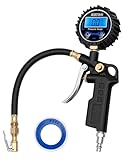
The AstroAI unit earns its slot here because it is the only product under twenty-five dollars that pairs a 0.1 PSI display resolution with a 3-250 PSI range. That combination means you can inflate a low-profile tire and read the result to a tenth of a pound without squinting at an analog dial. The quick-connect coupler makes hose swaps under a second, which matters when you are doing all four corners at a gas station.
- Pro: 0.1 display resolution at this price is unusual and genuinely useful.
- Pro: Wide 3-250 PSI band covers everything from a bike to a trailer.
- Con: The included air chuck is functional but shorter than dedicated lock-on models.
Skip it if you need a hands-free auto shut-off for production-level shop work; this is a read-and-bleed tool.
CZC AUTO Inflator/Deflator Gauge
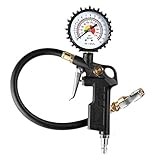
At just under fifteen dollars, the CZC AUTO is the cheapest entry with a built-in deflator bleed valve. That single feature saves you from over-inflating and then hunting for a pen cap to press the valve stem. The rubber hose stays flexible in cold weather, and the lock-on chuck clips onto the stem so you can read pressure hands-free.
- Pro: Integrated deflator eliminates the guess-and-correct cycle.
- Pro: Lowest price point among all eight picks.
- Con: No digital display; you rely on an analog dial that is harder to read at low light.
Pass on it if you need PSI readings precise enough for race tires or low-profile setups where a half-pound matters.
AZUNO Digital Inflator with Gauge
The AZUNO stands out because it ships in a portable carrying box with the hose, chuck, and coupler all organized inside. If your inflator spends life in a glove compartment or under a truck seat, that case keeps threads from getting gunked up. At 200 PSI it covers passenger cars, SUVs, and light trucks comfortably, and the rubber lock-on chuck holds a seal while you read the display.
- Pro: Dedicated carrying case protects fittings and keeps everything together.
- Pro: 200 PSI rating handles every common vehicle tire without straining.
- Con: Display resolution is standard whole-number steps, not the 0.1 you get on the AstroAI.
Consider skipping it if you already have a tool box and the carrying case is redundant clutter.
DigitPro Heavy-Duty Inflator
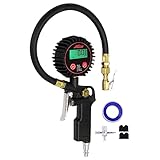
The DigitPro mirrors the AstroAI’s 3-250 PSI range but costs seven dollars less, making it the most affordable way to get a wide digital band. Heavy-duty labeling is accurate for its price tier: the body is thicker plastic than the CZC, and the display is backlit for garage use. It is a sensible pick for a homeowner who inflates a couple of times a month and wants more range than a basic unit.
- Pro: 250 PSI ceiling at the lowest price in the list.
- Pro: Backlit LCD readable in dim garage lighting.
- Con: No lock-on chuck; you hold the coupler steady while reading.
Skip it if you want a hands-free reading experience or a built-in deflator valve.
JACO FlowPro Digital Inflator
The JACO FlowPro sits at the top of the sub-forty-dollar tier, and its price reflects a heavier internal regulator and a more consistent bleed valve. Owners frequently note that readings stay stable across temperature swings where cheaper units drift by several PSI. The 200 PSI rating is sufficient for anything short of a commercial dump truck, and the rubber hose is noticeably thicker gauge than budget competitors.
- Pro: Temperature-stable accuracy over long ownership.
- Pro: Thick rubber hose resists kinking and cracking.
- Con: Highest price among all non-automatic models here.
Leave it on the shelf if you only top off one or two tires a month and do not care about thermal stability.
Milton 507KIT Digital Inflator
Milton built its reputation on air fittings, and the 507KIT carries that pedigree forward with a 14-inch rubber hose and a brass lock-on clip chuck. The 250 PSI ceiling and brass construction make this the most durable option under thirty-five dollars. If you work on vehicles with valve stems set deep behind a wheel face, that fourteen-inch hose reaches where shorter ones cannot.
- Pro: Brass lock-on chuck outlasts plastic alternatives by a wide margin.
- Pro: Fourteen-inch rubber hose handles recessed valve stems.
- Con: Bulkier head makes it less pocketable than the AZUNO in a case.
Skip it if your priority is compactness and you only check tires at home where reach is not an issue.
Red Stripe Automatic Inflator
This is the only model in the group with a true auto shut-off function. You set your target PSI, connect the chuck, and the unit stops inflating when it hits that number. For a shop or garage where a tire technician repeats the same pressure on dozens of vehicles per shift, that hands-free behavior saves meaningful time. The LCD display is large, and the heavy-duty air chuck is rated for daily abuse.
- Pro: Auto shut-off eliminates manual monitoring during inflation.
- Pro: Heavy-duty chuck and fitting quality designed for shop use.
- Con: Price is more than four times the next most expensive option in this list.
Do not buy it for occasional personal use; the cost is only justified by volume or commercial need.
Spurtar 10-120 PSI Inflator
The Spurtar is the narrowest-range pick here, capping at 120 PSI. That ceiling covers every passenger car and most bicycles, but it rules out heavy trucks and any trailer tire that calls for higher pressure. On the upside, the 10-120 scale gives a longer throw per PSI on the dial, which makes fine adjustments easier to judge by eye than on a 250 PSI gauge where the whole car range is compressed into a quarter turn.
- Pro: Compressed range yields clearer incremental readings for low-pressure tires.
- Pro: Compact head fits easily in a glove box.
- Con: 120 PSI cap excludes light trucks and trailers.
Skip it if you own anything heavier than a crossover or if you ever inflate trailer tires.
Buying Guide
Pressure Range and Display Resolution
Match the ceiling to your highest-pressure tire. Passenger cars and SUVs rarely exceed 45 PSI cold, so a 120 or 200 PSI gauge is comfortable. If you also service light trucks, RVs, or trailers, go for 250 PSI headroom. On resolution, a 0.1-step display is a meaningful upgrade over whole numbers when your target sits between marks on an analog dial; it removes the guesswork and reduces over- or under-inflation.
Chuck Type and Hose Length
A lock-on air chuck clips onto the valve stem so you can hold the gauge with both hands and read without squeezing a coupler. A quick-connect coupler is faster for swap-outs but demands one-handed pressure while you check. For hose length, twelve inches is tight around a wheel well; fourteen inches clears most steel and alloy rims without pulling the gauge across the lug nuts.
Build Materials and Long-Term Reliability
Brass fittings resist stripping and corrosion far better than aluminum or molded plastic. Rubber hoses outlast vinyl by resisting crack in cold weather. If the unit will live in a car trunk through freeze-thaw cycles, weight the chuck and hose material more heavily than the display size.
Our Verdict
The top pick overall is the Milton 507KIT for its brass lock-on chuck, fourteen-inch hose, and 250 PSI ceiling at a fair price. If budget is the driving factor, the DigitPro delivers a digital display and wide range for under seventeen dollars. However, the Red Stripe Automatic Inflator becomes the right answer the moment you are inflating more than a handful of tires per week, because its auto shut-off saves time that no other tool in this group can match.
FAQ
Is a digital gauge more accurate than analog?
Not inherently, but a digital readout with 0.1 resolution gives you finer repeatability than judging a needle position on a compressed analog scale. Over time, analog springs can drift; a digital sensor tends to stay consistent if you keep moisture out of the head.
Do I need 250 PSI if my tires max out at 44 PSI?
You do not, but the extra headroom means the gauge is not operating at the extreme end of its spring travel every use, which can help long-term accuracy. If you only inflate passenger tires, a 120 or 200 PSI unit is perfectly adequate.
What is the advantage of a deflator valve?
A built-in deflator lets you release small amounts of air while watching the gauge, so you can fine-tune pressure without disconnecting and re-inflating. Without one, you must over-shoot and then bleed air through the chuck, which is slower and less repeatable.
Can I use a tire inflator with gauge on an air compressor line?
Yes, provided your compressor delivers at least as much CFM at the working PSI as the inflator’s internal regulator allows. Most of the models listed here are designed for that use case; just confirm the coupler thread matches your compressor’s outlet.