
The best birding binoculars for most people are 8×42 models: they provide a steady, bright view, a wide enough field for locating moving birds, and enough magnification for woodland, backyard, and general field use.
Choose 8×32 binoculars when low weight and portability matter most, 10×42 when you regularly watch birds across open water or fields, and 10×50 only when you accept extra size and weight for improved low-light performance. The right choice depends less on maximum magnification than on how steadily you can hold the binoculars and how quickly you can find a bird in the view.
Our top picks
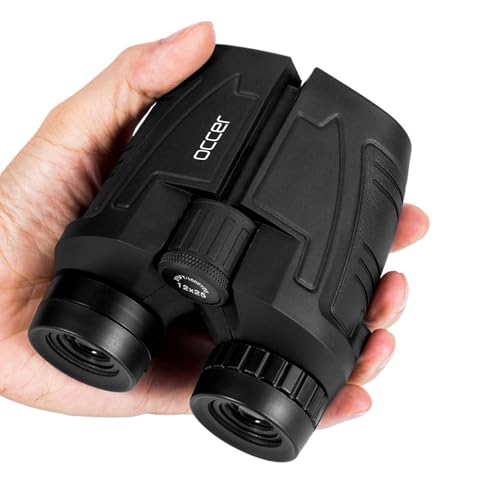 Occer 12x25 Compact Binoculars for Adults and
- 【HIGH-POWERED LARGE EYEPIECE BINOCULARS】 This binoculars for adults…
- 【ADJUSTABLE EYE CUPS FIT EYEGLASS WEARERS OR NOT】The…
- 【FMC BROADBAND COATING TECHNOLOGY】The lightweight cruise binoculars is…
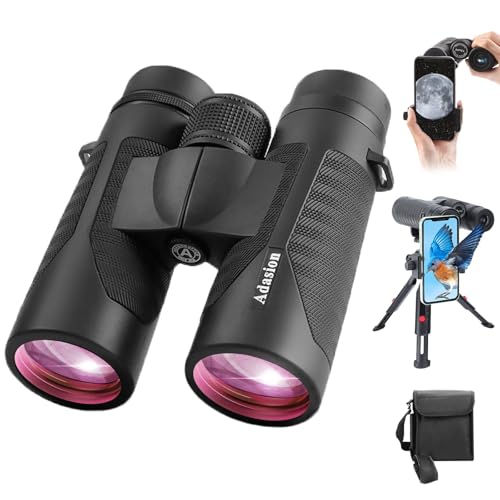 12x42 Binoculars for Adults High Powered with
- With 12x magnification and a 42mm objective lens,…
- Equipped with professional-grade BAK4 prisms, these binoculars enhance…
- The 2026 newly upgraded universal phone adapter fits…
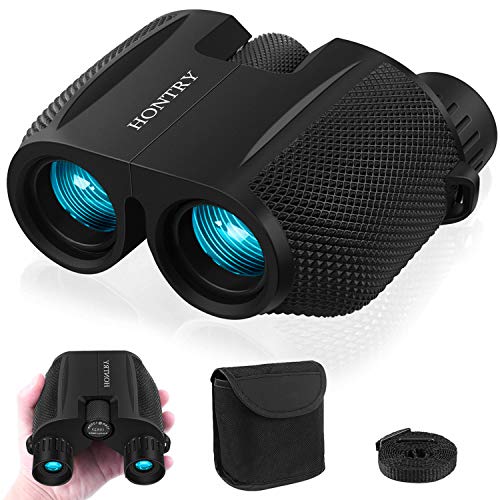 Hontry 10x25 Compact Binoculars for Adults and
- An ideal choice magnification: A 10x magnification strikes…
- Equipped with Bak-4 prisms: These prisms deliver images…
- Compact design: About the size of your palm…
| Product | Key specs | |
|---|---|---|
| Occer 12x25 Compact Binoculars for Adults and | 【HIGH-POWERED LARGE EYEPIECE BINOCULARS】 This binoculars for adults… 【ADJUSTABLE EYE CUPS FIT EYEGLASS WEARERS OR NOT】The… 【FMC BROADBAND COATING TECHNOLOGY】The lightweight cruise binoculars is… | Check price |
| 12x42 Binoculars for Adults High Powered with | With 12x magnification and a 42mm objective lens,… Equipped with professional-grade BAK4 prisms, these binoculars enhance… The 2026 newly upgraded universal phone adapter fits… | Check price |
| Hontry 10x25 Compact Binoculars for Adults and | An ideal choice magnification: A 10x magnification strikes… Equipped with Bak-4 prisms: These prisms deliver images… Compact design: About the size of your palm… | Check price |
 Vortex Triumph HD 10x42 Binoculars | A full-size binocular with 1x magnification and 42mm… With an HD optical system and fully multi-coated… Nitrogen purged, the Triumph is both waterproof and… | Check price |
As an Amazon Associate we earn from qualifying purchases at no extra cost to you.
Best birding binoculars by situation
- Best all-around choice: 8×42 roof-prism binoculars with a field of view around 7–8 degrees and close focus of about 2 meters.
- Best for backyard birding: 8×32 binoculars if most birds are within 5–30 meters and you want a compact, easy-to-carry instrument.
- Best for woodland trails: 8×42 binoculars with a wide field of view and close focus under 2 meters.
- Best for distant shorebirds and raptors: 10×42 binoculars, ideally used with a stable stance or support.
- Best for frequent low-light use: high-quality 8×42 or 10×50 binoculars with excellent optical coatings and good glare control.
- Best value for occasional birders: a well-made 8×42 model in the general $150–$300 market range, rather than an inexpensive 12x binocular with a narrow view.
8×42 versus 8×32 versus 10×42
The first number is magnification. An 8x binocular makes a bird appear eight times closer than it does to the unaided eye. The second number is the diameter of each objective lens in millimeters. Larger objective lenses can collect more light, but they also increase bulk.
| Configuration | Typical field of view | Typical close focus | Approximate weight | Best use |
|---|---|---|---|---|
| 8×32 | 7.5–8.5° | 1.5–2.5 m | 450–650 g | Backyards, travel, daylight woodland walks |
| 8×42 | 7.0–8.0° | 1.5–2.5 m | 600–850 g | Best general-purpose birding format |
| 10×42 | 5.8–6.8° | 1.8–2.5 m | 650–900 g | Open country, wetlands, distant birds |
| 10×50 | 5.5–6.5° | 2.5–4 m | 800–1,050 g | Long-distance and low-light viewing |
These are useful comparison ranges rather than universal specifications. Exact figures vary by model. An 8×32 has a 4 mm exit pupil, calculated by dividing 32 by 8. An 8×42 has a 5.25 mm exit pupil, while a 10×42 has a 4.2 mm exit pupil. In practical terms, the 8×42 usually looks more relaxed at dawn, dusk, and under a leafy canopy than a 10×42 of similar optical quality.
Recommended binocular types and representative models
Best all-around: Nikon Monarch M5 8×42
The Nikon Monarch M5 8×42 is a strong general-purpose option for birders who want useful optical performance without moving into premium pricing. Its 8x magnification is forgiving when identifying a bird quickly, and the 42 mm objectives suit changing light on woodland paths and garden feeders. Nikon lists a close-focus distance of approximately 2.5 meters and a weight of roughly 640 grams for this configuration.
This type of binocular is especially suitable for a birder who walks regularly but does not want to carry a full-size 10×50. The limitation is that its close focus is not as short as some compact birding binoculars, so it is less ideal for very nearby insects or birds at a close feeder.
Best value-oriented choice: Vortex Diamondback HD 8×42
The Vortex Diamondback HD 8×42 is aimed at buyers who want a practical, weather-resistant roof-prism binocular at a relatively accessible general market price, commonly around $200–$300 depending on sales and configuration. It weighs about 618 grams and focuses to approximately 1.5 meters.
That short close focus is useful in a backyard, where a bird may move from a distant tree to a nearby feeder. The wide, approximately 7.5-degree field of view also helps beginners locate birds. Compared with more expensive binoculars, edge sharpness, contrast in difficult backlight, and low-light refinement may be less impressive, but the core format is highly versatile.
Best for compact daytime carry: 8×32 binoculars
An 8×32 roof-prism binocular is often the better choice for travel, casual walks, and bright backyard viewing. At roughly 450–650 grams, it can be 150–250 grams lighter than many 8×42 models. That difference becomes noticeable after several hours around a reserve or during a trip when the binoculars hang from your neck all day.
The trade-off is light. The smaller 32 mm objectives produce a 4 mm exit pupil, so the image may appear dimmer before sunset or beneath dense foliage. For daylight birding, however, a quality 8×32 can look sharper and more comfortable than a cheap 10×42 because optical quality, focus precision, and contrast matter as much as lens diameter.
Best for open-country distance: 10×42 binoculars
Ten-power binoculars reveal more feather detail on distant raptors, shorebirds, and waterfowl. They are a good match for wide marshes, reservoirs, grasslands, and coastal viewpoints. Their narrower field of view makes fast-moving birds harder to acquire, and hand shake is more visible.
If you choose 10×42, look for a smooth central focus wheel, a comfortable grip, and a harness rather than relying only on a neck strap. A monopod or viewing rail can help during long observations, but a tripod adapter is not essential for ordinary handheld use.
What matters more than the headline specifications
Field of view
Field of view determines how much sky or woodland you can see at once. A wider view makes it easier to find a bird after following a call or pointing at a moving branch. It is particularly valuable for beginners and for woodland birding. Do not compare only the advertised field in feet at 1,000 yards; convert it to degrees when possible, since degree measurements make different models easier to compare.
Close-focus distance
Close focus matters around feeders, garden ponds, and hides. A binocular focusing to 1.5 meters can show nearby birds and butterflies clearly, while a model limited to 3 meters may force you to step back or miss an observation. Check whether the manufacturer measures from the front of the binocular or from your eyes; published methods are not always identical.
Low-light clarity
Objective size is only part of low-light performance. Fully multi-coated lenses, accurate alignment, good baffling against stray light, and high-quality glass can produce a more useful image than a larger but poorly made objective. In a store or during a return period, compare shadow detail, contrast around branches, and glare near a bright window or the setting sun. A bright image that looks washed out is not necessarily a better image.
Weight and balance
Weight affects how long you can observe without fatigue. Balance matters just as much: a front-heavy binocular can feel tiring even if its listed weight is moderate. Hold the binoculars in your normal viewing position for several minutes. If your hands begin to tremble or your shoulders tense, a lighter 8×32 or 8×42 may produce more usable detail than a heavier 10×50.
A practical decision matrix
| Your situation | Recommended format | Why |
|---|---|---|
| New birder, mixed habitats | 8×42 | Steady magnification, useful brightness, broad compatibility |
| Daily backyard use, mostly daylight | 8×32 or 8×42 | Short carrying distance and good close-focus potential |
| Long walks and travel | 8×32 | Lower weight and smaller packed size |
| Wetlands or open farmland | 10×42 | More detail at distance without 50 mm bulk |
| Dawn, dusk, or shaded forest priority | 8×42 or 10×50 | Larger exit pupil and improved light-gathering potential |
| Glasses wearer | Any format with adjustable eye cups | Proper eye relief helps retain the full field of view |
Setup and maintenance that improve real-world viewing
- Set the eyecups first. Keep them extended without glasses and retract them for glasses, then adjust until the full circular field is visible.
- Adjust the hinge width. Move the barrels until you see one round image rather than two overlapping circles.
- Focus the diopter. Close your right eye, focus with the central wheel using your left eye, then close your left eye and adjust the diopter for the right eye. After that, use only the central wheel.
- Carry the binoculars securely. A padded strap or harness reduces neck strain and lowers the risk of dropping them while climbing or crossing uneven ground.
- Clean only when necessary. Blow away grit first, use a lens brush, and then use a clean microfiber cloth or lens tissue. Wiping dry grit across the coatings is a common way to create fine scratches.
- Dry them before storage. If they become wet, remove the case and allow the binoculars to dry at room temperature. Do not use a radiator or hair dryer, which can damage seals, adhesives, or coatings.
The parts most likely to show wear are the rubber armor, eyecup mechanisms, strap attachments, and focus wheel. Keep the binoculars capped in a dusty environment, avoid leaving them in a hot vehicle, and have internal fogging or alignment problems handled by the manufacturer rather than opening the housing yourself.
Final recommendation
For one pair that covers most birding, choose a well-built 8×42 with a field of view near 7 degrees, close focus around 2 meters, comfortable eye relief, and a weight you can carry for a full outing. Choose 8×32 if portability dominates, or 10×42 if distant birds are your main subject. A stable view, fast focus, and useful contrast will usually help you identify more birds than simply choosing the highest magnification.





