
The best graphics cards GPUs for Ryzen 7 7700X are the Radeon RX 9070 XT for high-value 1440p, the GeForce RTX 5070 Ti for stronger ray tracing and creator features, and the GeForce RTX 5080 for high-refresh 4K; cheaper options such as the Radeon RX 9060 XT make more sense for 1080p.
AMD’s Ryzen 7 7700X remains a capable gaming processor in 2026, with eight Zen 4 cores, strong single-threaded performance, and support for PCIe 5.0 on the AM5 platform. At 1440p and 4K, the graphics card will usually determine frame rate, so the best match depends more on resolution, ray tracing settings, monitor refresh rate, power supply, and case space than on CPU compatibility.
Our top picks
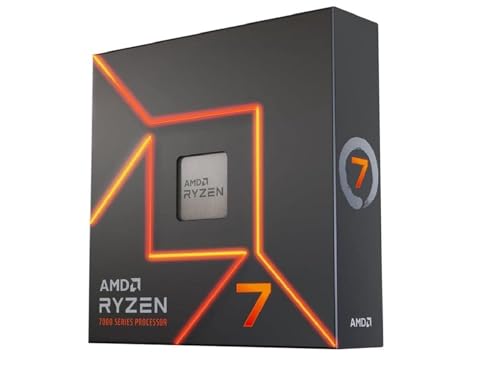 AMD Ryzen 7 7700X 8-Core
- This dominant gaming processor can deliver fast 100+…
- 8 Cores and 16 processing threads, based on…
- 5.4 GHz Max Boost, unlocked for overclocking, 80…
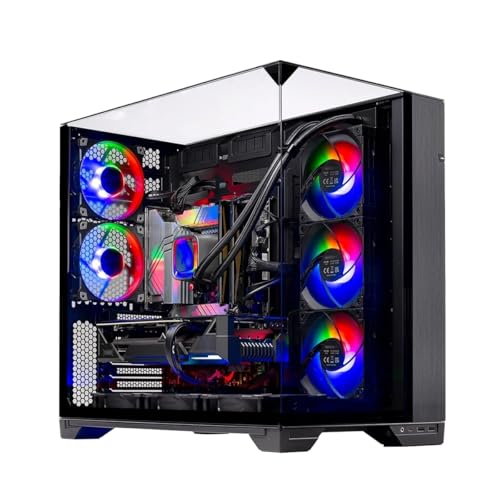 Skytech Gaming O11 Vision Gaming PC
- AMD Ryzen 7 7700X 4.5GHz (5.4GHz Turbo Boost)…
- NVIDIA GeForce RTX 5070 12GB GDDR7 Graphics Card…
- 802.11 AC | No Bloatware | Graphic output…
 INLAND AMD Ryzen 7 7700X CPU Processor
- AMD Ryzen 7 7700X Desktop Processor, 8-Core, 16-Thread,…
- For the state-of-the-art Socket AM5 platform, can support…
- GIGABYTE B650 Gaming X AX V2 Motherboard, ATX…
As an Amazon Associate we earn from qualifying purchases at no extra cost to you.
Quick picks for the Ryzen 7 7700X
- Best value for 1440p: Radeon RX 9070 XT 16GB
- Best Nvidia option for 1440p: GeForce RTX 5070 Ti 16GB
- Best budget choice: Radeon RX 9060 XT 16GB
- Best balanced 4K choice: GeForce RTX 5080 16GB
- Best for maximum 4K performance: GeForce RTX 5090 32GB
- Best for ray tracing on a tighter budget: GeForce RTX 5070 12GB
GPU comparison for the Ryzen 7 7700X
| GPU | VRAM | Typical board power | Recommended resolution | Typical market range |
|---|---|---|---|---|
| Radeon RX 9060 XT | 8GB or 16GB GDDR6 | 160W | 1080p; 1440p with 16GB | $300–$400 |
| GeForce RTX 5070 | 12GB GDDR7 | 250W | 1440p | $550–$700 |
| Radeon RX 9070 | 16GB GDDR6 | 220W | 1440p and entry-level 4K | $550–$650 |
| Radeon RX 9070 XT | 16GB GDDR6 | 304W | High-refresh 1440p and 4K | $600–$750 |
| GeForce RTX 5070 Ti | 16GB GDDR7 | 300W | High-refresh 1440p and 4K | $750–$900 |
| GeForce RTX 5080 | 16GB GDDR7 | 360W | 4K | $1,000–$1,200 |
| GeForce RTX 5090 | 32GB GDDR7 | 575W | 4K at maximum settings | $2,000–$2,500 |
Power figures are reference specifications; factory-overclocked cards can use more power. Physical dimensions also vary substantially between manufacturers, so treat the table as a performance and system-planning guide rather than a guarantee of fit.
Best value: Radeon RX 9070 XT
The RX 9070 XT is the strongest all-round pairing for a Ryzen 7 7700X when the priority is traditional rasterized gaming at 1440p. Its 16GB of VRAM gives it more room for high-resolution textures than 12GB cards, while its performance is suitable for high-refresh monitors and many 4K games with sensible settings.
It is particularly attractive when priced below the RTX 5070 Ti. AMD’s card generally offers strong performance per dollar, but Nvidia remains preferable if you frequently use demanding ray-tracing effects, DLSS features, CUDA-dependent applications, or livestreaming tools built around Nvidia’s software ecosystem.
Best Nvidia choice: GeForce RTX 5070 Ti
The RTX 5070 Ti is a better fit than the standard RTX 5070 for a premium 1440p system that may later move to 4K. Its 16GB of GDDR7 avoids the capacity compromise of a 12GB card, and Nvidia’s upscaling and frame-generation technologies can be useful in demanding ray-traced games.
Choose it over the RX 9070 XT when ray tracing, DLSS, Blender, AI-assisted applications, or Nvidia-specific creator features matter. For ordinary rasterized games, compare current prices rather than assuming the Nvidia model is automatically faster or better value.
Best budget option: Radeon RX 9060 XT 16GB
The RX 9060 XT is a sensible match for a 1080p monitor and a good lower-cost 1440p option in the 16GB version. The 8GB model can deliver good frame rates today, but the 16GB card is the safer long-term purchase for modern games with large texture packs and for users who keep a graphics card for several years.
The Ryzen 7 7700X may be faster than necessary for a budget 1080p build, but that is not a problem if the system will later receive a faster GPU. At very high frame rates in competitive games, the processor can help maintain smooth minimums, while the RX 9060 XT keeps heat, noise, and power consumption manageable.
Best 4K match: GeForce RTX 5080
The RTX 5080 is the balanced high-end choice for 4K gaming with the Ryzen 7 7700X. Its 16GB of GDDR7 is adequate for many current 4K games, and its performance is much more appropriate for a 4K 120Hz display than a midrange card.
There is an important limitation: at 4K, 16GB can become restrictive in some future games or heavily modded titles. If you want maximum texture headroom rather than the best balance of price and performance, the RTX 5090’s 32GB is substantially more comfortable.
When the RTX 5090 makes sense
The RTX 5090 is the choice for uncompromising 4K performance, high ray-tracing settings, professional GPU workloads, or unusually demanding simulators. It is also the least practical match for a typical Ryzen 7 7700X gaming system. At very high frame rates, especially at 1080p, the CPU can limit the card before the GPU reaches its full potential.
It demands careful system planning: a very large case, a high-capacity power supply, excellent airflow, and close attention to the 12V-2×6 power connection. For a gaming-only build, spending part of the budget on a faster gaming CPU platform or a better monitor may deliver more visible benefit than selecting the most expensive GPU available.
1080p, 1440p, or 4K: choose by workload
1080p gaming
For 1080p at 60–165Hz, choose the RX 9060 XT, RTX 5070, or a comparable previous-generation card if it is substantially discounted. The Ryzen 7 7700X is capable of high frame rates, but the benefit of a very expensive GPU decreases at this resolution. Competitive players targeting 240Hz or higher may justify the RTX 5070 or a faster card, depending on the game and settings.
1440p gaming
1440p is the natural target for this processor. The RX 9070, RX 9070 XT, RTX 5070, and RTX 5070 Ti cover the range from sensible high settings to high-refresh gaming. Pick 16GB of VRAM if you use ultra textures, mods, large open-world games, or intend to keep the card for four or more years.
4K gaming
For 4K, start with the RTX 5080 or RX 9070 XT, then move to the RTX 5090 if you want maximum settings and do not want to rely heavily on upscaling. The Ryzen 7 7700X is generally adequate at this resolution because the GPU does most of the work, although a newer X3D processor can be worthwhile for CPU-heavy games and very high refresh rates.
Power supply, case clearance, and airflow
A complete system using the RX 9060 XT generally works well with a quality 550W–650W power supply. The RTX 5070 or RX 9070 usually suits a 650W–750W unit, while the RX 9070 XT and RTX 5070 Ti are more comfortable with 750W–850W. An RTX 5080 typically calls for 850W, and an RTX 5090 commonly needs 1,000W or more depending on the rest of the system and the specific card.
Before buying, measure three areas:
- Length: compare the card’s exact length with the case’s maximum GPU clearance, allowing extra room for front fans or a radiator.
- Thickness: a 2.5-slot or 3.5-slot card can block neighboring expansion slots and restrict airflow to a second card or capture card.
- Power-cable clearance: avoid sharply bending a modern high-power connector immediately beside the plug. Leave room for the cable to exit naturally.
Large triple-fan cards often cool better, but a shorter dual-fan model may be the smarter purchase for a compact case. The 7700X itself can run warm under heavy loads, so use a capable tower cooler or liquid cooler and maintain front-to-back airflow.
Value calculation: why the 16GB version can be cheaper over time
Suppose an 8GB graphics card costs $320 and a 16GB version costs $370. The upgrade costs $50, or about 15.6% more. If the 8GB card forces you to replace it two years earlier than the 16GB model, the extra $50 works out to roughly $25 per year of additional useful life. That is not a guarantee, but it illustrates why memory capacity matters more than a small launch-price difference when you plan to keep the GPU for several years.
Common buying mistakes
- Buying an 8GB card for a long-term 1440p build solely because its current benchmark average looks attractive.
- Ignoring the exact dimensions of a factory-overclocked model.
- Using an old, low-quality power supply with a high-end GPU.
- Paying for extreme GPU performance while using a 1080p 60Hz monitor.
- Assuming frame generation replaces native GPU performance; it can improve perceived smoothness, but base frame rate and latency still matter.
Final recommendation
For most Ryzen 7 7700X owners, buy the Radeon RX 9070 XT if rasterized 1440p performance and value come first, or the GeForce RTX 5070 Ti if ray tracing and Nvidia software features are important. Choose the RX 9060 XT 16GB for affordable 1080p or moderate 1440p gaming, the RTX 5080 for a serious 4K system, and the RTX 5090 only when its power, size, and price are justified by your workload.





