
Best guitar cables: the right pick depends on where you play
For home practice, choose a flexible 10–15 ft instrument cable; for a recording desk, a 10–20 ft cable with dependable shielding and a quiet connector is usually enough; for most stages, a durable 20–25 ft cable gives you room to move without leaving excess cord underfoot. If you want one versatile option, look for a shielded, low-capacitance cable with straight ¼-inch TS plugs and a flexible jacket. There is no single best guitar cable for every setup: length, handling, and connector shape matter as much as brand.
A guitar cable carries an unbalanced instrument-level signal, so it can pick up interference more readily than a balanced microphone cable. A well-made cable helps reduce noise and withstand repeated coiling, but it will not fix hum caused by a power supply, grounding issue, or nearby electrical equipment.
Our top picks
 New Bee Guitar Cable 10ft Electric Instrument
- [Low Noise High Fidelity] New bee guitar cord…
- [Ideal for Choice] New bee 1/4 straight and…
- [Wide Compatible] Suitable for mixer, power amplifier, microphone,…
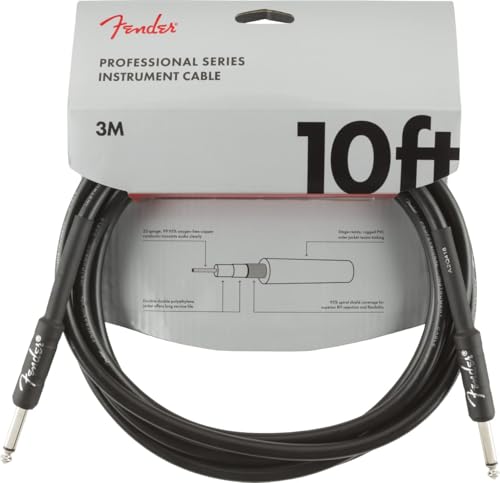 Fender Professional Instrument Cable
- One 10 foot Fender Instrument Cable guitar cords…
- Quality Fender Cable - Engineered to avoid twisting,…
- Durable Fender Guitar Cable - With an 8mm…
 Guitar Cable 10 ft/3m 2 Pack
- [Dual-Layer Shielding, Noise-Free Performance] Tired of noise from…
- [20AWG 99.99% OFC Conductor for True Tone] Compared…
- [Kevlar-Reinforced Durability] We reinforce our guitar cables with…
| Product | Key specs | |
|---|---|---|
| New Bee Guitar Cable 10ft Electric Instrument | [Low Noise High Fidelity] New bee guitar cord… [Ideal for Choice] New bee 1/4 straight and… [Wide Compatible] Suitable for mixer, power amplifier, microphone,… | Check price |
| Fender Professional Instrument Cable | One 10 foot Fender Instrument Cable guitar cords… Quality Fender Cable - Engineered to avoid twisting,… Durable Fender Guitar Cable - With an 8mm… | Check price |
| Guitar Cable 10 ft/3m 2 Pack | [Dual-Layer Shielding, Noise-Free Performance] Tired of noise from… [20AWG 99.99% OFC Conductor for True Tone] Compared… [Kevlar-Reinforced Durability] We reinforce our guitar cables with… | Check price |
 Amazon Basics TS 1/4 Inch Guitar Cable | Ideal for connecting an electric guitar, bass, or… 23 AWG oxygen-free copper (OFC) center conductor for… OFC spiral shield and conductive PVC shield to… | Check price |
As an Amazon Associate we earn from qualifying purchases at no extra cost to you.
Choose by situation
| Where you play | Useful length | What to prioritize | Typical trade-off |
|---|---|---|---|
| Bedroom or practice corner | 10–15 ft (3–4.6 m) | Soft, flexible jacket; reliable straight plug | Extra length can snag on furniture and add clutter |
| Recording desk | 10–20 ft (3–6 m) | Good shielding, low capacitance, quiet handling | Very short cables limit placement; longer runs may affect brightness |
| Small rehearsal room | 15–20 ft (4.6–6 m) | Durable strain relief and easy coiling | Heavier construction can be less supple |
| Live stage | 20–25 ft (6–7.6 m) | Robust plugs, secure fit, visible or easy-to-manage jacket | More cable to tape down and inspect |
| Pedalboard to amp across a large stage | 25–30 ft (7.6–9.1 m), if needed | Careful routing; consider a buffer or wireless system for longer paths | More opportunity for noise, tangles, and high-frequency loss |
These are practical starting points, not electrical limits. Measure the route from guitar to amp, including the path around a pedalboard or stand, then add a little slack for movement. Avoid buying a much longer cable “just in case”: excess length is more likely to become a trip hazard than a useful reserve.
What separates a good cable from a frustrating one?
Shielding and capacitance
Shielding—a braided, spiral, or foil layer around the signal conductor—helps reject electrical interference. Braided shielding is often chosen for ruggedness, while spiral shielding can be flexible and economical; construction quality matters more than the label alone. If a cable crackles when moved, the cause may be a worn conductor or connector rather than inadequate shielding.
Capacitance is commonly listed in picofarads per foot (pF/ft) or per meter (pF/m). In a passive-guitar setup, cable capacitance interacts with the pickups and can soften high frequencies. A lower-capacitance cable can preserve more of the signal over a long run, but the audible difference depends on the guitar, pickups, amplifier, and total cable length. For a short home connection, a modest specification is rarely worth sacrificing durability or a comfortable feel.
Connectors: straight, right-angle, and locking
Straight ¼-inch TS plugs fit most instruments and amplifiers. A right-angle plug can sit closer to the body on guitars with side-mounted jacks, reducing the chance of a cable sticking out where it can be bumped. Check the instrument’s jack location and shape before choosing one: recessed or top-mounted jacks may suit a straight plug better.
Locking connectors can help prevent accidental unplugging on a busy stage, but they must match the compatible jack or locking system. They are not a universal upgrade for an ordinary guitar input. At any connector, look for a firm fit and solid strain relief—the section that protects the cable where it meets the plug.
Flexibility, jacket, and handling noise
A supple jacket coils more easily and is less likely to pull a guitar off balance. A thicker jacket may resist abrasion, but bulk alone does not prove that a cable will last. For stage use, prioritize reinforced ends and a cable that can be routed neatly; for a home setup, easy handling may matter more than a heavy-duty outer layer. If a cable thumps loudly when tapped or dragged, it may transmit handling noise into the signal.
How to decide what to spend
For a basic practice cable, general market prices for standard instrument cables are often around $10–$25. Better-known, more rugged, or lower-capacitance models commonly fall around $25–$60, while specialty cables and locking systems can cost more. These are broad ranges, not a guarantee of current pricing; length and connector options affect the total.
| Your situation | Best-value approach | Why |
|---|---|---|
| New player, occasional practice | One 10–15 ft standard cable in the $10–$25 range | Enough length for a typical room without paying for stage-oriented features |
| Regular home or studio use | One 10–20 ft cable with stated capacitance and solid strain relief | Useful flexibility and signal specs without buying extras you may not need |
| Frequent rehearsals or gigs | A rugged 20–25 ft cable plus a short spare | A backup can keep a damaged cable from ending a session |
| Pedalboard with frequent setup changes | Choose cable lengths to match each connection; use a longer instrument cable only for the guitar-to-board or board-to-amp run as needed | Less excess cable means quicker setup and fewer tangles |
For example, if a $30 cable is used three times a week for two years, that is about 312 uses, or roughly 10 cents per use. A cheaper cable that fails after a few months may cost less upfront but create more replacements and interruptions. The calculation is only a planning aid: storage, transport, and how often the cable is stepped on usually matter more than price alone.
Setup and care that extend cable life
- Coil over-under or in relaxed loops. Avoid twisting the cable tightly around your elbow or pulling it taut; repeated twists strain the internal conductors.
- Unplug by gripping the plug. Pulling the cable itself loads the connector and is a common cause of intermittent signal.
- Route it away from power cables when possible. If audio noise appears, move the instrument cable first and check whether the noise changes before replacing it.
- Store it dry and untangled. Keep plugs protected from dirt and moisture, and avoid tight bends at the connector ends.
- Check for faults methodically. If you hear crackling, test the cable with another instrument or amplifier, then gently flex each end. A fault that follows the cable points to damage; do not keep using a cable that cuts out during performance.
Bottom line
The best guitar cables are the ones that fit the route and survive the way you use them. Choose 10–15 ft for a compact practice space, a sensibly routed 10–20 ft cable for recording, and 20–25 ft for most live setups. Favor dependable shielding, a comfortable jacket, secure connectors, and strain relief over flashy claims. If you gig regularly, keep a spare; if you play at home, avoid paying for stage features you will not use.





