Our Top Picks
 DIY CARTEL Corten Steel Outdoor Planter Box48in x 48in x 12in48 x 48 x 12 inches45 PoundsCheck on Amazon
 HGLADYU Corten Steel Garden Raised Bed Large Durable39.4" x 39.4" x 16.1" & 139.4 x 16.1 x 39.4 inches16.39 PoundsCheck on Amazon


The best modern corten steel raised garden planter for most patios and yards is the Nice Planter Corten Steel Trough Planter, 20″ x 46″ x 20″. Its 46-inch length gives you roughly 10.6 cubic feet of growing volume — enough for three determinate tomatoes or a full row of peppers and herbs — while the 20-inch depth clears the 12–18 inch root zone that most fruiting vegetables need. It suits anyone with a 4-foot stretch of patio wall, deck rail, or driveway edge who wants one piece that reads as designed rather than improvised. If your budget is the deciding factor, the BUYYAH Cor-Ten Steel Raised Garden Bed Kit (2 ft x 4 ft x 14 in) delivers the same weathering-steel behavior in a modular bed for far less. If you want a front-door piece with real presence, the Veradek Corten Steel Series Pedestal Planter is the premium answer. Everything below is judged on gauge class, patina timeline, drainage design, and how the footprint fits a real modern layout.
Top 3 Picks
Best overall: Nice Planter Corten Steel Trough Planter, 20″ x 46″ x 20″. A true trough proportion — long, deep, and narrow enough to run along a wall without swallowing a walkway. The 20-inch soil depth suits tomatoes, peppers, and dwarf shrubs, and the surface area is large enough that the box does not dry out between waterings the way a 12-inch accent pot does. It is the pick for readers who want one planter to do the work of a small bed.
Best budget: BUYYAH Cor-Ten Steel Raised Garden Bed Kit, 2 ft x 4 ft x 14 in. A bolt-together kit in the same weathering-steel family, at roughly 9.3 cubic feet of soil volume. It is the cheapest way to get a genuinely large growing footprint in corten, and because it assembles from panels, you can move it, reconfigure it, or stack two for a deeper bed later. Ideal for a first vegetable patch on a patio or a strip of lawn you would rather not dig up.
Best premium: Veradek Corten Steel Series Pedestal Planter. A tall, tapered pedestal form that lifts plantings to eye level — the piece that makes an entryway look finished. Premium tier pricing buys the sculpted silhouette and the heavier build class rather than more soil volume; a pedestal column holds far less than a trough. Buy it for the look at the front door, not for tomato yields.
Quick Comparison
Every product covered in this article, with the specs that actually drive a decision. Price tiers are general market bands — budget, mid-range, and premium — because listed prices move constantly with availability and season.
| Product | Best for | Key specs | Price tier |
|---|---|---|---|
| DIY CARTEL Corten Steel Outdoor Planter Box | Statement farmhouse-modern patios | Large-format corten box; rustic-modern farmhouse styling; confirm variant footprint | Premium |
| Nice Planter Corten Steel Trough Planter | Best overall long trough | 20 in H x 46 in L x 20 in W; approx. 10.6 cu ft soil volume; ~370 lb filled weight | Premium |
| Foresland Corten Steel Style Planter Box | Narrow balconies and entry gaps | 36 in W x 11 in D x 30 in H; ships not pre-rusted; approx. 6.9 cu ft volume | Mid-range |
| HGLADYU Corten Steel Garden Raised Bed | Budget square vegetable bed | 39.4 x 39.4 x 16.1 in; approx. 14.5 cu ft volume; ~500 lb filled weight | Budget |
| Watbick Corten Steel Planter, 46 x 20 x 20 in | Deep-rooted edibles and shrubs | 46 x 20 x 20 in; approx. 10.6 cu ft volume; 20 in usable depth | Premium |
| Watbick Corten Steel Long Box Planter | Long, low runs along fences | 46 x 16 x 16 in; approx. 6.8 cu ft volume; lower profile | Mid-range |
| BHCORTEN Corten Steel Planters, 26 Inch | Compact porch pairings | 26 in class planter; confirm which dimension the 26 in refers to | Mid-range |
| BHCORTEN Corten Steel Planter Box, 36 x 15 x 24 in | Tall screening and privacy | 36 in L x 15 in W x 24 in H; removable insert; approx. 7.5 cu ft gross | Budget |
| Veradek Corten Steel Series Pedestal Planter | Premium front-door pedestal | Tall pedestal silhouette; naturally rusting corten finish; narrow column footprint | Premium |
| Edge Right Raised Garden Bed Kit, COR-Ten Steel | Modular vegetable beds | 2 ft x 4 ft x 14 in; approx. 9.3 cu ft volume; panel kit assembly | Mid-range |
| BUYYAH Cor-Ten Steel Raised Garden Bed Kit | First-time growers on a budget | 2 ft x 4 ft x 14 in; approx. 9.3 cu ft volume; bolt-together panels | Budget |
| Decoroca Corten Steel Planter Box | Budget tall accent planter | 30 in L x 12 in W x 24 in H; approx. 5 cu ft volume; narrow vertical form | Budget |
How We Chose
This roundup is built from published product specifications, listed dimensions, and well-established behavior of weathering steel as a material — not from hands-on trials. Three filters did most of the work. First, gauge class and construction: a corten box is only as good as its wall thickness and how the panels are joined. Thin, spot-welded panels oil-can and bow once they carry wet soil, so we favored listings that specify heavy-duty construction, removable inserts, or bolted panel kits over boxes described only by appearance.
Second, real soil volume and usable depth. Manufacturers quote exterior dimensions, but plants care about interior depth. A 30-inch-tall planter with a false bottom may only give you 14 inches of soil. We calculated interior volume where dimensions were published and sorted each product by what it can actually grow. Third, drainage design: pre-drilled holes, drainage mats, and the ability to elevate the base all matter more in a metal container than in a wooden one, because standing water at the bottom of a steel box is the single most common cause of premature failure and root rot.
Finally, category fit and upgrade path. We kept one product per real-world job — patio centerpiece, narrow balcony, vegetable yield, front-door pedestal, modular bed — so the list works as a decision set rather than twelve variations on the same box.
1. DIY CARTEL Corten Steel Outdoor Planter Box – Best for a Statement Farmhouse-Modern Patio
As an Amazon Associate we earn from qualifying purchases at no extra cost to you.

The DIY CARTEL Corten Steel Outdoor Planter Box is aimed at the reader who treats the planter as architecture. The listing positions it as a large metal garden bed with a rustic-and-modern farmhouse design, which in practice means the box is meant to be seen — a weathered corten face, clean straight edges, and enough mass to anchor a patio corner, a pool deck, or the flank of a garage. It suits larger yards and modern-rustic outdoor rooms where a small accent pot would disappear.
Key specs
- Material: corten (weathering) steel with a naturally developing rust patina
- Form: large-format rectangular outdoor planter box / metal garden bed
- Styling: rustic and modern farmhouse — straight panels, visible steel edges, no applied finish color
- Dimensions: sold in size variants; confirm the exact footprint of the variant before ordering, because a large box is not a small box scaled up
- Assembly: typical of this class — panels that bolt or slot together, no welding required
- Placement: outdoor only; expect patina run-off for the first several months
The strongest argument for a box in this class is scale. A genuinely large corten planter can replace a section of garden bed entirely: you skip the digging, you skip the soil amendment of native ground, and you get a defined edge that reads as intentional design. In a farmhouse-modern layout — board-and-batten siding, black window frames, gravel or concrete paving — a rusted steel box is one of the few materials that sits comfortably between “old” and “new.”
Where this pick demands care is planning. Large corten boxes are heavy empty and very heavy full. A box that holds 12 cubic feet of potting mix carries roughly 400–420 pounds of soil on its own, before the water. That means two things: level, load-bearing ground underneath, and a decision about whether you will ever move it. Treat a large corten box like a small shed — place it once, correctly, and leave it.
Drainage is the other consideration. Big-volume metal planters benefit from a proper drainage layer — an inch or two of coarse gravel or a rigid drainage mat under a landscape-fabric barrier — plus drilled holes at the lowest point. Without that, the bottom four inches of a deep box stay saturated, which is exactly where roots of shrubs and small trees will sit.
Pros
- Statement scale — reads as a built landscape feature rather than a container
- Farmhouse-modern styling pairs with wood, black metal, gravel, and concrete
- Weathering steel needs no paint, stain, or sealing in normal outdoor use
- Large soil volume buffers temperature and moisture swings far better than small pots
- Genuinely long service life when drainage is handled properly
Cons
- Premium tier pricing for the size and build class
- Very heavy once filled — effectively permanent
- Variant sizing means you must confirm dimensions before ordering
- Initial patina run-off can stain light paving for the first year or two
- Overkill for herbs or a single shrub; you pay for volume you may not use
Against the nearest alternative in this list, the Nice Planter Corten Steel Trough Planter, the DIY CARTEL box wins on presence and footprint flexibility and loses on predictability — Nice Planter publishes a fixed 20″ x 46″ x 20″ size you can plan around down to the inch. If you are designing around a specific wall length, buy the fixed dimension. If you are filling a generous open corner and want the biggest visual mass, the DIY CARTEL box is the better instrument.
2. Nice Planter Corten Steel Trough Planter – Best for a Long, Deep Patio Trough

This is the best overall pick in this roundup, and the reason is arithmetic rather than aesthetics. At 20 inches high, 46 inches long, and 20 inches wide, the Nice Planter Corten Steel Trough Planter holds roughly 18,400 cubic inches — about 10.6 cubic feet — of growing medium. That is a real bed in a container. It suits patio and deck owners with a 4-foot run of wall or railing, and anyone who wants a single piece that can carry tomatoes, peppers, and herbs together without looking crowded.
Key specs
- Dimensions: 20 in H x 46 in L x 20 in W
- Interior volume: approximately 10.6 cubic feet at full fill
- Filled weight: roughly 370 lb of potting mix, plus water and plants
- Material: corten steel, naturally weathering finish
- Form: rectangular trough — long and relatively narrow
- Drainage: plan on drilled base holes plus a coarse drainage layer and a fabric barrier
- Best placement: against a wall, along a deck rail, flanking a door, or as a patio divider
The trough proportion is the quiet advantage. A 46-inch length with a 20-inch width gives you a planting strip you can actually design in layers — taller plants at the back, mid-height fillers, trailing plants spilling over the front lip. Because the box is 20 inches deep, you are not limited to shallow-rooted ornamentals: bush tomatoes, peppers, compact blueberries, and dwarf hydrangeas all have room. And because the volume is large, the soil mass itself moderates temperature, so roots are less likely to cook on a hot afternoon than they would in a 12-inch pot.
Weight is the trade-off to plan for. At full fill you are looking at roughly 370 pounds of moistened potting mix, plus the steel itself. That is fine on a concrete patio, a gravel pad, or a deck rated for it — but it should sit on a level surface, ideally on rubber feet or thin pavers that lift the base a quarter to half an inch off the paving. That gap does two jobs: it stops the base from sitting in standing water, and it keeps the rust bloom from bonding to the surface underneath.
On the patina timeline, expect the classic weathering-steel sequence: an orange flash-rust bloom within the first few weeks, mottled orange-brown through the first six to twelve months, and a deep, stable brown by roughly the two- to three-year mark. Rain and dry cycles speed this up; constant shade and constant wetness slow it down and can produce streaking.
Pros
- Best balance of length, width, and depth in this list
- 10.6 cubic feet of soil supports fruiting vegetables, not just ornamentals
- Clean trough proportions suit modern and industrial patio schemes
- Fixed, published dimensions make layout planning straightforward
- Large soil mass reduces watering frequency compared with smaller containers
Cons
- Premium tier pricing
- Requires a level, load-bearing surface — roughly 400 lb total when planted
- Too long for narrow balconies and small entry landings
- Needs added drainage hardware; holes and a gravel layer are on you
- Patina run-off will mark pale paving unless you use a tray or gravel border
Its closest competitor is the Watbick Corten Steel Planter, 46 x 20 x 20 in, which matches it dimension for dimension and therefore volume for volume. The difference is refinement versus rawness: Nice Planter is the more established planter-focused name, while Watbick competes on the same footprint. If the Nice Planter trough is out of stock, the Watbick 46 x 20 x 20 is a direct substitute with no change to your layout math.
3. Foresland Corten Steel Style Planter Box – Best for Narrow Balconies and Entry Gaps

The Foresland Corten Steel Style Planter Box is the narrow-space specialist in this roundup. At 36 inches wide, 11 inches deep, and 30 inches tall, it occupies a footprint smaller than a doormat while standing tall enough to place foliage at chest height. It suits balcony owners, renters with a single landing outside the door, and anyone trying to green up a gap between a downspout and a wall. Note the listing language: “corten steel style,” and “not pre-rusted.”
Key specs
- Dimensions: 36 in W x 11 in D x 30 in H
- Gross volume: approximately 6.9 cubic feet if filled to the top
- Finish: ships not pre-rusted — bare steel that develops its own patina on site
- Footprint class: narrow column — about one square foot of floor space per unit
- Height advantage: brings plantings up to 30 in, closer to eye level
- Best placement: balconies, entry gaps, between windows, beside a bench
The 11-inch depth is the defining number. It means this box fits where almost nothing else does — a balcony that is technically only wide enough for a chair, a side return beside a step, the sliver of wall between a door frame and a corner. But it also means the usable soil depth is constrained. A 30-inch-tall box is not a 30-inch-deep root zone; you will want a drainage layer at the base and, in many cases, a partial fill or false bottom, leaving perhaps 20 to 24 inches of actual growing medium. That is plenty for herbs, trailing plants, ferns, compact grasses, and even a determinate tomato in a single-plant column, but not for carrots or long-rooted crops.
Because it ships unrusted, the Foresland box gives you a decision most corten products take away from you: you see the steel as steel first. Some buyers prefer this — the patina develops under your eye, and you can document the change. Others are surprised by how bright the initial flash rust looks against a dark wall. Expect orange for the first several weeks, a mottled brown through the first year, and a settled dark finish after roughly two years of outdoor exposure. If you want the look immediately, you can accelerate it by keeping the surface alternately damp and dry — but never by applying a sealant, which locks out the moisture the patina needs.
Balcony placement adds one more consideration: run-off. A tall, narrow box on a balcony sits above a neighbour’s space or a walkway more often than a ground-level bed does. A shallow tray under the base, or a gravel-filled saucer, catches the rust-tinted water for the first season and protects the surface below.
Pros
- 11-inch depth fits balconies and gaps nothing else will
- 30-inch height lifts plants to a useful, viewable level
- Ships unrusted, so you control the patina from day one
- Mid-range pricing rather than premium
- Narrow footprint means you can pair two without crowding a landing
Cons
- Narrow depth limits you to shallow-rooted plants and column plantings
- Tall, narrow boxes tip more easily — secure or weight the base
- Not pre-rusted means you wait for the look you bought it for
- Smaller soil volume dries out faster than a trough or bed
- “Corten steel style” wording means you should confirm the exact material spec if alloy matters to you
Compared with the Decoroca Corten Steel Planter Box (30 x 12 x 24 in) — the other narrow vertical option here — the Foresland box is taller and longer but costs more. Decoroca is the budget way to test whether a narrow column works in your space; Foresland is the mid-range upgrade once you know it does.
4. HGLADYU Corten Steel Garden Raised Bed – Best Budget Square Bed for a Vegetable Plot

If your goal is growing food rather than decorating a patio, the HGLADYU Corten Steel Garden Raised Bed is the most volume per dollar in this list. Its 39.4 x 39.4 x 16.1-inch footprint produces roughly 24,990 cubic inches — about 14.5 cubic feet — of growing space in a compact square. That is a genuine kitchen garden: salad greens, radishes, bush beans, herbs, and a couple of peppers, all in under four square feet of ground.
Key specs
- Dimensions: 39.4 in x 39.4 in x 16.1 in (roughly 1 m x 1 m x 41 cm)
- Interior volume: approximately 14.5 cubic feet
- Filled weight: roughly 500 lb of potting mix at full fill
- Depth: 16.1 in of soil — good for most vegetables, short of long carrots
- Material: corten steel with a rusty patina finish, described as large and durable
- Form: open square bed, no false bottom
- Best placement: a level lawn edge, gravel pad, or paved corner with full sun
The square footprint is more useful than it first appears. A one-metre square is the classic allotment bed size because you can reach the centre from any side without stepping on the soil — which matters more than it sounds, since compacted bed soil is the number one reason raised-bed yields fall off in year two. At 16 inches deep, you are comfortably above the 12-inch minimum for peppers and bush beans, and close to the 18-inch target for tomatoes.
The honest constraint is depth. Sixteen inches is not enough for full-length carrots, parsnips, or potatoes, which want 18 to 24 inches of loose medium to size up properly. If root crops are your priority, either choose short varieties bred for shallow containers, or accept that this bed is a leaf-and-fruit-crop bed. That is a design decision, not a flaw.
Weight planning matters here too. Roughly 500 pounds of moist potting mix in a one-metre square means the bed should sit on soil, gravel, or a solid paved surface — not on a raised timber deck unless you have confirmed the load rating. Filling is also a cost people forget: 14.5 cubic feet is around 12 to 15 large bags of potting mix, or a bulk order. Blending roughly 60 percent quality potting mix with 30 percent compost and 10 percent coarse perlite or bark fines gives you a lighter, better-draining fill than straight garden soil, which at 75–100 lb per cubic foot would push this bed past 1,000 pounds.
Pros
- Budget tier with the largest soil volume in this roundup
- 14.5 cubic feet is enough for a serious kitchen garden
- One-metre square lets you reach the centre from every side
- Open-bottom design simplifies drainage — water moves down and out
- Metric dimensions match common European and international bed layouts
Cons
- 16.1-inch depth rules out long root crops
- Filling cost is significant — roughly 12–15 bags of medium
- Very heavy when planted; treat it as a permanent installation
- Budget-tier build quality means you should check panel joints and edge rigidity on arrival
- Square shape is less flattering against a straight wall than a trough
Its nearest alternative is the Edge Right Raised Garden Bed Kit, also a corten panel bed. Edge Right gives you a longer, shallower 2 ft x 4 ft rectangle at 14 inches — better for row planting and easier to reach across, but with about 9.3 cubic feet against HGLADYU’s 14.5. Choose HGLADYU for maximum volume in a compact square; choose Edge Right for a longer, more accessible row layout.
5. Watbick Corten Steel Planter, 46 x 20 x 20 in – Best for Deep-Rooted Edibles and Shrubs
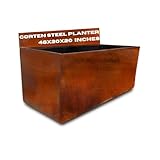
The Watbick Corten Steel Planter in the 46 x 20 x 20-inch size is a direct answer to the question “what if I want a raised bed, but I want it to look like furniture?” It holds the same roughly 10.6 cubic feet as the Nice Planter trough, in the same proportions, and it is sold as a large rectangle metal planter box for outdoor use. It suits gardeners who want fruiting crops at waist height without the visual bulk of a timber bed.
Key specs
- Dimensions: 46 in L x 20 in W x 20 in H
- Interior volume: approximately 10.6 cubic feet
- Filled weight: roughly 370 lb of potting mix
- Depth: 20 in — clears the 18-inch target for tomatoes and cucumbers
- Material: corten steel, naturally weathering
- Form: large rectangle, straight-sided
- Best placement: patio edge, driveway border, pool deck, or as a freestanding divider
Twenty inches of depth is the headline number. Most container vegetable failures trace back to shallow soil: the root ball dries out twice a day in July, the plant stalls at the flowering stage, and you blame the variety. At 20 inches, a determinate tomato has the root run to support fruit set, and a compact blueberry or dwarf hydrangea has room for the fibrous root mass it needs. It also means you can plant in genuine layers — a shrub at one end, herbs and trailing plants along the front — rather than a single row of identical pots.
Watbick positions this as a flower pot as well as a planter box, and the neutral steel finish is why that works. Corten has no color to clash with: it reads brown-grey in overcast light and warm rust in sun, and it sits happily against timber cladding, black aluminium, rendered walls, and gravel. In a modern patio layout, the 46-inch length is close to ideal for defining a zone without walling it off.
Practical ownership notes. Add drainage before planting: drill a spread of roughly 3/8-inch holes across the base at 6- to 8-inch centres, deburr them, then lay an inch of coarse gravel or a rigid drainage mat covered with landscape fabric. Elevate the box a quarter-inch on rubber feet so the base never sits in a puddle. And plan for the first-season rust bloom — a 46-inch box sheds a noticeable amount of orange run-off in its first wet months, so either keep it on gravel or accept some marking on pale paving.
Pros
- 20-inch depth supports tomatoes, peppers, cucumbers, and compact shrubs
- Substantial 10.6 cubic feet of growing volume
- Neutral corten finish works with almost any modern exterior palette
- 46-inch length defines a patio zone without dominating it
- Straight-sided form makes lining with fabric and calculating fill straightforward
Cons
- Premium tier pricing
- Around 400 lb total weight when planted — placement is effectively permanent
- Drainage holes and a gravel layer are not pre-installed in most listings of this class
- Long rectangle needs a level run; uneven paving will show as a gap under one end
- First-season patina run-off can stain light surfaces
Its nearest rival is the Watbick Corten Steel Long Box Planter, 46 x 16 x 16 in — same brand, same 46-inch length, but four inches shorter and four inches narrower, giving about 6.8 cubic feet instead of 10.6. The 46 x 20 x 20 is the right call when depth matters; the 46 x 16 x 16 is the right call when you want a lower, longer line along a fence or under a window.
6. Watbick Corten Steel Long Box Planter – Best for Long, Low Runs Along Fences

The Watbick Corten Steel Long Box Planter, at 46 x 16 x 16 inches, is the low-profile sibling of the trough above. It suits readers who want a continuous line of planting along a fence, a low wall, or the base of a garage — the kind of run where a taller box would block sightlines or light into a window. At roughly 6.8 cubic feet it is a mid-range compromise between a large trough and a narrow column.
Key specs
- Dimensions: 46 in L x 16 in W x 16 in H
- Interior volume: approximately 6.8 cubic feet
- Filled weight: roughly 240 lb of potting mix
- Depth: 16 in — good for greens, herbs, peppers, and compact flowers
- Material: corten steel, naturally weathering finish
- Form: long rectangle, low profile
- Best placement: fence lines, window bases, narrow patios, garage walls
The value of a 16-inch height is that it disappears into the landscape rather than competing with it. A low corten box along a fence reads as a planting strip, not a container — which is exactly what you want when the architecture should stay dominant. It also keeps plants below window sills, an underrated benefit on a patio where a 20-inch trough would sit right in your eyeline from a chair.
At 16 inches deep, this is a leaf-and-fruit bed rather than a root bed. Lettuce, chard, kale, basil, parsley, bush beans, strawberries, and peppers all work. Full-length carrots, parsnips, and potatoes do not — they want 18 to 24 inches of loose medium to reach market size, and cramming them into 16 inches gives you short, forked roots. If you want root crops in a low box, choose stubby varieties bred for shallow containers.
Volume planning: 6.8 cubic feet is roughly 6 to 7 large bags of potting mix, or about a third of a bulk yard. Moistened, that is around 240 pounds of medium plus the steel — heavy enough that you want it on solid ground, but manageable enough that two people can reposition it before filling. The 46-inch length gives you about 3.8 running feet of planting, which fits roughly four to six medium annuals or a dense row of salad crops.
Drainage follows the same rules as its taller sibling: 3/8-inch holes at 6- to 8-inch spacing, a gravel or mat layer, fabric over the top, and a small elevation gap under the base. Because this box is low, it is also more likely to be splashed by rain bouncing off paving, so a coarse mulch layer on top of the soil helps prevent soil splash and keeps the steel rim cleaner.
Pros
- Low 16-inch profile keeps sightlines and window light clear
- Mid-range pricing for a 46-inch corten run
- Around 240 lb filled — heavier than a pot, still repositionable
- Same neutral weathering finish as the rest of the Watbick range
- Good value per linear foot for edge-of-patio planting
Cons
- 16-inch depth rules out long root crops and large shrubs
- Lower volume dries out faster than a 20-inch trough
- Smaller soil mass offers less temperature buffering in heatwaves
- Still needs user-installed drainage
- Low boxes can look undersized against a tall fence or blank wall
Against the BHCORTEN Corten Steel Planter Box, 36 x 15 x 24 in, the Watbick long box is longer and lower; the BHCORTEN is shorter and 8 inches taller, which makes it the better pick if you need height for screening rather than length for a run. Choose by which dimension your space is short of.
7. BHCORTEN Corten Steel Planters Outdoor, 26 Inch – Best for Compact Porch Pairings

The BHCORTEN Corten Steel Planter, 26 Inch, is the flexible middle of this list — a compact planter sized for doorways, porches, and step landings, where you almost always want two rather than one. It suits readers who want a matched pair flanking an entrance, or a single accent piece on a small balcony. Because the listing names a single dimension, confirm whether the 26 inches refers to height, width, or diameter before you commit to a layout.
Key specs
- Size class: 26-inch planter — confirm which dimension is specified on the variant you choose
- Material: corten steel with a weathering patina finish
- Use: outdoor porch, patio, entryway, balcony
- Volume class: compact — expect roughly 2 to 6 cubic feet depending on whether the form is column or cube
- Pairing: designed to work as a matched set either side of a door
- Best placement: entryways, step landings, small patios, apartment balconies
The case for a compact planter is symmetry. Almost nothing improves a front door faster than two identical containers with two identical plantings — a matched pair of upright grasses, boxwood balls, or tall ferns. Corten works especially well here because the rust finish is a fixed neutral: you are not re-purchasing color every season, and you never have to repaint a chipped glaze. The steel just keeps weathering.
Compact size brings compact-size problems, and the main one is drying out. A smaller soil volume heats faster and holds less water, so a 26-inch planter in full sun may need watering daily in midsummer, sometimes twice. Two mitigations: choose a larger form within the size class if the variant allows, and mulch the soil surface with an inch of bark or gravel to cut evaporation. A drip line on a timer solves it permanently for a pair flanking a door.
Drainage on a small planter is simpler than on a bed but just as important. Two or three 3/8-inch holes in the base, a shallow gravel layer, and a saucer or rubber feet beneath will keep the roots healthy and protect a wooden step or stone landing from rust-tinted water. On a wooden porch, that protection matters — the first-season run-off from unweathered corten will leave orange marks on unfinished timber.
Mid-range pricing is fair for this size class. You are paying for the material and the finish, not for volume, so judge it on how it looks at the door rather than on how much it grows. For a 26-inch planter, that is the right way to evaluate it anyway.
Pros
- Ideal size for a matched pair flanking a front door
- Mid-range pricing rather than premium
- Corten finish is season-neutral and never needs repainting
- Compact footprint suits porches, balconies, and step landings
- Light enough that two people can move it without emptying it first
Cons
- Single named dimension means you must confirm the full size before ordering
- Small soil volume dries quickly in sun
- Limited to ornamentals, herbs, and compact vegetables
- Light planters tip in wind — secure or weight the base
- Run-off can mark wooden steps and pale stone in the first season
Its nearest competitor is the Decoroca Corten Steel Planter Box (30 x 12 x 24 in), which publishes all three dimensions and is budget tier. If you need a planter you can size with certainty for a tight landing, Decoroca is the safer buy; if you want a slightly more premium finish and are comfortable confirming dimensions, the BHCORTEN 26-inch is the more polished piece.
8. BHCORTEN Corten Steel Planter Box, 36 x 15 x 24 in – Best for Tall Screening and Privacy

The BHCORTEN Corten Steel Planter Box at 36 inches long, 15 inches wide, and 24 inches tall is the screening specialist. Twenty-four inches of height plus a 36-inch run gives you a base for tall plantings — ornamental grasses, bamboo in a root barrier, columnar evergreens, or climbing supports — that will block a sightline to a neighbour, a hot tub, or an air-conditioning unit. It is listed as heavy duty and tall, with a removable insert.
Key specs
- Dimensions: 36 in L x 15 in W x 24 in H
- Gross volume: approximately 7.5 cubic feet
- Construction: heavy duty tall rectangle, described with a removable insert
- Usable depth: the insert may reduce effective soil depth — check how deep the planting cavity actually is
- Material: corten steel, weathering finish
- Best placement: privacy lines, balcony edges, patio perimeters, utility screening
The removable insert is the detail worth understanding. In tall metal planters, an insert — often a false bottom or a drop-in liner — is there to reduce the amount of soil needed, lighten the unit, and in some designs to hold a potted plant rather than loose medium. That is genuinely useful: filling a 24-inch-tall box to the brim takes about 7.5 cubic feet, roughly 260 pounds of medium, and most tall grasses and shrubs do not need more than 16 to 18 inches of it. Using the insert saves you several bags of mix and a lot of weight.
The trade-off is drainage geometry. If the insert creates a closed cavity, water needs a path out — either holes in the insert itself or a gap that lets water drain to the base and out through the box’s own holes. Check this before planting, and if the insert is solid, drill it. A tall box with a sealed false bottom becomes a reservoir, and roots sitting in a reservoir rot.
At 36 x 15 inches, this is a good screening footprint: narrow enough to sit on a balcony without eating walking space, long enough to look like a deliberate screen rather than a pot. Pair two or three along a boundary and you have a movable hedge. Budget tier pricing makes multiples realistic — three of these cost less than one premium trough.
Pros
- 24-inch height plus 36-inch length makes a real screen
- Removable insert reduces soil volume, weight, and fill cost
- Budget tier pricing means you can buy two or three as a set
- Heavy duty construction description suggests thicker-gauge panels than typical budget boxes
- 15-inch width fits balconies and narrow patios
Cons
- Insert design must be checked for drainage before planting
- Tall, narrow boxes are more prone to wind tip-over
- Budget tier means you should inspect panel joins and edge rigidity on arrival
- Smaller soil volume than a 46-inch trough
- Screening plants in containers need more winter protection than in-ground plantings
Against the Watbick Long Box Planter (46 x 16 x 16 in), the choice is simple geometry: BHCORTEN gives you height and a screen, Watbick gives you length and a low run. If privacy is the goal, height wins; if you want planting along a fence without blocking the view, length wins.
9. Veradek Corten Steel Series Pedestal Planter – Best Premium Pedestal for a Front Door

The Veradek Corten Steel Series Pedestal Planter is the design piece in this roundup. A pedestal planter is a tall, tapered column on a flared base — the shape you see flanking gallery doors and boutique entrances — and it lifts a single planting to roughly waist or chest height. It suits readers who care most about how the front of the house reads from the street, and who are willing to trade soil volume for silhouette.
Key specs
- Form: tall pedestal planter with a tapered column and flared base
- Material: corten steel series with a naturally rusting finish
- Planting volume: modest — pedestal columns hold far less than a trough of similar height
- Finish behavior: develops the standard weathering
Affiliate disclosure. As an Amazon Associate we earn from qualifying purchases at no extra cost to you. Prices accurate as of the date shown.Best Modern Corten Steel Raised Garden PlantersCheck price on Amazon