
Our Top Picks
 Celestron CGX Computerized German Equatorial Mount & Tripod9.1 x 9.1 x 9.1 inches108.02 PoundsCheck on Amazon
 Kenko Telescope Accessory SKYMEMO S Equatorial Wedge Red4.33 x 4.33 x 4.72 inches1.9 PoundsCheck on Amazon

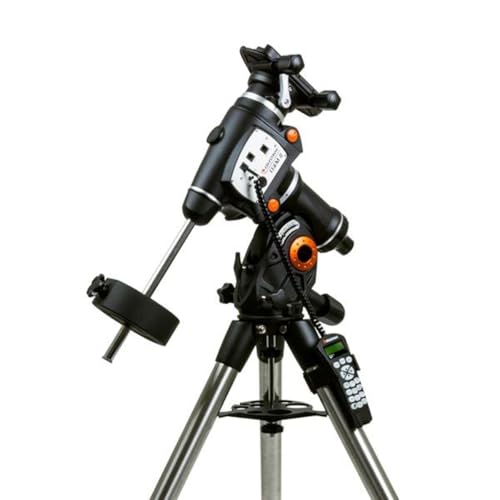


The best motorized equatorial mount for heavy payloads is the Sky-Watcher EQ6-R. With a belt-driven GoTo head rated around 44 lb (20 kg) of payload, it is the most affordable mount in this roundup that can carry a large refractor or an 8- to 10-inch astrograph, a guidescope and a full imaging train without straining. It suits intermediate imagers who want a semi-permanent setup and who are prepared to run it from a proper 12 V supply rather than AA cells. If you want a turnkey system, the Celestron CGX 9.25-inch Schmidt-Cassegrain packages a 55 lb-class CGX mount with a long-focal-length optical tube; if you are motorizing a small mount you already own, the MINZIHAO EQ1/CG2/CG3 driver kit is the cheapest route. Everything else on this list serves lighter rigs, travel kits and budget visual setups, and the buying guide below explains where each one actually fits.
Top 3 Picks
Best overall: Sky-Watcher EQ6-R
The EQ6-R hits the sweet spot between payload, price and portability for the heavy-payload buyer. Its belt-driven dual-axis stepper drive keeps periodic error low enough for guided deep-sky imaging at long focal lengths, and the SynScan GoTo hand controller handles alignment, object databases and autoguider passthrough. It is the mount most people should shortlist first unless they need more than roughly 44 lb of capacity.
Best budget: MINZIHAO Motor Driver for EQ1 / CG2 / CG3 Mounts
If you already own a small manual German equatorial mount, this driver kit turns it into a motorized tracking mount for a fraction of the cost of a GoTo head. It is a single-axis drive, so it tracks in right ascension only and will not slew to objects for you, but it is a genuine, low-risk entry into motorized tracking for visual work and short-exposure camera imaging. It is not a heavy-payload solution and should not be treated as one.
Best premium: Celestron CGX Mount and Tripod, 55 lb Payload
The CGX is the pick when you need headroom above 44 lb, spring-loaded worm gears for backlash control, and a stiffer tripod for long focal lengths. It carries a 9.25-inch SCT, a large refractor or a heavy Newtonian astrograph with room to spare, and its GoTo and alignment routines are among the most beginner-friendly in the class. It is heavy, it wants a 12 V supply, and it rewards a permanent or semi-permanent setup.
Quick Comparison
Every product below appears somewhere in the payload ladder, from camera-class trackers to 55 lb-class GoTo heads. Price tiers are general market bands only — budget, mid-range and premium — because listing prices move constantly.
| Product | Best for | Key specs | Price tier |
|---|---|---|---|
| Sky-Watcher EQ6-R | Heavy imaging rigs up to roughly 44 lb | Belt-driven dual-axis stepper GoTo German equatorial; ~44 lb (20 kg) payload class; 12 V DC; ST-4 autoguider port; SynScan hand controller | Premium |
| Celestron CGEM II | Visual observers who also image, up to 40 lb | 40 lb payload; NexStar+ GoTo; All-Star Polar Alignment; PPEC; dual-axis drive | Premium |
| Celestron CGX (mount and tripod) | 50 lb-class payloads and long focal lengths | 55 lb payload; spring-loaded worm gears; 2-inch class steel tripod legs; GoTo; 12 V DC | Premium |
| Generic Latitude Equatorial Mount base | Budget latitude adjustment and small mount bases | Aluminum alloy base with latitude adjustment; compact footprint; accessory-grade hardware | Budget |
| Kenko SKYMEMO S Equatorial Wedge | Camera-based nightscape and wide-field tracking | Wedge-style equatorial accessory in the SkyMemo S system; camera-class payload only | Mid-range |
| Skyoptikst 750x 150mm Newtonian | Budget deep-sky visual observation | 150 mm aperture; 750 mm focal length (f/5); motorized equatorial mount and tripod included | Mid-range |
| Sky-Watcher Star Adventurer Mini | Travel, nightscapes and time-lapse | Single-axis tracking; ~6.6 lb (3 kg) payload class; AA or USB power; app control; sidereal, solar and lunar rates | Mid-range |
| MINZIHAO Motor Driver for EQ1 / CG2 / CG3 | Motorizing a small manual mount you already own | Single-axis (RA) motor drive kit for EQ1/CG2/CG3-class mounts; low payload ceiling | Budget |
| Celestron CGX 9.25″ Schmidt-Cassegrain | Turnkey heavy-payload package | 9.25-inch SCT OTA, 2350 mm focal length at f/10, on the 55 lb-class CGX mount and tripod | Premium |
| Explore Scientific iEXOS-100-2 PMC-Eight | Lightweight GoTo astrophotography | ~15 lb payload class; belt-driven; PMC-Eight controller with WiFi and Bluetooth; app-driven GoTo | Mid-range |
| TeSeek Equatorial Mount Star Tracker | Budget wide-field tracking with a ball head | Single-axis tracker with ball-head gimbal; camera and lens payloads only | Budget |
| WOWOBONTOY OrionU Star Tracking Equatorial Mount | Beginners learning polar alignment on the move | Portable single-axis tracker with alignment pointer; camera-class payload; tripod-friendly base | Budget |
How We Chose
This roundup is built from published manufacturer specifications, category-standard engineering practices and the physics of what a mount can actually carry — not from laboratory measurements or field trials. The selection criteria were straightforward. First, payload capacity, because it is the single number that decides whether a mount is relevant to a heavy-payload buyer at all; anything under roughly 15 lb is included only as a clearly labelled light-duty option. Second, drive design: belt-driven stepper systems generally show lower backlash and smoother periodic error than inexpensive spur-gear drives, which matters more as focal length increases. Third, GoTo and alignment capability, including object databases, multi-star alignment and polar alignment routines, since these determine how long it takes to get to a target. Fourth, power requirements, because a mount that needs 12 V at several amps is a different purchase from one that runs on AA cells. Fifth, upgrade path — whether the mount can grow with a heavier optical tube, an autoguider, or a permanent pier. Finally, category fit: mounts were assigned to the role their specifications genuinely support, so camera-class trackers are not presented as heavy-payload solutions.
1. Sky-Watcher EQ6-R – Best for Heavy Astrophotography Rigs
As an Amazon Associate we earn from qualifying purchases at no extra cost to you.
Who it suits: the EQ6-R is the reference point for the heavy-payload buyer who wants a GoTo German equatorial mount that can carry a serious imaging train without jumping into four-figure-plus territory. It fits a permanent or semi-permanent backyard setup, a roll-out rig on a dolly, or an observatory pier. It is not a grab-and-go mount; the head alone is a substantial lift, and the assembled head and tripod is realistically a two-trip job from car to field.
Key specifications:
- Payload class: roughly 44 lb (20 kg), which is the figure to plan against for imaging
- Drive: belt-driven stepper motors on both axes, with the belt design chosen to reduce backlash and smooth out periodic error compared with direct spur-gear drives
- Control: SynScan GoTo hand controller with multi-star alignment, a large deep-sky object database and tracking rates for sidereal, lunar and solar work
- Connections: ST-4 autoguider port for a guide camera, plus the usual hand-controller and power inputs
- Power: 12 V DC centre-positive; expect a draw in the region of 2 A while tracking, rising during slews, so a wall adapter or a sizeable battery is required
- Polar alignment: an illuminated polar scope is part of the package on the Pro variant, which matters for northern and southern hemisphere users alike
- Mounting: standard Vixen/Losmandy-style dovetail saddle, with a tripod in the same class as the head
Strengths: the belt drive is the headline. On a heavy mount carrying a long focal length, backlash shows up as guiding oscillation and as a lag when you correct in declination; a belt-driven stage is more forgiving and generally easier to tune. The payload rating also leaves realistic headroom — a 44 lb figure is enough for an 8-inch Newtonian astrograph, a large refractor, or a 9.25-inch SCT with a guidescope and imaging train, provided you do the weight arithmetic honestly. GoTo performance is solid, with alignment routines that work well enough for repeat sessions once you settle on a repeatable setup position.
The mount is also a known quantity in the aftermarket sense: dovetail plates, pier adapters, replacement knobs, belt kits and power solutions exist for it, which matters more than most buyers expect when a mount is going to live outdoors for years.
Pros
- About 44 lb (20 kg) of payload at a price point below most comparable 50 lb-class heads
- Belt-driven dual-axis stepper drive with low backlash for guided imaging
- SynScan GoTo with multi-star alignment and a large object database
- ST-4 autoguider port, so a guide camera is a plug-in upgrade rather than a workaround
- Wide accessory and adapter ecosystem for piers, dovetails and power
Cons
- Heavy head and tripod; not a realistic travel mount
- Needs a proper 12 V supply and enough current headroom for slews
- No absolute encoders, so it relies on alignment and guiding for accuracy
- Belt tension and worm mesh are maintenance items you will eventually have to address
Compared with the nearest alternative in this list, the Celestron CGX, the EQ6-R gives up roughly 11 lb of rated payload and the CGX’s spring-loaded worm design, but it typically sits at a lower price tier and is the more common choice for a first serious imaging mount. If your total imaging load lands between 30 lb and 40 lb, the EQ6-R is the better value. If you are at 45 lb and climbing, the CGX is the safer platform.
2. Celestron CGEM II – Best for Visual Observers Who Also Image

Who it suits: the CGEM II is a 40 lb-class GoTo German equatorial mount aimed at observers who want a confident visual platform and occasional astrophotography, rather than a dedicated imaging workhorse. It suits someone running an 8-inch SCT, a 6- to 8-inch Newtonian or a mid-size refractor who values simple alignment and a familiar hand controller over maximum payload.
Key specifications:
- Payload class: 40 lb, the figure stated in the product name
- Control: NexStar+ GoTo hand controller with a large object database and guided tours
- Alignment: All-Star Polar Alignment, which lets you polar align on a chosen star without a clear view of Polaris — a genuine advantage on a balcony or in a tree-lined garden
- Tracking: permanent periodic error correction (PPEC) to reduce the impact of the worm cycle during long exposures
- Drive: dual-axis motorized drive with a dovetail saddle compatible with common plate sizes
- Power: 12 V DC, with the usual current draw you would expect from a mount in this class
- Mounting: supplied with a tripod rated for the head
Strengths: the CGEM II’s strongest card for a mixed visual and imaging buyer is All-Star Polar Alignment. On a heavy mount, polar alignment is the step that most often goes wrong and costs the most time; being able to align on any suitable star rather than sighting the celestial pole removes a real obstacle. PPEC then helps on the imaging side by memorising the worm’s periodic error and correcting for it, which is meaningful for unguided or lightly guided exposures. The 40 lb payload is enough for a serious but not extreme rig — a 9.25-inch SCT for visual work, or a smaller refractor with a full imaging train.
The NexStar+ controller is a mature, well-documented system, and the mount’s mechanical design is conventional in a good way: nothing exotic to maintain, and plenty of community knowledge about mesh adjustment and balance.
Pros
- All-Star Polar Alignment is genuinely useful in obstructed locations
- PPEC reduces periodic error for longer exposures
- 40 lb payload covers most mid-size SCT and refractor rigs
- Mature, well-documented GoTo controller with a deep object database
- Good balance of visual and imaging capability in one mount
Cons
- 40 lb is below the 44 lb and 55 lb options here, so it is not the pick for the heaviest rigs
- Still a heavy, non-portable-class head and tripod
- Requires 12 V power; no battery-only operation
- Decades-old worm-gear architecture means periodic error is managed rather than eliminated
Against the Sky-Watcher EQ6-R, the CGEM II trades about 4 lb of payload and a belt drive for a friendlier alignment routine and a controller many users already know. If your site has a clear view of the pole and your load is under 35 lb, the EQ6-R’s belt drive is the better long-term imaging choice. If your observing position is hemmed in by buildings or trees, the CGEM II’s alignment system can save you more time than the extra payload would.
3. Celestron CGX – Best for 50 lb-Class Payloads and Long Focal Lengths
Who it suits: the CGX is the mount to buy when 40 to 44 lb of payload is not enough headroom. It targets imagers running heavy Newtonian astrographs, large refractors or long-focal-length SCTs, and it is the natural choice for anyone building a semi-permanent setup where the mount will stay assembled and roughly polar aligned between sessions.
Key specifications:
- Payload class: 55 lb, as stated in the product name — the highest rated standalone mount in this roundup
- Drive: motorized dual-axis drive with spring-loaded worm gears, a design that keeps the worm engaged against the wheel and reduces backlash over the life of the mount
- Tripod: 2-inch class steel legs, which is the stiffness step that matters most once you go past roughly 1,500 mm of focal length
- Control: computerized GoTo with alignment routines and periodic error correction
- Power: 12 V DC; plan on a supply with current headroom for slewing
- Mounting: dovetail saddle and internal cable routing considerations typical of this class
Strengths: spring-loaded worms are the CGX’s real differentiator. On a heavy mount, backlash in declination is the usual cause of guiding corrections that overshoot and oscillate. A spring-loaded design keeps continuous contact between worm and wheel, which means less backlash to tune out and more consistent guiding night to night. Combined with the 2-inch-class tripod, that makes the CGX noticeably more stable than a 40 lb-class mount carrying a similar load, and stability is what actually determines whether a 2,000 mm focal length image holds together.
The 55 lb rating also gives you honest margin. If your optical tube, rings, dovetail, camera, filter wheel, focuser and guidescope add up to around 35 lb, you are running at roughly 64 percent of rated capacity — a comfortable place to be. The same rig on a 40 lb mount would be at 88 percent, which is where tracking problems start.
Pros
- 55 lb payload, the most headroom of any standalone mount here
- Spring-loaded worm gears reduce backlash and guiding oscillation
- 2-inch class steel tripod legs for long-focal-length stability
- Same CGX platform used in the 9.25-inch SCT package, so the upgrade path is proven
- Well suited to a permanent or roll-out setup
Cons
- Premium tier pricing and genuinely heavy to move
- Overkill — and awkward — for rigs under about 25 lb
- Requires 12 V DC power and a stable supply
- Setup and teardown each session is a real effort unless it stays mounted
Compared with the Sky-Watcher EQ6-R, the CGX costs more and weighs more, but buys you 11 lb of extra rated capacity, a stiffer tripod and a backlash-resistant worm design. Choose the EQ6-R if your imaging load is comfortably under 35 lb. Choose the CGX if you are at 35 lb or above, if your focal length exceeds about 1,500 mm, or if you intend to add a heavier tube later.
4. Generic Latitude Equatorial Mount – Best Budget Base for Latitude Adjustment

Who it suits: this is an accessory-grade latitude base, not a mount in the sense the rest of this article uses the word. It suits someone who needs a compact aluminum alloy base with latitude adjustment to support a small equatorial head, a camera tracker or a DIY rig. If you are shopping for a heavy-payload GoTo mount, this is not it, and treating it as one is the single most common mistake budget buyers make.
Key specifications:
- Construction: aluminum alloy base with an adjustable latitude mechanism
- Role: latitude adjustment and mounting interface for small equatorial heads and trackers
- Payload: accessory class — suitable for camera and small-head loads, not telescope-class payloads
- Footprint: compact, intended for tripod tops and flat mounting surfaces
- Hardware: basic fasteners and adjustment screws typical of the budget tier
Strengths: the value here is in the latitude adjustment itself. Setting your latitude accurately is the difference between a tracker that holds a target and one that drifts out of frame in minutes. A dedicated adjustable base makes that repeatable, and aluminum alloy keeps it light enough to pack. For someone building a small portable setup around a camera tracker or a lightweight equatorial head, a base like this is the part that turns a tripod into something usable.
It is also a reasonable spare or replacement part. If you already own a small equatorial mount whose base has stripped threads or a stiff latitude screw, replacing the base is far cheaper than replacing the mount.
Pros
- Low cost entry into adjustable latitude mounting
- Aluminum alloy construction keeps weight down for travel kits
- Compact enough to live in a camera bag
- Useful as a replacement or spare base for small equatorial heads
Cons
- No motors, no GoTo, no tracking — it is a base, not a motorized mount
- Payload ceiling is accessory class, nowhere near heavy-payload territory
- Budget-tier fasteners and adjustment screws may need occasional attention
- Not a substitute for a proper heavy German equatorial head
Compared with the MINZIHAO motor driver, this base solves a different problem: the driver adds motion, the base adds geometry. If you have a small manual mount and want tracking, the driver is the relevant purchase. If you have a tracker head and no stable adjustable platform, this base is. Neither is a route to carrying a heavy telescope.
5. Kenko SKYMEMO S Equatorial Wedge – Best for Camera-Based Nightscape Tracking

Who it suits: the Kenko SKYMEMO S equatorial wedge is aimed at the photographer who wants to track the sky with a camera and lens rather than a telescope. It fits nightscape shooters, wide-field astrophotographers and anyone building a compact travel kit where a full German equatorial mount would be absurd. It is a camera-class accessory in the SkyMemo S system, and it should be bought on that understanding.
Key specifications:
- Type: equatorial wedge accessory within Kenko’s SkyMemo S system, supplied in red
- Role: provides the equatorial geometry needed for camera tracking rather than carrying a telescope
- Payload: camera and lens class only
- Build: compact, travel-oriented construction consistent with the SkyMemo S product family
- Part reference: 844212
Strengths: Kenko’s SkyMemo family exists for one purpose — putting a camera on a tracking platform that is small enough to carry and simple enough to set up in the dark. An equatorial wedge in that system gives you the tilt you need to match your latitude, which is what converts a rotating platform into a proper equatorial tracker. For Milky Way panoramas and wide-field shots at moderate focal lengths, this class of equipment delivers the single biggest image-quality improvement available to a photographer: it removes star trailing without forcing you into a telescope mount.
The system is also genuinely portable. If your imaging is done on hikes, at dark-sky campsites or on trips where weight is the binding constraint, a camera-class equatorial setup is the only realistic option, and Kenko’s ecosystem is built around exactly that use case.
Pros
- Compact, travel-friendly equatorial geometry for camera tracking
- Part of a coherent accessory system rather than a one-off bracket
- Well matched to nightscape and wide-field work
- Simple enough to set up and align without a computer
Cons
- Camera-class payload only — it will not carry a telescope
- Not a GoTo system and not motorized in the heavy-mount sense
- Premium-adjacent pricing relative to generic alternatives in the same role
- Limited relevance to anyone whose goal is a heavy imaging rig
Compared with the TeSeek star tracker with ball-head gimbal, the Kenko option is the more system-oriented purchase: it slots into an established accessory family and is designed to work with Kenko’s own tracking hardware. The TeSeek approach is more generic and typically cheaper. Neither competes with the Sky-Watcher EQ6-R or Celestron CGX, because they are solving a completely different problem.
6. Skyoptikst 750x 150mm Newtonian – Best for Budget Deep-Sky Visual Observation
Who it suits: this is a complete, motorized equatorial telescope package rather than a mount on its own. It suits a beginner or a budget-limited observer who wants a 150 mm Newtonian on a driven equatorial mount with a tripod, ready to use for deep-sky and planetary visual work. It is the sensible entry point for someone who wants the whole system in one purchase.
Key specifications:
- Aperture: 150 mm
- Focal length: 750 mm, giving a focal ratio of f/5 — derived directly from the 750 mm / 150 mm figures in the product name
- Design: Newtonian reflector, an optical layout well suited to deep-sky observing because it delivers the most aperture per unit of cost
- Mount: motorized equatorial mount with a tripod included
- Stated magnification: 750x in the listing name; the practical useful limit for a 150 mm aperture is around 300x on a good night, so treat the higher figure as a marketing ceiling
- Class: mid-range budget package
Strengths: an f/5 150 mm Newtonian is a genuinely capable deep-sky instrument. It gathers enough light to show globular clusters, brighter nebulae and galaxies, and the 750 mm focal length gives a reasonably wide field for a reflector. Because it sits on a motorized equatorial mount, the drive tracks objects as the Earth rotates, which is the difference between a planet drifting out of a high-power eyepiece in seconds and staying put for comfortable viewing.
Buying the mount and tube together also avoids the compatibility guesswork that trips up first-time buyers — no dovetail sizing questions, no wondering whether the tripod can handle the tube.
Pros
- 150 mm of aperture at a budget-friendly package price
- f/5 focal ratio gives a versatile field of view for deep-sky work
- Motorized equatorial tracking included, not sold separately
- Complete system: optical tube, mount and tripod in one purchase
- Newtonian design is simple to collimate and maintain
Cons
- The mount is a lightweight equatorial class, not a heavy-payload head
- The 750x magnification claim far exceeds what a 150 mm aperture can usefully deliver
- Not designed to carry a heavy imaging train or a larger tube
- Budget mount mechanics mean more flex and vibration than a premium German equatorial
Compared with the iEXOS-100-2 PMC-Eight, the Skyoptikst package is the better buy if you want a telescope to look through and a mount to carry it. The iEXOS-100-2 is the better buy if you already have optics and want a lightweight GoTo mount for astrophotography. They overlap only at the entry level, and the Skyoptikst option is the one to choose for visual observing on a budget.
7. Sky-Watcher Star Adventurer Mini – Best for Travel and Time-Lapse

Who it suits: the Star Adventurer Mini is a single-axis tracking mount for cameras, built for nightscapes, wide-field astrophotography and time-lapse. It suits travellers, hikers and photographers who want tracked sky images without carrying a German equatorial mount. It is not a heavy-payload solution and should never be presented as one.
Key specifications:
- Type: single-axis (right ascension) motorized tracker for cameras and lenses
- Payload class: roughly 6.6 lb (3 kg), camera and lens territory
- Tracking rates: sidereal, solar and lunar, plus slower rates suited to time-lapse work
- Power: AA batteries or external USB power, which makes it genuinely field-portable
- Control: app-based control over a wireless connection, including interval shooting for time-lapse sequences
- Mounting: standard camera-thread interface and a ball-head-compatible platform
Strengths: the payload-to-weight ratio is the point. A tracker that runs on AA cells and fits in a camera bag changes what is possible on a trip where a full mount is out of the question. Because it supports sidereal, solar and lunar rates plus slow rates for time-lapse, one device covers several different shooting styles, and app control means you are not fumbling with a hand controller in the dark.
The tracking-rate flexibility is underrated. Time-lapse work often benefits from a rate that is not sidereal — for example, tracking at a fraction of sidereal speed to keep a foreground element from smearing while still holding stars reasonably tight over a sequence. That is exactly what this class of tracker is designed to do.
Pros
- Highly portable; runs on AA batteries or USB power
- Multiple tracking rates covering nightscapes, solar and time-lapse
- App control with interval shooting built in
- Fast setup compared with a German equatorial mount
- Well established within the Sky-Watcher tracking ecosystem
Cons
- About 6.6 lb payload — nowhere near heavy-telescope capacity
- Single-axis tracking only; no declination drive and no GoTo
- Not suitable for long focal lengths or heavy imaging trains
- Polar alignment quality still determines results, and the small form factor makes fine adjustment fiddly
Compared with the TeSeek star tracker, the Star Adventurer Mini is the more polished and more flexible system, with app control and multiple tracking rates that the generic option does not match. Compared with the iEXOS-100-2 PMC-Eight, the Mini is lighter and simpler but gives up GoTo, the declination axis and roughly twice the payload. If your goal is a heavy telescope, none of these three is the answer — the EQ6-R and CGX are.
8. MINZIHAO Motor Driver for EQ1 / CG2 / CG3 – Best Budget Way to Motorize a Manual Mount

Who it suits: this driver kit is for the observer who already owns a small manual German equatorial mount — an EQ1, CG2 or CG3-class head — and wants to add motorized tracking without buying a new mount. It is the cheapest realistic route into driven tracking, and it is honest about what it does: it drives the right ascension axis so objects stay in the eyepiece.
Key specifications:
- Type: motor drive kit for EQ1, CG2 and CG3-class equatorial mounts
- Axis: right ascension drive, providing tracking rather than full dual-axis slewing
- Function: counteracts Earth’s rotation so a target stays centred in the field of view
- Payload: whatever the host mount is rated for — these are lightweight heads, so the practical ceiling is small telescopes and cameras
- Power: low-draw, battery-friendly electronics consistent with small-mount tracking
- Tier: budget
Strengths: the economics are compelling. If you already own a usable EQ1-class mount, a motor driver costs a small fraction of a new GoTo mount and immediately improves every observing session. High-power planetary viewing is where the benefit is most obvious: at 150x to 250x, an undriven mount requires constant nudging, and a driven axis removes that entirely.
It is also a low-risk learning tool. Understanding how a motor drive interacts with balance, clutch tension and polar alignment on a small mount teaches you the skills that transfer directly to a heavy GoTo mount later. That progression — small driven mount first, heavy GoTo head second — is a reasonable path for a beginner who wants to spread the cost.
Pros
- Very low cost way to add tracking to a mount you already own
- Transforms high-magnification visual observing by removing constant nudging
- Simple installation on EQ1/CG2/CG3-class heads
- Builds understanding of balance and alignment that transfers to larger mounts
- Low power draw, friendly to small batteries
Cons
- Right ascension only — no declination drive, no GoTo, no object database
- Payload limited by the host mount, which is lightweight by definition
- Not a solution for heavy telescopes or long-exposure imaging
- Tracking accuracy depends entirely on how well you polar align the host mount
Compared with the Generic Latitude Equatorial Mount base, this driver is the more useful purchase for most people, because it adds motion rather than geometry. Compared with the iEXOS-100-2 PMC-Eight, it is a fraction of the cost but gives up GoTo, dual axes and app control. The honest framing is this: the driver is an upgrade for equipment you already own, while the iEXOS-100-2 is a complete modern mount.
9. Celestron CGX 9.25″ Schmidt-Cassegrain – Best Turnkey Heavy-Payload Package

Who it suits: this is the mount-and-telescope bundle for someone who wants a single purchase that covers heavy-payload imaging and serious visual observing. It pairs the 55 lb-class CGX mount with a 9.25-inch Schmidt-Cassegrain optical tube, which is a long-focal-length instrument suited to planets, globular clusters, planetary nebulae and smaller galaxies.
Key specifications:
- Optical tube: 9.25-inch aperture Schmidt-Cassegrain
- Focal length: 2350 mm at f/10 — a long focal length that demands a stable mount, which is exactly what the CGX provides
- Mount: Celestron CGX computerized German equatorial with a 55 lb payload rating
- Tripod: 2-inch class steel legs, included
- Control: computerized GoTo with alignment routines and periodic error correction
- Power: 12 V DC, with current draw typical of a heavy GoTo mount
- Tier: premium
Strengths: the pairing is well judged. A 9.25-inch SCT at 2350 mm focal length is an unforgiving instrument — at that focal length, small tracking errors become visible quickly, and a marginal mount will show it immediately. Putting that tube on a 55 lb-class mount with spring-loaded worms and a stiff tripod means the mount is not the limiting factor, and the payload headroom leaves room for a guidescope, an off-axis guider and a camera without approaching the rating.
For visual observers, the aperture is a genuine step up: 9.25 inches of light gathering shows structure in brighter nebulae and resolves globular clusters well. For imagers, the long focal length makes small targets accessible, and the mount’s GoTo and alignment system handles the pointing accuracy that such a narrow field requires.
Pros
- Complete heavy-payload system in one purchase — no compatibility guesswork
- 55 lb-class CGX mount with spring-loaded worms and a 2-inch class tripod
- 2350 mm focal length at f/10 for small, distant targets
- Substantial payload headroom for guidescopes and imaging accessories
- Works as both a serious visual instrument and an imaging platform
Cons
- Premium tier pricing for the whole package
- Heavy and bulky; not portable in any practical sense
- f/10 is slow for deep-sky imaging, so exposures need to be long
- 2350 mm focal length is demanding — guiding is effectively mandatory for imaging
Compared with buying the CGX mount and tripod separately, this package adds the optical tube at a combined price that usually works out better than buying the two independently, and it removes any question about whether the mount suits the tube. If you already own optics, buy the mount alone. If you are starting from nothing and want a heavy-payload system ready to observe, this bundle is the shortest path.
10. Explore Scientific iEXOS-100-2 PMC-Eight – Best for Lightweight GoTo Astrophotography

Who it suits: the iEXOS-100-2 PMC-Eight is a lightweight GoTo equatorial mount for astrophotography with small telescopes and camera lenses. It suits a beginner imager who wants genuine GoTo capability, belt-driven motion and app-based control without the weight and cost of a heavy mount. It is a first serious mount, not a heavy-payload solution.
Key specifications:
- Payload class: around 15 lb, which covers small refractors and camera lenses with a modest imaging train
- Drive: belt-driven stepper motors, which reduces backlash compared with inexpensive spur-gear designs
- Controller: PMC-Eight system with WiFi and Bluetooth connectivity
- Control: app-driven GoTo and tracking, with the option of computer control
- Tripod: included, sized to the mount
- Class: mid-range
Strengths: belt drive at this price and weight is the standout feature. Backlash is the enemy of accurate guiding, and a belt-driven stage gives smoother, more predictable motion than a cheap spur-gear drive. The PMC-Eight controller’s WiFi and Bluetooth support means you can run the mount from a tablet or phone, which lowers the barrier for a new imager considerably — no hand controller, no cable management puzzle, just an app and a target list.
The 15 lb payload is honest and useful: it comfortably carries a small apochromatic refractor in the 60 mm to 80 mm range with a camera, and it handles a DSLR or mirrorless camera with a lens as a wide-field imaging platform. For someone learning guiding, plate solving and image processing, that is enough to produce real results.
Pros
- Belt-driven stepper motors for smoother tracking at a mid-range price
- WiFi and Bluetooth control through the PMC-Eight controller
- Genuine GoTo capability, not just tracking
- Light enough to move easily and set up in one trip
- Good match for small refractors and camera lenses
Cons
- Roughly 15 lb payload — far below heavy-payload requirements
- App and wireless control adds a dependency that a hand controller does not have
- Not suited to long focal lengths or large optical tubes
- Less stable than a 40 lb-plus class mount in wind
Compared with the Sky-Watcher EQ6-R, the iEXOS-100-2 is a fraction of the weight and cost but offers roughly a third of the payload





