
Our Top Picks
 Raypak Heat Pump 8450 Model with Titanium Heat140K BTU44 x 30 x 29.99 inches422 PoundsCheck on Amazon


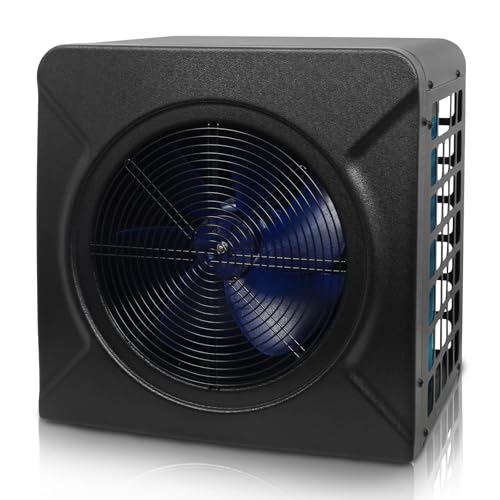

Best overall: the Raypak WeatherKing TWPH-6560 (118,000 BTU). If you have a 15,000–30,000 gallon in-ground pool in a mild-to-warm climate and you want a unit with a titanium heat exchanger, enough capacity to hold temperature through a cool night, and a brand with a real parts-and-service footprint, that is the pick. It also handles a spa, which most mid-size heat pumps do not do comfortably. If your priority is the lowest cost per degree and your pool is large, the MICOE 100,000 BTU inverter is the efficiency-first choice. For a small above-ground pool running off a household outlet, the Della Omi Spark 21,000 BTU inverter or the DOEL Mini 17,100 BTU cost far less and are properly sized. The most common buying mistake is choosing on gallon rating alone — those numbers are marketing ceilings, and a 110-volt unit rated to 10,000 gallons behaves very differently from a 240-volt unit of the same rating.
Top 3 Picks
Best overall — Raypak WeatherKing TWPH-6560 (118K BTU). A titanium heat exchanger, 118,000 BTU of nominal capacity, and pool-plus-spa duty in one cabinet. It suits in-ground owners who want a unit sized for a 15,000–30,000 gallon pool and who value being able to get a compressor or control board replaced in ten years rather than replacing the whole heater.
Best budget — Della Omi Spark 21,000 BTU Inverter. An inverter-driven heat pump rated for pools up to 7,000 gallons at a price tier that undercuts almost everything else here. Inverter control matters more than raw BTU on small pools: the unit modulates down instead of cycling on and off, which is where the running-cost savings come from.
Best premium — MICOE 100,000 BTU Inverter. Sized for pools up to 26,000 gallons, inverter-driven, and positioned at the top of the efficiency conversation. This is the pick if you are heating a big pool for a long season and want the lowest cost per degree rather than the lowest purchase price.
Quick Comparison
Every unit below is a real, currently listed product. Price tier is a market position, not a quote — listed prices on pool heat pumps move with season and stock, so treat the tier as a rough band and check current pricing yourself.
| Product | Best for | Key specs (as listed) | Price tier |
|---|---|---|---|
| Raypak WeatherKing TWPH-6560 | In-ground pools and spas, 15,000–30,000 gal | 118,000 BTU/hr; titanium heat exchanger; pool + spa duty; 240V class | Premium |
| Vidapool Electric Pool Heat Pump | Very large pools on a mid-range budget | Sized up to 32,000 gallons; large-pool capacity class | Mid-range |
| Della Omi Spark | Small pools, tight budget, efficiency-first | 21,000 BTU/hr; inverter; rated to 7,000 gal | Budget |
| DOEL Mini | Small above-ground pools | 17,100 BTU/hr; rated to 2,600 gal | Budget |
| Raypak 8450 (TWPH-8450EHT08) | The largest residential pools | 140,000 BTU/hr; titanium heat exchanger; 240V class | Premium |
| Raypak Crosswind V | Connected setups and cooler-climate hybrid heating | Hybrid heating; Wi-Fi fleet monitoring; pool + spa | Premium |
| WARMBLU 7,500 gal | Mid-size above-ground pools with 110V only | 110-volt plug-in class; rated to 7,500 gal | Budget |
| WARMBLU 10,000 gal | Large above-ground pools with 110V only | 110-volt plug-in class; rated to 10,000 gal | Mid-range |
| Varpoolfaye 90,000 BTU | Mid-to-large in-ground pools | 90,000 BTU/hr; inverter; 220V | Mid-range |
| TURBRO 58,000 BTU | Mid-size pools, efficiency-focused buyers | 58,000 BTU/hr; inverter; rated to 18,000 gal | Mid-range |
| WARMBLU 5,500 gal | Small above-ground pools | 110-volt plug-in class; rated to 5,500 gal | Budget |
| MICOE 100,000 BTU | Large pools, top efficiency priority | 100,000 BTU/hr; inverter; rated to 26,000 gal | Premium |
How We Chose
Selection was built from listing specifications and category fundamentals, not from hands-on use. The first filter was capacity class: a heat pump only earns its efficiency advantage if it can hold your pool at temperature without running flat out all day, so each unit was slotted by its stated BTU output or gallon rating. The second filter was control type, because inverter (variable-speed) compressors modulate output and avoid the on/off cycling that hurts both efficiency and noise on fixed-speed units. Third was heat exchanger material — titanium is the category standard for pool duty and the thing that decides whether the unit survives chlorinated or salt water. Fourth was category fit: voltage class, above-ground versus in-ground plumbing, and whether the unit is intended for spa duty as well as pool duty. Finally we looked at upgrade path and ownership: brand service footprint, availability of the same model in a larger size if your pool grows, and whether the listing publishes enough spec (BTU, voltage, refrigerant) to compare fairly. Where a listing omits a number, we say so rather than fill it in.
1. Raypak WeatherKing TWPH-6560 — Best for Large In-Ground Pools and Spas
As an Amazon Associate we earn from qualifying purchases at no extra cost to you.

The TWPH-6560 is the unit to look at first if you own an in-ground pool in the 15,000–30,000 gallon range and you also want to bring a spa up to temperature. At 118,000 BTU/hr nominal, it sits in the upper-middle of the residential range — enough output to recover from a cool night without running continuously, and enough headroom to heat a spa several degrees above pool temperature. The listing explicitly covers both in-ground and above-ground installation, and specifies a titanium heat exchanger, which is the single most important durability spec on a pool heat pump.
Key specs as listed:
- 118,000 BTU/hr nominal heating capacity
- Titanium heat exchanger
- Rated for in-ground and above-ground pools, plus spa duty
- 240-volt class installation — dedicated circuit required
- Model code TWPH-6560 (WeatherKing heat pump line)
What makes this a “best overall” rather than just a big heater is the combination of capacity and serviceability. Raypak has been in commercial and residential pool heating for decades, and that matters in year eight when a control board or fan motor fails. On a generic import, a failed board often means a new heater. On a Raypak, it usually means a part. Titanium also means you are not gambling on water chemistry — a titanium exchanger handles chlorinated, brominated, and saltwater pools without the corrosion risk that makes cheaper exchangers fail early.
The trade-offs are real. This is a 240-volt appliance, so if you do not already have a suitable circuit near the equipment pad, add the cost of an electrician to your budget. It is a physically large cabinet and it makes noise comparable to a residential air conditioner when the compressor is at full output — placement matters, and you should keep clearance around the unit for airflow, since a heat pump starved of air loses capacity fast. It is also priced in the premium tier, and the listing does not publish a COP or an AHRI rating at standard test conditions. Before buying, ask for that number: a heat pump’s efficiency claim is meaningless without it.
Pros
- 118,000 BTU/hr covers a wide band of real-world in-ground pools
- Titanium heat exchanger suits chlorinated and saltwater pools
- Rated for pool and spa duty rather than pool only
- Brand with a long pool-heating history and parts availability
- Works on both in-ground and above-ground installations
Cons
- Premium price tier for the capacity on offer
- Requires a dedicated 240-volt circuit
- Large footprint and audible at full compressor speed
- No COP or AHRI rating published in the listing
- Overkill for pools under about 12,000 gallons
Versus the nearest alternative: the Raypak 8450 at 140,000 BTU is the next step up in the same family. If your pool is above roughly 30,000 gallons, in a cool climate, or you want fast recovery after heavy use, the 8450 is the better buy and the efficiency difference at part load is smaller than the capacity difference suggests. Below 25,000 gallons, the TWPH-6560 is the smarter spend — a 140K unit on a small pool short-cycles, which wastes energy and wears the compressor.
2. Vidapool Electric Pool Heat Pump — Best for Very Large Pools on a Mid-Range Budget

Vidapool positions this unit by volume rather than BTU: the listing rates it for pools up to 32,000 gallons. That is a genuinely large residential pool, and it puts this heat pump in a capacity class where most mid-range competitors simply do not play. If you have a big pool and the premium-tier Raypak and MICOE options are more than you want to spend, this is the natural place to start looking.
Key specs as listed:
- Electric pool heat pump
- Rated for pools up to 32,000 gallons
- Large-pool capacity class — expect a 240-volt class circuit
- Mid-range price tier
The strength here is straightforward: capacity per dollar. A 32,000-gallon rating means the compressor is sized to move a serious amount of heat, and on a large pool that is the difference between a heater that holds temperature and one that runs 24 hours a day and never quite catches up. Large pools punish undersized heat pumps more than small pools do, because the surface area — and therefore the evaporation loss — scales with the pool, and the volume you have to reheat after a cool night is much bigger.
The caveats are about what the listing does not say. There is no BTU figure, no COP, no stated heat exchanger material, and no refrigerant type in the title. For a purchase at this capacity and price, you should confirm all four before ordering. Titanium is the material you want; anything else shortens service life in a chlorinated pool. You also want the AHRI rating at 80°F air / 80°F water / 80% relative humidity, which is the standard condition manufacturers test to and the only way to compare two units fairly. If a seller cannot provide that number, treat the efficiency claim as unverified.
Installation-wise, a unit of this capacity needs a dedicated 240-volt circuit, adequate airflow clearance, and proper bypass plumbing so you can service the heat exchanger without draining the pool. Because it is an electric heat pump rather than a gas heater, it heats slowly and steadily — excellent for maintaining temperature across a long season, less dramatic if you expect the pool to jump ten degrees in an afternoon.
Pros
- 32,000-gallon rating is unusually generous for the mid-range tier
- Appropriate capacity for genuinely large residential pools
- Electric heat pump operation avoids gas line or propane tank costs
- Substantially cheaper than premium-tier units of similar capacity
Cons
- Listing omits BTU output, COP, refrigerant, and exchanger material
- Less brand recognition than the established pool-heating names
- Requires a dedicated 240-volt circuit and careful placement
- Slow to raise temperature from cold compared with a gas heater
Versus the nearest alternative: the MICOE 100,000 BTU inverter is the direct step up. MICOE publishes a BTU figure and specifies inverter control, which typically means quieter operation and better part-load efficiency — the mode a large pool spends most of its time in. If your electricity is expensive or your season is long, the MICOE’s higher upfront cost can pay back. If your season is short and your rate is low, the Vidapool’s capacity-per-dollar is hard to beat.
3. Della Omi Spark 21,000 BTU Inverter — Best for Small Pools on a Tight Budget

The Omi Spark is the value pick for anyone heating a pool up to about 7,000 gallons. At 21,000 BTU/hr with inverter control, it is not trying to be a whole-pool powerhouse — it is trying to be an affordable, efficient way to extend the season on a small in-ground or above-ground pool. For that job, the spec sheet lines up well.
Key specs as listed:
- 21,000 BTU/hr heating capacity
- Inverter (variable-speed) compressor
- Rated for pools up to 7,000 gallons
- Electric heat pump, budget price tier
Inverter control is the headline here, and it is the reason this unit earns a recommendation over cheaper fixed-speed heaters of similar output. A fixed-speed heat pump has two states: full blast or off. It overshoots your setpoint, shuts down, waits for the water to drift, and starts again. Every one of those starts draws a surge, makes noise, and runs the compressor at its least efficient point. An inverter compressor modulates — it settles into whatever speed holds your setpoint, which is usually somewhere between 30% and 70% of full output. That is where the real-world efficiency and the quiet operation come from, and it is why an inverter unit at 21,000 BTU can outperform a fixed-speed unit at 25,000 BTU on running cost.
The 7,000-gallon rating is realistic for a small pool with a cover in a mild climate, and optimistic without one. Evaporation is the dominant heat loss in any uncovered pool, and on a 7,000-gallon pool a solar cover can be the difference between this unit holding temperature comfortably and this unit running all night. Budget for a cover as part of the purchase, not as an optional extra.
Because it is a smaller unit, electrical requirements are gentler than the 240-volt giants above, though you should still confirm the voltage and circuit requirement with the seller — small heat pumps are not universally plug-and-play, and a unit that needs a dedicated circuit is a different project from one that does not. The trade-off for the low price is brand support: Della is not a pool-heating specialist, so parts availability long-term is less predictable than with Raypak or a dedicated heat pump manufacturer.
Pros
- Inverter compressor at a budget price point
- Quieter and more efficient at part load than fixed-speed rivals
- Properly sized for small pools rather than oversized
- Low entry cost makes season extension affordable
Cons
- 7,000-gallon ceiling is a hard limit — no headroom for a bigger pool
- Needs a cover to hit its rated performance in most climates
- Listing does not state heat exchanger material or COP
- Less established service and parts network than the legacy brands
Versus the nearest alternative: the DOEL Mini at 17,100 BTU is the closest competitor and the cheaper of the two. The DOEL is rated for only 2,600 gallons, so it is a genuinely small-pool unit; the Della covers nearly three times the volume for a modest step up in price. If your pool is under 2,600 gallons and you want the absolute minimum spend, the DOEL makes sense. For anything from 3,000 to 7,000 gallons, the Della’s extra capacity and inverter control are worth the difference.
4. DOEL Mini Swimming Pool Heat Pump 17,100 BTU — Best for Small Above-Ground Pools

The DOEL Mini is the smallest unit in this roundup by rated volume, sized for above-ground pools up to roughly 2,600 gallons. That is a specific job — a 12- to 15-foot round above-ground pool, or a small oval — and for that job a big 100,000 BTU heat pump is not just expensive, it is wrong. Oversizing a heat pump on a small pool causes short cycling, and short cycling is the fastest way to wear out a compressor.
Key specs as listed:
- 17,100 BTU/hr heating capacity
- Electric pool heater / heat pump
- Rated for above-ground pools up to 2,600 gallons
- Budget price tier
The appeal of a properly sized small heat pump is that it runs in its efficient band. On a 2,000-gallon pool, 17,100 BTU/hr is enough to hold temperature comfortably and to recover a few degrees overnight, and because the unit is matched to the load it spends its time modulating or running steadily rather than slamming on and off. For an above-ground pool with a cover, that adds up to a genuinely cheap season extension.
Above-ground installation is its own discipline, and it is where small heat pumps earn their keep or fail. Above-ground pools typically have no equipment pad, no bypass plumbing, and often no convenient power. A unit this size is easier to accommodate than a 240-volt monster, but you still need to think about where the water returns, how the unit drains in winter, and whether it sits level. Standing water and a tilted cabinet are two of the most common causes of early failure on above-ground heat pumps.
The listing does not publish a COP, refrigerant type, or heat exchanger material. For a budget unit in this size class, that is normal, but it does mean you should treat the efficiency claim as unverified and confirm the voltage and plug type before buying. The other thing to weigh is lifespan: budget-tier small heat pumps generally have shorter service lives than premium units, and when something fails, replacement is often more economical than repair. On a small above-ground pool that is a reasonable trade — you are not protecting a $60,000 pool installation.
Pros
- Correctly sized for small above-ground pools — no short cycling
- Low purchase price and simple installation
- Enough output to extend the season on a covered pool
- Compact footprint suits a backyard without an equipment pad
Cons
- 2,600-gallon rating excludes most in-ground pools
- No COP, refrigerant, or exchanger material published
- Budget-tier build means shorter expected service life
- Will struggle to hold temperature on an uncovered pool in a cool climate
Versus the nearest alternative: the WARMBLU 5,500-gallon 110V unit costs a similar amount and claims double the pool volume. If your above-ground pool is between 2,600 and 5,500 gallons, the WARMBLU’s higher volume rating makes it the better fit on paper — but check the technology and output, because a 110-volt heater’s gallon rating assumes covered, mild-weather conditions. If your pool is under 2,600 gallons, the DOEL is the more honest match and the simpler install.
5. Raypak 8450 Heat Pump with Titanium Heat Exchanger, 140K BTU — Best for the Biggest Residential Pools

At 140,000 BTU/hr, the Raypak 8450 (TWPH-8450EHT08) is the largest single unit in this roundup and the one to choose when capacity is the binding constraint. Pools above 30,000 gallons, pools in cooler climates where the heat pump’s output derates, and pools where the owner wants fast recovery after a party all point to this unit. The titanium heat exchanger puts it in the durable tier, and Raypak’s service footprint means the 8450 is repairable rather than disposable.
Key specs as listed:
- 140,000 BTU/hr nominal heating capacity
- Titanium heat exchanger
- Model TWPH-8450EHT08
- 240-volt class installation, dedicated circuit
- Premium price tier
Capacity matters more than most buyers expect, because a heat pump’s rated output is measured at a favorable condition — typically 80°F air, 80°F water, 80% relative humidity. Drop the air temperature to 50°F and both the capacity and the coefficient of performance fall, often substantially. A unit that looks generously sized in July can look marginal in October. Buying one size larger than the bare minimum is the cheapest insurance against that derating, and it is exactly what the 8450 offers: headroom.
Headroom has a second benefit that buyers rarely think about — runtime. A large heat pump on a large pool reaches setpoint and then idles or modulates. A smaller heat pump on the same pool runs at 100% for most of the day. Continuous full-load operation is the least efficient way to run any compressor, and it is also the loudest and the hardest on the hardware. The energy argument for buying the bigger unit is real, not just a sales line.
What you pay for that is upfront cost, a bigger electrical circuit, more noise at full output, and a larger footprint. The listing does not publish a COP, so as with the other Raypak units, ask for the AHRI rating before you commit. Also check the warranty terms — pool heat pump warranties are frequently voided by poor water chemistry or by installing the unit without a bypass, and those are the two most common causes of premature exchanger failure.
Pros
- 140,000 BTU/hr handles the largest residential pools
- Capacity headroom offsets cold-weather derating
- Titanium heat exchanger for chlorinated and saltwater pools
- Established brand with strong parts and service support
- Lower runtime at setpoint than an undersized alternative
Cons
- Premium price and the highest electrical demand here
- Overkill — and prone to short cycling — on pools under 25,000 gallons
- No COP or AHRI rating published in the listing
- Audible at full load; placement and clearances matter
Versus the nearest alternative: the Raypak WeatherKing TWPH-6560 at 118,000 BTU is the same family one step down. On a 20,000-gallon pool in a warm climate, the 6560 is the better value and will spend more of its time in an efficient modulation band. The 8450 only justifies itself above roughly 30,000 gallons, in a cool climate, or where spa heating is a priority — that is where the extra 22,000 BTU/hr stops being wasted capacity and starts being the thing that makes the system work.
6. Raypak Crosswind V — Best for Connected Setups and Cooler-Climate Hybrid Heating

The Crosswind V is the odd one out in this roundup, and that is its selling point. The listing describes hybrid heating, free Wi-Fi for fleet monitoring, and combined spa and pool duty. Hybrid heating is the significant phrase: a standard air-source heat pump loses capacity as air temperature falls and typically should be shut down somewhere in the mid-40s Fahrenheit, whereas a hybrid design extends the operating window. For anyone in a climate with cool nights and a shoulder season, that changes what a heat pump can do for you.
Key specs as listed:
- Hybrid heating design
- Free Wi-Fi with fleet monitoring
- Spa and pool heating duty
- Premium price tier
Wi-Fi fleet monitoring sounds like a gimmick until you have more than one unit. For a homeowner with a single pool, remote monitoring means checking setpoint, reading a fault code, and adjusting schedule from your phone instead of walking out to the pad in the rain. For someone managing several pools — a small rental portfolio, a vacation property, a club — fleet monitoring is the feature that stops a fault from turning into a week of cold water and a service call. It is the most operationally useful thing on this list.
The hybrid heating claim is the one worth interrogating carefully before purchase. Ask the seller for the operating envelope: at what air temperature does the unit still produce useful heat, and what is the capacity at that temperature? A heat pump that produces 140,000 BTU/hr at 80°F air and 60,000 BTU/hr at 45°F air is a different machine from one that holds most of its output down to 40°F. The listing does not publish those figures, and they are the ones that determine whether this unit is a genuine season-extender in your climate or an expensive way to heat a pool in July.
Like the other premium Raypak units, expect a 240-volt class installation, a substantial cabinet, and a service network that makes repair realistic. The premium price is partly for the hybrid capability and connectivity rather than raw BTU, so if you are in a warm climate and do not need either, you are paying for features you will not use.
Pros
- Hybrid heating extends the usable season in cooler climates
- Wi-Fi fleet monitoring is genuinely useful across multiple units
- Rated for spa as well as pool duty
- Premium build and brand service support
Cons
- Premium price driven partly by connectivity features
- No published BTU output, COP, or low-temperature capacity curve
- Wi-Fi adds a failure point and depends on network reliability
- Hard to justify in a warm climate where standard units already perform well
Versus the nearest alternative: against the MICOE 100,000 BTU inverter, the comparison comes down to climate and control. MICOE gives you a published BTU figure, inverter efficiency, and a large-pool gallon rating for a premium price. The Crosswind V gives you a wider operating envelope and remote management, but without published capacity numbers. If your season runs through genuinely cool nights, the hybrid capability is the deciding factor. If your pool sits in a warm climate, the MICOE’s transparent efficiency spec is the safer buy.
7. WARMBLU 7,500 Gallons Above Ground Pool Heater 110V — Best for Mid-Size Above-Ground Pools on a Standard Outlet

This is the middle of WARMBLU’s 110-volt above-ground line, rated for pools up to 7,500 gallons. The 110-volt specification is the whole story: it means the unit runs on standard household current rather than a dedicated 240-volt circuit, which removes the electrician from the project for most above-ground owners. That convenience is real, and it is why this tier of product exists at all.
Key specs as listed:
- 110-volt plug-in class
- Rated for above-ground pools up to 7,500 gallons
- Budget price tier
There is a physics trade-off hiding behind the convenience. On a 110-volt circuit you have limited power available — a standard 15-amp household circuit delivers roughly 1,800 watts at most, and continuous loads are usually limited to about 80% of that. A heat pump’s output is its electrical input multiplied by its COP, so even a very efficient unit on a standard outlet cannot produce the BTU/hr that a 240-volt unit does. That is not a defect; it is arithmetic. The practical consequence is slower heat-up and a greater dependence on a cover.
This is the honest way to read a 110-volt gallon rating: it is a maintenance-and-extension rating, not a “heat it from 60 to 85 in a day” rating. A covered 7,500-gallon above-ground pool in a mild climate will hold temperature comfortably on this unit. The same pool uncovered on cool nights will lose ground. If your goal is a warm pool from May through September without drama, this fits. If your goal is a hot pool in April, it does not.
The listing does not publish BTU output, COP, or heat exchanger material. Before buying, confirm the actual BTU/hr figure — a gallon rating alone makes it impossible to compare against the inverter units above, which publish BTU directly. Also confirm the plug type and whether the unit can share a circuit with anything else. Pool equipment running continuously on a shared household circuit is a common cause of nuisance tripping.
Pros
- 110-volt operation avoids a 240-volt circuit installation
- Rated for a meaningful 7,500 gallons in the above-ground class
- Budget price tier keeps entry cost low
- Simple installation suited to above-ground plumbing
Cons
- Limited output by electrical physics, not by design
- Needs a cover to perform to its rating
- No BTU, COP, or exchanger material published
- Slower recovery than any 240-volt unit of similar price
Versus the nearest alternative: the WARMBLU 10,000-gallon 110V unit is the step up and the WARMBLU 5,500-gallon unit is the step down. The three differ mainly in rated volume, which is the right way to choose among them — match the rating to your actual pool volume and do not oversize, because on a 110-volt unit the extra capacity does not translate into dramatically faster heating. If your pool is around 7,000 gallons and you have no 240-volt option, this is the one in the family to pick.
8. WARMBLU 10,000 Gallons Above Ground Pool Heater 110V — Best for Large Above-Ground Pools With 110V Only

The largest of WARMBLU’s 110-volt above-ground heaters, rated for pools up to 10,000 gallons. If you have a big above-ground pool — an 18- or 21-foot round, or a large oval — and your only practical power is a household outlet, this is the top of the range before you have to move to 240 volts. It sits at the mid-range price tier, which reflects that larger capacity.
Key specs as listed:
- 110-volt plug-in class
- Rated for above-ground pools up to 10,000 gallons
- Mid-range price tier
The 10,000-gallon figure deserves a hard look. On a 110-volt supply, the available electrical power is fixed. Covering a bigger pool with the same power ceiling means the heat-up rate per gallon drops — a 10,000-gallon pool on a 110-volt heater warms more slowly than a 5,500-gallon pool on the same class of unit. That is fine if your goal is maintaining temperature on a covered pool across a warm season. It is not fine if you expect to raise the pool ten degrees for a weekend.
For a large above-ground pool, the operating discipline matters as much as the equipment. A solar cover is close to mandatory — evaporation is the biggest single heat loss, and on a 10,000-gallon uncovered pool it can outpace what a 110-volt heater can replace overnight. A secondary cover or a reel that makes covering easy will do more for your comfort than any upgrade to the heater. Running the unit during the warmest part of the day rather than overnight also extracts more heat from the same electricity, because the heat pump’s COP rises with air temperature.
The listing does not publish BTU output or COP, so the honest comparison against the inverter units in this roundup is not possible on efficiency. Treat this as a convenience-first product: it heats a large above-ground pool without an electrician, and you pay for that convenience in heat-up speed. Confirm the plug type, the actual wattage draw, and whether the circuit can be dedicated before you buy — a large 110-volt heater sharing a household circuit is a recipe for tripped breakers.
Pros
- Highest volume rating in the 110-volt above-ground class
- No 240-volt circuit required
- Suited to large round and oval above-ground pools
- Mid-range price for the capacity class
Cons
- Same power ceiling as smaller siblings means slower heat-up per gallon
- Cover is effectively required for the rating to hold
- No BTU or COP published for comparison
- Shared household circuits are a real risk with a load this size
Versus the nearest alternative: against the WARMBLU 7,500-gallon unit, the choice is simply volume. If your pool is 8,000–10,000 gallons, the larger rating is the right match and the extra cost is justified. If your pool is under 7,500 gallons, the smaller unit is the better buy — same electrical constraints, less spend, and no meaningful loss in real-world heat-up speed on a smaller body of water.
9. Varpoolfaye 90,000 BTU Inverter Pool Heat Pump — Best for Mid-to-Large In-Ground Pools
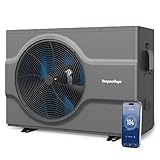
Varpoolfaye’s 90,000 BTU inverter unit sits in the sweet spot for in-ground pools that are too big for a small heat pump but not big enough to justify 140,000 BTU. At 90,000 BTU/hr with inverter control and a 220-volt supply, it is aimed squarely at the 15,000–25,000 gallon in-ground pool — the most common size in the residential market. For a lot of readers, this is the unit the sizing math actually points to.
Key specs as listed:
- 90,000 BTU/hr heating capacity
- Inverter (variable-speed) compressor
- 220-volt installation
- For in-ground pools
- Mid-range price tier
The combination of 90,000 BTU and inverter control is what makes this a strong efficiency proposition. Ninety thousand BTU/hr is roughly 26 kW of thermal output. At a COP of 5 — a realistic figure for a modern inverter heat pump at standard test conditions — that is about 5.3 kW of electrical input, or roughly $0.90 per hour at a typical residential rate. That is the number to hold in your head: a heat pump of this class costs well under a dollar an hour to run flat out, and far less when it is modulating at part load, which is most of the time.
Inverter control also changes the noise profile, and noise is one of the most underrated buying criteria in this category. A fixed-speed compressor running at full tilt is loud and constant. An inverter unit that has reached setpoint drops to a low speed and becomes close to inaudible from a few metres away. If the equipment pad is near a patio, a bedroom window, or a neighbour’s fence line, that difference is worth paying for.
The listing does not publish a COP, refrigerant type, or heat exchanger material, which is the main gap. Confirm titanium before buying, and ask for the AHRI rating. Varpoolfaye is not a legacy pool-heating brand, so parts availability over a ten-year horizon is less certain than with Raypak — a consideration that matters more on a mid-range unit than on a cheap one you expect to replace.
Pros
- 90,000 BTU/hr suits the most common in-ground pool sizes
- Inverter compressor for efficient part-load running and low noise
- 220-volt supply is appropriate for the output class
- Mid-range price undercuts premium units of comparable capacity
Cons
- No COP, refrigerant, or exchanger material published
- Non-specialist brand means uncertain long-term parts support
- Requires a dedicated 220–240-volt circuit
- Undersized for pools above about 25,000 gallons in a cool climate
Versus the nearest alternative: the TURBRO 58,000 BTU inverter is the smaller, cheaper sibling in this class and the MICOE 100,000 BTU is the larger one. TURBRO’s 18,000-gallon rating and 58,000 BTU output suit a 10,000–15,000 gallon pool; step to the Varpoolfaye if you are above 15,000 gallons or in a cooler climate. Step to the MICOE if you are above 22,000 gallons or want the most efficient unit in this size range regardless of price.
10. TURBRO 58,000 BTU Inverter Swimming Pool Heat Pump — Best for Mid-Size Pools and Efficiency-Focused Buyers
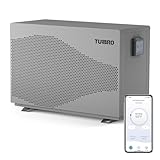
TURBRO’s 58,000 BTU inverter heat pump is rated for pools up to 18,000 gallons, and it is the unit that most directly targets buyers who care about running cost rather than raw capacity. Fifty-eight thousand BTU/hr is a modest output, but paired with an inverter compressor it is enough for a well-covered mid-size pool in a temperate climate, and it will spend most of its life running at partial load where efficiency is highest.
Key specs as listed:
- 58,000 BTU/hr heating capacity
- Inverter (variable-speed) compressor
- Rated for pools up to 18,000 gallons
- Mid-range price tier
There is an interesting tension in the specs worth flagging. A 58,000 BTU/hr unit rated for 18,000 gallons implies about 3.2 BTU/hr per gallon, which is a lighter ratio than some other units in this roundup claim. That is not necessarily wrong — it reflects an assumption about climate, cover use, and how much temperature rise you expect. But it does mean you should read the gallon rating as “this pool, covered, in a mild climate, holding temperature” rather than “this pool, any condition, heated fast.” If you are in a cool climate or you run your pool uncovered, size down the gallon figure by 25–30% and check the math against your actual pool.
Where this unit wins is running cost per degree





