
Our Top Picks
 ULTIMEA 5.1CH Surround Sound Bar System with Dolby31.5 x 3.54 x 2.76 inches12.57 PoundsCheck on Amazon


The best premium Dolby Atmos soundbar for most buyers is the Sonos Arc Ultra: a single 46-inch bar with a 9.1.4-channel driver array that produces convincing height and width without a separate subwoofer or rear speakers in the room. If you have a dedicated room and want true rear-channel immersion, the LG S95TR 9.1.5-channel system with its included wireless subwoofer and rear speakers is the stronger pick. If you are building a first Atmos setup on a budget, the TCL S65K S Series 5.1-channel system delivers discrete surrounds and DTS:X support for a fraction of a flagship bar. Everything below is organized around what actually separates these systems: how the surround and height channels are produced, whether a subwoofer is included and how large it is, what connections you need for Atmos to work at all, and how much room each system is realistically built to fill.
Top 3 Picks
Best overall: Sonos Arc Ultra. The cleanest premium path to immersive audio for a normal living room. A 9.1.4 driver array, an integrated woofer that removes the need for a separate sub in most rooms, and the deepest streaming and multiroom ecosystem of anything here. It suits the buyer who wants one box, one cable and no speaker stands.
Best budget: TCL S65K S Series 5.1. The least expensive way in this list to get real rear speakers, a wireless subwoofer and both Dolby Atmos and DTS:X decoding. It suits first-time buyers and secondary rooms where a flagship bar would be wasted, and it costs a fraction of the premium tier.
Best for a dedicated room: LG S95TR 9.1.5. The most channels and the most speaker boxes in this roundup, with up-firing drivers in both the bar and the rear speakers. It suits a purpose-built theater room with a flat ceiling and enough space to place rears behind the seating row.
Quick Comparison
| Product | Best for | Configuration | Subwoofer | Surround / height | Key connectivity | Room fit | Price tier |
|---|---|---|---|---|---|---|---|
| ULTIMEA Poseidon M60 | First Atmos setup, tight budget | 5.1 | Included | Discrete surround speakers included | HDMI eARC, optical, Bluetooth | Small to medium | Budget |
| TCL S65K S Series | Budget surround with DTS:X | 5.1 | Wireless | Wireless surround speakers | HDMI eARC, optical, Bluetooth | Small to medium | Budget |
| Bose Smart Dolby Atmos Soundbar | Dialogue clarity in small rooms | All-in-one bar | None | None (bar-only virtualization) | HDMI eARC, Wi-Fi, Bluetooth, AirPlay 2 | Small | Mid-range |
| Sonos Arc Ultra | One-bar premium Atmos | 9.1.4 | None (integrated woofer) | None (bar-only array) | HDMI eARC, Wi-Fi, Bluetooth, AirPlay 2 | Medium to large | Premium |
| ULTIMEA 5.1.2ch | Budget height effects | 5.1.2 | Wireless | Wireless surrounds plus up-firing drivers | HDMI eARC, optical, Bluetooth | Small to medium | Budget |
| Sony BRAVIA Theater System 6 | Sony TV owners who want rears | 5.1 | Wireless | Wireless rear speakers | HDMI eARC, Bluetooth | Medium | Mid-range |
| LG S95TR | Dedicated home theater room | 9.1.5 | Wireless | Wireless rears with up-firing drivers | HDMI eARC with 4K/120 passthrough, Wi-Fi, Bluetooth | Large | Premium |
| Bose Smart Ultra | All-in-one immersion | All-in-one bar | None | Up-firing and side-firing drivers in bar | HDMI eARC, Wi-Fi, Bluetooth, AirPlay 2 | Small to medium | Premium |
| ULTIMEA 7.1ch Wireless | Wireless-everything mid-range | 7.1 | Wireless | Wireless surrounds | HDMI eARC, optical, Bluetooth | Medium | Mid-range |
| JBL Bar 800 | Flexible rooms and renters | 5.1.2 | 10-inch wireless | Detachable battery surrounds | HDMI eARC, Bluetooth, USB | Small to large | Premium |
| Monoprice Premium 5.1.4 | AVR owners who want real speakers | 5.1.4 passive | 8-inch, 200-watt | Four up-firing Atmos modules | Requires an AV receiver; no built-in HDMI | Medium to large | Mid-range |
| TCL S60K S Series | Small rooms, simple 3.1 | 3.1 | Wireless | None | HDMI eARC, optical, Bluetooth | Small | Budget |
How We Chose
This roundup is built from published manufacturer specifications, category standards for channel configurations and decoding formats, and the practical constraints that decide whether a system works in a given room. The criteria were applied in a fixed order. First, category fit: does the product actually decode Dolby Atmos, and does it produce height information from physical up-firing drivers, from a bar-mounted array, or not at all? Second, system completeness: how many boxes are in the box, whether a subwoofer is included or must be added later, and whether the surround speakers are wired, wireless or detachable. Third, connectivity: HDMI eARC support, passthrough capability for 4K and high-frame-rate sources, and whether the bar can accept music over Wi-Fi and Bluetooth. Fourth, room fit: the channel count and driver layout are matched to realistic room volumes rather than treated as an abstract score, because a 9.1.5 system in a 120-square-foot bedroom is harder to place and no more immersive than a well-positioned 5.1.2. Fifth, upgrade path and ownership: whether the system can be expanded, how it is updated, and which parts are likely to need attention first. No unit was physically tested, benchmarked or owned; recommendations are based on documented specifications and how those specifications map to specific rooms and budgets.
1. ULTIMEA Poseidon M60 – Best for a first Atmos setup on a tight budget
As an Amazon Associate we earn from qualifying purchases at no extra cost to you.

The Poseidon M60 is the entry point into a genuine 5.1 layout: a soundbar, a separate subwoofer and discrete surround speakers, all in one purchase. It suits a first-time buyer who has never owned anything better than TV speakers, wants the rear-channel effect a single bar cannot fake, and is working within the budget tier where a flagship bar is simply out of reach. It also suits a secondary room — a bedroom, a den, a finished basement — where a full premium system would be overkill and cable runs are short.
Key specs at a glance
- Configuration: 5.1 channels with an included subwoofer and surround speakers
- Decoding: Dolby Atmos
- Connections: HDMI eARC, plus optical and Bluetooth for music
- Room fit: small to medium rooms, roughly 10 x 12 feet up to about 14 x 16 feet
- Placement: bar on a TV stand or wall bracket; surrounds on stands, shelves or wall mounts
Where it earns its place. The value here is not the bar itself — it is the fact that you get a separate subwoofer and two surround speakers without moving into the mid-range tier. A separate subwoofer changes the character of movie playback more than any other single component, because it takes low-frequency work away from the bar’s small drivers and lets them handle dialogue and effects. The surround speakers then place effects behind and beside you, which is the difference between hearing an Atmos mix and being inside it. For a first system, that combination teaches you more about what immersive audio does than a more expensive single bar will.
What to expect in practice. A budget 5.1 system will not reproduce the deepest, tightest bass of a premium subwoofer, and the surround speakers are best placed at or slightly above ear height rather than high on a wall. Dialogue clarity depends heavily on placement: keep the bar centered under the TV and out of a closed cabinet, because a recessed bar muffles the center channel and no amount of volume will fix it. Atmos height information is generated from the bar’s processing rather than dedicated up-firing drivers, so overhead effects read as a widened front stage rather than distinct sound above your head.
How it compares. The nearest alternative in this list is the TCL S65K S Series 5.1. The two are close in concept, but the TCL adds DTS:X decoding alongside Dolby Atmos and uses a wireless subwoofer connection, which reduces the cable clutter behind the TV. If your disc collection or streaming library includes DTS:X titles, that extra format support matters. If you mostly stream and want the lowest possible entry cost, the Poseidon M60 gets you the same 5.1 shape for less.
Pros
- Complete 5.1 package — bar, subwoofer and surrounds in one purchase
- Real rear-channel effects, not simulated ones
- Bluetooth and optical inputs make it usable without HDMI eARC
- Lowest-cost route to a discrete surround layout in this roundup
Cons
- No DTS:X decoding, which limits some disc-based content
- Height effects are processed rather than produced by up-firing drivers
- Surround speakers require power or cable runs depending on the model variant
- Bass depth and control are entry-level compared with mid-range subwoofers
2. TCL S65K S Series – Best for budget surround with DTS:X

The TCL S65K S Series is a 5.1-channel system with a wireless subwoofer, wireless surround speakers and support for both Dolby Atmos and DTS:X. It suits the buyer who wants a full surround layout without paying premium prices, and who cares about format coverage because their library mixes streaming Atmos titles with DTS:X discs. It is also a strong fit for a renter or apartment dweller, since the wireless subwoofer and wireless surrounds mean fewer physical cable runs across a living room floor.
Key specs at a glance
- Configuration: 5.1 channels, wireless subwoofer and wireless surround speakers
- Decoding: Dolby Atmos and DTS:X
- Connections: HDMI eARC, optical, Bluetooth for music streaming
- Room fit: small to medium rooms, up to roughly 14 x 16 feet
- Extras: wall-mountable bar, remote control, multiple listening modes
Where it earns its place. Format coverage is the headline. Dolby Atmos and DTS:X are the two object-based surround formats that matter for home content, and plenty of budget bars support only Atmos. If you own Blu-ray or 4K UHD discs, a meaningful share of them are mixed in DTS:X, and without that decoder the bar falls back to a conventional surround mode. The S65K avoids that compromise. The wireless subwoofer also removes the single most annoying cable in a typical living room setup, and wireless surrounds mean you can place the rear speakers behind the couch without fishing cable under a rug.
What to expect in practice. Wireless does not mean battery-powered: the surround speakers and subwoofer still need power outlets, so plan for two sockets near the rear seating position and one near the subwoofer. The 5.1 layout gives you a center channel for dialogue and two rear channels for effects, but no dedicated height drivers, so Atmos height cues are produced by processing. In a room with hard floors and bare walls, budget surround systems can sound bright; a rug and a couple of soft furnishings do more for the sound than an equalizer preset.
How it compares. Against the ULTIMEA Poseidon M60, the S65K wins on format support and cable management and roughly matches on channel count and price tier. Against the TCL S60K S Series, the difference is layout rather than quality: the S60K is a 3.1 system with no surround speakers, so it delivers a strong front stage and a subwoofer but no rear effects. If your seating is against a wall with no room behind it, the S60K is the more honest choice; if you can place rears, the S65K is the better buy.
Pros
- Both Dolby Atmos and DTS:X decoding at the budget tier
- Wireless subwoofer and wireless surrounds reduce cable clutter
- Full 5.1 layout with a dedicated center channel for dialogue
- Bluetooth streaming for music without turning on the TV
Cons
- No up-firing height drivers, so overhead effects are simulated
- Surround and subwoofer still need power outlets at the rear of the room
- Wireless links can be susceptible to interference in crowded Wi-Fi environments
- Output ceiling is modest for very large or open-plan rooms
3. Bose Smart Dolby Atmos Soundbar – Best for dialogue clarity in small rooms

The Bose Smart Dolby Atmos Soundbar is an all-in-one bar with A.I. Dialogue Mode, built-in voice control and no separate subwoofer or rear speakers. It suits someone in a small living room, apartment or bedroom who wants better sound than the TV can produce but has no floor space for a subwoofer and no ability to place speakers behind the couch. It also suits households where one person in the room consistently struggles to follow dialogue while another finds the volume too loud — that specific problem is what the dialogue processing is designed to address.
Key specs at a glance
- Configuration: single all-in-one soundbar, no separate subwoofer or surrounds
- Decoding: Dolby Atmos
- Connections: HDMI eARC, Wi-Fi, Bluetooth, AirPlay 2, voice assistant support
- Room fit: small rooms, roughly up to 12 x 14 feet
- Features: A.I. Dialogue Mode, room calibration, app-based EQ
Where it earns its place. Dialogue is the most common complaint about modern film mixes, which increasingly push effects loud and center-channel speech quiet. A.I. Dialogue Mode analyzes content and adjusts the center channel in real time rather than simply boosting the volume, so speech becomes more intelligible without pushing the whole mix louder. Combined with the bar’s room calibration, which measures your space and adjusts the output, this makes the Smart Dolby Atmos Soundbar unusually good at the one thing people actually notice night to night. Setup is also the simplest in this roundup: one HDMI cable to the TV’s eARC port and you are finished.
What to expect in practice. An all-in-one bar has physical limits. Without a separate subwoofer, deep bass is produced by small drivers in a shallow cabinet, so explosions will have impact but not the physical pressurization a dedicated subwoofer provides. Without rear speakers, surround effects are steered to the sides of the bar and reflected off walls, which works best in a symmetrical room with the bar centered and walls of roughly equal distance on both sides. In an open-plan room with one wall missing, that reflection trick largely collapses and the soundstage narrows.
How it compares. The closest alternative in this list is the Bose Smart Ultra Dolby Atmos Soundbar, which is the same philosophy pushed further: it adds up-firing and side-firing drivers for a more convincing height and width effect, at a premium-tier price. If dialogue clarity in a small room is the goal, the standard Smart Dolby Atmos Soundbar is the more sensible spend. If you want the all-in-one format to genuinely approximate overhead sound, the Smart Ultra is the step up. For the same money as the standard bar, a budget 5.1 system like the TCL S65K gives you real rear channels — but only if you can place them.
Pros
- A.I. Dialogue Mode measurably improves speech intelligibility
- Room calibration adapts output to your specific space
- No subwoofer or surround speakers to place or power
- Wi-Fi, AirPlay 2, Bluetooth and built-in voice control
Cons
- No dedicated subwoofer, so deep bass is limited
- No physical rear or height channels
- Reflection-based surround depends on room symmetry
- Mid-range price for a single box with no expandable speakers
4. Sonos Arc Ultra – Best for a one-bar premium Atmos setup

The Sonos Arc Ultra is a 9.1.4-channel soundbar that produces immersive sound from a single 46-inch enclosure, using an integrated woofer instead of a separate subwoofer box. It suits the buyer who wants premium performance with zero clutter: no subwoofer on the floor, no speaker stands behind the couch, no calibration microphone. It also suits anyone already inside the Sonos ecosystem, since it joins the same app and multiroom network as the brand’s other speakers.
Key specs at a glance
- Configuration: 9.1.4 channels from a single bar
- Driver array: multiple tweeters and midwoofers plus an integrated woofer
- Connections: HDMI eARC, Wi-Fi, Bluetooth, AirPlay 2
- Dimensions: approximately 46 inches wide, about 13 pounds
- Room fit: medium to large rooms, up to roughly 18 x 20 feet with high ceilings
Where it earns its place. The channel count is not marketing arithmetic — it reflects a driver array large enough to steer effects left, right and upward from a single housing. That matters in rooms where you cannot place rear speakers: behind the couch is a wall, a walkway or a window, and stands would be a trip hazard. The Arc Ultra is designed for exactly that situation, producing a wide front stage and a sense of height without any satellites. The integrated woofer is the other major advantage, since it removes the low-frequency burden that makes most single bars sound thin, and it eliminates the placement problem of a subwoofer in a small room.
What to expect in practice. Room correction is close to mandatory here. The bar measures your room using your phone’s microphone and adjusts the output, and the difference between corrected and uncorrected sound is significant in a room with hard surfaces. A 46-inch bar is also wide enough that it will not fit between the legs of smaller TV stands; measure your stand before buying, and note that the bar is designed to sit in front of the TV, not inside a cabinet, because the up-firing drivers need an unobstructed path to the ceiling. Pairing two of the brand’s smaller speakers as rears later is the natural upgrade if you want true rear channels.
How it compares. The nearest premium alternative in this list is the Bose Smart Ultra Dolby Atmos Soundbar, another all-in-one design with up-firing and side-firing drivers. The Arc Ultra has more channels and a larger, wider enclosure, and it slots into a broader multiroom ecosystem. The Bose leans harder into dialogue processing and tends to be easier to place in a small room. Against the LG S95TR, the trade-off is clear: the LG includes physical rear speakers and a separate subwoofer for genuine rear and height channels, but it requires space and power behind the seating position. The Arc Ultra is the better choice when the room will not allow that.
Pros
- 9.1.4-channel array delivers immersion without satellite speakers
- Integrated woofer removes the need for a separate subwoofer box
- Wi-Fi, Bluetooth, AirPlay 2 and full multiroom integration
- Regular firmware updates add features over time
Cons
- Premium tier pricing for a single enclosure
- 46-inch width will not fit narrower TV stands
- No physical rear channels; rear effects remain simulated
- Needs unobstructed ceiling clearance for height effects to work
5. ULTIMEA 5.1.2ch Sound Bar – Best for budget height effects

The ULTIMEA 5.1.2ch system adds a dedicated height layer to the budget formula: a bar, a wireless subwoofer, wireless surround speakers and up-firing drivers aimed at the ceiling. It suits the buyer who has read that “5.1.2” is the entry-level Atmos configuration and wants the extra .2 without paying mid-range or premium prices. It also suits a small-to-medium room with a flat, reflective ceiling, where up-firing drivers can actually bounce sound and create the impression of overhead effects.
Key specs at a glance
- Configuration: 5.1.2 channels — front, center, surround and two height channels
- Height production: up-firing drivers in the bar
- Subwoofer: wireless, included
- Connections: HDMI eARC, optical, Bluetooth
- Room fit: small to medium rooms, ideally 10 x 12 to 14 x 16 feet with a flat ceiling
Where it earns its place. The .2 in the configuration is the whole point. A standard 5.1 system places sound around you on a single plane; adding two height channels gives the processor somewhere to send overhead effects. In practice, up-firing drivers do not reproduce sound directly above your head — they bounce it off the ceiling so it arrives from above, which is why ceiling height, flatness and material matter so much. In a room with a standard 8 to 10-foot flat painted ceiling, the effect is noticeable on Atmos content with genuine height mixing: rain, aircraft, and the vertical movement in action scenes. That is a real step up from a 5.1 system at the same price tier.
What to expect in practice. Placement discipline matters more with up-firing drivers than with any other component. The bar must sit with a clear, unobstructed line to the ceiling — no shelf directly above it, no cabinet recess. A textured ceiling, a ceiling fan, or a ceiling higher than about 12 feet will weaken the effect considerably. The wireless surrounds and subwoofer need power outlets, so budget for three sockets in addition to the TV. Because the system targets a low price, expect the subwoofer to emphasize mid-bass impact over the deepest extension, and expect the height effect to be subtle on content that was not mixed with strong overhead elements.
How it compares. The nearest alternative is the ULTIMEA Poseidon M60, also budget-tier and also 5.1. The M60 gives you more of your money in the subwoofer and surround speakers; the 5.1.2ch trades a little of that for the height layer. If your ceiling is flat and low enough for bouncing and you watch a lot of Atmos-mixed films, the 5.1.2ch is the more interesting system. If your ceiling is angled, vaulted or unusually high, the height channels will do very little and the M60 is the better use of the same budget. Against the TCL S65K, the trade is height effects versus DTS:X decoding.
Pros
- 5.1.2 configuration with real up-firing height drivers at budget pricing
- Wireless subwoofer and wireless surrounds reduce cable runs
- Complete system in one purchase with no extra boxes needed
- Notably better overhead effect than a same-price 5.1 system in the right room
Cons
- Height performance depends heavily on ceiling height and flatness
- No DTS:X decoding
- Budget subwoofer emphasizes impact over depth
- Requires three power outlets in addition to the TV
6. Sony BRAVIA Theater System 6 – Best for Sony TV owners who want real rear speakers

The Sony BRAVIA Theater System 6 is a 5.1-channel system with a wireless subwoofer and wireless rear speakers, designed to work as a matched companion to Sony televisions. It suits someone who already owns a Sony BRAVIA TV and wants the sound system and the television to cooperate — sharing volume control, sound modes and spatial processing — rather than fighting each other. It also suits a medium-sized living room where a 5.1 layout with physical rear speakers is the goal and a 9-channel flagship would be excessive.
Key specs at a glance
- Configuration: 5.1 channels with wireless subwoofer and wireless rear speakers
- Decoding: Dolby Atmos and DTS:X
- Processing: 360 Spatial Sound Mapping for a wider perceived soundstage
- Connections: HDMI eARC, Bluetooth; integrates with BRAVIA TV menus and remotes
- Room fit: medium rooms, roughly 12 x 14 up to 16 x 18 feet
Where it earns its place. Integration is the differentiator. When paired with a compatible BRAVIA television, the system can be controlled from the TV’s own menu, and the TV can use the soundbar’s speakers as part of its own acoustic output. The spatial mapping processing also deserves a mention: it synthesizes additional phantom speakers between and beyond the physical ones, which widens the soundstage beyond the four corners of the room. For dialogue-heavy content, Sony’s voice processing lifts speech out of the mix without the whole soundtrack getting louder — a useful feature if you watch a lot of drama or news in a room with background noise.
What to expect in practice. The wireless rear speakers need power at the back of the room, and they perform best at or slightly above seated ear height, angled toward the listener. Placing them on the floor or directly behind a sofa back will localize them badly. Because the subwoofer is wireless, you have freedom to move it, and moving it is worth doing: a corner placement reinforces bass noticeably, sometimes by several decibels, which can be too much in a small room and just right in a large one. As with any 5.1 system, the height layer is processed rather than produced by up-firing drivers, so overhead effects read as a taller front stage rather than discrete sounds above you.
How it compares. The closest premium alternative in this list is the LG S95TR, which steps up to 9.1.5 channels with up-firing drivers in both the bar and the rear speakers. The LG produces more convincing height and a denser surround field, and it costs a premium-tier price for it. The Sony sits in the mid-range tier with a simpler 5.1 layout, and its advantage is integration and value rather than raw channel count. Against the ULTIMEA 7.1ch system, the Sony has fewer channels but stronger processing, better format coverage and a more refined dialogue mode.
Pros
- Dolby Atmos and DTS:X decoding with spatial mapping processing
- Deep integration with compatible Sony BRAVIA televisions
- Wireless subwoofer and wireless rear speakers
- Effective voice enhancement for dialogue-heavy content
Cons
- No up-firing height drivers; overhead effects are simulated
- Best features depend on owning a matching Sony television
- Rear speakers require power outlets behind the seating area
- Mid-range channel count compared with premium 9-channel systems
7. LG S95TR – Best for a dedicated home theater room

The LG S95TR is a 9.1.5-channel system: a wide main bar, a wireless subwoofer and wireless rear speakers that themselves contain up-firing drivers. It suits someone with a dedicated or semi-dedicated theater room — a space where the seating sits well forward of the back wall, the ceiling is flat, and there is room and power for rear speakers. It also suits a household that wants the maximum number of physical channels rather than the most elegant single-box solution.
Key specs at a glance
- Configuration: 9.1.5 channels — front, center, side, rear and five height channels
- Speakers included: main bar, wireless subwoofer, two wireless rear speakers with up-firing drivers
- Decoding: Dolby Atmos and DTS:X
- Connections: HDMI eARC with 4K and high-frame-rate passthrough, Wi-Fi, Bluetooth
- Room fit: large rooms, roughly 16 x 20 feet and up, with a flat ceiling
Where it earns its place. This is the most complete physical speaker layout in the roundup. The .5 height layer is spread across the bar and the rear speakers, which means overhead effects can be steered from behind as well as from the front — a meaningful difference on Atmos mixes that pan sound front-to-back over your head. The passthrough capability matters too: with a games console or a 4K disc player connected through the bar, the bar can pass high-frame-rate video to the television while handling the audio, so you do not lose gaming features by routing through it. For a room built around the screen, this is the configuration that behaves most like a component-based surround system.
What to expect in practice. Placement is more demanding than with a one-bar solution. The rear speakers need to sit behind and slightly outside the main listening position, ideally at or just above ear height with a clear path to the ceiling for their up-firing drivers. Placing them at the back of the room but level with the front row, or on a shelf with an overhang above, wastes the height channels. The subwoofer is wireless, which helps, but its output will interact strongly with room corners; start near a front corner and move it along the wall if bass sounds bloated. Calibration and firmware updates are handled through the app, and running the room correction before judging the system is essential.
How it compares. The nearest alternative is the Sony BRAVIA Theater System 6, which is also a bar-plus-sub-plus-rears design but with 5.1 channels and no up-firing drivers. The LG is a genuine step up in channel count, height realism and video passthrough, at premium-tier pricing. Against the JBL Bar 800, the LG has more channels and a fixed rear-speaker design, while the JBL’s surrounds detach from the bar and run on batteries — better for rooms where permanent rear speakers are impossible. Against the Sonos Arc Ultra, the LG wins on physical channels and loses on simplicity and ecosystem.
Pros
- 9.1.5 channels with up-firing drivers in both the bar and rear speakers
- Dolby Atmos and DTS:X decoding with room calibration
- HDMI eARC passthrough for 4K and high-frame-rate sources
- Complete package — bar, subwoofer and rear speakers in one purchase
Cons
- Premium-tier price and the largest physical footprint here
- Requires power outlets and floor or stand space behind the seating area
- Height channels underperform in rooms with vaulted or textured ceilings
- Overkill for small rooms, where the extra channels add little
8. Bose Smart Ultra Dolby Atmos Soundbar – Best for all-in-one immersive sound
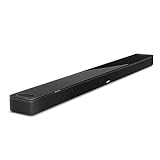
The Bose Smart Ultra Dolby Atmos Soundbar is the brand’s flagship all-in-one: a single bar with up-firing and side-firing drivers, A.I. Dialogue Mode, room calibration and built-in voice assistants. It suits someone who wants the most immersive effect possible without adding a subwoofer or rear speakers — typically because the room is small, the layout is fixed, or the household simply refuses to accommodate more boxes. It also suits anyone who watches a lot of dialogue-driven content and wants speech to stay intelligible at low volumes.
Key specs at a glance
- Configuration: single all-in-one bar with up-firing and side-firing drivers
- Decoding: Dolby Atmos
- Connections: HDMI eARC, Wi-Fi, Bluetooth, AirPlay 2, built-in voice assistants
- Features: A.I. Dialogue Mode, ADAPTiQ-style room calibration, app EQ
- Room fit: small to medium rooms, roughly 12 x 14 up to 14 x 18 feet
Where it earns its place. The up-firing and side-firing drivers are what separate this from a conventional bar. Sound is bounced off the ceiling and off the side walls, creating the impression of height and width without any satellites. In a rectangular room with the bar centered, that works surprisingly well, and it produces a wider, taller front stage than a bar with only forward-facing drivers. Dialogue processing is the other half of the pitch: the system analyzes what you are watching and adjusts the center channel so speech stays clear, which is genuinely useful when you are watching at night and cannot raise the volume.
What to expect in practice. Reflection-based immersion is a room-dependent trick. A perfectly symmetrical room with parallel side walls and a flat ceiling gives the best result; an open-plan space with one side open to a kitchen, or a room with heavy curtains on one wall and glass on the other, will produce an asymmetric soundstage. The bar should not be placed in a cabinet, and nothing should sit directly above the up-firing drivers. Bass is competent for a single enclosure but cannot match a separate subwoofer for the lowest octaves, so if physical impact during action films matters to you, this is the compromise you are accepting in exchange for a one-box solution.
How it compares. Its nearest alternative is the Sonos Arc Ultra, which offers more channels and a wider enclosure, and which integrates into a broader multiroom system. The Bose counters with a more aggressive dialogue mode and a form factor that fits smaller spaces more easily. Against the standard Bose Smart Dolby Atmos Soundbar, this model is the significant upgrade: the up-firing and side-firing drivers are what make the immersive claim credible, and the standard model cannot match it. Against the LG S95TR, the Bose is simpler and tidier but produces simulated rather than physical height and rear channels.
Pros
- Up-firing and side-firing drivers create height and width without satellites
- A.I. Dialogue Mode keeps speech clear at low listening levels
- Room calibration adapts the sound to your specific space
- Wi-Fi, AirPlay 2, Bluetooth and built-in voice assistants
Cons
- Premium pricing for a single enclosure
- No separate subwoofer, so the deepest bass is out of reach
- Reflection-based effects degrade in asymmetric or open-plan rooms
- No rear channels and no path to add physical ones
9. ULTIMEA 7.1ch Fully Wireless Sound Bar – Best for a wireless-everything mid-range setup

The ULTIMEA 7.1ch system is a fully wireless surround package: a soundbar, a wireless subwoofer and wireless surround speakers, arranged in a 7.1-channel configuration. It suits a buyer who wants more channels than a budget 5.1 provides but is not ready for premium pricing, and who specifically values minimal cabling. It is a good fit for a medium living room where the seating is roughly centered and there is space to place surrounds slightly behind and to the sides.
Key specs at a glance
- Configuration: 7.1 channels with wireless subwoofer and wireless surround speakers
- Decoding: Dolby Atmos
- Connections: HDMI eARC, optical, Bluetooth
- Room fit: medium rooms, roughly 12 x 14 up to 16 x 18 feet
- Design: fully wireless rear and subwoofer links; bar is wall-mountable
Where it earns its place. The jump from 5.1 to 7.1 adds side or rear-surround channels, which fills the gap between the front stage and the rear speakers. In practice this makes panning effects — a car moving from the front of the screen around behind you — sound continuous rather than jumping from the bar to the rears. Combined with a wireless subwoofer and wireless surrounds, the system delivers a genuinely enveloping layout for the mid-range tier. It is also one of the few configurations in this list that gives you a rear-surround layer without requiring an AV receiver or premium-tier spending.
What to expect in practice. Wireless connections mean each speaker still needs a power outlet, so the practical difference from a wired system is cable length, not cable count. Placement follows the same rules as any surround system: surrounds at or just above ear height, angled in toward the listening position, and the subwoofer positioned by ear rather than by diagram. Because this is a mid-range system without up-firing height drivers, Atmos content will produce a wide, tall front stage but not discrete overhead effects — the 7.1 layout is about horizontal envelopment, not vertical. That is a legitimate trade: many viewers find a dense horizontal field more convincing than a weak height effect.
How it compares. The nearest alternative is the Sony BRAVIA Theater System 6, a 5.1 system with stronger processing and format coverage, including DTS:X. The Sony wins on decoding breadth and dialogue handling; the ULTIMEA wins on channel count and, for non-Sony households, on not paying for television integration you cannot use. Against the ULTIMEA 5.1.2ch, the choice is straightforward: the 7.1ch gives you a wider horizontal field, while the 5.1.2ch gives you a height layer. If your ceiling is flat and low, height is the more noticeable upgrade; if your ceiling is awkward, the extra surround channels are the safer investment.
Pros
- 7.1 channels provide smoother panning than a 5.1 layout
- Wireless subwoofer and wireless surrounds keep the room tidy
- Mid-range pricing for a fairly complete speaker package
- Bluetooth and optical inputs for flexible source connections
Cons
- No DTS:X decoding
- No up-firing height drivers; Atmos height is simulated
- Surround and subwoofer speakers still require power outlets
- Processing and bass depth are a step below premium systems
10. JBL Bar 800 – Best for flexible rooms and renters

The JBL Bar 800 is a 5.1.2-channel system whose surround speakers detach from the ends of the main bar and run on their own rechargeable batteries, paired with a 10-inch wireless subwoofer. It suits renters, people in rooms where permanent rear speakers are impossible, and anyone who wants surround sound for movie nights without a permanent installation behind the couch. It also suits a mixed-use living room where the same space has to work for films, music and everyday television.
Key specs at a glance
- Configuration: 5.1.2 channels
- Subwoofer: 10-inch wireless — the largest in this roundup
- Surrounds: detachable, battery-powered, dock into the main bar to charge
- Connections: HDMI eARC, Bluetooth, USB
- Room fit: small to large, adaptable because the surrounds are not fixed
Where it earns its place. The detachable surround speakers solve a real problem. Most surround systems require you to commit to rear speakers in fixed positions with power cables; the Bar 800 lets you dock them into the bar for everyday television and pull them out for a film, placing them on side tables or behind the couch and re-docking them afterwards to charge. Combined with a 10-inch subwoofer — noticeably larger than the 8-inch and smaller drivers typical of budget systems — this produces a more physical low end than most soundbar packages. The 5.1.2 configuration adds a height layer via up-firing drivers in the bar.
What to expect in practice. The battery-powered surrounds are the defining ownership consideration. Battery capacity in speakers of this size is measured in hours rather than days, and rechargeable cells lose capacity over years of cycling, so the surrounds will eventually hold less charge than they did when new. That is the trade for not running cable. Placement still matters: the detachable speakers work best at or near ear height rather than on the floor, and they should be angled toward the listener. The subwoofer is large enough that placement affects the sound considerably — a corner will reinforce it, sometimes more than a small room can tolerate.
How it compares. The nearest alternative is the LG S95TR, which offers far more channels (9.1.5) and up-firing drivers in the rear speakers as well as the bar, but requires permanently placed, powered rear speakers. If you have a dedicated room and can commit to placement, the LG produces a denser and taller field. If your room has to serve multiple purposes or you move frequently, the JBL’s detachable design is the more practical answer, and its 10-inch subwoofer is a genuine advantage over smaller systems at similar or lower prices.
Pros
- Detachable battery-powered surrounds work in rooms with no rear placement
- 10-inch wireless subwoofer delivers deeper bass than most soundbar packages
- 5.1.2 layout with up-firing height drivers in the bar
- Surrounds recharge by docking into the main bar
Cons
- Surround battery capacity degrades over years of use
- Premium-tier pricing for a 5.1.2 configuration
-
Affiliate disclosure. As an Amazon Associate we earn from qualifying purchases at no extra cost to you. Prices accurate as of the date shown.Best Premium Dolby Atmos Soundbars for Home TheaterCheck price on Amazon





