
Our Top Picks
 Waterdrop G3P600 Tankless Reverse Osmosis Water Filter System600 GPD18.06 x 5.68 x 17.76 Inches31 poundsCheck on Amazon
 DREO Reverse Osmosis Water Filter Countertop5L15.67 x 6.73 x 13.35 inches10.78 poundsCheck on Amazon


If you want one answer: the iSpring RCC7AK-BN is the best reverse osmosis system for most homes. It produces 75 gallons per day through six stages, finishes with an alkaline remineralization cartridge that puts calcium and magnesium back into water the RO membrane has stripped, and it runs on standard 10-inch cartridges you can buy almost anywhere. It suits households of two to five people who want a dedicated drinking-water faucet, who can spare roughly a cubic foot of under-sink cabinet space for a storage tank, and who would rather replace a generic filter than wait on a proprietary part. If your cabinet is cramped, you rent, or your household drinks water fast, the tankless Waterdrop G3P600 is the better fit — 600 gallons per day with no tank at all. If upfront cost is the deciding factor, the APEC ROES-50 and the iSpring RCC7-BN deliver the core job for less, and the countertop DREO is the only pick here that needs no plumbing whatsoever.
Top 3 Picks
Best overall: iSpring RCC7AK-BN
Six stages, 75 GPD, NSF/ANSI 58 certified, and a brushed nickel faucet in the box. The alkaline stage is the difference between flat-tasting RO water and water people actually drink, and the whole system is built on standard cartridges, so you are never locked into one supplier. It is the safest default for a family that wants this to be the last water decision they make for a decade.
Best budget: iSpring RCC7-BN
Same 75 GPD platform and the same 10-inch cartridge format as the overall pick, minus the alkaline stage, at a budget-tier price. If you want maximum output per dollar and don’t care about remineralization, this is the value pick. The APEC ROES-50 is the other credible budget contender, and it trades 25 GPD of output for a lower entry price.
Best premium: Waterdrop G3P800
800 gallons per day, tankless, and a 3:1 pure-to-drain ratio that wastes far less water than a traditional tank system. It costs premium money and needs an outlet under the sink, but for a large household, a small cabinet, or anyone who fills big pitchers constantly, it removes the two biggest annoyances of the category: waiting and wasted water.
Quick Comparison
| Product | Best for | Key specs | Price tier |
|---|---|---|---|
| iSpring RCC7AK-BN | Most households wanting remineralized water | 6-stage, 75 GPD, alkaline pH+ stage, tanked, NSF/ANSI 58, brushed nickel faucet, standard 10″ cartridges | Mid-range |
| Waterdrop G3P600 | Small cabinets and high daily demand | Tankless, 600 GPD, ~2:1 pure-to-drain, 3-stage, smart faucet with TDS readout, needs outlet | Premium |
| iSpring RCC7-BN | Lowest-cost proven 75 GPD platform | 5-stage, 75 GPD, tanked, NSF/ANSI 58, standard 10″ cartridges, brushed nickel faucet | Budget |
| APEC ROES-50 | First-time buyers and small households | 5-stage, 50 GPD, tanked, ~3.2 gal storage, standard cartridges, WQA-certified line | Budget |
| iSpring RCC7AK-BLK | Dark kitchens and matte-fixture remodels | 6-stage, 75 GPD, alkaline stage, tanked, NSF/ANSI 58, black faucet, standard 10″ cartridges | Mid-range |
| DREO Countertop RO | Renters and anyone with no plumbing access | Countertop, no installation, 3:1 pure-to-drain, TDS display, filter-life indicator, reservoir-based | Budget |
| Waterdrop G5P500A | Tankless buyers who still want alkaline water | Tankless, 500 GPD, 8-stage with alkaline mineral stage, smart faucet, needs outlet | Mid-range |
| Geekpure 5-Stage 75 GPD | DIY maintainers on a tight budget | 5-stage, 75 GPD, tanked, standard 10″ cartridges, includes faucet and tank | Budget |
| Waterdrop G3P800 | Large households and heavy daily use | Tankless, 800 GPD, 3:1 pure-to-drain, 3-stage, smart faucet, needs outlet | Premium |
| Waterdrop WD-T4-A | Two water types from one faucet | Tankless, 450 GPD, 10-stage, dual-flow alkaline + pure RO, NSF/ANSI 372 certified, needs outlet | Premium |
| Waterdrop G5P700A | Big families wanting tankless alkaline | Tankless, 700 GPD, alkaline mineral stage, smart faucet, needs outlet | Premium |
| APEC RO-90 | Higher-output traditional setups | 5-stage, 90 GPD, tanked, standard cartridges, WQA-certified line, chrome faucet | Mid-range |
How We Chose
This roundup is built from published manufacturer specifications, third-party certification listings, and the maintenance economics that govern ownership — not from any physical evaluation of the units. We started with the numbers a buyer can verify before purchase: rated gallons per day, stage count, what each stage actually does, storage tank capacity, pure-to-drain ratio, cartridge format, and whether the system needs a power outlet. From there we weighed category fit, because a 600 GPD tankless unit is the wrong answer for a rental kitchen with no outlet under the sink, and a 50 GPD tanked system is the wrong answer for a family of six. Filter replacement interval and cartridge cost carried real weight, since consumables over five years often exceed the purchase price. Finally, we looked at the upgrade path: whether a system uses standard 10-inch cartridges, whether the brand sells replacement parts individually, and whether you can add remineralization later without replacing the whole unit. Every product below is judged against the alternatives in this same list rather than against an abstract ideal.
1. iSpring RCC7AK-BN – Best for Most Households
As an Amazon Associate we earn from qualifying purchases at no extra cost to you.

The RCC7AK-BN is the system to buy when you want a proven under-sink platform with one upgrade most people can actually taste. It runs six stages: a 5-micron sediment filter, granular activated carbon, a carbon block, a thin-film composite RO membrane, a post-carbon polishing stage, and finally an alkaline cartridge that raises pH and reintroduces calcium and magnesium. Rated at 75 gallons per day, it suits households of two to five people who want a dedicated drinking-water tap and don’t want to think about it again for years.
Key specifications:
- Filtration stages: 6 (sediment, GAC, carbon block, TFC RO membrane, post-carbon, alkaline remineralization)
- Rated output: 75 gallons per day
- Storage: pressurized bladder tank, roughly 3.2 gallons nominal and about 2 to 2.5 gallons usable
- Faucet: brushed nickel, lead-free, dedicated drinking-water tap included
- Certification: NSF/ANSI 58 for the system
- Cartridge format: standard 10-inch, widely cross-compatible
- Feed water: cold only, typically 40–80 psi
- Replacement rhythm: prefilters every 6–12 months, RO membrane every 2–3 years, alkaline cartridge every 6–12 months
The strengths here are boring in the best way. Standard cartridges mean you are not captive to a single vendor, and a decade from now you will still be able to buy filters. The alkaline stage solves the most common complaint about RO water — that it tastes flat and slightly acidic — without requiring a second appliance. Because it uses a storage tank and no electricity, it keeps working during a power outage and delivers water at a steady trickle without any pump noise. The included brushed nickel faucet is metal, not chrome-plated plastic, which matters in a kitchen you plan to keep.
The tradeoffs are the classic tanked-system tradeoffs. You give up cabinet space, the pure-to-drain ratio is roughly 1:3 so it sends more water down the drain than a modern tankless unit, and recovery is slower — fill a gallon jug right after a big pasta night and you may wait. The alkaline cartridge is an extra consumable to track. None of that is disqualifying, but it is the reason tankless systems exist.
Pros
- Six stages including genuine remineralization, at a mid-range price
- Standard 10-inch cartridges with broad third-party availability
- No electricity required, so it keeps working in a power cut
- 75 GPD is comfortably above what a typical family consumes
- NSF/ANSI 58 certification and a metal faucet in the box
Cons
- Storage tank consumes meaningful under-sink cabinet volume
- Roughly 3 gallons of wastewater per gallon produced
- Slower recovery than tankless after heavy use
- Alkaline cartridge adds a recurring consumable
- Needs adequate line pressure to hit its rated output
Against the iSpring RCC7-BN, this is the same platform with the alkaline stage added — if you don’t care about remineralization, save the money and buy the five-stage version. Against the Waterdrop G3P600, you are choosing between cheap standard filters and no tank versus proprietary cartridges and much higher output with far less waste. If cabinet space is tight or your household drinks a lot, the G3P600 wins; if you want the lowest long-run consumable cost and maximum parts availability, this one does.
2. Waterdrop G3P600 – Best for Small Cabinets and High Demand

The G3P600 is a tankless under-sink system rated at 600 gallons per day with a pure-to-drain ratio around 2:1. That combination — no tank, high output, less waste — is exactly what a busy household with a shallow cabinet wants. It suits families of four or more, anyone who fills large pitchers or water bottles daily, and anyone who has already lost cabinet space to a disposal and a trash can.
Key specifications:
- Filtration stages: 3 (composite pre-filter, RO membrane, post-carbon)
- Rated output: 600 gallons per day, tankless
- Pure-to-drain ratio: approximately 2:1
- Faucet: smart faucet with TDS readout and filter-life indication
- Footprint: compact, wall-mounted or base-mounted under the sink
- Power: requires a standard electrical outlet under the sink
- Replacement rhythm: composite filter roughly every 6 months, RO membrane roughly every 24 months
The headline advantage is that it removes the tank without removing capacity. Traditional tanked systems recover slowly; a 600 GPD tankless unit makes water on demand, so the faucet runs at a usable rate indefinitely. The 2:1 ratio is a real environmental and cost improvement over the 1:3 of a conventional system, and because there is no tank, the entire unit fits in a fraction of the cabinet volume. The smart faucet’s TDS readout is genuinely useful for spotting a filter that has stopped performing before taste tells you.
The tradeoffs are real. It needs an outlet, which many older kitchens simply do not have under the sink — that alone can turn a simple install into an electrician’s visit. Cartridges are proprietary, so you buy from one source and pay accordingly, and there are only three stages, meaning no dedicated alkaline or remineralization stage in this configuration. Tankless units also stop producing water during a power outage, which is worth knowing if you live somewhere with an unreliable grid.
Pros
- 600 GPD with no storage tank at all
- Roughly 2:1 pure-to-drain, far less wastewater than tanked systems
- Smart faucet reports TDS and filter status
- Very small under-sink footprint
- Fast, continuous delivery at the tap
Cons
- Requires an electrical outlet under the sink
- Proprietary cartridges limit where you can buy replacements
- Three stages, with no alkaline or remineralization stage
- Stops working during a power outage
- Premium-tier purchase price
Compared with the iSpring RCC7AK-BN, you are trading standard cheap cartridges and remineralization for speed, space savings, and less waste. Compared with the G3P800 in this same list, the difference is capacity and drain ratio: the 800 model pushes more gallons per day and a 3:1 ratio for more money. If your household is large or your cabinet is genuinely tight, step up; if 600 GPD already exceeds your usage, this is the smarter buy.
3. iSpring RCC7-BN – Best Budget Under-Sink System
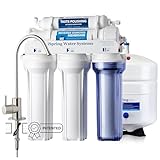
The RCC7-BN is the five-stage version of iSpring’s long-running under-sink platform: 75 gallons per day, a storage tank, a brushed nickel faucet, and NSF/ANSI 58 certification at a budget-tier price. It is the right pick for a first RO system, a rental where you still want a permanent install, or anyone who wants maximum output per dollar and does not need remineralization.
Key specifications:
- Filtration stages: 5 (sediment, granular activated carbon, carbon block, TFC RO membrane, post-carbon)
- Rated output: 75 gallons per day
- Storage: pressurized bladder tank, roughly 3.2 gallons nominal
- Faucet: brushed nickel, lead-free, included
- Certification: NSF/ANSI 58
- Cartridge format: standard 10-inch
- Replacement rhythm: prefilters every 6–12 months, membrane every 2–3 years, post-carbon annually
What you get for the money is the same hardware architecture as the alkaline model above, minus one cartridge. That means the same 75 GPD rating, the same metal faucet, the same certification, and the same standard 10-inch consumables. In practice, that last point is the whole argument: a five-stage traditional system with generic cartridges is the cheapest RO water you can make over a ten-year horizon, because you are never paying a proprietary-cartridge premium.
The obvious gap is taste. Without a remineralization stage, the water comes out neutral to slightly acidic and some people find it flat compared with what they were drinking before. That is a preference issue rather than a safety one, and you can address it later — either by adding an inline alkaline cartridge or by upgrading to the RCC7AK-BN. The other tradeoffs are inherent to tanked systems: cabinet space, a roughly 1:3 drain ratio, slower recovery, and a dependency on decent line pressure.
Pros
- 75 GPD at a budget-tier price
- Standard 10-inch cartridges that are cheap and easy to source
- NSF/ANSI 58 certified
- No electricity needed
- Metal faucet and tank included
Cons
- No remineralization, so water can taste flat
- Tank takes up cabinet space
- Roughly 3 gallons wasted per gallon produced
- Slower recovery than tankless
- Performance depends on incoming water pressure
Against the APEC ROES-50 — the other budget heavyweight in this list — this model wins on output, 75 GPD against 50 GPD, for a modest price step. If your household is one or two people and you want the absolute lowest entry cost, the ROES-50 is fine. If you have three or more people drinking and cooking with RO water, the extra 25 gallons per day of headroom is worth the small premium.
4. APEC ROES-50 – Best Budget Pick for Small Households

The ROES-50 is APEC’s entry five-stage system: 50 gallons per day, a storage tank, standard cartridges, and a long track record as one of the most widely installed budget RO units in North America. It suits one- and two-person households, apartments where a permanent under-sink install is allowed, and anyone who wants a name-brand system at the lowest sensible price.
Key specifications:
- Filtration stages: 5 (sediment, carbon block, granular carbon, TFC RO membrane, post-carbon)
- Rated output: 50 gallons per day
- Storage: pressurized bladder tank, roughly 3.2 gallons nominal
- Faucet: dedicated drinking-water faucet included
- Certification: sold under a WQA-certified product line
- Cartridge format: standard 10-inch
- Replacement rhythm: prefilters every 6–12 months, membrane every 2–3 years
APEC’s reputation in this category rests on two things: build consistency and cartridge availability. The ROES-50 uses standard 10-inch filters, so replacements are inexpensive and you can buy them in bulk without worrying about a discontinued part number. The tank gives you instant water at the tap and no electrical requirement, and 50 GPD is genuinely adequate for two people who use RO water for drinking and cooking.
The limitation is the 50 GPD rating itself. Rated output is measured under favorable conditions — adequate pressure, warm-ish feed water — and real-world performance drops in winter when the incoming water is cold. Three or four people filling bottles, a coffee machine, and a stockpot will outrun a 50 GPD system with a 3.2-gallon tank, and you will notice the faucet slowing. If that describes your household, the iSpring RCC7-BN’s 75 GPD or the APEC RO-90’s 90 GPD is the better call.
Pros
- Lowest-cost credible five-stage system in this roundup
- Standard 10-inch cartridges, cheap and widely available
- Storage tank means no electricity and no waiting for the first glass
- Long-standing, widely supported product line
- Compact footprint for a tanked system
Cons
- 50 GPD can be marginal for households of three or more
- Output drops noticeably with cold feed water
- No remineralization stage
- Tank consumes cabinet space
- Higher wastewater ratio than tankless designs
Against the iSpring RCC7-BN, this is a straightforward capacity decision: the iSpring makes 25 more gallons per day and costs a little more. Against the countertop DREO, the ROES-50 produces more water and never needs refilling by hand, but it requires drilling a faucet hole and tapping a drain line. If you cannot modify plumbing at all, the DREO is the only option; if you can, the ROES-50 gives you a permanent installation for similar money.
5. iSpring RCC7AK-BLK – Best for Dark Kitchens and Matte Fixtures
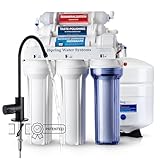
The RCC7AK-BLK is functionally the RCC7AK-BN with a black faucet instead of brushed nickel. Same six stages, same 75 GPD rating, same alkaline remineralization, same NSF/ANSI 58 certification. It exists for the buyer whose kitchen is finished in matte black and who does not want a bright chrome or nickel tap interrupting the countertop.
Key specifications:
- Filtration stages: 6 (sediment, GAC, carbon block, TFC RO membrane, post-carbon, alkaline remineralization)
- Rated output: 75 gallons per day
- Storage: pressurized bladder tank, roughly 3.2 gallons nominal
- Faucet: black finish, lead-free, dedicated drinking-water tap
- Certification: NSF/ANSI 58
- Cartridge format: standard 10-inch
- Replacement rhythm: prefilters every 6–12 months, membrane every 2–3 years, alkaline cartridge every 6–12 months
The practical case for this model is identical to the brushed nickel version, which is a good thing: 75 GPD is generous, the alkaline stage fixes the flat taste of straight RO water, and the standard cartridge format keeps long-run costs low. The finish is the differentiator, and it is a legitimate one — a mismatched faucet is the kind of detail that bothers people for as long as they own the kitchen.
If you are choosing between this and the RCC7AK-BN purely on price, note that finish variants occasionally sit at slightly different points in the same tier. There is no performance difference between them, so the decision is aesthetic. The same caveats apply as with any tanked system: cabinet space, a roughly 1:3 drain ratio, and slower recovery after heavy use.
Pros
- Black faucet matches modern matte-black kitchen hardware
- Six stages including alkaline remineralization
- 75 GPD and NSF/ANSI 58 certification
- Standard 10-inch cartridges
- No electricity required
Cons
- Identical performance to the brushed nickel version, so you are paying partly for cosmetics
- Storage tank takes cabinet space
- Wasteful drain ratio compared with tankless
- Alkaline cartridge is an extra recurring cost
- Slower recovery than a 600+ GPD tankless unit
Against the RCC7AK-BN, this is a coin flip decided by your faucet finish. Against the Waterdrop G5P500A, the comparison gets more interesting: the Waterdrop is tankless with 500 GPD and alkaline filtration, so it is faster and saves cabinet space, but it costs more and needs an outlet. If your kitchen has a free outlet and you value the space, the Waterdrop is the upgrade; if not, this iSpring is the safe, serviceable answer.
6. DREO Countertop RO – Best for Renters and No-Plumbing Setups

The DREO countertop RO is the outlier in this list: it sits on the counter, needs no plumbing, no faucet hole, and no drain saddle, and it runs a 3:1 pure-to-drain ratio with a TDS readout and a filter-life indicator built in. It suits renters, dorm rooms, RVs, offices, and anyone whose building will not permit a permanent modification.
Key specifications:
- Type: countertop RO, no installation required
- Pure-to-drain ratio: 3:1
- Display: TDS readout and filter-life indicator
- Water supply: reservoir-based; you fill a raw-water tank by hand and draw from a filtered-water tank
- Output class: countertop-scale, suited to drinking and cooking for one or two people rather than whole-house demand
- Power: standard wall outlet
The category advantage is obvious: zero installation risk. You cannot flood a cabinet you never opened. You also get a genuinely efficient 3:1 ratio, which is better than most under-sink tanked systems, plus visible TDS and filter status so you always know where you stand. Because it is portable, it moves with you — apartment to apartment, kitchen to office — which is something no under-sink unit can do.
The tradeoffs follow from the form factor. You refill the raw-water reservoir by hand, so it is a chore rather than an automatic supply. Output is limited by the reservoir and the pump, so filling a large pitcher takes longer than at a tankless under-sink tap, and you cannot plumb it to an ice maker or a coffee machine. It occupies permanent countertop space, which is the scarcest real estate in most kitchens.
Pros
- No plumbing, no drilling, no permanent modification
- 3:1 pure-to-drain ratio, better than most tanked systems
- TDS display and filter-life indicator built in
- Portable — move it between kitchens
- Budget-tier price
Cons
- Manual reservoir refilling is a recurring chore
- Lower output than any under-sink unit here
- Occupies countertop space permanently
- Cannot supply an ice maker or plumbed appliance
- Smaller reservoir means more frequent top-ups for heavy users
Against the APEC ROES-50, the decision is about permission and effort rather than performance. If you can drill a hole and tap a drain line, the ROES-50 gives you unlimited water for a similar budget and you never refill anything by hand. If you cannot — or you are moving in twelve months — the DREO is the only one of the two that works. That is the entire case for countertop RO, and it is a strong one.
7. Waterdrop G5P500A – Best Mid-Range Tankless with Alkaline Water

The G5P500A is Waterdrop’s mid-range tankless system with an eight-stage configuration that includes an alkaline mineral stage, rated at 500 gallons per day. It suits buyers who want tankless convenience and remineralized water without paying the top premium tier, and who have an outlet available under the sink.
Key specifications:
- Filtration stages: 8, including an alkaline mineral stage
- Rated output: 500 gallons per day, tankless
- Footprint: compact under-sink, no storage tank
- Faucet: smart faucet with filter-status indication
- Power: requires a standard outlet under the sink
- Replacement rhythm: pre-filter stages more frequently, RO membrane and mineral stage on longer intervals
This is the sweet spot of the tankless category for a lot of households. It keeps the two things people like about tankless — no tank eating cabinet space, and continuous output instead of a slow trickle after heavy use — while adding the remineralization that the entry tankless models skip. The eight-stage layout also means more of the taste-and-odor work happens in dedicated cartridges rather than being bundled into one composite filter.
The compromises are the standard tankless set. You need power under the sink, cartridges are proprietary, and the unit stops producing water in an outage. The stage count is also worth reading carefully rather than counting: more stages is not automatically better water, and a well-designed three-stage system can outperform a poorly specified eight-stage one. What matters is what each stage does and how often you replace it.
Pros
- Tankless with an alkaline mineral stage, a combination the entry tankless models lack
- 500 GPD is ample for most families
- No storage tank, so cabinet space is preserved
- Smart faucet shows filter status
- Mid-range price for tankless-plus-alkaline capability
Cons
- Needs an electrical outlet under the sink
- Proprietary cartridges with a single supply source
- Multiple stages mean multiple replacement intervals to track
- No water during a power outage
- Premium-adjacent consumable costs over time
Against the iSpring RCC7AK-BN, this is the classic tankless-versus-tanked decision: the Waterdrop is faster, smaller, and wastes less water; the iSpring uses cheaper standard cartridges and works without power. Against the G5P700A, the difference is capacity — 700 GPD versus 500 — and price. If your household regularly fills multiple large containers back to back, the 700 is worth the step up; otherwise 500 GPD is more than enough and the 500A is the better value.
8. Geekpure 5-Stage 75 GPD – Best Budget DIY-Maintenance System

The Geekpure five-stage system is a conventional 75 GPD under-sink RO unit with a storage tank, standard 10-inch cartridges, and an included faucet. It suits budget-conscious buyers who are comfortable doing their own filter changes and who want the simplest possible architecture to maintain.
Key specifications:
- Filtration stages: 5 (sediment, carbon stages, TFC RO membrane, post-carbon)
- Rated output: 75 gallons per day
- Storage: pressurized bladder tank included
- Faucet: dedicated drinking-water faucet included
- Cartridge format: standard 10-inch
- Replacement rhythm: prefilters every 6–12 months, membrane every 2–3 years
The appeal is straightforward: 75 GPD at a budget-tier price, using the same generic cartridge format as the more expensive traditional systems. If you are willing to look up a filter cross-reference and swap housings yourself, the ongoing cost of ownership here is among the lowest in this roundup. The design is also simple enough that most failures are diagnosable — a slow faucet usually means a clogged prefilter or a depressurized tank, both of which are cheap to fix.
What this system does not offer is the polish of a flagship brand: no certification claim pushed to the front of the listing, no alkaline stage, no smart faucet, and documentation that is thinner than what iSpring or APEC provide. If third-party certification is a requirement for you, verify it on the specific listing before buying rather than assuming it. That is a reasonable precaution with any value-tier RO system, not a knock specific to this one.
Pros
- 75 GPD at a budget price
- Standard 10-inch cartridges keep long-run costs low
- Tank and faucet included
- Simple, repairable architecture with no electronics
- Works without electricity
Cons
- Certification claims are less prominent than with premium brands — verify before buying
- No remineralization stage
- Tank consumes cabinet space
- Thinner documentation and support ecosystem
- Standard tanked-system waste ratio and slower recovery
Against the iSpring RCC7-BN, the two are close in capability and price tier. The iSpring brings NSF/ANSI 58 certification and a longer track record; the Geekpure brings a slightly lower entry point and the same generic cartridge ecosystem. If certification matters to you, pay the small difference for the iSpring. If you are optimizing purely on upfront cost and you are comfortable verifying specs yourself, this one works.
9. Waterdrop G3P800 – Best Premium for Large Households

The G3P800 is the highest-capacity tankless system in this roundup at 800 gallons per day, with a 3:1 pure-to-drain ratio and a smart faucet. It suits large families, households that cook with RO water constantly, and anyone who has been frustrated by a tanked system running dry mid-pitcher.
Key specifications:
- Filtration stages: 3 (composite pre-filter, RO membrane, post-carbon)
- Rated output: 800 gallons per day, tankless
- Pure-to-drain ratio: 3:1
- Faucet: smart faucet with TDS readout and filter-life indication
- Footprint: compact under-sink, wall or base mounted, no tank
- Power: requires a standard outlet under the sink
- Replacement rhythm: composite filter roughly every 6 months, RO membrane on a longer multi-year interval
Three things justify the premium tier. First, capacity: 800 GPD means you will essentially never wait, even with several people drawing water at once. Second, efficiency: a 3:1 ratio sends one gallon to drain for every three produced, which is dramatically better than the roughly 1:3 of a traditional tanked system — over a year that difference is thousands of gallons. Third, space: no tank means the cabinet stays usable.
The honest caveats: it is a three-stage system, so there is no dedicated alkaline or remineralization stage in this configuration, and some buyers who want minerals back will need to add a separate cartridge or choose a different model. Cartridges are proprietary and priced accordingly. It needs an outlet, and it stops producing water during a power cut. Those are the costs of the tankless architecture, and they apply here as much as anywhere.
Pros
- 800 GPD, the highest output in this list
- 3:1 pure-to-drain ratio saves thousands of gallons a year
- No storage tank, preserving cabinet space
- Smart faucet with TDS and filter-life readout
- Continuous delivery — never runs dry mid-container
Cons
- Premium-tier purchase price
- Only three stages, with no alkaline stage included
- Requires an outlet under the sink
- Proprietary cartridges from a single source
- No water during a power outage
Against the G3P600, this is a straightforward step up in both capacity and drain efficiency for more money. If 600 GPD already exceeds what your household uses, the difference will be invisible and the 600 is the better buy. Against the G5P700A, the choice is capacity and efficiency versus remineralization: the G3P800 makes more water and wastes less, the G5P700A puts minerals back in. Which matters more depends entirely on how the water tastes to you.
10. Waterdrop WD-T4-A – Best Dual-Flow System for Two Water Types

The WD-T4-A is a tankless, ten-stage system rated at 450 gallons per day with a dual-flow faucet that delivers alkaline pH+ water from one stream and straight RO water from the other. It suits households that want both — mineral-adjusted water for drinking, plain RO water for coffee, formula, aquariums, or anything where added minerals are unwanted.
Key specifications:
- Filtration stages: 10
- Rated output: 450 gallons per day, tankless
- Faucet: dual-flow, one alkaline pH+ stream and one pure RO stream
- Certification: NSF/ANSI 372 for lead-free compliance
- Footprint: compact under-sink, no storage tank
- Power: requires a standard outlet under the sink
The dual-flow design is the reason to buy this over any single-stream system. Most households that add remineralization do it because plain RO tastes flat — but then they are stuck with minerals in every glass, including the ones where they don’t want them. Having both streams at one faucet solves that without a second appliance, a second faucet hole, or a second filtration system under the counter. The ten-stage layout also gives the system more granular control over taste and odor than a three-stage unit.
Two caveats. Ten stages means more cartridges to track and replace, and each has its own interval, so maintenance requires a bit more attention than a three-stage tankless system. And the dual-flow faucet is a more complex part than a standard tap; it is the component most likely to need attention first. Neither is a dealbreaker, but both are ownership realities rather than marketing points.
Pros
- Two water types from one faucet — alkaline and pure RO
- Tankless design saves cabinet space
- Ten stages for fine-grained taste and odor control
- NSF/ANSI 372 lead-free certification
- No need for a second faucet or second system
Cons
- Premium-tier price
- Many cartridges, each on its own replacement schedule
- Dual-flow faucet is a more failure-prone component than a simple tap
- Requires an outlet under the sink
- 450 GPD is the lowest tankless rating in this list
Against the G5P700A, the tradeoff is capacity versus flexibility: the 700 makes more water, the T4-A gives you two streams. If you have ever wanted plain RO water for a coffee machine while still drinking remineralized water by the glass, the T4-A is the only system here that does both. Against the iSpring RCC7AK-BN, the iSpring is cheaper, uses standard cartridges, and works without power — but it gives you one stream and a tank.
11. Waterdrop G5P700A – Best Premium Tankless with Alkaline Filtration

The G5P700A is the higher-capacity sibling of the G5P500A: tankless, 700 gallons per day, with an alkaline mineral stage. It suits larger families who want remineralized water at tankless speed and are willing to pay premium pricing for the combination.
Key specifications:
- Filtration stages: multi-stage, including an alkaline mineral stage
- Rated output: 700 gallons per day, tankless
- Footprint: compact under-sink, no storage tank
- Faucet: smart faucet with filter-status indication
- Power: requires a standard outlet under the sink
- Replacement rhythm: pre-filter stages more frequently, membrane and mineral stage on longer intervals
The case for this model is capacity plus minerals. At 700 GPD it keeps up with a busy kitchen — multiple bottles, a coffee machine, a pot of water for pasta — while the alkaline stage keeps the water from tasting flat. It is the closest thing in this roundup to a no-compromise tankless system: fast, space-efficient, and pleasant to drink, without the dual-faucet complexity of the T4-A.
The usual tankless costs apply: an outlet is mandatory, cartridges are proprietary, and a power cut stops production. There is also a genuine argument that a 700 GPD rating is more than most homes can use — a family of four drinking and cooking with RO water typically consumes a small fraction of that per day. The extra capacity is really about instantaneous flow rate and recovery, not daily volume, so if your current system never runs dry you are paying for headroom you will not notice.
Pros
- 700 GPD tankless with an alkaline mineral stage
- No storage tank, so cabinet space stays usable
- Continuous output at the faucet with no recovery lag
- Smart faucet reports filter status
- Better taste than a plain three-stage tankless unit
Cons
- Premium-tier price
- 700 GPD exceeds the needs of most households
- Proprietary cartridges
- Requires an outlet and stops working in an outage
- More stages
Affiliate disclosure. As an Amazon Associate we earn from qualifying purchases at no extra cost to you. Prices accurate as of the date shown.Best Reverse Osmosis Systems for Clean Home WaterCheck price on Amazon





