Key takeaways
- Pro: Zero installation required, making it viable for temporary living situations
- Pro: Visible TDS readout and filter-life indicator remove uncertainty from replacement timing
- Con: The 3:1 ratio still means drain water, which adds to usage in already water-restricted areas
What's inside
Most people pour a glass of tap water without a second thought, but growing concerns about lead in aging infrastructure, PFAS contamination, and chlorine byproducts have made a drinking water filter one of the most practical purchases for any household. The market, however, is cluttered with options that range from simple carbon-pitcher systems that barely touch dissolved solids to reverse osmosis units that strip nearly everything out. Choosing the wrong one means either spending too much on filtration you do not need or trusting your health to a filter that removes far less than it claims.
What separates a worthwhile filter from a disappointing one comes down to three things: the type of contaminants actually reduced, the real cost per filtered gallon over time, and whether the form factor fits your daily routine well enough that you will keep using it. A pitcher is useless if you forget to refill it, and an under-sink RO system is a poor fit in a rental. This roundup compares published specifications, list prices, and consistent owner feedback to help you match the right drinking water filter to your situation in 2026.
As an Amazon Associate we earn from qualifying purchases at no extra cost to you. Product prices and availability are accurate as of the date shown and are subject to change.


Quick Picks
| Product | Best for | Price |
|---|---|---|
| DREO RO Countertop | Comprehensive purification without plumbing | $152.99 |
| Brita X-Large 27-Cup | Families needing volume with minimal refills | $37.97 |
| Brita Large 10-Cup | Everyday kitchen use with basic taste improvement | $28.33 |
| Brita Small 6-Cup | Couples, dorms, or small refrigerators | $20.99 |
| LifeStraw Personal | Hiking, travel, and emergency kits | $14.99 |
| Culligan ZeroWater 22-Cup | Readily visible TDS reduction at a dispenser format | $44.99 |
| Waterdrop PT-07B | Budget-conscious buyers wanting NSF certification | $16.97 |
| iSpring RCC7AK-BN | Whole-house tap water with remineralization | $234.99 |
How We Picked
We evaluated every option against four criteria. First, certified contaminant reduction: we gave priority to products backed by NSF, IAPMO, or equivalent third-party certification rather than manufacturer-only claims. Second, long-term cost of ownership, including filter replacement frequency and drain ratio for RO units. Third, practical usability, meaning how naturally the filter fits into a morning routine without friction. Fourth, value relative to price tier, because a $210 system must justify its premium over a $50 alternative through meaningfully superior output quality or durability.
The 8 Best Drinking Water Filter in 2026
DREO Reverse Osmosis Countertop
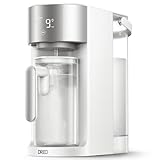
This countertop RO system targets renters, apartment dwellers, or anyone who wants near-distilled water without hiring a plumber. Its 3:1 pure-to-drain ratio is generous compared to older RO units that waste far more water per glass produced. The built-in autofill pitcher and TDS display let you verify output in real time, while the self-cleaning cycle reduces the maintenance guesswork that deters many first-time RO owners.
- Pro: Zero installation required, making it viable for temporary living situations
- Pro: Visible TDS readout and filter-life indicator remove uncertainty from replacement timing
- Con: The 3:1 ratio still means drain water, which adds to usage in already water-restricted areas
Skip it if your tap water already scores low on TDS and you only want chlorine taste removal; a simple carbon pitcher handles that at a fraction of the cost.
Brita X-Large 27-Cup Dispenser
Brita’s largest dispenser format serves households where a pitcher is constantly empty. The 27-cup reservoir means one fill covers most of a day’s drinking for a family of four without running to the sink. Carbon-based filtration addresses chlorine taste, sediment, and some heavy metals, though it will not reduce dissolved solids the way RO or multi-stage ion-exchange systems do.
- Pro: High capacity eliminates refill fatigue for busy households
- Pro: Dispenser form factor works well on countertops without refrigerator clearance issues
- Con: Large volume means water sits longer, and the carbon filter does not inhibit bacterial growth
Skip it if you are concerned about PFAS or lead reduction beyond what basic carbon offers; look at certified multi-stage or RO options instead.
Brita Large 10-Cup Pitcher
The most recognizable drinking water filter in American kitchens for good reason: it is cheap, easy to use, and improves chlorine taste enough that most people drink more water. The 10-cup capacity balances fridge shelf space against refill frequency for one to two people. Filter replacements are widely available and inexpensive, keeping annual costs low.
- Pro: Lowest barrier to entry; the habit stick is high because pouring and refilling take seconds
- Pro: Replacement filters are ubiquitous, reducing the chance of running dry
- Con: Certification scope is narrow compared to competitors at similar or lower prices
Skip it if you need lead or PFOA/PFOS reduction; the standard Brita filter is not certified for those contaminants.
Brita Small 6-Cup Pitcher
For a single person, a dorm room, or a compact refrigerator, the 6-cup Brita is the right size. It filters on the same basic principle as its larger siblings but in a footprint that does not dominate a shelf. Owners consistently note it fits in door compartments where larger pitchers cannot.
- Pro: Smallest footprint among Brita pitchers, fitting tight refrigerator layouts
- Pro: Lower initial cost makes it easy to try filtered water without commitment
- Con: Small reservoir means refilling daily for two drinkers, which becomes a chore
Skip it if more than one person drinks from it regularly; you will wish you had bought the 10-cup or the dispenser instead.
LifeStraw Personal
LifeStraw occupies a different niche entirely: a hollow-fiber membrane filter for backcountry water sources, travel in areas with unreliable tap water, or emergency preparedness. It removes bacteria and protozoa at a 4000-liter rated capacity but does not address dissolved chemicals, heavy metals, or salts. It is not a household water filter, and treating it as one would be a mistake.
- Pro: Sips directly from the source; no containers or pumping required
- Pro: Exceptionally low price for the protection it offers in the field
- Con: No chemical or dissolved-solids reduction, so it cannot replace a kitchen or under-sink filter
Skip it for home use; buy a pitcher or RO system for tap water and keep the LifeStraw in your pack.
Culligan ZeroWater 22-Cup Dispenser
ZeroWater’s five-stage ion-exchange process drives TDS to near zero, which is rare in a gravity-fed dispenser at this price. The IAPMO certification to reduce lead, chromium, and PFOA/PFOS gives it a broader contaminant scope than most carbon pitchers. A built-in TDS meter on the base lets you verify performance and know when to swap the filter.
- Pro: Near-zero TDS with third-party certification at under fifty dollars
- Pro: Integrated TDS meter removes guesswork from filter replacement
- Con: Five-stage filters exhaust faster than simple carbon, raising the annual cost per gallon
Skip it if your tap water is already soft and low in dissolved solids; you will replace filters frequently for marginal benefit.
Waterdrop PT-07B
At under seventeen dollars, the Waterdrop 10-cup pitcher is the cheapest NSF-certified option in this group. It targets chlorine taste and odor, sediment, and several contaminants certified by third-party testing, which puts it on a credible technical footing at a price that undercuts most Brita pitchers. The blue housing is a minor cosmetic difference.
- Pro: NSF certification at a price below most uncertified alternatives
- Pro: 10-cup capacity matches mid-size Brita without the brand premium
- Con: Replacement filter availability outside major retailers can be inconsistent
Skip it if you prefer a widely stocked brand where filter replacements are guaranteed at any big-box store.
iSpring RCC7AK-BN
The iSpring RCC7AK-BN is the only under-sink system here, and it is also the most capable. A 6-stage process with reverse osmosis and a final alkaline remineralization cartridge produces water at 75 gallons per day while restoring a modest amount of beneficial minerals. The top-mounted faucet simplifies installation compared to traditional RO setups, and NSF certification covers the whole assembly.
- Pro: Remineralization stage addresses the flat, slightly acidic taste common in pure RO water
- Pro: Under-sink installation keeps the countertop clear and provides a dedicated filtered faucet
- Con: Highest upfront cost and requires some plumbing skill or a handyman to install properly
Skip it if you rent, lack under-sink space, or do not want permanent plumbing modifications; the DREO countertop delivers similar purification without installation.
Buying Guide
Match Filter Type to Your Contaminant Concern
Carbon pitchers and dispensers tackle taste and odor: chlorine, sediment, and some organic compounds. If your tap water smells like a pool but tests clean on lead and PFAS, a $20 Brita or Waterdrop solves the problem. For lead, hexavalent chromium, or PFOA/PFOS, you need either multi-stage ion exchange (ZeroWater), RO membranes (DREO, iSpring), or specifically certified carbon blocks. Check for NSF or IAPMO certification stamps listing the exact contaminants reduced; a generic “reduces 99% of contaminants” claim without a certification number is meaningless.
Calculate Cost Per Gallon, Not Sticker Price
A $17 pitcher with a filter rated for 40 gallons costs more per gallon than a $45 dispenser rated for 100 gallons over the same period. RO systems add a second cost layer: drain water. The DREO’s 3:1 ratio means you pay for roughly one gallon of wasted water per three produced. In a city with metered water and sewer charges, that can quietly add several cents per glass. Multiply filter cost by expected lifespan, add drain-water cost where applicable, and divide by daily consumption to get a realistic annual figure.
Choose a Form Factor You Will Actually Use
The best drinking water filter is the one that stays filled and on your counter. If you drink two liters a day and a 6-cup pitcher empties by afternoon, you will either stop filtering or start drinking unfiltered water out of convenience. High-capacity dispensers, countertop RO units with built-in reservoirs, and under-sink systems each solve a different lifestyle friction point. Before comparing specs, decide where the filter will live and whether the refill or maintenance rhythm fits your schedule.
Our Verdict
Top pick: The Culligan ZeroWater 22-Cup Dispenser delivers the broadest certified contaminant reduction among gravity-fed options at a price well under a hundred dollars, with a TDS meter that proves it is working. Budget pick: The Waterdrop PT-07B at $16.97 is the cheapest NSF-certified pitcher and covers chlorine, sediment, and several targeted contaminants that similar-priced rivals do not address. When another wins: If you rent or cannot modify plumbing, the DREO Countertop RO provides near-identical purification to the iSpring under-sink system without a single wrench turn, making it the clear choice for non-permanent residences.
FAQ
Do I need reverse osmosis, or is a pitcher enough?
A pitcher suffices when your goal is chlorine taste removal and your municipal water already meets lead and PFAS action levels. RO becomes worthwhile when TDS is high, you suspect specific contaminants that carbon cannot address, or you simply prefer the mineral-stripped purity that comes from a multi-stage membrane.
How often should I replace filters?
Follow the manufacturer’s rated capacity in gallons, not calendar months. If you filter 40 gallons a month and a pitcher filter is rated for 40 gallons, replace it monthly regardless of the date printed on the box. RO membranes last one to three years depending on feed-water hardness.
Does filtered water lose too many beneficial minerals?
RO removes dissolved minerals along with contaminants, which is why systems like the iSpring include a remineralization stage. For most people eating a balanced diet, mineral contribution from drinking water is negligible, so the trade-off rarely matters. If you are on a restricted diet or drink unusually high volumes of water, a remineralizing stage adds a small practical benefit.
Can I use a LifeStraw at home?
Not effectively. The LifeStraw Personal is engineered for turbid surface water and removes pathogens but does nothing for dissolved chemicals, heavy metals, or salts. For a kitchen application, a pitcher or RO system addresses the contaminants that actually appear in municipal or well water in developed areas.