Key takeaways
- Pro: Generous thickness delivers consistent comfort even for hips and shoulders.
- Pro: Self-inflating core means no time spent blowing up a pad after a long drive.
- Con: Too heavy and bulky to consider for trail use beyond short walk-in sites.
What's inside
Choosing the right sleeping pad from Exped’s lineup means matching insulation, thickness, and footprint to how and where you actually sleep. The brand offers distinct product families — MegaMat, DeepSleep, and Ultra — each built for a different use case, from base-camp luxury to fast-and-light backpacking. A buyer comparing these options is really asking two questions: “Will this keep me warm enough in my typical conditions?” and “Does the size suit the way I camp — alone or with a partner, on a narrow tent floor or a generous one?”
What separates a good fit from a bad one in this category is not raw comfort but appropriateness. The thickest, warmest pad is overkill for summer car camping and a liability on a multi-day hike. Conversely, a lightweight pump pad may leave a cold sleeper uncomfortable when temperatures dip below freezing. Owner feedback consistently highlights the same trade-offs Exped makes across the line: weight versus thickness, price versus insulation, solo versatility versus couple-wide convenience. This roundup helps you zero in on which compromise matches your sleep style and budget.
As an Amazon Associate we earn from qualifying purchases at no extra cost to you. Product prices and availability are accurate as of the date shown and are subject to change.



Quick Picks
| Product | Best for | Price |
|---|---|---|
| MegaMat Medium Wide | Solo car camping comfort | $259.95 |
| MegaMat Duo Queen | Couples wanting maximum width | $549.95 |
| MegaMat Duo Long Wide Plus | Tall couples in three-season use | $449.95 |
| DeepSleep Single MW | Budget-conscious solo campers | $189.95 |
| Ultra 6.5R Medium | Backpackers prioritizing warmth-to-weight | $199.95 |
| MegaMat Duo Medium | Couples with standard tent floors | $399.95 |
| DeepSleep Auto | Solo campers who hate blowing up pads | $349.95 |
| DeepSleep Duo Long Wide Plus | Couples wanting value in the DeepSleep line | $324.95 |
How We Picked
We ranked these pads against four criteria that owner reviews and published specs consistently flag as decisive: intended use environment (backpacking versus car camping versus base camp), sleeping arrangement and resulting size needs, insulation level appropriate to typical conditions for that use, and overall value relative to competing options within Exped’s own lineup. A pad that excels in one dimension — say, warmth-to-weight — can lose in another, so no single “best” exists across the board. What matters is identifying which trade-off you can live with.
The 8 Best Exped Sleeping Pad in 2026
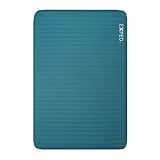
Exped MegaMat Sleeping Pad, Medium Wide
This is the pad for solo campers who treat their tent like a bedroom. The MegaMat line sits at the premium end of Exped’s self-inflating range, with a thick profile that owners describe as the closest thing to a real mattress in the backcountry. The Medium Wide footprint accommodates side sleepers who need elbow room without dominating a one-person tent floor.
- Pro: Generous thickness delivers consistent comfort even for hips and shoulders.
- Pro: Self-inflating core means no time spent blowing up a pad after a long drive.
- Con: Too heavy and bulky to consider for trail use beyond short walk-in sites.
Skip this if your tent floor is narrow or if you need something you can strap to a backpack. The size simply does not compress down to trail-worthy dimensions.
Exped MegaMat Sleeping Pad, Duo Queen
The widest option in this roundup, the Duo Queen is built for couples who refuse to compromise on space. At the top of the price range, it commands the floor of larger two-person and three-person tents. Owners praise the uninterrupted surface — no seam or divider between sleepers — which makes it popular with families or partners who shift positions frequently through the night.
- Pro: Queen-width surface eliminates the “rolling off the edge” problem couples report on narrower duo pads.
- Pro: Self-inflating convenience applies even at this scale, saving both campers from manual inflation.
- Con: The premium price is nearly double a solo MegaMat, making it hard to justify for occasional campers.
Pass if you camp solo most of the time or if your tent’s interior dimensions cannot accommodate the full footprint.
Exped MegaMat Sleeping Pad, Duo Long Wide Plus
Designed for couples where at least one sleeper needs extra length or diagonal room, this pad trades some width for a longer, more accommodating silhouette. It fits snugly in standard two-person tent floors where the Duo Queen would overflow. Owners note that the “Long Wide Plus” designation means you can sleep at an angle without your feet hitting the pad edge.
- Pro: Extended length solves the problem for sleepers over six feet who feel cramped on standard duo pads.
- Pro: Sits at a lower price than the Duo Queen while offering similar MegaMat comfort.
- Con: Narrower than the Queen, so couples who spread out may find less lateral space.
Skip if you and your partner both prefer to sleep flat on your backs side by side — the Queen’s width would serve you better.
Exped DeepSleep Mat, Single MW
The most affordable pad in this roundup targets solo campers who want self-inflating convenience and a meaningful upgrade over thin foam without paying MegaMat prices. Owners consistently call it the best value in Exped’s solo lineup, noting that comfort is slightly reduced compared to the thicker MegaMat but still well above what you would find in budget alternatives.
- Pro: Lowest price point here, making it an accessible entry into Exped’s self-inflating range.
- Pro: Compact enough for car camping and light enough to haul a short distance to a site.
- Con: Thinner profile means pressure-point comfort is noticeably less than the MegaMat for side sleepers.
Look elsewhere if you are a strict side sleeper with hip sensitivity or if you regularly camp in very cold conditions where maximum insulation matters.
Exped Ultra 6.5R Lightweight Sleeping Pad, Lichen, Medium
This pad exists to be carried on your back. The 6.5R value in its name signals a warm, well-insulated build suited to cold-weather backpacking, and its pump-inflating design lets you dial firmness without exhaling into a valve. Owners highlight the warmth-to-weight ratio as the primary reason they chose it over heavier self-inflating options.
- Pro: High R-value combined with low carry weight makes it suitable for four-season trail use.
- Pro: Pump-inflating design allows precise firmness adjustment and eliminates moisture buildup from breath.
- Con: Pump inflation requires time and effort at camp — a trade-off for the weight savings.
Skip if you are a car camper who values instant setup or if you tend to lose small components like pump sacks in the field.
Exped MegaMat Sleeping Pad, Duo Medium
The Duo Medium is the practical middle child of the MegaMat couple range. It delivers the same self-inflating comfort as its larger siblings in a footprint that fits standard two-person tents without crowding gear storage. Owners appreciate that it preserves MegaMat-level thickness and surface feel while being easier to transport and store than the Long Wide Plus or Queen versions.
- Pro: Full MegaMat comfort profile at the lowest duo price in the line.
- Pro: Fits most standard two-person tent floors, leaving room for packs and boots inside.
- Con: Less width means couples who spread out or sleep with a dog on the pad will feel confined.
Move up to a larger duo size if your tent has the floor space and you value elbow room over cost savings.
Exped DeepSleep Mat, Auto
The Auto variant adds a built-in pump to the DeepSleep platform, solving the setup friction that owners mention most often with self-inflating pads. The pump delivers firmness faster and with less physical effort than traditional valve designs. It sits at a higher price than the standard DeepSleep Single MW, and the premium is entirely about convenience rather than added insulation or comfort.
- Pro: Integrated pump eliminates the frustration of waiting for a pad to self-inflate to proper firmness.
- Pro: Same DeepSleep comfort and warmth as the non-Auto version, so no performance is sacrificed.
- Con: Higher price for the same core pad — you are paying purely for the inflation mechanism.
Stick with the standard DeepSleep if budget matters more than setup speed, or if you already have a separate pump sack that does the job.
Exped DeepSleep Mat, Duo Long Wide Plus
This pad extends the DeepSleep platform to couples who need length and modest width at a price well below the MegaMat Duo equivalents. Owners who want a shared surface without paying the full MegaMat premium find this option satisfying for car camping and short walk-in sites. The self-inflating core still does its job; the difference from MegaMat Duo pads is primarily thickness and the resulting plush feel.
- Pro: Duo convenience at nearly the price of some solo MegaMat pads, offering strong couple value.
- Pro: Long Wide Plus format accommodates taller sleepers or angled positions without stepping off.
- Con: Thinner than MegaMat duo options, so side-sleeping comfort is a step down for sensitive hips.
Invest in a MegaMat Duo if you camp together frequently and want every night to feel hotel-grade rather than merely adequate.
Buying Guide
Match the Pad to Your Sleeping Arrangement First
Solo versus duo is the first fork in the road. A duo pad in a solo context wastes money, floor space, and carry weight. A solo pad shared by two people on a cold night creates a seam of inadequate insulation between sleepers. Measure your tent floor before committing to any duo size — the Queen in particular exceeds many standard two-person interiors.
Understand the MegaMat, DeepSleep, and Ultra Tier Differences
MegaMat is Exped’s thickest, most luxurious self-inflating line; it prioritizes comfort over packability. DeepSleep offers a similar self-inflating concept at reduced thickness and price, making it a practical car-camping choice. Ultra is a pump-inflating, lightweight pad built for backpackers who need high insulation with minimal carry weight. These are not interchangeable categories — choosing wrong means paying for features you will never use or lacking features you need.
Decide Whether Self-Inflating or Pump-Inflating Suits Your Routine
Self-inflating pads like MegaMat and DeepSleep do most of the work automatically, adding a few minutes for final firmness adjustment. Pump-inflating pads like the Ultra require deliberate effort but give you precise control and keep moisture out of the pad’s interior. If you camp after long hikes or late arrivals when energy is low, self-inflating wins. If you prioritize weight and are willing to spend two minutes at setup, pump pads are the smarter tool.
Our Verdict
For most solo car campers, the MegaMat Sleeping Pad in Medium Wide offers the best balance of comfort, convenience, and price without over-committing to a duo size you may not need. Budget-conscious buyers should look at the DeepSleep Single MW — it delivers the core Exped self-inflating experience at the lowest cost in this lineup. However, if you are a backpacker heading into cold conditions, the Ultra 6.5R wins outright despite its higher effort at setup, because nothing else in this group matches its warmth-to-weight profile.
FAQ
Can I use a MegaMat for backpacking?
Technically yes, but owners universally discourage it. MegaMat pads are designed for car camping and base camps; their weight and bulk make them impractical for any trail use beyond very short walks to a nearby site. If you need a pad that goes on your back, the Ultra line exists specifically for that purpose.
How much warmth do I actually need in a sleeping pad?
Pad insulation matters more than most people expect because the ground steals body heat continuously through the night. A general guideline is that summer car camping is forgiving, but shoulder-season and winter use demands a higher R-value pad or a supplemental insulating layer underneath. The Ultra 6.5R is the only pad in this list explicitly named for its insulation rating, signaling it targets cold conditions.
Is the DeepSleep Auto worth the premium over the standard DeepSleep?
It depends entirely on how much setup friction bothers you. The pad beneath the pump is the same; you are paying for the convenience of faster, easier inflation. Owners who camp in the dark, arrive tired, or simply dislike blowing into valves report the Auto is worth it. If you have no such frustration, save the difference.
Do duo sleeping pads feel like sharing a bed at home?
Owner feedback suggests duo MegaMat pads come close, particularly the Queen size where there is genuinely no divider. Narrower duo pads like the Duo Medium can still feel like sleeping on a shared surface rather than separate beds, especially if one partner moves a lot. If uninterrupted personal space matters, two solo pads placed side by side is the better solution.