
The best basketball hoops for driveways are in-ground anchor systems for maximum stability, while portable hoops make more sense when you rent, share a narrow driveway, or need to move the goal; among recognizable options, Goalrilla GS54c is the strongest performance choice, Spalding The Beast is the best heavy-duty portable option, and Lifetime’s 52-inch Pro Court is the value pick.
Our top picks
 IGL Portable Basketball Hoop Outdoor
- 【40x24 IN Shatterproof Backboard】: The 40x24-inch acrylic backboard…
- 【3-10 FT Adjustable Height】: Set to 3-5 ft…
- 【Dual Fillable Base】: Main base holds 77 lbs…
 IGL Portable Basketball Hoop for Backyard
- A basketball hoop in the driveway often becomes…
- The main base can be filled with up…
- Easily adjust height as your child grows: Younger…
 Yohood Kids Basketball Hoop Outdoor Height Adjustable
- 【Inspire Active Play & Family Fun】The basketball hoop…
- 【Built for Lasting Durability & Performance】Engineered for long-term…
- 【Stable & Safe Triangular Support Design】Safety comes first
| Product | Key specs | |
|---|---|---|
| IGL Portable Basketball Hoop Outdoor | 【40x24 IN Shatterproof Backboard】: The 40x24-inch acrylic backboard… 【3-10 FT Adjustable Height】: Set to 3-5 ft… 【Dual Fillable Base】: Main base holds 77 lbs… | Check price |
| IGL Portable Basketball Hoop for Backyard | A basketball hoop in the driveway often becomes… The main base can be filled with up… Easily adjust height as your child grows: Younger… | Check price |
| Yohood Kids Basketball Hoop Outdoor Height Adjustable | 【Inspire Active Play & Family Fun】The basketball hoop… 【Built for Lasting Durability & Performance】Engineered for long-term… 【Stable & Safe Triangular Support Design】Safety comes first | Check price |
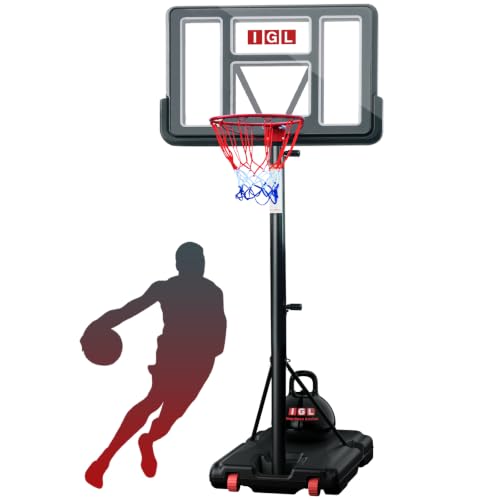 IGL Portable Basketball Hoop | 【Adjustable Height: 5.6-10 Feet】: The IGL adjustable basketball… 【Stable 13.2 GAL Base】: The IGL portable basketball… 【Mobile Basketball Hoop】: The front wheels of the… | Check price |
As an Amazon Associate we earn from qualifying purchases at no extra cost to you.
Quick comparison
| Hoop | Type | Backboard | Height adjustment | Driveway fit | Practical assembly plan |
|---|---|---|---|---|---|
| Goalrilla GS54c | In-ground, anchor-mounted | 54-inch tempered glass | 7.5–10 feet | Best for permanent concrete installation with adequate runoff space | Two adults; plan about 6–10 hours including concrete curing time |
| Spalding The Beast | Portable | 60-inch glass | 7.5–10 feet | Best for wide, level driveways where a large base can remain in place | Two adults; plan about 3–5 hours |
| Lifetime 52-inch Pro Court | Portable | 52-inch polycarbonate | Adjustable around 7.5–10 feet, depending on model | Good for casual play and tighter budgets | Two adults; plan about 2–4 hours |
| Generic anchor-mounted 54–60-inch hoop | In-ground, anchor-mounted | Tempered glass or acrylic | Usually 7.5–10 feet | Best when you want a permanent goal but need to match local space and concrete conditions | Two adults; plan about 6–10 hours plus curing time |
Assembly times are realistic planning estimates rather than promises. In-ground installations also require digging, leveling, concrete placement, and a curing period before the pole should carry a backboard and rim.
Our picks by driveway situation
Best overall for serious driveway play: Goalrilla GS54c
The Goalrilla GS54c is the best fit when stability and rebounding performance matter more than easy relocation. Its 54-inch tempered-glass backboard gives a more responsive rebound than entry-level plastic boards, and the anchor-mounted pole can be removed or replaced without breaking out the entire concrete footing.
The important trade-off is installation. You need a suitable concrete area, permission if the property is rented or shared, and enough room to excavate safely. A typical anchor system requires a substantial concrete footing; follow the supplied instructions rather than choosing a footing size by guesswork. The hoop is also a poor choice for a driveway that slopes noticeably toward the street, because an uneven foundation can leave the backboard out of level and make the base less reliable.
Best portable hoop for frequent use: Spalding The Beast
Spalding The Beast is a strong portable alternative for families that cannot install an in-ground system. Its 60-inch glass backboard provides a more game-like target, while the large base and heavy construction are designed to reduce movement during play.
Portable does not mean effortless. The base must be filled according to the instructions, kept level, and inspected for cracks or leaks. Water-filled bases are easier to empty and move but can freeze and expand in cold weather. Sand adds weight and avoids freezing, but it makes the hoop much harder to relocate. A large portable hoop also consumes more driveway space than its backboard width suggests: allow clearance behind the base, around the pole, and beside the playing area.
Best value for casual family use: Lifetime 52-inch Pro Court
The Lifetime 52-inch Pro Court is a sensible choice for shooting practice, children learning the game, and occasional one-on-one play. Its polycarbonate backboard is more impact-tolerant than acrylic and generally less expensive than glass. The lighter construction is also easier to assemble and reposition.
Expect more vibration and a less authentic rebound than you would get from a glass backboard. This matters most for bank shots and repeated full-power play, not for free throws or casual shooting. Check the exact model’s adjustment mechanism before buying: some lower-cost systems use a pin or telescoping pole, while premium systems use a crank. A crank is easier to operate frequently, but a simple pin system can be perfectly adequate when the hoop stays at one height.
What matters more than the backboard size
Base stability and anchor requirements
An in-ground hoop transfers force into a buried concrete footing, so it normally moves less than a portable goal. An anchor-mounted design is especially useful because the pole attaches to bolts above the concrete; future replacement is simpler than removing a permanently embedded pole.
A portable hoop depends on three things: base mass, pole rigidity, and driveway levelness. The labeled base capacity is not the same as real-world stability. A base can be full yet still allow noticeable rocking if the pole is narrow, the wheels are loose, or the driveway slopes. Never use loose paving blocks, bricks, or improvised weights on top of a base unless the manufacturer specifically permits them. They can shift, damage the plastic, or create a trip hazard.
Backboard material
- Tempered glass: Best rebound response and the most convincing playing feel, but heavy and more expensive. It needs a rigid pole and well-leveled base.
- Acrylic: Clear and relatively light, with a better rebound than basic plastic. It can scratch and may become less clear with age.
- Polycarbonate: Highly impact-resistant and practical for family use. It usually produces more vibration and a softer rebound than glass.
- High-density polyethylene or molded plastic: Affordable and durable for casual use, but generally the least responsive option.
For a driveway, a 52-inch board is enough for most recreational play. Choose 54–60 inches if several people will shoot together or if you want more usable target area. A full regulation board is 72 inches wide and usually needs a more substantial installation than a typical residential portable hoop.
Height adjustment
A 7.5–10-foot range is the most useful residential standard. It lets younger players lower the rim without permanently committing to a youth-height hoop, then raise it to the regulation 10 feet as skills improve.
Pin-adjust systems are inexpensive but require two people or a ladder for some designs. Telescoping systems are convenient at several preset heights. Crank systems are easiest for frequent adjustment, particularly when children and adults share the hoop. Inspect the adjustment points periodically: loose pins, worn cables, and bent telescoping sections can create sudden movement under load.
Concrete-surface fit: measure before ordering
Do not measure only the distance from the garage door to the street. Measure the complete operating zone:
- Mark the planned pole or base position.
- Measure the available width, including space beside the backboard for angled shots.
- Check that the surface is level enough for the base or footing.
- Locate expansion joints, drainage channels, utility covers, and cracks.
- Confirm that the backboard will not hit a garage door, roof edge, tree, or overhead cable.
- Keep the base and pole outside the normal path of vehicles, and use wheel locks whenever the model provides them.
For a portable goal, the base depth can be more important than the advertised backboard width. A large 60-inch unit may need roughly 3–4 feet of clear depth for the base and pole assembly, plus room to walk behind it. For an in-ground goal, leave enough space to work around the footing and remember that the rim projects forward from the pole. Follow the manufacturer’s minimum clearance requirements instead of assuming every driveway has the same safe layout.
Decision matrix
| Your situation | Best direction | Why |
|---|---|---|
| Budget-conscious, occasional shooting | 52-inch polycarbonate portable hoop | Lower purchase and installation cost; adequate for basic practice |
| Daily play, dunking attempts, or frequent group games | Anchor-mounted glass hoop | Less movement, stronger pole structure, and better rebound consistency |
| Renting or likely to move within a few years | Portable hoop with a manageable base | No excavation and easier removal, though it sacrifices some stability |
| Children and adults share the hoop | Adjustable 7.5–10-foot system | One installation can suit multiple skill levels |
| Narrow or sloped driveway | Smaller portable model or a different installation area | Large bases and unstable slopes create clearance and safety problems |
Ownership costs and maintenance
Plan for more than the hoop’s advertised price. General market ranges are roughly $200–$500 for basic portable systems, $500–$1,200 for heavier portable models, and $800–$2,500 or more for quality in-ground systems before any unusual concrete, labor, or site-preparation costs. Professional installation can add substantially to an in-ground project.
A simple cost-per-use calculation can clarify the decision. Suppose a $900 hoop is used three times a week for five years: 3 × 52 × 5 equals 780 sessions, or about $1.15 per session before maintenance. A $300 hoop used once a week for two years provides about 104 sessions, or $2.88 per session. The cheaper hoop is not automatically the lower-cost choice if it is rarely used or needs early replacement.
Wash dust and road salt from the backboard and pole with mild soap and water. Avoid abrasive cleaners, which can scratch acrylic and plastic. Tighten accessible fasteners at the beginning of each season, inspect the rim bolts and net, and look for rust around pole joints. Replace a frayed net rather than allowing it to catch fingers. On portable models, examine the base for bulges, cracks, and leaks; drain water before freezing weather if the instructions call for it.
Final buying advice
Choose an anchor-mounted tempered-glass hoop if you have a level, permanent concrete location and expect frequent play. Choose a heavy portable glass hoop if relocation matters but stability still ranks highly. Choose a 52-inch polycarbonate portable hoop when budget, simpler assembly, and casual family use are the priorities. Whichever type you buy, verify the base or footing dimensions, adjustment range, clearance requirements, and concrete-surface limitations before placing the order.





