
The best magnetic stirrer hot plates match your vessel size and heating target first, then add the RPM control, temperature feedback, and plate material you actually need: a compact analog unit suits occasional brewing or DIY work, while a digital model with a probe and ceramic-coated plate is the safer choice for repeatable laboratory procedures.
Our top picks
 Slendor Magnetic Stirrer Hot Plate Mixer 1000ml
- All you need is included: Come with teflon-coated…
- Excellent Stirrer Hotplate can up to 520°F heating…
- Up to 2000 RPM Speed, integrated magnetic stirrer
 Slendor Magnetic Stirrer SH-2 Hot Plate Mixer
- Adjustable Stirring Speed -- There is a speed…
- Rapid Heating -- Heating Power: 180W, Max Temp:…
- Advanced Material -- The magnetic stir plate is…
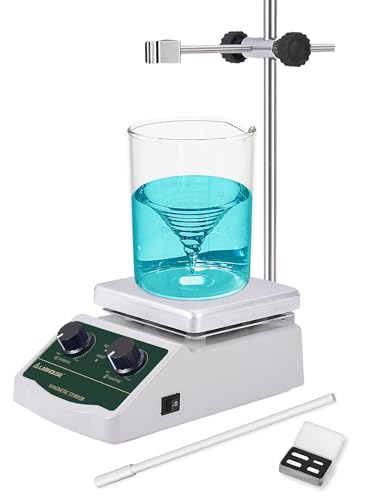 LABHOUSE LHS-2 Magnetic Stirrer Hot Plate
- 【HIGH-TEMP PERFORMANCE】Aluminum plate heats fast to 300°C (572°F)…
- 【EFFICIENT MIXING】Includes a a box of PTFE-coated stirring…
- 【DUAL CONTROL】Independent knobs adjust speed (100-2000 RPM) and…
| Product | Key specs | |
|---|---|---|
| Slendor Magnetic Stirrer Hot Plate Mixer 1000ml | All you need is included: Come with teflon-coated… Excellent Stirrer Hotplate can up to 520°F heating… Up to 2000 RPM Speed, integrated magnetic stirrer | Check price |
| Slendor Magnetic Stirrer SH-2 Hot Plate Mixer | Adjustable Stirring Speed -- There is a speed… Rapid Heating -- Heating Power: 180W, Max Temp:… Advanced Material -- The magnetic stir plate is… | Check price |
| LABHOUSE LHS-2 Magnetic Stirrer Hot Plate | 【HIGH-TEMP PERFORMANCE】Aluminum plate heats fast to 300°C (572°F)… 【EFFICIENT MIXING】Includes a a box of PTFE-coated stirring… 【DUAL CONTROL】Independent knobs adjust speed (100-2000 RPM) and… | Check price |
 Magnetic Stirrer Hot Plate w/Stir Bar | With a temperature range of up to 520℉,… Equipped with a high-temperature-resistant magnet, our magnetic stir… Our hot plate with magnetic stirrer is commonly… | Check price |
As an Amazon Associate we earn from qualifying purchases at no extra cost to you.
Quick picks by use case
| Situation | Best choice | Useful target specification | Typical market range |
|---|---|---|---|
| Occasional home brewing or soap-making | Single-position analog stirrer hot plate | Up to 1,000–1,500 rpm; 1–2 L working capacity; 300–600 W heating | $70–$180 |
| DIY chemistry and small-batch formulation | Digital unit with external temperature probe | Ambient to at least 300°C; 50–1,500 rpm; 2–5 L capacity | $180–$500 |
| Routine laboratory work | Closed-loop digital hot plate stirrer | ±1–2°C displayed control; 100–1,500 rpm; ceramic or coated metal plate | $400–$1,200 |
| Larger vessels or parallel samples | Multi-position or high-capacity laboratory model | 4–10 L total capacity; independent or synchronized stirring; 600–1,500 W | $700–$2,500+ |
These are buying categories rather than promises of exact performance. Actual heating time depends on vessel material, liquid volume, starting temperature, room temperature, and whether the container is covered.
What separates the best magnetic stirrer hot plates
Temperature range and control
Temperature range is useful only when paired with control quality. A unit advertised to 550°C may still overshoot significantly at low settings if it uses a simple thermostat. For water-based brewing, extraction, and general mixing, a usable range from roughly 50°C to 300°C is normally sufficient. High-temperature work benefits from a plate rated around 400–550°C, but that rating describes the plate, not necessarily the liquid.
For repeatable work, look for a thermocouple or PT100-style external probe. The probe measures the liquid or vessel temperature, allowing the controller to reduce power as the target is reached. Without one, the sensor usually measures the plate, so a thin flask may become hotter than the displayed setting while a large beaker remains cooler.
Do not confuse resolution with accuracy. A display that changes in 1°C increments does not guarantee the liquid is within 1°C. A credible specification will separately state temperature accuracy, stability, or control tolerance.
RPM control and stirring behavior
Stirring speed commonly spans about 100–1,500 rpm. Low-speed control matters for viscous liquids and delicate suspensions; high speed matters for quickly dissolving powders in low-viscosity liquids. A wide maximum RPM is less important than whether the motor starts smoothly and maintains speed when the viscosity changes.
Magnetic coupling also limits real capacity. A small 20–25 mm stir bar may work well in a 500 ml beaker but decouple in a 3 L flask. For larger vessels, choose a longer stir bar, a stronger drive magnet, and a vessel with a flat base. If the liquid forms a deep vortex or the bar repeatedly stops, reduce speed before increasing it again. A stable central vortex is usually more useful than maximum RPM.
Plate material
- Glass-ceramic: resistant to many laboratory chemicals, easy to wipe clean, and usually capable of high surface temperatures. It can chip or crack after impact or thermal shock.
- Ceramic-coated metal: a practical balance of heat transfer, corrosion resistance, and cost. Scratches or chips in the coating can expose the underlying metal.
- Stainless steel: mechanically durable and well suited to general-purpose heating, but staining and chemical compatibility depend on the grade and spill.
- Aluminum: heats quickly and keeps weight down, but exposed aluminum is a poor choice for many corrosive chemicals.
For most users, a glass-ceramic or intact ceramic-coated plate is the easiest material to live with. Check the manufacturer’s chemical-compatibility guidance before heating acids, alkalis, solvents, or salt solutions.
Head-to-head: analog, digital, and probe-controlled units
| Type | Advantages | Limitations | Best fit |
|---|---|---|---|
| Analog | Low cost, simple controls, quick to understand | Less repeatable; temperature dial may not equal liquid temperature | Infrequent heating and mixing |
| Digital, plate-sensing | Clear settings, timers on some models, more repeatable than analog | Still cannot directly measure the liquid without a probe | Brewing, education, and routine noncritical work |
| Digital, external-probe controlled | Better liquid-temperature control and process repeatability | Higher cost; probe must be positioned and cleaned correctly | Laboratory protocols and repeatable DIY formulations |
| Multi-position | Processes several vessels at once and saves bench space | More expensive; positions may share controls or have lower per-position power | Batch comparison and teaching laboratories |
Recognized laboratory brands such as IKA, OHAUS, Corning, Thermo Scientific, and Stuart offer models across these categories. Their specifications vary substantially by model, so compare the actual plate size, probe type, control tolerance, and electrical rating rather than choosing by brand alone.
Choosing capacity without overbuying
Manufacturers often quote a maximum stirred volume using water. Treat that as an upper limit, not a comfortable working volume. A useful rule is to select a unit rated for at least twice your normal batch size. If you regularly mix 1 L, a 2–5 L-rated drive gives more margin than a unit whose headline capacity is exactly 1 L.
Plate dimensions matter as much as liquid capacity. A 180 × 180 mm plate can support a 2 L beaker or flask, but a wide-bottom vessel may need a 250 × 250 mm plate even if the liquid volume is modest. Keep the vessel centered so the magnetic field and heating zone work evenly.
Setup procedure that prevents common failures
- Inspect the plate and vessel. Do not use cracked glass, a damaged coating, or a vessel with a warped base.
- Choose the stir bar. Start with a bar about one-quarter to one-third of the vessel’s internal diameter. Use a pivot ring or cross-shaped bar when the vessel geometry calls for it.
- Add liquid before heating. Never run an empty heated vessel unless the manufacturer explicitly permits it.
- Center the vessel and start slowly. Begin around 100–200 rpm, then increase until the contents circulate without splashing or drawing air into the liquid.
- Set the temperature conservatively. If using a probe, suspend its sensing tip in the liquid without touching the vessel wall or bottom. Allow the system to stabilize before recording a result.
- Cool before cleaning. Switch off heating, remove the vessel with suitable heat protection, and wait for the plate to cool before wiping spills.
Probe placement is a frequent source of misleading readings. A probe touching hot glass can report a temperature higher than the bulk liquid; a probe sitting above the liquid measures air instead. Clamp it in a consistent position for repeatable batches.
Ownership realities: what wears out first
The stir bar is usually the first consumable. Its PTFE coating can become scratched, stained, or chemically attacked, and a damaged bar may shed particles or couple poorly. Keep several sizes available and replace bars that have exposed metal, cracks, or persistent discoloration that cleaning cannot remove.
Controls, display panels, and cooling fans are more vulnerable than the plate itself. Keep ventilation openings clear, avoid placing the unit beside a sink, and do not drape cloth over the housing while it is operating. Wipe spills promptly rather than allowing them to migrate around knobs or buttons.
Never pour cold liquid onto a hot glass-ceramic surface. Thermal shock can crack the plate. Likewise, do not scrape hardened residue with a metal blade; use the cleaning method specified for the plate material. If a chemical spill reaches the controls or housing vents, disconnect power and follow the manufacturer’s decontamination instructions instead of continuing to operate it.
Final buying recommendation
Choose an analog 300–600 W unit if you need occasional mixing and heating and can verify temperature independently. Step up to a digital model when you repeat recipes, need a timer, or want more consistent RPM. For laboratory procedures, temperature-sensitive formulations, or any process where the liquid temperature matters, prioritize an external probe, documented control tolerance, a chemically resistant plate, and serviceable replacement parts over an impressive maximum-temperature number.
For home use, also check footprint, noise, electrical requirements, and the minimum controllable speed. The best magnetic stirrer hot plates are not necessarily the hottest or fastest; they are the ones that keep your actual vessel, volume, temperature, and mixing speed under reliable control.





