
Key takeaways
- Magnification: 22-66x zoom, a 3x zoom ratio
- Objective diameter: 100 mm
- Exit pupil: 4.5 mm at 22x, falling to 1.5 mm at 66x
- Twilight factor: approximately 47 at 22x, approximately 81 at 66x
- Body: offered in angled and straight configurations depending on the version — confirm which you are buying, because it changes how you use the scope
- Tripod mounting: standard 1/4″-20 threaded foot, compatible with the vast majority of photo and video tripod heads
- Weather protection: maker-stated waterproof and fogproof construction
- Price tier: premium
For long-distance nature viewing, the Celestron Ultima 22-66×100 is the best premium pick in this group: a 100 mm objective and a 66x top end give it the reach and light-gathering to resolve detail at ranges where 50-65 mm scopes have already run out of both. It suits a stationary observer — someone working from a hide, a seawatching point, a ridge line, or a vehicle-based survey route, with a serious tripod and no intention of carrying the outfit far. If you need to walk miles with your scope, the Kowa TSN-55A PROMINAR 17-40×55 is the better answer: it trades reach for portability and optical purity, and its pure fluorite crystal objective is the reason it sits where it does in the market. Buyers on a tight budget should start with the Vortex Crossfire HD 12-36×50, the most affordable way into a sealed, fogproof, warranty-backed 50 mm scope, accepting a lower ceiling on magnification and low-light performance. Everything below is compared on the five things that actually decide whether a scope works at 300 metres in February: optical clarity, magnification, objective size, tripod compatibility and weather protection.
Top 3 Picks
Best overall: Celestron Ultima 22-66×100
The largest objective and the highest magnification ceiling in this roundup, which together mean more usable detail at extreme range than anything else here. A 100 mm lens collects roughly 56 percent more light than an 80 mm and 137 percent more than a 65 mm, and that is the difference between identifying a distant wader and merely watching it. It demands a heavy tripod and rewards a fixed viewing position.
Best budget: Vortex Crossfire HD 12-36×50
A 50 mm HD-class scope from a brand with a genuinely transferable lifetime warranty, at the lowest price tier in this list. It is the right first scope for a new birder who wants something sealed, fogproof and repairable rather than a disposable kit. The trade-off is honest: 36x is not a long-range magnification, and 50 mm is not a low-light objective.
Best for travel and optical purity: Kowa TSN-55A PROMINAR 17-40×55
A compact 55 mm body built around a pure fluorite crystal objective — the same material class used in flagship astronomy and photography optics — which is why it controls colour fringing better than anything else here. It weighs and packs like a mid-size camera lens, making it the only scope in this group that genuinely belongs in a daypack. You give up reach: 40x at 55 mm is a mid-range instrument, not a long-range one.
Quick Comparison
Exit pupil is calculated as objective diameter divided by magnification, and it is the single best predictor of how bright and comfortable the image will be at any given zoom setting. Weather protection reflects what each manufacturer publishes for the line; where nothing is published, assume splash resistance only and verify the individual SKU before buying.
| Product | Best for | Magnification | Objective | Exit pupil range | Weather protection | Price tier |
|---|---|---|---|---|---|---|
| Celestron Ultima 22-66×100 | Maximum long-range reach from a fixed position | 22-66x | 100 mm | 4.5 mm – 1.5 mm | Waterproof, fogproof (maker-stated) | Premium |
| Celestron Ultima 20-60×80 Angled | All-round mid-range wildlife viewing | 20-60x | 80 mm | 4.0 mm – 1.33 mm | Waterproof, fogproof (maker-stated) | Mid-range |
| Kowa TSN-55A PROMINAR 17-40×55 | Travel, packing light, colour fidelity | 17-40x | 55 mm | 3.2 mm – 1.4 mm | Waterproof, fogproof (maker-stated) | Premium |
| Hawke Nature-Trek 9-27×56 | Wide field at close-to-mid range | 9-27x | 56 mm | 6.2 mm – 2.1 mm | Waterproof, fogproof (maker-stated) | Mid-range |
| Vortex Crossfire HD 12-36×50 | First scope on a tight budget | 12-36x | 50 mm | 4.2 mm – 1.4 mm | Waterproof, fogproof, gas-purged (maker-stated) | Budget |
| Vortex Diamondback HD 16-48×65 | Compact sealed all-rounder with HD glass | 16-48x | 65 mm | 4.1 mm – 1.35 mm | Waterproof, fogproof, gas-purged (maker-stated) | Premium |
| Vortex Diamondback 20-60×80 | Big objective without a flagship price | 20-60x | 80 mm | 4.0 mm – 1.33 mm | Waterproof, fogproof (maker-stated) | Mid-range |
| SVBONY SV28 with tripod and phone adapter | Complete starter kit including support and digiscoping | Varies by SKU (20-60x class) | Varies by SKU (60-80 mm class) | Approx. 4.0 mm – 1.3 mm at 80 mm | Not specified – treat as splash-resistant | Budget |
| BOSTRON 25-75×100 with tripod | High-magnification target work on a budget | 25-75x | 100 mm | 4.0 mm – 1.33 mm | Not specified – treat as splash-resistant | Budget |
How We Chose
This roundup is built from published manufacturer specifications, published line-level design documentation, and category research into how spotting scopes are actually used in the field — not from laboratory testing, and not from hands-on ownership. Where a specification is not published, we describe the instrument by class rather than inventing a figure.
Four filters shaped the list. First, specification completeness: a scope only earns a place if its magnification range, objective diameter and weather treatment are documented well enough for a buyer to make a rational decision. Second, category fit: the scope has to be genuinely competitive at what its format is for, whether that is 100 mm light-gathering, 55 mm portability, or sub-200-unit budget access. Third, use-case coverage: we deliberately included one instrument per realistic buyer situation — fixed-position long range, mid-range all-round, travel, wide field, first scope, compact premium, value big-objective, and two budget kits — so that the comparison is a decision set rather than a list. Fourth, upgrade path: we favoured products whose makers publish a warranty, service network and accessory ecosystem, because a spotting scope is a ten-year purchase and the ability to add a better eyepiece, a stay-on case, or a replacement eyecup matters more than a marginal specification win on paper.
1. Celestron Ultima 22-66×100 – Best for maximum long-range reach
As an Amazon Associate we earn from qualifying purchases at no extra cost to you.

The Ultima 22-66×100 is the scope in this group built around one idea: put as much light through the eyepiece as the format allows. A 100 mm objective gathers roughly 56 percent more light than an 80 mm, roughly 137 percent more than a 65 mm, and roughly 300 percent more than a 50 mm. That difference is what separates an instrument that shows you a distant shorebird as a silhouette from one that shows you the pattern on its back. If your viewing happens from a fixed position — a hide, a seawatching headland, a ridge above a valley, a vehicle-based survey route — the size penalty is irrelevant and the light-gathering advantage is decisive.
Who it suits: dedicated long-range observers, raptor and wader watchers working across open country, estuary and coastal counters, and anyone who already owns a tripod capable of holding a heavy body steady. It does not suit backpackers or casual day-walkers. A 100 mm body plus a tripod that can genuinely support it is a two-trip load, and if you carry it far you will resent it.
The zoom range is the other half of the argument. A 22x bottom end gives a 4.5 mm exit pupil — bright enough to scan a marsh edge at dusk and find the bird before you commit to a higher setting. A 66x top end gives a 1.5 mm exit pupil, which is dim but workable in good daylight, and it is the setting that lets you read leg colour or bill shape on a bird 400 metres out. Twilight factor, the square root of magnification times objective diameter, runs from roughly 47 at 22x to roughly 81 at 66x, which is about as high as a spotting scope format gets.
Key specifications as published for the model:
- Magnification: 22-66x zoom, a 3x zoom ratio
- Objective diameter: 100 mm
- Exit pupil: 4.5 mm at 22x, falling to 1.5 mm at 66x
- Twilight factor: approximately 47 at 22x, approximately 81 at 66x
- Body: offered in angled and straight configurations depending on the version — confirm which you are buying, because it changes how you use the scope
- Tripod mounting: standard 1/4″-20 threaded foot, compatible with the vast majority of photo and video tripod heads
- Weather protection: maker-stated waterproof and fogproof construction
- Price tier: premium
Strengths cluster around reach and light. At 100 mm, the scope stays usable at magnification settings that render smaller instruments muddy — where an 80 mm scope is effectively capped around 40-45x on a dull day, a 100 mm instrument still has something left to give at 55-60x. The long zoom range also means one instrument covers both scanning and detail work, so you are not swapping eyepieces with cold fingers. Celestron’s ecosystem of cases, eyepieces and adapters is broad and widely stocked, which matters for long-term ownership.
The honest weaknesses are weight, balance and the discipline it demands. A large objective exaggerates every weakness in your support system: a tripod that felt fine under a 65 mm scope will shiver visibly at 60x. Atmospheric conditions also become the limiting factor — at long range, heat shimmer over a field or across water will cap usable magnification well below 66x on many afternoons, no matter how good the glass is. And the narrow field at the top of the zoom makes finding a small, moving subject genuinely difficult without a red-dot sight or a two-stage technique: find at 22x, then zoom.
Pros
- Largest objective in this roundup, with roughly 56 percent more light than an 80 mm and 137 percent more than a 65 mm
- Highest usable magnification ceiling of any scope listed here
- Wide 3x zoom ratio covers both scanning and detail work in one instrument
- Maker-stated waterproof and fogproof sealing suits damp coastal and winter use
- Standard 1/4″-20 mounting, so tripod choice is wide and cheap to solve
Cons
- Heavy body that requires a substantial tripod — the total outfit is not a walking load
- 1.5 mm exit pupil at 66x is dim and unforgiving of poor light
- Heat shimmer and atmospheric distortion will often cap usable magnification below the zoom’s maximum
- Narrow field of view at high zoom makes locating fast-moving subjects harder
Compared with the nearest alternative in this list, the Celestron Ultima 20-60×80, the 100 mm version buys you roughly 56 percent more light and six extra magnification steps at the top end, at the cost of a heavier, more tripod-dependent package. Compared with the Vortex Diamondback 20-60×80, the same light advantage applies, plus a slightly higher magnification ceiling. The trade is simple: if you view from one place, take the 100 mm. If you walk to your viewing spots, the 80 mm bodies are the more rational choice.
2. Celestron Ultima 20-60×80 Angled – Best for all-round mid-range wildlife viewing

The 20-60×80 Ultima is the sensible centre of this list. An 80 mm objective is the classic compromise in spotting scope design: large enough to give a genuinely bright 4.0 mm exit pupil at 20x and to remain usable at 40-50x in reasonable light, but small enough that the body still fits in a daypack and works on a mid-weight tripod. The angled eyepiece is the other important choice here, and it is the right one for most nature viewing: it lets you keep the scope low on the tripod, share the view with a shorter companion, and look comfortably upward at birds in trees or on cliffs without contorting your neck.
Who it suits: the generalist. Someone who watches wildfowl at a reservoir in the morning, butterflies along a hedgerow at midday, and deer at the woodland edge in the evening. It suits a birder who wants one scope for a decade rather than a specialist instrument for one discipline. It also suits a household where two people of different heights will use the same instrument, which is precisely where an angled eyepiece earns its keep.
At 20x the scope delivers a 4.0 mm exit pupil, which is a comfortable, forgiving view — easy to hold, easy to find things with, and bright enough to keep working into the last twenty minutes of usable light. At 60x the exit pupil falls to 1.33 mm, which is dim, but that setting still has real value on high-contrast subjects in full sun: reading a colour ring on a leg, separating two waders standing close together, or checking the shape of a raptor’s head as it circles. Twilight factor runs from about 40 at 20x to about 69 at 60x.
Key specifications as published for the model:
- Magnification: 20-60x zoom, a 3x zoom ratio
- Objective diameter: 80 mm
- Exit pupil: 4.0 mm at 20x, 1.33 mm at 60x
- Twilight factor: approximately 40 at 20x, approximately 69 at 60x
- Body: angled eyepiece, which suits sharing the view and upward viewing angles
- Tripod mounting: standard 1/4″-20 foot, often paired with a rotating collar on bodies of this size
- Weather protection: maker-stated waterproof and fogproof construction
- Price tier: mid-range
Strengths: the balance. This is the format that is light enough to carry, large enough to be genuinely useful at distance, and bright enough at low magnification to work in poor light. An 80 mm objective is also the point at which a scope starts to make digiscoping worthwhile — there is enough light reaching the camera sensor to keep shutter speeds manageable. The 20x bottom end is wide enough to be a real scanning magnification, so you can follow a flying flock across the sky and then zoom in once you have it framed.
The weaknesses are the flip side of the compromise. At 60x the image is noticeably dimmer than through a 100 mm instrument, and on grey winter days you will find yourself living at 30-40x. An 80 mm body is still heavy enough to demand a proper tripod; a lightweight travel tripod will show vibration at anything above about 35x, which is the single most common disappointment reported by new scope owners.
Pros
- Balanced 80 mm format that carries reasonably and still performs at distance
- Bright, comfortable 4.0 mm exit pupil at 20x for low-light scanning
- Angled eyepiece is easier on the neck and lets two people of different heights share the view
- Maker-stated waterproof and fogproof sealing for year-round field use
- Enough light for digiscoping with a phone adapter to be practical
Cons
- 1.33 mm exit pupil at 60x is dim; the top third of the zoom range is fair-weather only
- Requires a genuinely sturdy tripod — lightweight supports vibrate visibly above roughly 35x
- Loses roughly 36 percent of the light-gathering of a 100 mm objective
- Angled bodies are less intuitive to aim at distant ground-level subjects than straight ones
Against its nearest alternative in this list, the Vortex Diamondback 20-60×80, the two are near-identical in format and arithmetic — both give a 4.0 mm exit pupil at 20x and 1.33 mm at 60x, and both use an 80 mm objective. The decision comes down to optical class, warranty terms and which body fits your hands and tripod, not to the numbers. Against the Celestron Ultima 22-66×100, this scope gives up 56 percent of the light-gathering and the top six magnification steps, but saves meaningful weight and works on a cheaper tripod.
3. KOWA TSN-55A PROMINAR 17-40×55 – Best for travel and optical purity

The TSN-55A is the specialist in this roundup, and the one whose design brief is unmistakably different from everything else here. It uses a pure fluorite crystal objective rather than a glass element, and fluorite is the material of choice in high-end optical instruments because of how it handles chromatic aberration — colour fringing, the purple and green halos that appear on high-contrast edges at high magnification. In a scope pointed at a dark bird against a bright sky, that is not a cosmetic issue; it is the difference between a sharp edge and a smeared one.
Who it suits: the travelling observer. Someone who hikes into a site, flies with a scope in hand luggage, or works in the field on foot with a pack. At 55 mm the objective is small enough that the whole instrument packs down to roughly the size and weight class of a mid-size telephoto lens, which means it goes with you instead of staying in the car. It also suits the observer who values image quality over reach — someone watching birds at 20-80 metres in woodland, hedgerow or a garden hide, where 40x is plenty and where a clean, high-contrast image matters more than magnification.
The arithmetic is honest and worth stating plainly. A 55 mm objective collects roughly 53 percent less light than an 80 mm and roughly 70 percent less than a 100 mm. At 17x the exit pupil is 3.2 mm, which is a bright, easy view. At 40x it is 1.4 mm, which is dim — this is not a scope for the last half hour of daylight at long range. What it does instead is deliver the cleanest image per millimetre of aperture in this group.
Key specifications as published for the model:
- Magnification: 17-40x zoom
- Objective diameter: 55 mm, pure fluorite crystal
- Exit pupil: 3.2 mm at 17x, 1.4 mm at 40x
- Twilight factor: approximately 31 at 17x, approximately 47 at 40x
- Body: angled eyepiece, compact footprint
- Tripod mounting: standard 1/4″-20 foot; the light body works well on a compact travel tripod
- Weather protection: maker-stated waterproof and fogproof construction
- Price tier: premium
Strengths: optical quality, portability and build. Fluorite objectives are difficult and expensive to produce, and the payoff shows up as colour fidelity that smaller-aperture glass scopes cannot match. The 17x bottom end is unusually wide for a premium compact, giving a bright, generous field for locating subjects before you zoom in — an important practical advantage in woodland, where finding a bird through a narrow field is half the battle. And because the instrument is light, a modest tripod is enough to steady it, which removes a hidden cost that heavier scopes impose.
The weaknesses are reach and low light, and there is no way around them. A 40x maximum is a mid-range magnification: fine at 100 metres, limited at 400. And 55 mm of aperture simply cannot compete at dusk. If your birding happens on estuaries in winter at 300-600 metres, this is the wrong instrument — a much cheaper 80 mm scope will show you more, because aperture beats optical pedigree once the light runs down.
Pros
- Pure fluorite crystal objective delivers outstanding control of colour fringing
- Compact, lightweight body that genuinely travels in a daypack
- Wide 17x bottom end makes locating subjects easy
- Light enough to be steadied by a compact travel tripod
- Maker-stated waterproof and fogproof sealing
Cons
- 40x maximum magnification limits genuinely long-range work
- 55 mm objective gathers roughly 53 percent less light than an 80 mm
- 1.4 mm exit pupil at 40x is dim in poor light
- Premium price tier for a small-aperture instrument — you are paying for optical quality, not reach
Compared with the nearest alternative here, the Hawke Nature-Trek 9-27×56, the Kowa costs far more and offers less magnification at the top end, but it is a different class of optical instrument: fluorite versus conventional glass, premium body versus budget-friendly build. Compared with the Vortex Diamondback HD 16-48×65, the Kowa is smaller, lighter and optically purer, while the Diamondback HD offers 48x and a 65 mm objective for more reach. Choose the Kowa if the scope must travel with you; choose the Diamondback HD if it must reach.
4. Hawke Sport Optics Nature-Trek 9-27×56 – Best for wide-field viewing in dense habitat
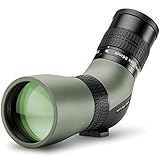
The Nature-Trek 9-27×56 occupies a niche that most scope buyers do not think about until they have bought the wrong instrument: close-to-mid range viewing where field of view matters more than magnification. A 9x bottom end on a 56 mm objective gives a 6.2 mm exit pupil — brighter than anything else in this roundup at any setting — and a correspondingly wide field of view. That combination is ideal for watching birds in a hedgerow at 15 metres, following insects, observing mammals at a woodland edge, or scanning a garden pond from a kitchen window.
Who it suits: the naturalist rather than the lister. Someone who watches behaviour — a pair of birds at a nest, a dragonfly patrolling a territory, a fox working a field margin — rather than identifying a dot at 500 metres. It also suits a beginner who wants a first scope that is easy to aim and easy to use, because wide fields and large exit pupils are forgiving in a way that 60x magnification never is. It is a good choice for a young or new observer, and it doubles as a very capable long-range observation instrument for general nature study.
At 27x the exit pupil is still 2.1 mm, which is larger than the Vortex Crossfire HD manages at its 12x setting — that is how much difference the modest 27x ceiling makes. Twilight factor runs from about 22 at 9x to about 39 at 27x, which is low, reflecting a scope that is not designed for distance or dusk. That is not a flaw; it is the design.
Key specifications as published for the model:
- Magnification: 9-27x zoom, a 3x zoom ratio
- Objective diameter: 56 mm
- Exit pupil: 6.2 mm at 9x, 2.1 mm at 27x
- Twilight factor: approximately 22 at 9x, approximately 39 at 27x
- Body: angled eyepiece with a compact, lightweight chassis
- Tripod mounting: standard 1/4″-20 foot; light enough for a small pan-and-tilt head
- Weather protection: maker-stated waterproof and fogproof construction
- Price tier: mid-range
Strengths: usability. The 6.2 mm exit pupil at 9x produces an image that is almost impossible to lose — you put your eye to the eyepiece and the view is there, bright and wide, even with glasses on and even in poor light. That makes it the best scope in this group for anyone who finds high-magnification instruments fiddly. It is also light and packs small, so it can go in a rucksack alongside binoculars without much argument. Hawke’s warranty and service arrangements are well regarded in the European market.
The weakness is the obvious one: 27x is not a long-range magnification. At 300 metres, a 27x image of a wader is small, and no amount of optical quality changes that. Buyers who expect this scope to replace an 80 mm instrument for estuary counting will be disappointed. It is also the least capable option here for digiscoping at high magnification, though its bright low-magnification view is actually helpful for phone photography at short range.
Pros
- Brightest exit pupil in this roundup at 6.2 mm, making the view exceptionally easy to acquire
- Wide field of view at 9x is ideal for dense habitat and close subjects
- Light and compact enough to carry alongside binoculars
- Maker-stated waterproof and fogproof sealing
- Very forgiving for beginners and for eyeglass wearers
Cons
- 27x maximum magnification is not enough for genuine long-distance identification
- Low twilight factor means it is not a dusk or dawn instrument
- 56 mm objective limits performance on overcast days at longer ranges
- Not a substitute for an 80 mm or 100 mm scope if distance is your priority
Against the nearest alternative, the Vortex Crossfire HD 12-36×50, the Hawke is the better optical compromise for close work: bigger objective, brighter low-end view, similar price tier. The Crossfire HD gives you 36x and a smaller, more packable body. If you want to watch behaviour at 20 metres, take the Hawke. If you want to identify birds at 150 metres, take the Crossfire HD. Against the Kowa TSN-55A, the Hawke is the budget-minded version of the same idea — a compact, easy, wide-field scope — without the fluorite premium.
5. Vortex Crossfire HD 12-36×50 – Best for a first scope on a tight budget

The Crossfire HD 12-36×50 is the entry point in this roundup, and it is a well-chosen one. A 50 mm objective with an HD optical system, a 12-36x zoom, an angled body, and sealing that the manufacturer states as waterproof, fogproof and gas-purged. The HD designation refers to the use of extra-low dispersion glass in the optical path, which reduces colour fringing relative to conventional glass — a meaningful advantage in a small, affordable scope where chromatic aberration is otherwise most visible.
Who it suits: a new birder, a casual wildlife watcher, a walker who wants more reach than binoculars provide without committing to a heavy outfit, and anyone buying a first scope for a young observer. It also suits a second scope — a light, cheap instrument to keep in a vehicle or a holiday cottage where a premium scope would be an anxiety. Vortex’s warranty terms are among the most buyer-friendly in the optics industry and are transferable, which is unusual and genuinely valuable on a budget purchase.
The arithmetic: at 12x the exit pupil is 4.2 mm, which is comfortable and bright. At 36x it falls to 1.4 mm, which is dim but usable in daylight. Twilight factor runs from about 24 to about 42. The 50 mm objective collects roughly 69 percent less light than an 80 mm, so this is a daylight scope; expect to be at 20-25x for most real viewing and to use 36x only for short confirmation looks in good light.
Key specifications as published for the model:
- Magnification: 12-36x zoom, a 3x zoom ratio
- Objective diameter: 50 mm
- Exit pupil: 4.2 mm at 12x, 1.4 mm at 36x
- Twilight factor: approximately 24 at 12x, approximately 42 at 36x
- Optical system: HD glass with extra-low dispersion elements to control colour fringing
- Body: angled eyepiece, compact chassis
- Tripod mounting: standard 1/4″-20 foot, light enough for a modest tripod
- Weather protection: maker-stated waterproof, fogproof and gas-purged
- Price tier: budget
Strengths: value, warranty and sealing. Gas purging prevents internal fogging when you move a cold scope into a warm car or a warm room, which is one of the most common ways cheap optics fail in real use. The HD glass matters more here than on a large objective, because small apertures push magnification hard and colour fringing is worst at high magnification on high-contrast edges. And the warranty means a mistake — a dropped scope, a scratched lens — is a service problem rather than a total loss.
The weaknesses are inherent to the format. A 50 mm objective with a 36x ceiling is a daylight, mid-range instrument; at 300 metres in poor light it will not deliver an identification that an 80 mm scope would. The narrow exit pupil at the top of the zoom makes the image fussy and sensitive to eye position. And a 50 mm body on a cheap tripod is still a vibration problem — the scope is light, but the magnification is not.
Pros
- Lowest price tier in this roundup with HD glass rather than plain glass
- Maker-stated waterproof, fogproof and gas-purged construction, rare at this price
- Transferable lifetime warranty terms from a well-established optics brand
- Compact and light — genuinely packable alongside other kit
- Comfortable 4.2 mm exit pupil at 12x makes it easy to use for newcomers
Cons
- 50 mm objective gathers roughly 69 percent less light than an 80 mm
- 36x maximum is a mid-range magnification, not a long-range one
- 1.4 mm exit pupil at 36x is dim and sensitive to eye placement
- Not a realistic digiscoping platform at high magnification
Compared with the nearest alternative, the Hawke Nature-Trek 9-27×56, the Crossfire HD offers 36x against 27x and a smaller, more packable body, while the Hawke gives a brighter, wider low-magnification view and a larger objective. For distance, the Vortex wins; for close-range behaviour watching and ease of use, the Hawke does. Compared with the SVBONY SV28 kit, the Crossfire HD costs more but brings HD glass, verified sealing and a real warranty — which is the whole argument for spending a little more on a first scope.
6. Vortex Diamondback HD 16-48×65 – Best for a compact, weather-sealed all-rounder
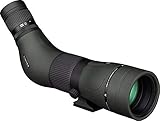
The Diamondback HD 16-48×65 is the sweet spot of the whole list for a large number of buyers, and it earns that position through arithmetic rather than marketing. A 65 mm objective with a 48x ceiling gives an exit pupil of 4.1 mm at 16x and 1.35 mm at 48x — very close to what an 80 mm scope delivers across the same magnification band, but in a smaller, lighter body that works on a lighter tripod. HD glass with extra-low dispersion elements controls colour fringing, and the 16x bottom end is wide enough for real scanning.
Who it suits: the mobile all-rounder. Someone who walks a reserve for three hours, wants a scope that is not a burden, and needs to identify birds between 80 and 250 metres in mixed light. It also suits a travelling birder who wants one instrument that handles woodland, wetland and coast without being a specialist in any of them. And it suits anyone upgrading from a 50 mm first scope who wants a clear, meaningful step up in aperture without stepping into 100 mm weight.
The numbers: a 65 mm objective collects about 69 percent more light than





