
The best acoustic guitar amps for clear, rich tone are the Fishman Loudbox Artist for small gigs, the AER Compact 60 for premium natural sound, the Boss Acoustic Singer Live LT for singer-songwriters, and the Bose S1 Pro+ when battery-powered portability matters most.
Our top picks
 Fender Acoustasonic 40-Watt Acoustic Guitar Amplifier
- The Fender Acoustasonic Guitar Amplifier features 40 watts,…
- This unique amplifier is the only Fender guitar…
- Enjoy extra ambiance with the instrument channel's built-in…
 Flatsons Crush20 20W Rechargeable Acoustic Guitar Amp
- Professional Dual-Channel Sound: Designed for singer-songwriters, this amp…
- 20W RMS Full-Range Performance: Driven by a 5.5"…
- 8-Hour Playtime & Steady Power: Powered by a…
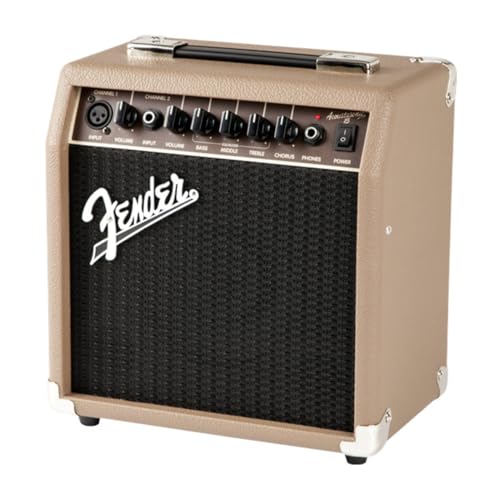 Fender Acoustasonic 15 Acoustic Guitar Amplifier
- The Fender Acoustasonic Guitar Amplifier features 15 watts,…
- The Acoustasonic 15's convenient dual front-panel inputs include…
- This unique amplifier is the only Fender guitar…
| Product | Key specs | |
|---|---|---|
| Fender Acoustasonic 40-Watt Acoustic Guitar Amplifier | The Fender Acoustasonic Guitar Amplifier features 40 watts,… This unique amplifier is the only Fender guitar… Enjoy extra ambiance with the instrument channel's built-in… | Check price |
| Flatsons Crush20 20W Rechargeable Acoustic Guitar Amp | Professional Dual-Channel Sound: Designed for singer-songwriters, this amp… 20W RMS Full-Range Performance: Driven by a 5.5"… 8-Hour Playtime & Steady Power: Powered by a… | Check price |
| Fender Acoustasonic 15 Acoustic Guitar Amplifier | The Fender Acoustasonic Guitar Amplifier features 15 watts,… The Acoustasonic 15's convenient dual front-panel inputs include… This unique amplifier is the only Fender guitar… | Check price |
 Fishman Loudbox Micro 40-watt 1 x 5.25-inch | Two channels: Instrument & Microphone Digital Reverb & Chorus Master Volume | Check price |
As an Amazon Associate we earn from qualifying purchases at no extra cost to you.
Quick comparison: the best acoustic guitar amps
Acoustic amps differ from ordinary electric-guitar combos because they are designed to reproduce a wider frequency range with less coloration. Look for a speaker-and-tweeter arrangement, a useful feedback filter, independent microphone and instrument channels, and enough clean headroom for the venue.
| Model | Rated power | Speaker configuration | Approx. weight | Power source | Best for |
|---|---|---|---|---|---|
| Fishman Loudbox Artist | 120 watts | 8-inch woofer plus tweeter | 28 lb / 12.7 kg | AC power | Small venues and two-channel gigs |
| AER Compact 60 | 60 watts | 8-inch speaker plus tweeter | 21.4 lb / 9.7 kg | AC power | Premium, highly natural acoustic tone |
| Boss Acoustic Singer Live LT | 60 watts | 6.5-inch woofer plus tweeter | Approx. 22 lb / 10 kg | AC power | Solo singers and guitarists |
| Roland AC-60 | 60 watts | Two 6.5-inch speakers | 21.6 lb / 9.8 kg | AC power | Small rooms and stereo effects |
| Bose S1 Pro+ | Portable PA-style system | 8-inch woofer plus high-frequency driver | 15.7 lb / 7.1 kg | AC or rechargeable battery | Outdoor playing and fast setup |
Power figures are not directly comparable across manufacturers, particularly between conventional acoustic combos and battery-powered PA systems. Speaker efficiency, cabinet design, dispersion, and available headroom can matter as much as the wattage printed on the panel.
Best overall for small gigs: Fishman Loudbox Artist
The Fishman Loudbox Artist is the safest all-round choice for a guitarist who plays cafés, restaurants, churches, and small outdoor events. Its 120-watt design gives it more clean headroom than many 60-watt competitors, while the 8-inch woofer produces fuller low mids than a compact 6.5-inch speaker.
It has separate instrument and microphone channels, making it practical for a singer-songwriter who does not want to carry a separate vocal PA. Anti-feedback controls, phase switching, reverb, chorus, and an auxiliary input cover most solo-performance needs. A balanced output can feed a larger sound system when the amp itself is being used as a monitor.
The trade-off is weight. At roughly 28 pounds, it is manageable for one person but noticeably less convenient than a battery-powered column or PA speaker. Choose it when clean volume and flexible inputs matter more than minimizing luggage.
Best natural acoustic tone: AER Compact 60
The AER Compact 60 is a premium choice for players who want the amplifier to sound more like the guitar in the room rather than an obviously processed version of it. Its 8-inch speaker, tweeter, carefully voiced cabinet, and high-quality preamp produce articulate fingerpicking, balanced strumming, and controlled vocal reproduction.
Its compact 60-watt output is sufficient for solo work in small and medium rooms, especially when the venue provides a main PA. The controls are comparatively focused rather than overloaded with features, but the essential tools—reverb, multiple channels, EQ, and feedback management—are present.
Expect to pay a premium market price, commonly around $1,000 to $1,500 depending on the version and region. It is difficult to justify for an occasional beginner, but sensible for a working musician who values low noise, consistent tone, and a relatively compact cabinet.
Best for singer-songwriters: Boss Acoustic Singer Live LT
The Boss Acoustic Singer Live LT is designed around the common solo-performance problem: one person needs a guitar channel, a vocal microphone channel, effects, and a way to fill a room without assembling a full PA.
The guitar channel includes acoustic-focused processing and anti-feedback functions, while the vocal channel provides its own EQ and reverb. A 60-watt amplifier with a 6.5-inch woofer and tweeter keeps the cabinet reasonably compact. It is particularly appealing for open mics, rehearsals, lessons, and small coffeehouse sets.
Its smaller speaker does not move as much air as the Loudbox Artist’s 8-inch driver, so it is less convincing for loud strumming in a larger room. For venues beyond roughly 50 to 100 people, use the line output into the house PA rather than trying to make the combo do all the work.
Best portable battery option: Bose S1 Pro+
The Bose S1 Pro+ is not a traditional acoustic-guitar combo, but it is one of the most practical solutions for busking, ceremonies, patios, and outdoor events. It accepts instrument and microphone sources, supports wireless expansion through compatible accessories, and runs from a rechargeable battery for several hours depending on volume and signal processing.
Its roughly 7-kilogram cabinet is easier to carry than most mains-powered acoustic amps. The broad dispersion also helps when listeners are positioned around a small performance area rather than directly in front of the speaker.
There are compromises. The controls and effects are more PA-oriented, and a dedicated acoustic combo may provide more precise guitar feedback control and a more familiar acoustic preamp response. Choose the S1 Pro+ when battery operation, setup speed, and portability outrank specialized guitar voicing.
How much power do you need?
- Bedroom, lesson, or rehearsal: 15 to 40 clean watts is usually enough. Prioritize low-volume clarity and a headphone or line output.
- Solo café or small room: 40 to 80 watts is a useful range, particularly if you sing while playing.
- Small gig without a PA: Around 60 to 120 watts provides useful headroom for strong strumming and vocals.
- Larger venue: Use the amp as a monitor and send its balanced output to the house PA. Simply buying a higher-wattage combo will not replace proper front-of-house coverage.
A rough coverage calculation explains why. If a 60-watt amp is comfortable at a moderate level in a 50-person café, doubling the audience does not mean you should automatically buy a 120-watt amp. Room acoustics, speaker height, audience noise, and whether the venue supplies a PA have greater effects. Extra wattage mainly buys clean headroom before distortion, not a guaranteed doubling of audience coverage.
Feedback control is more important than extra effects
Acoustic guitars are prone to low-frequency feedback because the pickup, soundboard, and speaker interact. Useful controls include a notch filter, phase switch, sweepable midrange, and a master anti-feedback function. These tools are more valuable than a long list of modulation effects.
A practical setup sequence
- Place the amp in front of the guitar, aimed toward the audience rather than behind the soundhole.
- Start with the bass, middle, and treble controls near their center positions.
- Raise the volume until the guitar is loud enough, then reduce bass if the sound becomes boomy.
- If a note begins to howl, lower the relevant frequency with the notch or sweepable mid control.
- Try the phase switch if feedback continues, then move the amp farther from the guitar before adding more EQ.
Do not point a monitor directly at the guitar’s soundhole, and do not solve every feedback problem by cutting all the bass. Excessive EQ cuts can make the guitar thin and less audible.
Decision matrix: which amp fits your situation?
| Your situation | Recommended direction | Why |
|---|---|---|
| Beginner, occasional home use, limited budget | Compact 15–40 watt acoustic combo | Lower cost and easier storage; no need to pay for large-gig headroom |
| Solo singer-songwriter playing weekly cafés | Boss Acoustic Singer Live LT or Fishman Loudbox Artist | Independent vocal and guitar channels with useful feedback control |
| Fingerstyle player who prioritizes realism | AER Compact 60 | Detailed response and low-noise amplification |
| Outdoor performer without reliable mains power | Bose S1 Pro+ | Rechargeable operation and lightweight cabinet |
| Regular larger-venue work | Any quality combo with balanced output, plus the venue PA | Consistent monitoring without trying to cover the entire room from the stage |
Ownership details that affect the real cost
The speaker grille, input jacks, and carrying handle usually experience more wear than the amplifier electronics. Transport the amp in a padded cover, avoid placing drinks on top, and keep cables from pulling sideways on the input sockets. Dust the grille and control panel with a dry or barely damp cloth; do not spray cleaner into switches or jacks.
Rechargeable systems also have a long-term battery consideration. Battery capacity gradually declines with charging cycles and storage conditions. If you only perform near electrical outlets, a mains-powered combo may remain the simpler ownership choice. If you regularly play outdoors, calculate the value of saved setup time: a battery speaker that takes two minutes to place can be more useful than a heavier amp with slightly richer guitar EQ.
Final buying advice
Choose the Fishman Loudbox Artist for the strongest combination of volume, channels, and gig-ready features. Choose the AER Compact 60 when natural tone and premium construction justify the price. Choose the Boss Acoustic Singer Live LT for a compact vocal-and-guitar setup, and the Bose S1 Pro+ when battery operation and portability are the deciding factors. Whatever you buy, prioritize clean headroom, effective feedback control, and the input connections you will actually use over wattage alone.





