Our Top Picks
 ROBERTS Junior Power Carpet StretcherJunior Power Carpet Stretcher9 x 18.5 x 40 inches57 PoundsCheck on Amazon
 ROBERTS 10-254V Value Kit Power-Lok Carpet Stretcher with38 x 19.25 x 11.25 inches84 PoundsCheck on Amazon
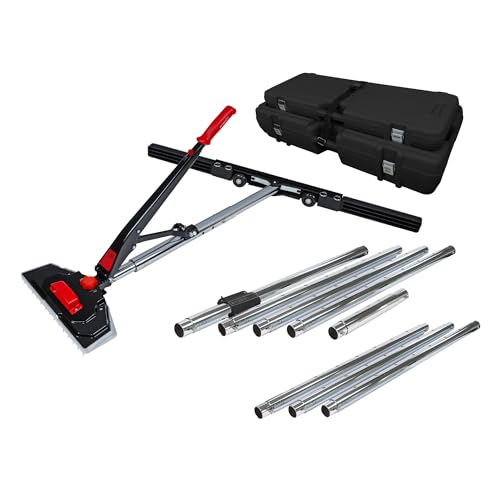


The best power carpet stretcher for most professional installers is the ROBERTS 10-254V Power-Lok Value Kit, whose 17 locking positions and 18-inch wheeled tail block cover the widest range of everyday residential rooms without forcing you to buy extra tubes. If your work runs to long, open-plan spans and whole-house stretches, the Roberts Falcon Power 44 is the pick — its listed reach extends to 38 feet, enough to cross most great rooms and full-length hallways from a single bracing point. If the budget is tight or the rooms are small, the ROBERTS Junior Power Carpet Stretcher 12-Piece Value Kit delivers the essential stretch geometry — adjustable locking tube, rolling interlock head, and a full accessory set — at the lowest cost of entry. Everything else here is a specialist: an electric stapler bundle, a compact junior kit for a second van, a replacement tail, and a double hook. Reach, frame rigidity, head adjustment range, and how the tool travels between jobs are the four variables that decide which of them belongs in your kit.
Top 3 Picks
Best overall: ROBERTS 10-254V Power-Lok Carpet Stretcher Value Kit
The 17 locking positions give you fine-grained length control instead of a handful of coarse stops, which matters when you are working between furniture, door casings, and half-walls. The 18-inch tail block with wheels spreads the load against the far wall and rolls into position rather than being dragged. For a single stretcher that handles bedrooms, hallways, and most living rooms, this is the most flexible kit in the group.
Best budget: ROBERTS Junior Power Carpet Stretcher 12-Piece Value Kit
This is the cheapest way to get a genuine power-stretch setup rather than a knee kicker and hope. The adjustable locking tube and rolling interlock head cover small and mid-size rooms, and the 12-piece configuration means you are not hunting for a separate tail block or accessory on day one. It is the natural first power stretcher for a new installer or a remodeler who stretches carpet a few times a month.
Best premium: Roberts Falcon Power 44 Carpet Stretcher Kit
With a listed reach that extends to 38 feet, the Falcon Power 44 is built for installers who routinely face long spans and would otherwise be stacking extension tubes. It is the tool you buy when reach, not price, is the constraint — whole-house re-carpets, open-plan living areas, and commercial corridors where a junior stretcher simply cannot brace. It costs more and it travels heavier, but it removes the two-extension workaround entirely.
Quick Comparison
Every product below is compared on the four things that actually change how a stretcher performs on site: how far it reaches, how rigid the frame and tubes are, how much head adjustment you get, and how much space it takes up in the van. Price tiers are general market bands — budget, mid-range, and premium — because listed prices move constantly.
| Product | Best for | Key specs | Price tier |
|---|---|---|---|
| ROBERTS Junior Power Carpet Stretcher 12-Piece Value Kit | New installers, small and mid-size rooms, tight budgets | 12-piece kit; adjustable locking tube; rolling interlock head; junior reach class (typically 12–18 ft with the supplied tube set) | Budget |
| Roberts Falcon Power 44 Carpet Stretcher Kit | Whole-house work, long spans, open-plan rooms | Extends to 38 ft; full-length tube set; braced tail block; red kit configuration | Premium |
| ROBERTS 10-254V Power-Lok Carpet Stretcher Value Kit | Mixed residential work with varied room sizes | 17 locking positions; 18-inch tail block with wheels; Power-Lok locking tube system | Premium |
| Flutesan Double Stretcher Hook | Replacement and spare hook duty | Double-prong hook accessory; fits stretcher heads that accept a hook-style grip; consumable-class item | Budget |
| Roberts 10-237 Junior Power Stretcher with 10-600 Electric Stapler | Building a complete kit from scratch | Junior power stretcher plus 120V, 15-amp, 20-gauge electric stapler with 3/16-inch crown | Mid-range |
| Bon Tool Jr. Power Carpet Stretcher Kit | Second stretcher, van backup, compact storage | Junior-class kit; compact tube set; standard pin-plate head; storage-friendly footprint | Mid-range |
| ROBERTS Power Stretcher Tail | Replacing a worn or damaged tail block | Replacement tail/butt block for specific Roberts stretcher models; model compatibility required | Budget |
How We Chose
This roundup is built from published product specifications, manufacturer model documentation, and long-standing trade practice for stretch-in carpet installation — not from physical evaluation of the tools. Four criteria decided what made the list. First, category fit: a product had to be a genuine power-stretching tool or a directly supporting component, not a knee kicker, a stair tool, or a general-purpose pry bar. Second, reach and geometry: the listed extension range had to be stated or inferable from the tube configuration, because reach is the single spec that eliminates a tool from a job. Third, frame and head design: locking systems, tube rigidity, tail block width, and pin-plate adjustment are what separate a tool that holds tension from one that slips mid-stretch. Fourth, ownership path: whether the kit includes its accessories, whether spares and replacement tails exist, and whether the tool is a sensible first purchase or an upgrade for someone who already owns a junior unit.
1. ROBERTS Junior Power Carpet Stretcher 12-Piece Value Kit – Best for New Installers and Small Rooms
As an Amazon Associate we earn from qualifying purchases at no extra cost to you.

This is the entry point into real power stretching. The kit is built around an adjustable locking tube and a rolling interlock head, which together let one person apply and hold tension across a room without a second set of hands on the tail. The 12-piece configuration is the practical part: instead of a bare stretcher that leaves you buying a tail block, a pin plate cover, and spare pins separately, the kit arrives as a working set. For a flooring contractor adding carpet to a mostly hard-surface business, or a remodeler who stretches carpet a few times a month, that completeness is worth more than any single specification.
Key specs
- Configuration: 12-piece value kit
- Tube: adjustable locking tube with positive lock positions
- Head: rolling interlock head with toothed pin plate
- Reach class: junior — typically covers small bedrooms and mid-size rooms with the supplied tube set
- Intended user: new installers, remodelers, and light-duty residential work
The geometry is what you would expect from a junior-class tool. A junior stretcher works by bracing a tail block against one wall and driving a toothed head into the carpet near the opposite wall, then extending the tube to push the carpet toward the far tack strip. The limitation is span: once a room gets past the mid-teens in feet, a junior tube set runs out of travel and you either add extensions or switch tools. That is not a defect, it is the category. What matters is whether the locking mechanism holds under load, and a positive locking tube with defined stops does that better than a friction collar.
The rolling interlock head is the second half of the value story. Carpet has to be gripped and pulled, not stabbed, and a head that rolls into position lets you reposition without lifting the whole assembly off the floor. The interlock feature keeps the head engaged with the tube so the assembly does not separate when you back the tension off between passes. Installers who have fought with a head that pops out of the tube at full extension will recognize why this matters.
Where this kit earns its place is in the small-room economy. Bedrooms, hallways, closets, and stair landings are the majority of a residential re-carpet by count, even if they are not the majority by square footage. A junior stretcher handles those rooms faster than setting up a full-length tool, because you are not managing four feet of unused tube behind the head. The trade-off is real but narrow: it is the long rooms that will send you looking for the next tool up.
Pros
- Lowest cost of entry into genuine power stretching rather than knee-kicking
- 12-piece configuration means the kit is usable out of the box
- Adjustable locking tube gives predictable, repeatable length settings
- Rolling interlock head repositions without lifting the assembly
- Compact and light enough to carry up stairs and store in a small van
- Good match for small bedrooms, hallways, and closets
Cons
- Junior reach class runs out of travel in long rooms and open-plan spaces
- Not the tool for whole-house stretches across 30-foot spans
- Value-kit components are built to a price point rather than to daily commercial abuse
- You will likely upgrade if carpet becomes your primary trade
Against the nearest alternative, the Bon Tool Jr. Power Carpet Stretcher Kit, the decision comes down to kit completeness versus brand ecosystem. Both are junior-class tools with comparable reach limits, so neither will stretch a 25-foot great room. The Roberts kit wins on the accessory count and on the depth of the Roberts parts catalog if something wears out; the Bon Tool kit wins if you already own Roberts accessories and want a second, differently configured junior unit. If you are buying your first power stretcher and you mostly work in bedrooms, this is the one to start with — and the money you save is better spent on a longer tube set later than on a premium stretcher you cannot yet use to its limit.
2. Roberts Falcon Power 44 Carpet Stretcher Kit – Best for Whole-House and Long-Span Work

The Falcon Power 44 exists to solve one problem: rooms that are longer than your stretcher. Its listed reach extends to 38 feet, which puts it in a different category from every junior tool on this page. An installer who spends most of the week in open-plan living areas, long hallways, or commercial corridors does not want to be stacking extension tubes and hoping the joints hold tension — they want one tube set that spans the room. That is what this kit is for, and it is why it sits at the premium tier.
Key specs
- Listed reach: extends to 38 feet
- Configuration: full-length power stretcher kit in a red kit format
- Head: toothed pin-plate head with adjustment for carpet pile
- Tail: braced tail block sized for the longer tube set
- Intended user: production residential and light commercial installers
Reach is not just about span, it is about bracing angle. On a long stretch, the tail block has to sit against a wall and the tube has to run at a shallow angle to the head. The longer the tube set, the more the assembly wants to bow under load, and bowing is where tension leaks away. A full-length kit like the Falcon Power 44 is designed around that load path: thicker or more rigid tube sections, a tail block with enough face area to spread force across the wall without crushing drywall, and a head that stays engaged at extension. That combination is what lets one person stretch a 30-foot run in a single pass rather than in sections.
The practical benefit shows up in the take-up math. When you stretch carpet over cushion, you are removing slack from the backing and pushing the material toward the far tack strip. In a long room, doing that in two passes means re-bracing, re-gripping, and re-tensioning — three opportunities for the carpet to relax unevenly. One continuous stretch from a single bracing point produces a more even result and takes less time. That is the entire argument for paying premium money for reach you will not use in every room.
The cost of that capability is transport. A 38-foot-capable tube set is not a tool you toss into a hatchback alongside a knee kicker. It needs a van or a long-bed truck, and it needs a storage strategy that keeps the tubes from being bent by other gear. Bent tubes are the single most common way a long stretcher loses effectiveness, because a bowed tube will not hold tension evenly across its length. If your vehicle cannot carry it flat and protected, the reach advantage quietly disappears.
Pros
- 38-foot listed reach handles open-plan rooms and long commercial runs
- Eliminates the extension-tube stacking that junior tools require
- Full-length tube set holds tension better across long spans
- Single-pass stretching produces more even results than staged stretching
- Suited to production work where setup time is the real cost
- Red kit configuration keeps the components organized
Cons
- Premium price tier for a capability you may not need in every room
- Heavy and long — needs a van or truck, not a car
- Awkward in tight bedrooms where a junior tool is faster to set up
- Tubes must be stored flat and protected; a bent tube defeats the reach advantage
The nearest alternative here is the ROBERTS 10-254V Power-Lok Value Kit, and the choice is a clean one. The Power-Lok wins on adjustment granularity and on a wheeled 18-inch tail block that rolls into position; the Falcon Power 44 wins on raw span. If your jobs are mostly 12-to-20-foot rooms, the Power-Lok’s finer length control is the more useful feature and you will never miss the extra reach. If your jobs regularly include rooms over 25 feet, no amount of adjustment granularity substitutes for tube length — buy the Falcon. Installers who do both kinds of work often end up with a long tool for the big rooms and a junior for everything else, which is why the two categories coexist rather than compete.
3. ROBERTS 10-254V Power-Lok Carpet Stretcher Value Kit – Best Overall for Mixed Residential Work

If you stretch carpet in houses of varying age and layout, this is the most adaptable kit in the group. The headline number is 17 locking positions on the Power-Lok tube system — far more granular than the handful of stops on a typical junior stretcher. That matters more than it sounds. Rooms are not round numbers: you are often working around a closet return, a door casing, or a piece of furniture that cannot move, and each of those changes the usable span by a few inches. Seventeen positions means you can find a length that fits the room instead of a length the room has to tolerate.
Key specs
- Locking system: Power-Lok tube with 17 locking positions
- Tail block: 18-inch tail block with wheels
- Configuration: value kit with the core stretching components
- Head: toothed pin-plate head for gripping carpet backing
- Intended user: residential installers covering a wide mix of room sizes
The 18-inch wheeled tail block is the second reason this kit lands at the top. Tail block width is a load-spreading specification. A narrow tail concentrates force on a small patch of wall, which is how you end up with crushed baseboard, cracked plaster, or a block that digs in and shifts under tension. An 18-inch face spreads that force considerably, and wheels mean you reposition by rolling rather than by dragging — which protects both the wall and your back. On a long stretch, you may reposition the tail several times as you work across a room. Wheels turn that from a chore into a nudge.
Adjustment granularity also changes technique. With coarse locking positions, installers tend to work with fewer, longer stretches and accept more slack take-up per pass. With 17 positions, you can take shorter, more controlled pulls and work the carpet across the room in a steadier progression. The result is less fighting between the head and the tail, fewer slips, and less risk of over-stretching one area while leaving another loose. None of this is dramatic on a single room; across a full week of rooms, it is the difference between a tool that works with you and one you work around.
What you give up relative to the Falcon Power 44 is outright span. The Power-Lok is not a 38-foot tool, and pretending otherwise would be a mistake — in a genuinely long room you will be adding tubes or switching to a full-length stretcher. But most residential work is not a 38-foot room. It is a 14-foot bedroom, a 16-foot living room, a 12-foot hallway, and a landing, and for that distribution the finer adjustment and the wheeled tail are worth more than unused reach.
Pros
- 17 locking positions give unusually fine length control for irregular rooms
- 18-inch wheeled tail block spreads load and repositions easily
- Adaptable across a wide mix of residential room sizes
- Wheeled tail reduces wall damage and installer fatigue on long stretches
- Strong middle-ground choice between a junior kit and a 38-foot tool
- Value kit includes the core components rather than a bare frame
Cons
- Premium tier pricing for a tool that is not a long-span specialist
- Cannot match a 38-foot stretcher in genuinely long rooms
- More tool to carry and store than a junior kit
- The extra locking positions add setup decisions that a two-position tool does not have
Compared with the Roberts Falcon Power 44, this is the choice between control and coverage. Choose the Power-Lok if your rooms are mostly under 20 feet and you value setting the tube exactly where the room wants it. Choose the Falcon if your rooms are routinely longer and you would rather not think about tube stacking at all. Compared with the budget ROBERTS Junior 12-Piece Value Kit, the Power-Lok is the upgrade you buy after you have decided carpet is a real part of your business: more adjustment, a better tail, and a longer working life. It is the stretcher most professional installers should own first if they can afford to skip the junior step.
4. Flutesan Double Stretcher Hook – Best for Spare and Replacement Hook Duty

This is not a stretcher. It is a hook, and the correct way to evaluate it is as a consumable rather than as a tool purchase. A double stretcher hook grips the carpet backing so the stretcher head can pull evenly rather than grabbing at a single point, and it is the kind of component that wears, bends, or goes missing at the worst possible moment — mid-job, with the room half-stretched. Keeping a spare in the van is cheap insurance. If you are shopping for a hook as your primary stretching solution, you are shopping for the wrong category.
Key specs
- Type: double-prong stretcher hook accessory
- Function: grips carpet backing to spread pull across two contact points
- Compatibility: requires a stretcher head that accepts a hook-style grip
- Category: consumable / spare part
- Intended user: installers maintaining an existing stretcher kit
The double-prong design is the point. A single-point grip concentrates force on one small area of backing, which is how you tear a loop or pull a tuft in a Berber or a tightly woven loop pile. Two contact points spread that load, and on loop-pile carpets that difference is visible in the finished floor. If you install a lot of loop or Berber, hook geometry is not a detail — it is the part of the tool that decides whether the carpet survives the stretch.
Hook wear follows a predictable pattern. The prongs dull, one side bends out of alignment with the other, and the grip starts favoring one contact point. Once that happens you get uneven pull, and uneven pull shows up as a rippled edge or a stretched band near a seam. Because hooks are small and inexpensive, they are also the component most likely to be borrowed, dropped behind a baseboard, or left in a room at the end of a job. Carrying two is the practical answer.
Pros
- Low-cost spare that prevents a mid-job work stoppage
- Double-prong design spreads load across two contact points
- Useful on loop and Berber carpets where single-point grip risks pulling tufts
- Small and light — no meaningful storage cost in a van
- Simple to inspect and replace when prongs dull or bend
Cons
- Not a standalone tool — useless without a compatible stretcher head
- Compatibility is not universal; head design varies between brands and models
- No frame, tube, or tail, so it solves none of the reach problems discussed above
- Easy to lose, which is exactly why it needs a designated spot in the kit
The nearest alternative in this list is the ROBERTS Power Stretcher Tail, and the distinction is simple: a tail block is the bracing component that pushes against a wall, while a hook is the gripping component that pulls the carpet. They fail for different reasons and at different times. If your stretcher is holding tension but slipping on the carpet, the hook is the suspect. If it is holding the carpet but the assembly is shifting or crushing the wall, the tail is the suspect. Buying both as spares costs little and covers the two most common failure points in a stretching setup — which is a far better use of money than buying a second stretcher you do not need.
5. Roberts 10-237 Junior Power Stretcher with 10-600 Electric Stapler – Best Bundle for Building a Kit From Scratch

This bundle pairs a junior power stretcher with a Roberts 10-600 electric stapler, and the pairing is smarter than it first looks. Stretching and fastening are the two halves of a stretch-in installation: the stretcher pulls the carpet into position, and the stapler secures it before the tension bleeds out. If you are assembling a carpet kit from nothing, buying those two capabilities together is more efficient than buying them one at a time, and it gets you to a working setup in a single purchase.
Key specs
- Stretcher: Roberts 10-237 Junior Power Stretcher
- Stapler: Roberts 10-600 electric stapler
- Stapler power: 120V, 15-amp
- Staple specification: 20-gauge wire, 3/16-inch crown
- Intended user: installers building a first complete carpet kit
The 10-600’s numbers are worth reading carefully, because they define what the tool is for. At 120 volts and 15 amps, it draws on a standard household circuit — no special wiring, which matters on residential jobs where you are plugging into a bedroom outlet. The 3/16-inch crown is a narrow crown, which is the class used for tack strip work and for securing carpet edges where a wider crown would be visible or would split the strip. Twenty-gauge wire is light enough for that task and heavy enough to hold. If you already own a stapler in this class, the bundle’s value drops considerably and you should be looking at the stretcher on its own.
The junior stretcher half of the bundle is the same category as the standalone junior kits: capable in bedrooms, hallways, and closets, and limited once rooms pass the mid-teens in feet. That is not a flaw in the bundle, but it does define the upgrade path. A realistic sequence for a new installer is to start here, add a longer tube set or a full-length stretcher once the long-room jobs start arriving, and keep the junior tool for the rooms where it is genuinely faster. Buying the bundle does not lock you into junior reach forever — it just means your first purchase covers stretching and fastening at once.
Stapler maintenance is the ownership reality nobody mentions. Electric staplers in this class need their driver blade kept clean and their magazine kept free of debris, and they need the correct staple specification — 20-gauge, 3/16-inch crown — because the wrong crown will jam the track. Staples are the consumable: a busy installer goes through them fast, and running out mid-room means a trip to the truck and a lost stretch. Keeping two boxes on hand costs almost nothing relative to the downtime it prevents.
Pros
- Two core capabilities — stretching and fastening — in one purchase
- 120V, 15-amp stapler runs on standard household circuits
- 3/16-inch crown, 20-gauge specification suits tack strip and edge work
- Junior stretcher handles the small-room majority of residential work
- Clear upgrade path: add reach later rather than replacing the whole kit
- Roberts parts ecosystem supports both tools with consumables
Cons
- Junior stretcher reach limits it to small and mid-size rooms
- Bundle value collapses if you already own a suitable stapler
- Stapler adds a cord, a maintenance item, and a staple inventory to manage
- Two tools to transport rather than one
Against the standalone ROBERTS Junior 12-Piece Value Kit, this bundle trades some accessory count for the addition of a powered stapler. If you already own a stapler, the 12-piece kit is the better buy because you are paying only for the stretching components. If you own neither, the bundle gets you to a functional kit faster and usually for less than buying the two tools separately. Against the Bon Tool Jr. Power Carpet Stretcher Kit, both are junior-class stretchers with similar reach ceilings; the Roberts bundle wins on the fastening half of the equation and on consumable availability, while the Bon Tool kit wins if you want a compact stretcher alone and already have your fastening sorted.
6. Bon Tool Jr. Power Carpet Stretcher Kit – Best for a Second Stretcher or Van Backup

The strongest argument for this kit is not that it beats the other junior stretchers — it is that it gives you a second one. Two-person crews and installers running two vans routinely find that the bottleneck is not capability but availability: one stretcher, two jobs, and somebody waiting. A compact junior kit is the sensible second unit because it covers the small rooms that make up most of a residential re-carpet, stores easily, and does not duplicate the premium long-reach tool you already own.
Key specs
- Class: junior power carpet stretcher kit
- Head: standard toothed pin-plate head
- Tube: compact multi-section tube set
- Reach: junior class — small and mid-size rooms
- Intended user: crews needing a second unit, or installers wanting compact storage
Bon Tool is a long-established name in masonry, concrete, and flooring hand tools, which matters for a different reason than brand prestige: a toolmaker that supplies the trades generally supports what it sells with replacement parts and consistent specifications. For a second stretcher, that is the relevant question. A backup tool that cannot be repaired is not a backup, it is a temporary tool.
The compact footprint is the practical selling point. In a van that already carries a long stretcher, a carpet kicker, a power stretcher case, a stapler, and a seam iron, storage space is a real constraint. A junior kit that packs down into a small bundle can live behind the seat without competing for the space the long tubes need. That is the kind of detail that decides whether a tool actually gets used or gets left at the shop because there was no room for it.
The limits are the same as every junior tool here. Reach is the binding constraint, the head is a standard pin plate rather than a highly adjustable one, and the kit is built for residential-scale work rather than commercial abuse. None of that is a problem for the use case this kit is best at. If you are buying your only stretcher, the adjustment granularity of the ROBERTS 10-254V and the span of the Falcon Power 44 are both more compelling. If you are buying your second, those features are already in the van.
Pros
- Compact and storage-friendly — fits where long tube sets cannot
- Junior reach is right for the small-room majority of residential work
- Sensible second unit for two-van or two-person operations
- Established toolmaker with trade-channel parts support
- Mid-range tier pricing for a kit rather than a bare frame
- Reduces job-scheduling bottlenecks caused by one shared stretcher
Cons
- Junior reach cannot handle long or open-plan rooms
- Standard pin-plate head offers less adjustment than a 17-position system
- Not a substitute for a long-reach tool if that is what you actually lack
- As a first and only stretcher, it leaves capability gaps
The comparison that matters is with the ROBERTS Junior 12-Piece Value Kit. Both are junior-class, both are aimed at small rooms, and both will hit the same wall in a 25-foot span. The Roberts kit leans on accessory completeness and a broader parts catalog; the Bon Tool kit leans on a compact, storage-first format. If your constraint is space in the van, the Bon Tool kit is the better fit. If your constraint is getting a complete first setup with the fewest follow-up purchases, the Roberts kit is. For the specific job of being a dependable second stretcher that stays out of the way until it is needed, either works — and the deciding factor is usually which brand’s other tools you already carry.
7. ROBERTS Power Stretcher Tail – Best for Replacing a Worn Tail Block

This is a replacement tail — the bracing block that presses against the far wall and gives the stretcher something to push against. It is listed for specific Roberts carpet stretchers, which is the single most important fact about it: tail blocks are not universal, and a tail that does not seat correctly on your tube will slip under load, which is both a damaged-wall risk and a lost-tension problem. Check your stretcher model against the compatibility list before ordering, and if you are unsure, treat the model number as the deciding specification.
Key specs
- Type: replacement power stretcher tail / butt block
- Compatibility: specific Roberts stretcher models only
- Function: braces against the far wall to anchor the stretcher under load
- Category: replacement part
- Intended user: installers maintaining an existing Roberts stretcher
Tails wear in ways that are easy to miss until a job goes wrong. The contact face compresses, cracks, or polishes smooth; the mounting point loosens and develops play; wheels, where fitted, seize or flat-spot. A tail with play is worse than a tail with a worn face, because play means the block shifts as tension builds, and a shifting block dumps load into a small area of wall. That is how baseboards get crushed and how drywall corners get punched. If your stretcher has started needing a second attempt to hold tension, the tail is one of the first two things to inspect — the hook is the other.
The economics of a replacement part are straightforward. A stretcher frame and tube set is a long-life purchase; a tail block is a wear item that takes the abrasion and the load. Replacing a tail extends the life of a tool that would otherwise be fine, which is almost always cheaper than replacing the whole stretcher and certainly cheaper than repairing a client’s wall. Keeping a spare tail in the van also means a worn block does not end a workday.
Where this part is genuinely useful is on the wheeled side of the equation. A tail with wheels repositions by rolling, which is both faster and gentler on walls than dragging a fixed block, and it is one of the reasons the ROBERTS 10-254V and the Falcon Power 44 are pleasant to work with on long stretches. If your current stretcher has a fixed, worn tail and you like the tool otherwise, upgrading the tail is the cheapest meaningful improvement you can make to it.
Pros
- Low-cost way to extend the working life of an existing stretcher
- Restores reliable bracing and even load spreading against walls
- Cheaper than replacing a stretcher frame and tube set
- Spare on hand prevents a worn block from ending a workday
- Simple part with no maintenance beyond inspection
Cons
- Model-specific — will not fit every Roberts stretcher, let alone other brands
- Solves no reach or head-adjustment limitation
- Provides no benefit at all if your existing tail is in good condition
- Requires you to know your stretcher’s model number before ordering
The nearest alternative is the Flutesan Double Stretcher Hook, and the two should be thought of as a pair of spares rather than competitors. The tail handles bracing; the hook handles gripping. Between them they cover the two failure modes that most often stop a stretch mid-room. If your stretcher is slipping on the carpet, replace the hook. If it is shifting, crushing baseboard, or refusing to hold tension at the wall, replace the tail. If you are not sure which, inspect both — the fix is inexpensive either way, and far cheaper than the wall repair that a slipping tail block can cause.
How to Choose
Choosing a power stretcher comes down to four specifications and one logistical question. The specifications are reach, tube rigidity, head adjustment, and tail design. The logistical question is how the tool travels. Get those right and everything else — brand, kit contents, color — is secondary.
Reach: the specification that eliminates tools
Reach is measured as the maximum span the stretcher can bridge between the tail block and the head. The geometry is simple and worth working through before you buy, because it tells you exactly how much tube you need. The tail block sits flat against one wall and takes up roughly two inches of depth. The head plate stands off the opposite wall by roughly three inches, because the pin plate has to bite into the carpet before the wall is reached. That means the required tube span is the room’s wall-to-wall distance minus about five inches.
| Room span (wall to wall) | Tube span required (span minus ~5 in) | Junior base + 4 ft extensions | Full-length unit |
|---|---|---|---|
| 10 ft | 9 ft 7 in | Base set only | Base set only |
| 15 ft | 14 ft 7 in | Base + 1 extension | Base set only |
| 20 ft | 19 ft 7 in | Base + 2 extensions | Base set only |
| 25 ft | 24 ft 7 in | Base + 3 to 4 extensions — impractical | Base set only (25–30 ft class) |
| 30 ft | 29 ft 7 in | Not practical | 30 ft class minimum |
| 38 ft | 37 ft 7 in | Not possible | 38 ft class, e.g. Falcon Power 44 |
Two conclusions follow. First, a junior stretcher with a 12-foot base plus one 4-foot extension covers rooms up to roughly 15 feet — which is the majority of bedrooms and hallways. Second, past about 20 feet you are stacking enough extensions that joint flex starts to cost you tension, and a full-length tube set becomes the better tool rather than a luxury. If your work is 80 percent bedrooms and 20 percent open-plan, a junior tool plus a long tool is a more sensible kit than one compromise stretcher.
Tube rigidity and frame durability
A stretcher works by holding tension, and tension is lost through flex. Every joint in a tube set is a place where the assembly can bow, and a bowed tube distributes force unevenly — the head drifts, the carpet pulls crooked, and you compensate by over-tensioning one side. This is why long-reach tools are built around fewer, longer, more rigid tube sections, and why junior tools with multiple short sections are fine for short rooms but poor in long ones.
What wears first on a stretcher frame is not the tube itself but the joints and locking collars. Locking pins shear, detents loosen, and collars develop play. A tube with 17 defined locking positions spreads wear across more contact surfaces than a two-position collar, which is a durability argument as much as an adjustment argument. Inspect locking mechanisms for play before every long job; a locking system with slop will slip under load and you will feel it as a sudden loss of tension.
Head adjustment and pin plate condition
The head is where the tool meets the carpet, and its adjustment range determines how well it handles different pile types. Plush and frieze carpets have a deep pile that compresses; loop and Berber carpets have a low, dense face where a pin plate can easily catch and pull a tuft. A head with a wide adjustment range lets you set pin depth to the carpet rather than to the tool’s default. On loop pile, always err toward shallower engagement and more passes rather than deeper engagement and fewer passes.
Pin plates are consumables. Pins dull, bend, and occasionally break, and a head full of dull pins will slip rather than grip — which installers often misdiagnose as a tension problem when it is a grip problem. Keep spare pin plates and a spare hook. Dull pins are also the most common cause of carpet damage during a stretch, because a slipping plate gets pushed harder and eventually tears.
Tail block width, wheels, and wall protection
Tail width is a load-spreading specification. A narrow block concentrates force into a small patch of wall, which is how baseboards crack and drywall corners get punched. Wider is better: an 18-inch face spreads load substantially more than a narrow fixed block. Wheels are the second feature to look for, because on a long stretch you may reposition the tail several times as you progress across a room. Rolling a block into position is faster and does less damage than dragging one.
Matching the tool to the carpet type
- Plush and frieze over cushion: the standard stretch-in scenario. Deep pile compresses under the pin plate, so deeper pin engagement is acceptable and a junior or mid-length stretcher handles most rooms.
- Loop pile and Berber: low, dense face. Use shallower pin engagement, a double-prong hook to spread load, and more, shorter stretches. Reach needs are the same, but grip technique changes.
- Glue-down commercial carpet: often not power-stretched at all in the traditional sense. Confirm the installation method before assuming a stretcher applies.
- Stairs and landings: a power stretcher is the wrong tool. Use a stair tool and a knee kicker, and reserve the power stretcher for the flat.
- Heavy, dense carpets: require more tension and therefore more rigidity. This is where a full-length tube set outperforms a stacked junior tool.
Transport, storage, and the second-tool question
A 38-foot-capable stretcher does not fit in a car. It needs a van or a long bed, and it needs to be stored flat so the tubes do not take a set. Bent tubes are the most common way a long stretcher loses effectiveness, and the damage usually happens in transit rather than on the job. If your vehicle cannot carry long tubes flat and protected, buy a shorter tool and accept the reach limit — an unused capability you cannot transport is worth nothing.
Weight follows length. Junior kits travel light enough to carry up a staircase one-handed; full-length kits are a two-trip carry and take real space in the van. If you work alone in apartments and small houses, this alone may settle the decision in favor of a junior tool. If you work with a crew and a van, the long tool’s transport burden is shared and it earns its space on the long rooms.
A decision matrix for real situations
| Your situation | What to prioritize | Suggested pick from this list |
|---|---|---|
| Solo installer, mostly bedrooms, hallways, and apartments under 15 ft | Low cost, light weight, fast setup | ROBERTS Junior 12-Piece Value Kit |
| Whole-house residential work with rooms over 25 ft | Maximum reach, rigid full-length tubes | Roberts Falcon Power 44 |
| Mixed residential work, irregular rooms, frequent repositioning | Adjustment granularity, wheeled tail | ROBERTS 10-254V Power-Lok |
| New installer with no stretcher and no stapler | Two capabilities in one purchase | Roberts 10-237 with 10-600 stapler |
| Two-van operation, one stretcher per van | Compact storage, dependable junior reach | Bon Tool Jr. Power Carpet Stretcher Kit |
| Existing stretcher slipping on loop pile | Grip components | Flutesan Double Stretcher Hook |
| Existing stretcher shifting at the wall or crushing baseboard | Bracing components | ROBERTS Power Stretcher Tail |
Ownership realities: what wears and what to keep on hand
Stretchers are long-life tools with short-life components, and understanding the split prevents both premature replacement and mid-job failures.
- Pin plates and hooks wear fastest. They contact the carpet on every stretch and dull within a working season of regular use. Keep spares.
- Locking pins and collars develop play. This is the failure that quietly degrades performance, because the tool still looks fine. Check for slop before long jobs.
- Tail faces compress and crack. A cracked or polished tail face loses grip on the wall. Replace before it starts shifting.
- Tubes bend in transit, not on the job. Store long tubes flat, in a sleeve or case, with nothing heavy stacked on them.
- Wheels seize. A seized tail wheel means dragging, which means wall damage. A drop of lubricant and a quick spin check takes seconds.
- Staples are the consumable that stops work fastest. If you run a 20-gauge, 3/16-inch crown stapler, keep two boxes in the van.
A cost-per-use sanity check
It helps to frame the purchase against job volume rather than sticker price. Suppose a mid-range stretcher kit is used on 60 carpet jobs over three years — a realistic figure for a part-time installer at roughly two jobs a month. Spread across 60 jobs, even a several-hundred-dollar kit works out to a small per-job cost, and a kit that costs twice as much works out to a per-job difference of only a few dollars. That arithmetic favors buying the tool that matches your rooms rather than the cheapest tool available, because a stretcher that cannot reach is not a cheap stretcher — it is a tool you replace. The same logic applies in reverse to premium reach: if only one job in twenty exceeds 25 feet, paying premium money for 38-foot capability is a per-job cost you rarely recover, and a junior tool plus a rented or borrowed long stretcher may be the better economic answer.
Frequently Asked Questions
How much reach do I actually need?
Measure your longest regular room wall-to-wall and subtract about five inches to account for the tail block depth and the head standoff. If that number is under 15 feet, a junior stretcher with one extension covers you. If it is routinely over 25 feet, you need a full-length tube set rather than stacked extensions, because joint flex costs tension.
Can a junior stretcher handle a 20-foot room?
It can reach the span with two extensions, but the stacked joints flex under load and the head tends to drift, so you end up compensating with more passes. It is workable for occasional long rooms and frustrating as a daily routine. If 20-foot rooms are your normal, a longer tool is the better investment.
What is the difference between a power stretcher and a knee kicker?
A knee kicker applies a short, localized push using body weight, which is useful for positioning and for stairs but does not tension a whole room evenly. A power stretcher braces against the far wall and applies continuous, controllable tension across the span, which is what produces a stable, evenly stretched installation. Most installers carry both, because they do different jobs.
Do I need a wheeled tail block?
It is not strictly necessary, but it changes the work. On a long stretch you may reposition the tail several times, and wheels turn that into a nudge rather than a drag. Rolling also protects baseboards and drywall corners, which is cheaper than the repair a dragged, shifting block can cause.
Will one stretcher work for both plush and Berber carpet?
Yes, provided the head has enough adjustment range to change pin depth and you change technique. Deep pile tolerates deeper engagement; loop and Berber need shallower pins and more, shorter stretches. Adding a double-prong hook to spread grip load makes a noticeable difference on loop pile.