
Our Top Picks
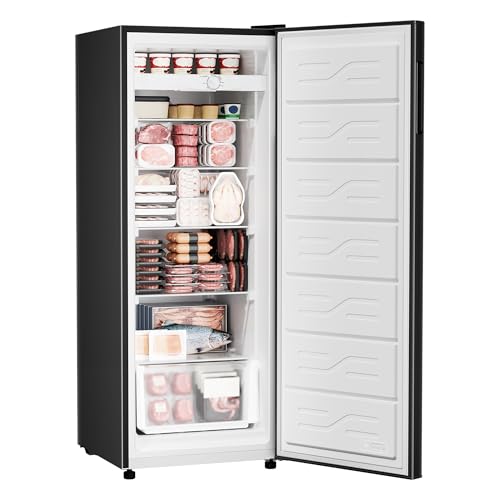
 Upstreman 7.0 Cu.Ft Upright Freezer21.3" W x 22.8" D x 56.0" H22.8 x 21.3 x 56 inchesCheck on Amazon
 BANGSON 6.5 Cu.ft Upright Freezer for Apartment6.5 cu. ft.22.83 x 24.02 x 59.06 inches91.49 poundsCheck on Amazon


Best Upright Freezers: The Short Answer
The best upright freezer for most homes is the ICEVIVAL 7 Cu Ft Convertible Freezer Refrigerator, because its 7-cubic-foot capacity fits a typical kitchen, mudroom, or laundry nook while the convertible thermostat lets the same cabinet run as a fridge or a freezer as your needs change. If you are fitting a freezer into an apartment corner and want to spend less, the Upstreman 3.0 Cu.ft or the BANGSON 6.5 Cu.ft are the practical budget-minded answers. If you are feeding a large household or buying beef in bulk, the Hamilton Beach 11 cu. ft. uprights and the BLACK+DECKER 8.5 Cu. Ft. BUF850LW carry the capacity and shelf structure to store volume efficiently without sprawling across the garage floor. Everything below compares capacity, footprint, shelf layout, frost management, and garage-readiness — the five variables that actually decide whether a freezer works in your space.
Top 3 Picks
Best Overall: ICEVIVAL 7 Cu Ft Convertible Freezer Refrigerator
A 7-cubic-foot upright with a convertible thermostat is the sweet spot for most households: big enough for a quarter of a beef and a few weeks of frozen groceries, small enough to fit a standard 24- to 25-inch alcove. The ICEVIVAL pairs that middle capacity with reversible-door flexibility and a mid-range price tier that undercuts the premium 8.5- and 11-cubic-foot cabinets.
Best Budget: Kismile 3.0 Cu.ft Mini Freezer Upright
If the job is overflow — extra ice cream, a few frozen pizzas, breast milk, or a dorm or office supply — a 3-cubic-foot upright does it for the least money. The Kismile is the compact pick that fits under a counter overhang and runs on a standard 120V household circuit without a dedicated breaker.
Best Premium / Bulk Storage: BLACK+DECKER 8.5 Cu. Ft. BUF850LW
For a family of four or more, or anyone buying a half or whole animal, the BUF850LW’s 8.5 cubic feet and full-width shelf-and-basket layout give you the most usable storage per square foot of floor. It is the pick when capacity matters more than the last hundred dollars of price.
Quick Comparison
| Product | Best For | Key Specs | Price Tier |
|---|---|---|---|
| ICEVIVAL 7 Cu Ft Convertible | Best overall for most homes | ~7 cu ft; convertible fridge/freezer; reversible door; upright | Mid-range |
| Upstreman 7.0 Cu.Ft Upright | Large capacity on a mid-range budget | ~7 cu ft; black finish; stand-up cabinet | Mid-range |
| BANGSON 6.5 Cu.ft Upright | Apartment and rental kitchens | ~6.5 cu ft; silver finish; compact upright footprint | Mid-range |
| Kismile 3.0 Cu.ft Mini | Cheapest useful overflow freezer | ~3 cu ft; stainless steel front; compact | Budget |
| Hamilton Beach HBFRF1100 | Maximum capacity, single door | ~11 cu ft; white; full upright cabinet | Premium |
| Commercial Cool CCUL50W | Small kitchens and offices | ~5 cu ft; white; upright | Mid-range |
| BLACK+DECKER BUF850LW | Families and bulk buyers | ~8.5 cu ft; white; shelf + basket layout | Premium |
| Upstreman 3.0 Cu.ft (Black) | Dorms, offices, tight corners | ~3 cu ft; reversible door; black | Budget |
| Whynter CUF-112SS | Smallest footprint, counter-height | ~1.1 cu ft; silver; mini upright | Budget |
| Hamilton Beach 11 cu ft Drawer | Organized bulk storage | ~11 cu ft; stainless steel; drawer compartments | Premium |
| Hamilton Beach HBFRF6892 | Convertible fridge or freezer | Reversible door; removable glass shelves | Mid-range |
| Maine 3.6 Cu. Ft. Small Upright | Tight-space compact storage | ~3.6 cu ft; black; compact mini upright | Budget |
How We Chose
We built this roundup from published product specifications and category conventions rather than from physical evaluation. Selection started with capacity, because that single number determines whether a freezer solves a household’s real problem — a 3-cubic-foot cabinet cannot absorb a bulk meat purchase, and an 11-cubic-foot cabinet cannot fit a galley kitchen. From there we weighted footprint, since uprights are chosen precisely for their small floor print, and shelf layout, because usable capacity is always lower than nominal capacity once baskets, coils, and door bins take their share.
Frost management was the next filter. Manual-defrost cabinets are cheaper and hold temperature well but demand periodic thawing; auto-defrost models trade a little humidity and energy for convenience. Garage-readiness matters more than buyers expect, so we favored models whose temperature controls and refrigerant systems are described for use in unconditioned or semi-conditioned space, and we flagged the ones better kept indoors. Finally, we mapped price tiers to value rather than to absolute cost, and checked that the list spans the full range of situations — dorm, apartment, family, bulk buyer, and convertible-fridge needs — so every reader finds a category fit rather than a single forced recommendation.
1. ICEVIVAL 7 Cu Ft Convertible Freezer Refrigerator — Best for Most Homes
As an Amazon Associate we earn from qualifying purchases at no extra cost to you.
The ICEVIVAL is the model to buy first if you are only buying one freezer and you are not certain yet how you will use it. At roughly 7 cubic feet it lands in the band where a household can store a meaningful stock of frozen goods — several weeks of meat, bread, vegetables, and prepared meals — without dedicating a wall of the garage to it. The convertible thermostat is the feature that separates it from a fixed freezer: you can run the cabinet in freezer mode when you are stocking up and switch it to refrigerator mode during a party, a holiday, or a season when you need overflow cold storage rather than frozen storage. That flexibility makes it useful even in months when you are not buying in bulk.
Key specs
- Capacity class: about 7 cubic feet, upright
- Configuration: convertible — operates as freezer or refrigerator
- Door: reversible, so it can open against either wall
- Form factor: single-door upright with internal shelving
- Finish class: standard appliance finish
- Price tier: mid-range
Strengths
The convertible function is genuinely useful rather than a marketing garnish. Households that host holidays often need a second refrigerator for two weeks a year and a freezer the rest of the time; one cabinet that does both avoids buying two appliances and storing one empty. The 7-cubic-foot class is also the most versatile size in the category — large enough for bulk buying, small enough for a laundry room or utility corner. A reversible door means you are not locked out of a spot because the hinge is on the wrong side, which is a real constraint in galley kitchens and narrow alcoves where the door must swing away from traffic. At a mid-range tier, it costs less than the 8.5- and 11-cubic-foot premium cabinets while covering the majority of household needs.
Pros
- Convertible freezer/fridge operation adds year-round usefulness
- 7-cubic-foot class suits most families without a large footprint
- Reversible door fits awkward alcoves and narrow kitchens
- Mid-range price tier, cheaper than premium bulk-storage cabinets
- Upright form keeps frozen items visible and reachable
Cons
- Will not absorb a whole-animal purchase the way an 11-cubic-foot cabinet will
- Convertible models add a control mode you must remember to reset after switching
- Shelf count and basket layout vary by build, so usable space can be less than the nominal figure
How it compares
Against the Upstreman 7.0 Cu.Ft, the ICEVIVAL wins on flexibility: the Upstreman is a straightforward upright freezer with a similar capacity class and a mid-range tier, but it does not switch to refrigerator duty. If you know you will only ever freeze, the Upstreman is the simpler, more focused machine and its black cabinet may suit a garage or utility room better. Against the BANGSON 6.5 Cu.ft, the ICEVIVAL offers slightly more capacity and the convertible mode, while the BANGSON leans toward apartment-friendly dimensions and a lighter silver finish. Choose the ICEVIVAL when you want one appliance to cover two jobs.
2. Upstreman 7.0 Cu.Ft Upright Freezer — Best for Straightforward Large-Capacity Freezing

The Upstreman 7.0 is the no-complications option in the 7-cubic-foot class. It is a stand-up freezer with a large-capacity cabinet and a black finish that reads well in a garage, basement, or utility room where a white appliance would look out of place. There is no convertible mode and no second set of controls to learn: you set a temperature, you fill it, and you take things out. For a household that has already decided it wants a dedicated freezer and simply wants volume at a mid-range price, that simplicity is the appeal.
Key specs
- Capacity class: about 7.0 cubic feet, upright
- Finish: black
- Configuration: dedicated upright freezer
- Form factor: single-door, internal shelves and basket
- Price tier: mid-range
Strengths
The value story here is capacity per dollar in a dedicated freezer. Because Upstreman did not spend cost or internal space on a convertible mechanism, the cabinet is oriented entirely around frozen storage — shelves sized for boxes and bags, a basket for small items that would otherwise vanish to the bottom. The dark finish is a practical choice for unconditioned spaces: white cabinets in a garage show every scuff and dust streak, while black hides them and looks intentional next to shelving and tool benches. The ~7-cubic-foot class, meanwhile, is the same size that makes the ICEVIVAL versatile, so you get comparable storage in a simpler package.
Pros
- Dedicated freezer design keeps the layout focused on frozen storage
- Black finish suits garages, basements, and utility rooms
- About 7 cubic feet covers most family freezer needs
- Mid-range tier without paying for features you may not use
- Upright access means no digging through a chest
Cons
- No refrigerator mode, so it is idle-value only as a freezer
- Not the largest capacity here; bulk beef buyers should size up
- Single-door uprights lose cold air faster than chests when opened
How it compares
Versus the ICEVIVAL, the Upstreman trades flexibility for simplicity: you give up the convertible mode and gain a cabinet designed purely around freezing, in a finish that holds up better in a working garage. Versus the BLACK+DECKER BUF850LW, it is smaller and cheaper but lacks the extra 1.5 cubic feet that a family of four or five will eventually want. If your household is two to four people and you want a dedicated freezer in a dark, utilitarian space, this is the more natural fit than either alternative.
3. BANGSON 6.5 Cu.ft Upright Freezer — Best for Apartments and Rental Kitchens

The BANGSON 6.5 is sized and styled for the apartment problem: you need real freezing capacity, but the only available spot is a corner of the kitchen, a closet, or a short stretch of wall beside the fridge. At around 6.5 cubic feet it gives up a little volume to the 7-cubic-foot class in exchange for dimensions that behave better in tight rooms, and the silver finish is a deliberate choice for interiors where a white box would look like an afterthought. It is the pick for renters, studio dwellers, and anyone who wants the freezer inside the living space rather than banished to a garage.
Key specs
- Capacity class: about 6.5 cubic feet, upright
- Finish: silver
- Configuration: dedicated upright freezer
- Intended setting: apartment, condo, smaller kitchen
- Price tier: mid-range
Strengths
The interior finish matters more than buyers expect indoors. Silver or stainless-look fronts sit comfortably next to modern kitchen appliances, which means the freezer can live in the room where you actually cook instead of in a garage you have to walk to. The 6.5-cubic-foot capacity is still substantial — comfortably more than double a typical freezer compartment in a top-mount refrigerator — so an apartment household can buy meat on sale, store batch-cooked meals, and keep frozen produce without running out of room. Because it is a smaller cabinet than the 8.5- and 11-cubic-foot models, it also asks less of the space around it: you need clearance for the door swing and airflow, not a dedicated appliance bay.
Pros
- Apartment-friendly dimensions for kitchens and closets
- Silver finish suits interior rooms better than a plain white box
- About 6.5 cubic feet is still far more than a fridge’s freezer compartment
- Mid-range tier that fits a renter’s budget
- Upright shelves keep food visible, which reduces waste
Cons
- Smaller than the 7- and 8.5-cubic-foot options, so bulk buys fill it fast
- Not designed as a garage or unconditioned-space appliance
- Indoor placement means compressor noise stays in your living area
How it compares
Against the ICEVIVAL 7 Cu Ft, the BANGSON gives up about half a cubic foot and the convertible function in exchange for a footprint and finish aimed squarely at apartment interiors. That is a reasonable trade if you never need refrigerator mode. Against the Commercial Cool CCUL50W, the BANGSON offers more capacity at a similar tier while the Commercial Cool is the smaller, simpler white box for offices and kitchens that just need a modest freezer. Choose the BANGSON when the freezer is going to sit in a room you look at every day.
4. Kismile 3.0 Cu.ft Mini Freezer Upright — Best Budget Overflow Freezer
The Kismile 3.0 is the cheapest way to solve a real freezing problem. It is not designed to replace a full-size freezer or to hold a bulk meat order; it is designed to absorb overflow — the extra frozen pizzas, the second gallon of ice cream, the bags of berries from a summer picking trip, the breast milk that needs its own dedicated space. At roughly 3 cubic feet it fits under a counter overhang or into a corner, and the stainless steel front keeps it presentable if it ends up somewhere visible.
Key specs
- Capacity class: about 3.0 cubic feet, upright
- Finish: stainless steel front
- Configuration: compact mini upright freezer
- Typical placement: under-counter, corner, office, dorm
- Price tier: budget
Strengths
Small uprights punch above their size because everything is reachable. In a 3-cubic-foot cabinet you can see the whole inventory at a glance, which is the opposite of a chest freezer where the item you want is always at the bottom. That visibility cuts duplicate purchases and freezer burn from forgotten food. The compact class also runs on a standard household circuit and draws little enough that it typically does not require a dedicated breaker, which removes an installation step that bigger freezers sometimes force. For a dorm room, a small office, a garage workshop, or a household already well served by a kitchen fridge, this is the lowest-cost useful addition.
Pros
- Lowest-cost tier in the roundup
- Compact enough for under-counter or corner placement
- Upright layout keeps everything visible
- Runs on a standard household outlet
- Stainless front suits visible placement
Cons
- About 3 cubic feet fills quickly with a bulk grocery run
- Not a replacement for a primary freezer in a family home
- Small cabinets have less thermal mass, so door-open time costs more
How it compares
Against the Upstreman 3.0 Cu.ft, the Kismile is the same capacity class and the same budget tier; the difference comes down to finish and door configuration, with the Upstreman offering a reversible door and a black cabinet that hides marks better in a garage or dorm. Against the Whynter CUF-112SS, the Kismile is roughly three times the capacity for a similar tier of spend, so the Whynter only makes sense when the available space is genuinely tiny. If you have room for a 3-cubic-foot cabinet, take it over the 1.1-cubic-foot class every time.
5. Hamilton Beach HBFRF1100 11 cu ft Upright Freezer — Best for Maximum Single-Door Capacity

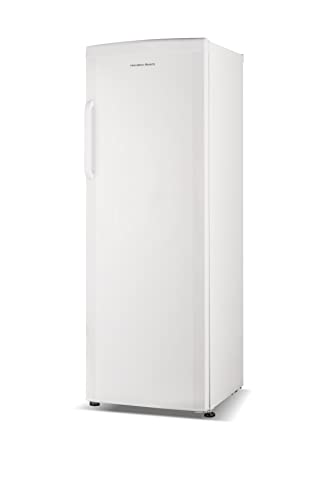
The HBFRF1100 is the largest conventional option in this roundup. At around 11 cubic feet it moves out of the “overflow” category entirely and into “this is the household’s primary frozen-food reserve.” It is a white, single-door upright — no drawer gimmicks, no convertible controls — which means the entire internal volume is given over to shelf storage. For households that buy a quarter or half of beef, shop warehouse-club bulk packs, or keep a deep pantry of frozen produce, this is the cabinet size that stops the inventory problem.
Key specs
- Capacity class: about 11 cubic feet, upright
- Finish: white
- Configuration: single-door upright freezer
- Price tier: premium
Strengths
An 11-cubic-foot upright is the most space-efficient way to store a large frozen inventory indoors. A chest freezer of comparable capacity consumes a similar or larger floor area, and unlike a chest, an upright lets you retrieve the bottom layer without unloading everything above it. That matters most for households where frozen food is a working pantry rather than an emergency stash: if you are in the freezer daily, the upright format saves real time and reduces the amount of cold air you spill. The white finish is the standard for a reason — it matches most kitchen and utility appliances, and it makes spills and frost visible early, which prompts maintenance before a problem builds.
Pros
- About 11 cubic feet absorbs bulk purchases and whole-animal orders
- Single-door upright maximizes usable shelf volume
- Daily access without unloading, unlike a chest freezer
- White finish suits kitchens and utility rooms
- Large thermal mass holds temperature well during short openings
Cons
- Premium tier and the highest capacity cost in the roundup
- Needs a substantial wall of space and door-swing clearance
- Longer empty stretches waste energy if you never fill it
How it compares
Against the BLACK+DECKER BUF850LW, the HBFRF1100 gives you roughly 2.5 more cubic feet but in a plainer single-door layout; the BLACK+DECKER spreads its capacity across a more organized shelf-and-basket arrangement that some households find easier to keep sorted. Against the Hamilton Beach 11 cu ft drawer model, the HBFRF1100 is the simpler cabinet: the drawer version trades some shelf openness for compartmentalization that helps prevent items from being buried. Choose the HBFRF1100 when capacity is the whole point and you want the least complicated way to get it.
6. Commercial Cool CCUL50W 5.0 Cu. Ft. Upright Freezer — Best for Small Kitchens and Offices
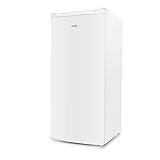
The CCUL50W sits in the useful middle ground that gets overlooked: bigger than a mini freezer, smaller than a family cabinet. At around 5 cubic feet it holds a genuine stock of frozen food yet fits the sort of nook that a 7- or 8.5-cubic-foot upright cannot. The plain white upright format makes it easy to place in a break room, a small kitchen, a basement bar area, or a secondary property where you want a working freezer without committing serious floor space.
Key specs
- Capacity class: about 5.0 cubic feet, upright
- Finish: white
- Configuration: dedicated upright freezer
- Typical placement: small kitchen, office, break room
- Price tier: mid-range
Strengths
Five cubic feet is a genuinely useful size that many buyers undershoot or overshoot. It is roughly three times the freezer compartment of a standard top-mount refrigerator, which is enough to hold a month of frozen meal prep, a batch of sale-priced meat, or an office’s worth of frozen lunches — without the cabinet dominating the room. The upright format keeps the footprint narrow, and because the capacity is moderate, the cabinet can usually go where you already have a spare outlet and 30 inches of width. White is forgiving in a setting like a break room, where durability and easy cleaning matter more than style.
Pros
- About 5 cubic feet — a middle size many households actually need
- Narrow upright footprint fits small kitchens and offices
- Simple white cabinet that cleans easily
- Better capacity-per-floor-space than a mini freezer
- Mid-range tier
Cons
- Not enough capacity for a large family’s bulk buying
- No convertible mode or drawer organization
- Smaller than the 6.5- and 7-cubic-foot options at a similar tier
How it compares
Against the BANGSON 6.5 Cu.ft, the Commercial Cool is smaller and more utilitarian, with a white finish aimed at workrooms rather than apartment kitchens. Against the Kismile 3.0, it offers substantially more capacity for a modest step up in tier, which makes it the better buy for anyone who has the 30 inches of width to spare. The CCUL50W is the right answer when you want a real freezer but the largest cabinets would be overkill and a mini would leave you short.
7. BLACK+DECKER 8.5 Cu. Ft. BUF850LW Upright Freezer — Best for Families and Bulk Buying

The BUF850LW is the family-scale cabinet. At around 8.5 cubic feet it holds a serious inventory — a half beef, a season of garden produce, weeks of batch cooking — while keeping the upright format’s small floor footprint. BLACK+DECKER is a well-established appliance brand, and the model’s white finish and conventional upright layout make it a straightforward fit in a garage, utility room, or mudroom. This is the pick for households where the freezer is a primary tool, not an overflow bin.
Key specs
- Capacity class: about 8.5 cubic feet, upright
- Finish: white
- Configuration: dedicated upright freezer with shelves and basket
- Price tier: premium
Strengths
The combination of 8.5 cubic feet and a full shelf-and-basket layout is what makes this cabinet work for families. Shelves let you stack flat packages and boxes so labels face outward; the basket catches odd-shaped items that would otherwise tumble to the bottom. In practice that means less rummaging and less food lost to the back of the cabinet. The capacity lands in a sweet spot: substantially more than the 6.5- and 7-cubic-foot class without the wall-claiming presence of an 11-cubic-foot upright. For a household of four or five, or anyone buying meat in bulk once or twice a year, the extra 1.5 to 2 cubic feet over a 7-cubic-foot cabinet is usually the difference between “full before the next shop” and “comfortable.”
Pros
- About 8.5 cubic feet suits families and bulk buyers
- Shelf-and-basket layout keeps inventory organized
- Upright format uses little floor space for its capacity
- Well-known appliance brand with broad service familiarity
- White finish matches common kitchen and utility appliances
Cons
- Premium tier; costs more than the 7-cubic-foot mid-range class
- More capacity than a one- or two-person household needs
- Requires clearance for door swing and rear airflow
How it compares
Against the ICEVIVAL 7 Cu Ft, the BLACK+DECKER gives you roughly 1.5 more cubic feet and a more structured interior, at the cost of the convertible mode and a step up in tier. Against the Hamilton Beach HBFRF1100, it gives up about 2.5 cubic feet of raw capacity but offers a more organized layout and a slightly smaller footprint. The BUF850LW is the better choice when you want capacity and order together; the HBFRF1100 wins when maximum volume is the only thing that matters.
8. Upstreman 3.0 Cu.ft Upright Freezer — Best Budget Compact with a Reversible Door

The Upstreman 3.0 is the budget mini with one feature that matters more than it sounds: a reversible door. In a dorm room, a small office, or a tight corner, the side the door hinges on often decides whether a cabinet fits at all. Beyond that, this is a compact black upright freezer in the same capacity class as the Kismile 3.0 — about 3 cubic feet, intended for home, dorm, or office use where a full-size freezer would be absurd but some real frozen storage is essential.
Key specs
- Capacity class: about 3.0 cubic feet, upright
- Finish: black
- Door: reversible
- Typical placement: home, dorm, office
- Price tier: budget
Strengths
The reversible hinge is a practical advantage in small rooms where you cannot choose which way a door opens relative to a desk, bed, or doorway. The black finish is also better suited than stainless to the sort of rough-and-tumble placement a dorm or workshop freezer gets: it hides fingerprints and scuffs, and it does not demand to be the visual center of the room. At roughly 3 cubic feet, the cabinet still holds a useful inventory — frozen meals, ice, snacks, a few bulk packs — and because it is compact it can sit on a sturdy stand or in a corner without dominating the space. Budget tier keeps the entry cost low, which matters when the freezer is a secondary convenience rather than the household’s main food reserve.
Pros
- Reversible door fits awkward corners and small rooms
- Black finish resists visible marks
- Budget tier with low entry cost
- About 3 cubic feet is useful without dominating a room
- Suited to dorm, office, and workshop placement
Cons
- Small capacity; not a family freezer
- Compact cabinets can struggle in very hot or very cold rooms
- Fewer shelves than larger uprights, so stacking is less flexible
How it compares
Against the Kismile 3.0, the Upstreman matches capacity and tier but adds the reversible door and a black cabinet — a better fit where placement is constrained or the surroundings are utilitarian. Against the Maine 3.6 Cu. Ft., it gives up about half a cubic foot of capacity; the Maine is the slightly roomier compact if your space allows. Against the Whynter CUF-112SS, the Upstreman is roughly triple the capacity for a similar tier, so it wins unless your available gap is genuinely minuscule.
9. Whynter CUF-112SS Upright Mini Freezer — Best for the Smallest Footprint

The Whynter CUF-112SS exists for the case where space is the binding constraint and everything else is secondary. At around 1.1 cubic feet it is a true mini — the size of a large microwave — and it will fit on a counter, a shelf, or the floor of a closet. That makes it the right answer for a home office, a studio apartment, a boat or RV, a workshop, or any situation where the choice is a very small freezer or no freezer at all. The silver finish keeps it presentable in a visible spot.
Key specs
- Capacity class: about 1.1 cubic feet, upright mini
- Finish: silver
- Configuration: compact upright freezer
- Typical placement: countertop, shelf, small room, vehicle
- Price tier: budget
Strengths
The value of a 1.1-cubic-foot upright is not capacity — it is the ability to put freezing capability almost anywhere. Because it draws little power and takes up barely more room than a microwave, it can go places a 3-cubic-foot cabinet cannot: on a counter under a cabinet run, on a sturdy shelf in a mudroom, or in a small office where employees want ice and frozen meals but nobody wants a full appliance. The silver finish and compact proportions make it look deliberate rather than improvised. For these specific jobs, no larger freezer is a substitute, because the larger freezer will not physically fit.
Pros
- Smallest footprint in the roundup; fits almost anywhere
- Low power draw suitable for light-duty circuits
- Silver finish looks at home in visible spots
- Budget tier with minimal commitment
- Ideal for offices, studios, and vehicles where space is fixed
Cons
- About 1.1 cubic feet holds very little — a few boxes at most
- Not a substitute for even a modest full-size freezer
- Small cabinets are more sensitive to frequent door opening
How it compares
Against the Upstreman 3.0 and Kismile 3.0, the Whynter is roughly one-third the capacity — but those cabinets need about three times the footprint, and in a genuinely tight space that is not a negotiable difference. Against the Maine 3.6, the gap is even wider. The honest framing is this: buy the Whynter only when a 3-cubic-foot cabinet will not fit or is not allowed. If it will fit, the 3-cubic-foot class gives you far more usable freezer for a similar tier of spend.
10. Hamilton Beach 11 cu ft Upright Freezer with Drawer Compartments — Best for Organized Bulk Storage
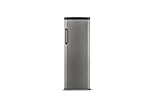
This Hamilton Beach model takes the same 11-cubic-foot class as the HBFRF1100 and rearranges the inside. Instead of open shelves, it uses drawer compartments, and the cabinet is finished in stainless steel. The result is a freezer that behaves like a filing system: categories of food get their own zones, and nothing disappears into a pile at the bottom. It is the pick for households with a large frozen inventory that also want to keep that inventory findable — a combination that open-shelf uprights do not always deliver once the cabinet is at capacity.
Key specs
- Capacity class: about 11 cubic feet, upright
- Finish: stainless steel
- Interior: drawer compartments
- Price tier: premium
Strengths
Drawer compartments solve the specific failure mode of large upright freezers: the deep pile. When an 11-cubic-foot cabinet is full and you are looking for the last bag of peas, an open shelf arrangement makes you excavate. Drawn compartments give each category a defined home, which makes restocking faster, reduces duplicate purchases, and limits the amount of time the door is open — which in turn reduces frost accumulation and energy use. The stainless finish is a genuine upgrade in appearance and puts the freezer in a different visual category from a plain white utility cabinet, which matters if it is going somewhere guests will see. The capacity itself is the largest class in this roundup, so it covers whole-animal purchases and warehouse-club bulk buying without strain.
Pros
- About 11 cubic feet of bulk storage capacity
- Drawer compartments keep inventory organized and visible
- Stainless steel finish suits visible placement
- Faster retrieval means less door-open time and less frost
- Best option for households that buy in large quantities regularly
Cons
- Premium tier at the top of this roundup’s price range
- Drawers reduce some of the flexible height open shelves allow
- Large cabinet needs serious clearance and floor space
How it compares
Against the Hamilton Beach HBFRF1100, this drawer model is the same capacity class, stainless finished, and organized differently: the HBFRF1100 gives you open shelves and a lower premium entry, while the drawer version trades a little flexibility for tidiness. Against the BLACK+DECKER BUF850LW, this model offers roughly 2.5 more cubic feet and the drawer system, at the cost of more floor space and a higher tier. If your household buys in bulk and loses track of what is in the freezer, the drawers earn their premium; if you simply need volume, the HBFRF1100 is the leaner choice.
11. Hamilton Beach HBFRF6892 Upright Convertible Fridge/Freezer — Best for Dual-Purpose Cold Storage

The HBFRF6892 is the second convertible in this roundup, and it is aimed at the same problem as the ICEVIVAL: households that need cold storage more than they need frozen storage, but not always the same kind. It has a reversible door and removable glass shelves, which let you reconfigure the interior for tall bottles, large platters, or stacked boxes depending on which mode it is running in. It is the pick for a secondary property, a garage entertaining space, a home bar, or a household that hosts often enough to need an extra fridge several times a year.
Key specs
- Configuration: convertible refrigerator/freezer, upright
- Door: reversible
- Shelves: removable glass
- Price tier: mid-range
Strengths
Removable glass shelves are the underrated feature here. In freezer mode you strip them out and stack boxes; in refrigerator mode you reinstall them and hold tall items. That adaptability makes the cabinet useful across seasons rather than sitting half-empty for months. The reversible door means it can be placed against either wall in a garage or utility area, and glass shelves are easy to clean when something leaks — a real consideration in a freezer that will eventually see a burst bag of something. At a mid-range tier it delivers two appliances’ worth of function for one purchase, which is the same value argument that makes convertible cabinets attractive in the first place.
Pros
- Switches between refrigerator and freezer duty
- Removable glass shelves reconfigure the interior quickly
- Reversible door fits either wall
- Mid-range tier for dual-purpose capability
- Useful for entertaining, secondary properties, and garages
Cons
- Convertible mode adds controls and a setting to manage
- Not the largest capacity here; bulk buyers should size up
- Glass shelves need care when removing them at freezer temperatures
How it compares
Against the ICEVIVAL 7 Cu Ft, the HBFRF6892 offers a similar convertible concept with removable glass shelves and a reversible door, though the ICEVIVAL’s listing emphasizes the 7-cubic-foot capacity class more directly. Against the BANGSON 6.5 Cu.ft, it gives up the apartment-oriented silver finish but adds dual-mode operation and shelf flexibility. Choose the HBFRF6892 when the freezer’s second job is hosting or backup refrigeration, and choose a dedicated freezer when freezing is all you will ever do.
12. Maine 3.6 Cu. Ft. Small Upright Freezer — Best Compact with a Little Extra Room

The Maine 3.6 is the roomier answer to the 3-cubic-foot compact class. That extra half-cubic-foot does not sound like much on a spec sheet, but in a mini freezer it is often the difference between fitting a frozen pizza box flat or not, and between one shelf of stacked items and two. It is a black compact upright intended for tight spaces — apartments, dorms, offices, small kitchens — where a full-size cabinet is out of the question but the smallest minis would leave you frustrated.
Key specs
- Capacity class: about 3.6 cubic feet, upright
- Finish: black
- Configuration: compact mini upright freezer
- Typical placement: apartment, dorm, office, small kitchen
- Price tier: budget
Strengths
Capacity in the compact class is won in small increments, and 3.6 cubic feet is meaningfully more usable than 3.0 once packaging is taken into account. Frozen pizza boxes, family-size entrée trays, and larger bags of vegetables are the items that expose a small freezer’s limits, and the extra interior height and width here make those items fit properly rather than at an angle. The black finish keeps the cabinet low-key in a visible room and hides the scuffs that come with dorm or workshop life, and the budget tier means the decision is low-risk. For a single person, a couple, or a secondary kitchen, this is close to the ideal size.
Pros
- About 3.6 cubic feet — more usable space than 3.0-cubic-foot minis
- Fits larger packages like pizza boxes and family trays
- Black finish hides marks and suits casual placement
- Budget tier keeps the commitment low
- Good fit for singles, couples, and secondary kitchens
Cons
- Still far short of a family freezer’s capacity
- Not intended for bulk meat purchases
- Compact cabinets benefit from being kept out of extreme heat and cold
How it compares
Against the Upstreman 3.0 and Kismile 3.0, the Maine offers about 20 percent more capacity in the same compact class, which is the single most useful upgrade available at this size. Against the Commercial Cool CCUL50W, it is smaller and cheaper — the Commercial Cool is the better choice if you can spare the extra width. Buy the Maine when a compact freezer is the only option and you want to maximize what fits without moving up a size class.
How to Choose an Upright Freezer
Choosing an upright freezer is mostly an exercise in matching three numbers — capacity, footprint, and clearance — to the space you actually have, then deciding how much maintenance you are willing to do. The features that get marketed hardest, like convertible modes and interior finishes, matter, but they matter less than whether the cabinet fits and holds enough food.
Start with usable capacity, not the sticker number
Every freezer’s nominal capacity overstates what you can store. Coils, baskets, door bins, and the gap required for airflow consume volume, and irregular packaging wastes more of it. As a working rule, plan on roughly 1.5 to 2 cubic feet of freezer space per person in a household that cooks most meals at home. That means a single person is well served by 3 to 4 cubic feet, a couple by 5 to 7, and a family of four by 8 to 11. If you buy meat in bulk — a quarter or half animal, or warehouse-club multi-packs — add 2 to 3 cubic feet on top of the household baseline, because bulk purchases arrive in large, awkwardly shaped parcels that never pack efficiently. A quarter beef typically needs somewhere in the region of 4 to 5 cubic feet on its own once wrapped and labeled, which is why a 3-cubic-foot mini is a snack freezer and not a beef freezer.
Match the footprint and clearance to the room
Upright freezers are chosen for their floor print, so measure before you shop. A 5- to 7-cubic-foot upright generally needs around 24 to 28 inches of width and 24 to 27 inches of depth. An 8.5- to 11-cubic-foot cabinet typically needs 28 to 32 inches of width and 26 to 30 inches of depth, plus taller height — often 60 to 65 inches. Then add clearance: most manufacturers ask for a few inches behind the cabinet for the condenser to shed heat and an inch or two on each side. The dimension buyers forget is the door swing. A full-width upright door opening 90 degrees projects roughly the freezer’s own depth into the room — a 27-inch-deep cabinet needs about 27 inches of clear space in front of it. If your spot is a galley or a corner, a reversible-door model or a drawer-compartment cabinet can rescue a layout that a standard hinge would block. Also confirm the doorway and stair width on the route in: a cabinet that fits the alcove but not the stairwell is a common and expensive mistake.
Understand the shelf layout you are buying
Upright freezer interiors come in three broad arrangements. Open shelves with a bottom basket are the most common: good for stacking flat packages, but prone to deep piles at the back once full. Shelf-and-drawer combinations, like the drawer-compartment Hamilton Beach model, divide the interior into zones that stay organized and reduce how long the door stays open. Removable glass shelves, as on the HBFRF6892, let you strip the interior for tall items or reinstall shelves for bottles, which is what makes convertible cabinets work in both modes. Whichever layout you pick, count the shelves and measure the vertical gaps. A cabinet with four shelves and a basket usually holds more usable food than one with three shelves, even at identical nominal capacity, because it lets you separate categories instead of stacking single tall towers.
Decide how you feel about defrosting
Frost management is the ownership reality that separates a pleasant freezer from an annoying one. Manual-defrost cabinets are cheaper, hold temperature steadily, and keep food from drying out — but moisture from the air condenses on the coils every time you open the door, and that frost slowly reduces usable space and efficiency. In a humid climate or a household that opens the freezer daily, expect to defrost once or twice a year; in a dry climate with occasional use, once a year may be enough. The job itself takes a few hours: unplug the cabinet, empty it into coolers or a second freezer, let the frost melt — never chip at it with a sharp tool, which can puncture the evaporator and total the appliance — wipe it dry, and restart it before restocking. Auto-defrost models handle this for you, but they cycle slightly warmer air through the cabinet, which can cause a little more freezer burn on poorly wrapped food and costs some energy. If you buy in bulk and store for months, manual defrost plus good vacuum sealing is often the better combination. If you open the freezer constantly for grab-and-go items, auto-defrost is worth the trade.
Check garage-readiness honestly
A freezer rated for garage use is not simply a freezer with a marketing sticker. Standard freezers rely on a refrigerant and thermostat calibrated for room temperatures, and when ambient temperature drops toward freezing — a common winter condition in an unheated garage — a standard cabinet may run erratically or shut down while its contents are still at risk. Some models are explicitly described as suitable for garage or unconditioned-space use; those are the ones to choose if the freezer will live outside the thermal envelope of the house. If your garage is insulated and stays above roughly 40°F in winter, a standard freezer is usually fine. If it drops near or below freezing, look for garage-rated wording in the description rather than assuming. Also consider heat instead of cold: a garage that bakes in summer makes any freezer work harder, raising running costs. Basements and utility rooms are the easiest placements — moderate temperatures with room for airflow and noise out of earshot of the kitchen.
Think about noise, power, and running cost
Compressor noise is the hidden cost of putting a freezer in a living space. A dedicated utility-room placement hides it; a studio apartment placement does not. Most upright freezers run on a standard 120V household circuit and draw modest current, but larger cabinets plus other appliances on the same circuit can trip a breaker, so check what else shares the outlet. Running cost scales with capacity, ambient temperature, and how often the door opens. Roughly speaking, a small compact freezer costs little to run, a 7-cubic-foot cabinet costs a moderate amount, and an 11-cubic-foot cabinet in a hot garage costs the most in this group — and the difference between a well-sealed full freezer and a half-empty one is real, because frozen mass holds cold and reduces compressor cycling. Keeping a cabinet reasonably full, or adding water jugs to fill empty space, is a free efficiency upgrade.
Budget for the total cost, not just the cabinet
The freezer is one line item in a system. Budget for freezer-safe containers and vacuum-seal bags, a thermometer to verify the interior actually holds 0°F, labels and tape so you can date everything, and possibly a small chest or second freezer if you buy in bulk. Also budget the value of your time: a freezer that is inconvenient to reach or awkward to organize will be used less, and food you forget about is the most expensive food you buy. The cheapest way to waste money is a large freezer filled carelessly, and the cheapest way to save it is a right-sized freezer kept well organized and defrosted on schedule.
Frequently Asked Questions
What size upright freezer do I need for a family of four?
Plan on roughly 1.5 to 2 cubic feet per person as a baseline, which puts a family of four in the 6- to 8-cubic-foot range, and closer to 8.5 to 11 cubic feet if you buy meat in bulk or keep a garden harvest. An 8.5-cubic-foot cabinet like the BLACK+DECKER BUF850LW is the most common fit for this household size. A 6.5- or 7-cubic-foot model works if the freezer supplements, rather than replaces, the kitchen fridge’s freezer compartment.
Do I need a garage-ready freezer, or will any upright work in my garage?
If your garage stays above roughly 40°F year-round, a standard freezer is usually fine. If winter temperatures drop near or below freezing, you need a model explicitly described as suitable for garage or unconditioned-space use, because standard thermostats and refrigerants are calibrated for room temperatures and can behave unpredictably in the cold. If the listing does not mention garage use, assume it is intended for indoor placement and put it in a basement or utility room instead.
How often do I have to defrost an upright freezer?
It depends on humidity, how often the door opens, and whether the model is manual- or auto-defrost. In a humid climate with daily use, manual-defrost cabinets may need defrosting once or twice a year; in dry conditions with occasional use, annually is often enough. Frost buildup visibly reduces usable space and forces the compressor to work harder, so defrost when the layer gets thick enough to notice. Never chip ice off with a sharp tool — puncturing the evaporator lines ruins the appliance.
Is an upright freezer better than a chest freezer?
For most homes, yes. An upright uses a similar or smaller floor footprint, keeps food visible and reachable, and does not require unloading to reach the bottom layer. A chest freezer holds cold air better when opened and generally costs less per cubic foot, which suits long-term bulk storage in a garage, but it is harder to organize and easier to lose food in. If you access the freezer daily, an upright is the more practical format.
What temperature should an upright freezer be set to?
Zero degrees Fahrenheit is the standard target for safe long-term frozen storage. Colder settings cost more energy and are unnecessary for most food; warmer settings shorten safe storage life. Use a dedicated freezer thermometer rather than trusting the dial, and check it after the cabinet has run empty for a day so you are reading the true interior temperature and not the residual warmth of a restock.
Can I put a freezer in an unheated space or on a porch?
Only if the model is explicitly rated for it. Freezers rely on a refrigerant and thermostat tuned for a specific ambient range, and both very cold and very hot surroundings can push a standard cabinet outside that range. An unconditioned porch that freezes in winter is one of the riskiest placements. A basement or insulated garage is a safer bet, and if a garage is your only option, look for garage-rated wording before buying.
How much does it cost to run an upright freezer?
Running cost scales with capacity, ambient temperature, door-opening frequency, and how full the cabinet is. A compact 3-cubic-foot freezer costs little to run; a 7-cubic-foot cabinet costs a moderate amount on a typical household electricity rate; an 11-cubic-foot cabinet in a hot garage costs the most in this group. Keeping the freezer reasonably full — adding water jugs to empty space if needed — reduces compressor cycling and trims the bill without any other change.
Why is my upright freezer frosting up so quickly?
Frost comes from moisture in the air condensing on cold surfaces, so the usual causes are frequent or prolonged door openings, a door seal that is not seating properly, and high ambient humidity. A full freezer opened less often frosts more slowly. If you notice frost forming fast even with careful use, check the door gasket for gaps or deformation, and make sure the cabinet is level so the door closes under its own weight.
Which Upright Freezer Should You Buy?
If you want one freezer that covers the broadest range of households, choose the ICEVIVAL 7 Cu Ft Convertible. Its capacity class fits most homes, the convertible thermostat keeps it useful year-round, and the reversible door solves the placement problems that rule out fixed-hinge cabinets. If your space is an apartment and the freezer will sit indoors where you can see it, the BANGSON 6.5 Cu.ft is the better-matched size and finish, and if you want a dedicated freezer in a garage or utility room with no extra features to manage, the Upstreman 7.0 Cu.Ft is the straightforward pick.
If you are feeding a family or buying in bulk, size up: the BLACK+DECKER BUF850LW offers the best mix of capacity and interior organization at 8.5 cubic feet, while the Hamilton Beach 11 cu ft drawer model is the right call when you want maximum volume kept tidy and are willing to pay the premium tier for it. The Hamilton Beach HBFRF1100 is the leaner route to 11 cubic feet if organization matters less than raw space.
If your constraint is space or budget, match the cabinet to the gap rather than to a wish list. The Maine 3.6 Cu. Ft. and the Upstreman 3.0 are the compact picks for dorms, offices, and small apartments — take the reversible door if placement is tight, and the extra half cubic foot if you can spare it. The Kismile 3.0 is the budget overflow freezer for a household that already has a kitchen fridge. And the Whynter CUF-112SS is the specialist choice: buy it only when a 3-cubic-foot cabinet genuinely will not fit, because in every other case the larger compacts give you far more usable freezer for a similar tier of spend.





